How to Plant Strawberries in Containers
As an Amazon Associate we earn from qualifying purchases.
Learning how to plant strawberries in containers comes down to three choices: a day-neutral or everbearing plant, a pot at least 12 inches across with drainage, and a crown set level with the soil. Put the pot where it gets full sun, and keep the soil moist, because containers dry out faster than garden beds. The extension pages we opened agree on those steps. They differ on pot depth, on feeding interval and on whether to keep the pot through winter, and this guide shows those gaps.
Quick answer
- Choose day-neutral or everbearing plants. Iowa State University Extension says June-bearing types are not recommended in containers.
- Use a container at least 12 inches across and 8 inches deep, with drainage, and set the crown level with the soil surface.
- Give full sun, water when the soil surface is dry, and feed by the label on your fertilizer, because the pages give different intervals.
Choose day-neutral or everbearing plants
Iowa State University Extension gives the clearest rule for pots: “When grown in containers, strawberries are best treated as annuals.” It explains why: “Because they are shallow-rooted and short-term perennials, they are rarely successfully overwintered.” Its advice is to pick “Day neutral and everbearing cultivars”, since they fruit in the first year. Oregon State University Extension says: “day-neutral cultivars are the best suited for container growing because they fruit almost continuously from May to autumn frost and don’t produce many runners.” Wisconsin Horticulture agrees in shorter form: “Day-neutral varieties are the easiest varieties for container gardening.”
June-bearing plants are the weak choice for a pot. Iowa State says that “June bearing types will only flower and fruit once early in the growing season”, and that they “tend to produce runners more vigorously than day neutral and everbearing types”. Iowa State names Albion, Cabrillo, Everest and Seascape among day-neutral types to consider. Those names come from one source, so check local nurseries for what is sold near you.
Pick a pot with room and drainage
Pot size is where the pages differ most. Iowa State says: “Containers at least 12 inches in diameter and 8 inches deep are best.” Oregon State says to choose containers “10 to 18 inches deep and 12 inches or larger in diameter”, depending on how many plants go in. Wisconsin Horticulture sets a floor for round pots: “The minimum size of round containers should be no less than twelve inches in diameter.” Its rectangular rule is longer: “Rectangular containers should be a minimum of 24 inches.” Wisconsin also reports that “Long narrow containers produce more heavily than round containers.”
Drainage is the other constant. The University of Nebraska-Lincoln says: “Ensure it has good drainage.” Oregon State puts it more strongly: “It is very important that the potting mix and the container drain well.” Nebraska recommends “a high-quality potting mix with good drainage”, and Oregon State names a mix of one part perlite, one part finely ground fir bark and two parts garden or potting soil. Iowa State is simpler and suggests an all-purpose potting soil.
Nebraska says that “Hanging baskets, strawberry pots, and standard planters all work well for strawberries”. Iowa State warns that hanging baskets “dry out quickly and can have high soil temperatures.” Oregon State says that “Growing strawberries in hanging baskets is tempting, but any runners that the plant(s) produce need to be removed.” If you plan to hang the pot, our guide to outdoor hanging planters is a place to compare hanging options.
Plant the crowns level and space them
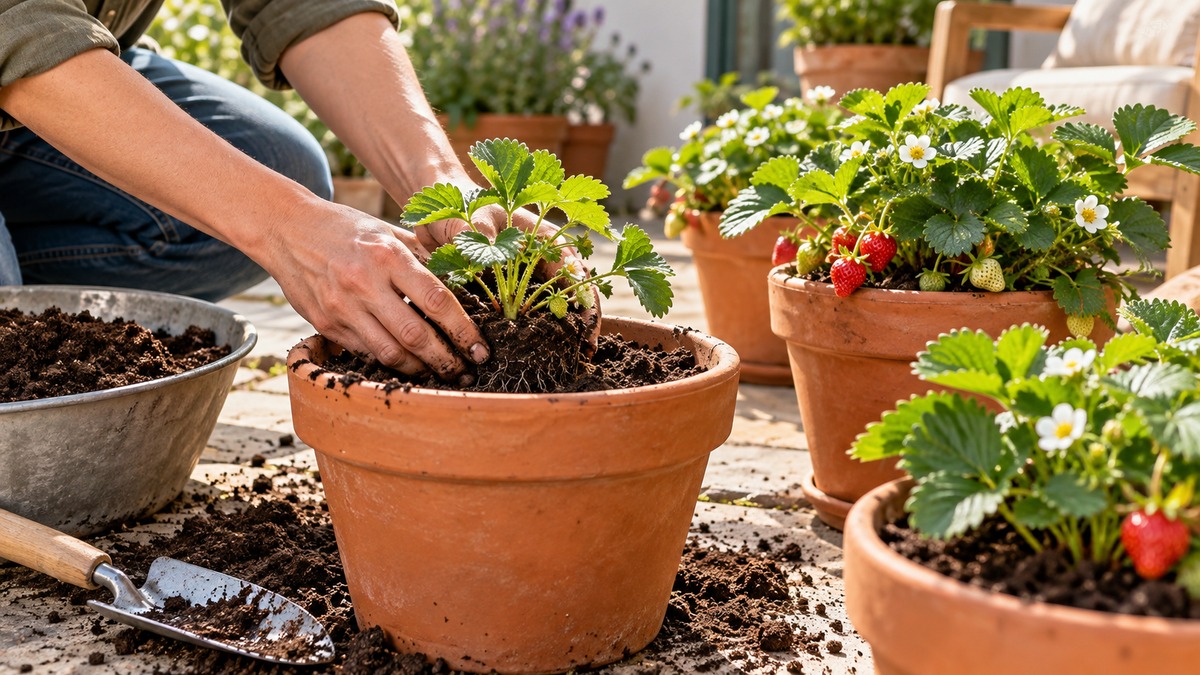
Iowa State says plants can be set as “dormant bare root plants or live plants purchased at the garden center.” Either way, the crown is the detail that matters. Nebraska gives the rule for potted plants: “Plant at the same depth as in the pot, ensuring the crown is level with the soil surface.” Iowa State says: “The crown of the plant should be even with the soil surface.” Nebraska gives the same rule in plainer words: “Plant strawberries the same way as in the ground, ensuring the crown is at soil level.” Iowa State adds a warning for pots: “it is essential not to put plants too deep in the potting soil.”
Timing comes first. Nebraska says to “Plant strawberries in early spring, as soon as the soil can be worked.” Iowa State gives a window and a frost rule: “Start plants in spring (early to mid-April) and protect them from below-freezing temperatures by bringing them indoors should frost threaten.” If a late cold snap is forecast, move the pot indoors, as Iowa State advises.
Spacing depends on pot size. Iowa State says that “Ideally, plants are spaced about 8 inches apart in the container.” It adds that “A 12-inch diameter container can accommodate 3 or 4 plants.” Oregon State allows up to four plants in a pot about 12 inches across. Iowa State also says that varieties without extensive runners “can be placed a bit closer together than those that set runners profusely.” Iowa State’s point is that low-runner varieties can sit a bit closer, so the variety matters when you set the spacing.
Sun, water and feeding
Sun is the next requirement. Iowa State says: “Containers should be placed in an area that receives full sun.” It also gives a number to plan for: “Plants should receive at least 6 hours of direct sunlight per day.” Choose that spot before you plant.
Water is the most common pressure point. Nebraska says containers “dry out more quickly than garden beds, so water regularly to keep the soil moist.” Iowa State gives a simple test: “Check regularly and water when the soil surface is dry.” Wisconsin Horticulture says: “Regular watering is critical as plants in containers can dry out more quickly than plants growing in the ground.” If keeping the soil moist is the hard part, our guide to self-watering window box planters is worth a look.
Iowa State also covers the potting soil itself: “If no starter fertilizer is included in the potting soil, an all-purpose fertilizer can be incorporated prior to planting as outlined in the label directions.” The feeding advice differs. Iowa State says to “Apply fertilizer 2 to 3 times throughout the growing season” and to “Use a water-soluble, all-purpose fertilizer as outlined on the label.” Nebraska asks for a steadier schedule: “Feed container-grown strawberries with a balanced liquid fertilizer every 4-6 weeks during the growing season.” The label is the common ground between the two pages, so start there and watch the plants.
Runners, first blooms and harvest
Runners are the main care task for a pot. Iowa State says: “Day neutral and everbearing types typically produce few runners, so one or two small plantlets can be allowed to root alongside the parent plant, but any additional runners should be removed as they form.” Oregon State applies the same logic to hanging baskets, where a runner cannot root and weakens the potted plant.
Iowa State also suggests removing the first flush of blooms in spring. The reason is root growth: the plant puts its early energy into roots before fruit. Expect a lighter harvest from a pot than from a garden bed. Iowa State says day-neutral strawberries “stop flowering and fruiting when temperatures get above 80-85°F”, so the harvest often pauses in midsummer and returns when the weather cools.
For picking, Iowa State says: “Harvest strawberries when the fruit is uniformly red.” Pick the fruit when it is uniformly red.
Winter: where the sources split
Winter is where the pages disagree most. Iowa State is firm: “It is not recommended to overwinter strawberries grown in containers.” Its end-of-season advice is to “simply remove them from the container and compost the plants”, then buy new plants in spring. Nebraska takes another route: “If growing strawberries in containers, move them to an unheated garage or shed for the winter.” It adds: “Water occasionally to prevent the roots from drying out.”
Wisconsin Horticulture treats the choice as yours. It says: “you will need to decide if you are going to overwinter your strawberry containers or properly dispose of the plants and soil” and start over the next spring. Oregon State adds a size rule for growers who want to keep plants: “When growing strawberries in containers, the larger the container, the more likely the plants can be kept for more than one growing season.”
Common mistakes to avoid
- Planting too deep. Iowa State says it is essential not to put plants too deep in the potting soil.
- Letting extra runners root in the pot. Iowa State says additional runners should be removed as they form.
- Choosing June-bearing plants for a pot. Iowa State says they are not recommended in containers.
- Letting the pot dry out. Nebraska says containers dry out more quickly than garden beds.
- Planning for winter too late. Iowa State says overwintering is rarely successful, so decide before the first frost.
How we chose
We began with extension pages that came up in a search for container strawberries, and kept those from university extension programs. We opened four of them on 2026-10-22: Iowa State University Extension, the University of Nebraska-Lincoln Backyard Farmer page, an Oregon State University Extension publication for coastal growers, and a Wisconsin Horticulture page. Oregon State’s publication covers strawberries in general, and we drew only on its container section. Wisconsin’s page is a short webinar description, so it supports only the points quoted above. We did not rank the four sources. A farm magazine article and a commercial site also came up, and we left them out because neither is an extension page.
What we could not verify
The pages do not agree on feeding intervals, winter storage or pot depth. They also do not give yields, the number of years a pot will keep producing, or a soil recipe that works in every climate. Oregon State’s guide is written for the Oregon coast, and Iowa State’s guide was last reviewed in May 2023. Nothing in this guide is a product recommendation.
What the sources do not say
The sources do not say how long a pot should dry out between waterings, and they give no soil moisture reading to aim for. Wisconsin Horticulture describes its content as a webinar, so it gives less detail on feeding and spacing than the other pages. None of the four pages says whether an eight-inch-deep pot from Iowa State or a 10-inch-deep pot from Oregon State gives a better crop. Treat the depth rule as a minimum and choose the larger pot when the space allows.
Frequently asked questions
What kind of strawberry plant works best in a pot?
A day-neutral or everbearing plant. Iowa State University Extension says those are the best to use in containers because they fruit readily in the first year. Oregon State University Extension calls day-neutral cultivars the best suited for container growing, and Wisconsin Horticulture calls them the easiest. June-bearing plants can be grown in pots, but Iowa State says that is not recommended.
How big should the container be for strawberries?
Iowa State recommends at least 12 inches across and 8 inches deep. Oregon State gives 10 to 18 inches deep and 12 inches or larger across, depending on how many plants go in. Wisconsin sets a minimum of 12 inches across for round pots and 24 inches for rectangular ones. A round pot at least 12 inches across and 10 inches deep meets the minimums on all three pages.
How many strawberry plants fit in one pot?
Iowa State says a 12-inch container can accommodate three or four plants, and Oregon State says up to four plants in a pot about 12 inches across. Plant fewer if the variety sends out a lot of runners. Iowa State says varieties with fewer runners can sit a bit closer together than those that set runners profusely.
Can strawberries in containers be kept over winter?
The sources disagree. Iowa State says overwintering is not recommended and suggests composting the plants at the end of the season. Nebraska suggests moving containers to an unheated garage or shed for the winter and watering occasionally. Wisconsin Horticulture leaves the decision to you. If you want to try, Oregon State says larger containers are more likely to keep plants for more than one growing season.
How often should potted strawberries be fed?
Follow the label on your fertilizer, which Iowa State asks for. Iowa State also suggests applying fertilizer two to three times through the season. Nebraska asks for a balanced liquid fertilizer every four to six weeks. Those two intervals do not match, so start with the label and adjust by watching how the plants look.
Sources
- https://yardandgarden.extension.iastate.edu/how-to/how-grow-strawberries-containers (opened 2026-10-22)
- https://byf.unl.edu/strawberries (opened 2026-10-22)
- https://extension.oregonstate.edu/sites/default/files/documents/em9178.pdf (opened 2026-10-22)
- https://hort.extension.wisc.edu/articles/growing-strawberries-in-containers/ (opened 2026-10-22)