Creating a Flower Bed From Scratch: Clearing, Soil and Drainage
As an Amazon Associate we earn from qualifying purchases. Details
Updated 19 October 2026 | Author: Editorial team, homelycapers.com
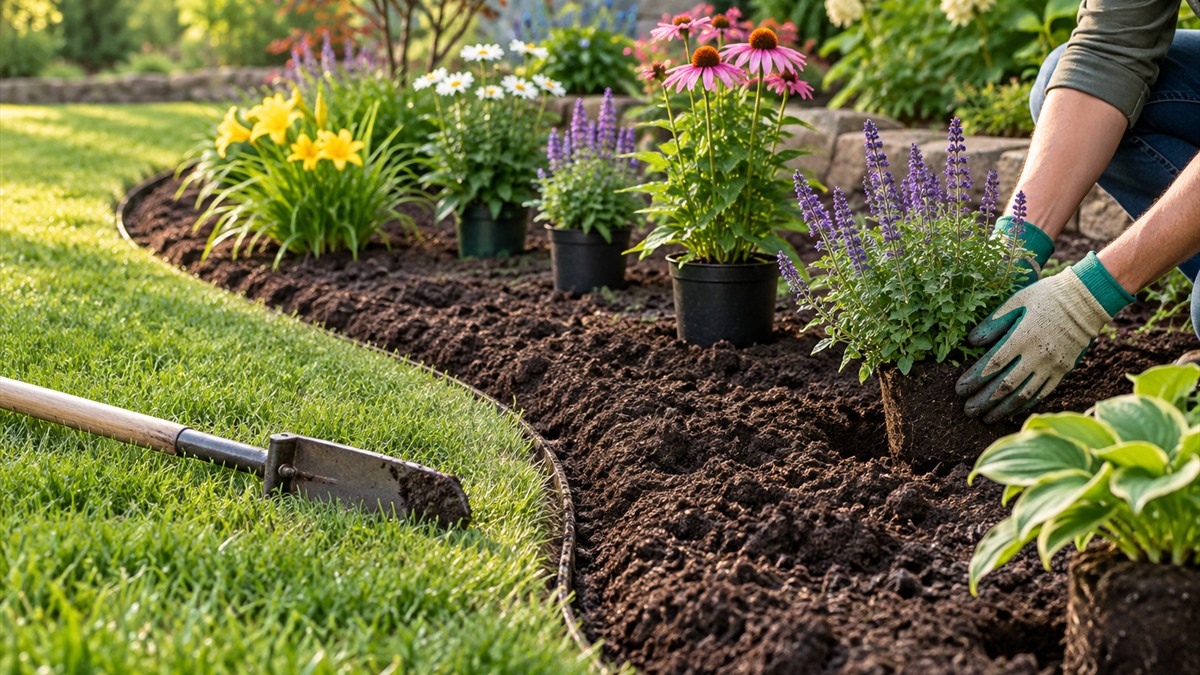
Creating a flower bed from scratch is mostly work done before the first plant goes in: clearing the turf or weeds, checking that the site drains, adding organic matter and choosing the season. The extension sources we downloaded give consistent steps for a bed on lawn or on weedy ground, and they include a simple drainage check and a rate for organic matter. This guide follows those steps in order, shows the organic matter arithmetic for a bed of any size, and notes what the sources leave open, including which plants to choose.
Quick answer
- Clear the grass thoroughly. Penn State Extension says “A thorough job of clearing turfgrass will save you hours of weeding in the future.”
- Check drainage before you plant. Illinois Extension describes a simple check: dig a hole 8-12 inches deep, fill it with water, and see whether it drains. If it drains in less than one hour, the source says drainage should be satisfactory.
- Add organic matter. Illinois Extension advises adding organic matter at about 25 to 30 percent by volume of soil during bed preparation.
- Prepare in the fall if you can. The UNH Extension chapter on herbaceous plants says “Preparation is best done in the fall.”
Clear the site first
The grass or weeds have to go before anything else. Penn State lists digging, plowing and rototilling combined with raking out grass clumps as an effective method. It also describes solarizing the area: cover the grassy area with plastic or newspaper, cover that with a good layer of mulch, and wait. After several weeks the grass is dead, and the soil can be loosened and prepared for planting by digging or tilling.
Illinois Extension describes the same job with an option for people who want to avoid herbicides. It says that if you do not want to use herbicides, you can cover the bed with several layers of wet newspaper and mulch or some other light blocking material such as black plastic. The newspaper and plastic smother the grass, and the bed is ready when the grass underneath is dead and the soil beneath is loose. Illinois also names a non-selective, systemic herbicide for perennial weeds on grassed areas. If you choose that route, follow the product label, including any timing it gives before you plant.
The sources differ in effort, not in result. Digging and tilling clears the bed faster, while smothering takes longer but leaves the soil structure undisturbed. Either way the goal is the same: remove the grass and perennial weeds before you plant, because the sources describe clearing as the step that saves the most weeding later.
Check the drainage
The next check is drainage, and it takes about an hour. Illinois Extension says that “Drainage can be checked by simply digging a hole 8-12 inches deep and filling it with water.” Let it drain, fill it again, and time the second fill. The source says that water draining in less than an hour means drainage should be satisfactory.
If the water sits longer, the bed needs work before planting. Illinois says to avoid planting in low-lying areas, and it stresses that well-drained soil is essential for growing perennials successfully. A bed in a low spot that holds water is a poor site, and the sources suggest choosing a higher area or raising the bed.
Drainage and clearing come together. Once the grass is dead and the soil is loose, the drainage check tells you whether the soil structure has improved. A hole that still holds water after the turf is gone is a sign to add more organic matter, which is the next step.
Add organic matter
Organic matter opens the soil and holds moisture, and it is the amendment the sources name most often. Illinois Extension gives a rate: during bed preparation, add organic matter at about 25 to 30 percent by volume of soil. That is a rate by volume, not by weight, and it applies to the soil you are preparing.
The arithmetic is simple. Multiply the bed’s length by its width and by the depth you are preparing, in feet, and you get the soil volume. Then take 25 to 30 percent of that volume. For a bed 4 feet by 8 feet, prepared 8 inches deep, the soil volume is 4 × 8 × 0.667 = 21.3 cubic feet. At 25 percent organic matter, that is 21.3 × 0.25 = 5.3 cubic feet. At 30 percent, it is 21.3 × 0.30 = 6.4 cubic feet. The result is a range, and the source gives the range rather than a single number.
The UNH Extension chapter on herbaceous plants gives a related rule for heavy clay. Its advice is to improve drainage by adding organic matter, and to add it to heavy clay to improve the soil texture. Use the same arithmetic when you plan the amount, and remember that the volume you need depends on the depth you prepare.
Timing and the soil check
The UNH chapter says that “Preparation is best done in the fall.” That gives the bed the winter to settle and gives the soil time to break down the organic matter before spring planting. The same chapter says to start with a soil check, and to adjust the pH if the result calls for it. The soil check tells you the pH, and the adjustment follows the result rather than a number taken from a different bed.
Illinois Extension lists what preparation has to achieve: clearing perennial weeds before the soil is turned, keeping the soil well drained while it still holds enough moisture for good plant growth, providing enough organic matter, and adding fertilizer as needed. Those goals sit behind each step above, and they are a useful checklist for the finished bed.
The sources do not give a pH target for flowers in general, because the right pH depends on the plants you choose. Follow the result of your own soil check, and do not copy a target from a different garden.
Timing also depends on the weather. A bed dug while the soil is soaked can compact, so wait until the soil is workable before you dig or till. The sources do not give a moisture threshold, so judge by how the soil crumbles in your hand.
How we chose
We chose three sources that cover a new bed from start to finish: Penn State Extension for clearing and solarizing, Illinois Extension for the drainage check and the organic matter rate, and the UNH Extension chapter on herbaceous plants for the fall timing and the soil check. Each one addresses preparation rather than plant selection. We did not include garden center or retailer advice, because the question is about the bed. Where the sources give a number, this guide shows the calculation, and where they give only a method, we describe the method.
What we could not verify
The sources do not say which flowers suit a particular bed, so this guide does not recommend plants or spacing. They do not give a set number of weeks for smothering in every climate, beyond Penn State’s “several weeks.” They do not give a rate for any specific herbicide product, and they do not say how long a non-selective herbicide must wait before planting, so follow the label on the package. The sources also do not give a single pH target for a flower bed, so the soil check result decides the step.
Scaling the organic matter for a larger bed
The same rule works at any size. A 10 by 20 foot bed prepared 8 inches deep has a soil volume of 10 x 20 x 0.667 = 133.4 cubic feet. At 25 percent organic matter that is 133.4 x 0.25 = 33.4 cubic feet, or 33.4 ÷ 27 = 1.2 cubic yards. At 30 percent it is 133.4 x 0.30 = 40 cubic feet, or 40 ÷ 27 = 1.5 cubic yards. Check the unit on the bag or the supplier’s quote before you buy, because cubic feet and cubic yards are easy to mix up.
When the water stays too long
If the one-hour check fails, the sources offer a fix beyond organic matter. Illinois Extension says that on sites with less than good drainage, “raising the bed either with timbers, rocks, landscape bricks or similar materials will greatly improve drainage and your chances of growing and maintaining a perennial bed.” That turns the flower bed into a raised one. The sources do not say how high to raise the bed for a given drainage problem, so this guide does not give a height.
Mistakes to avoid
The sources point to four shortcuts that cause trouble with a new bed.
- Skipping the drainage check. Illinois Extension says to avoid planting in low-lying areas, and the one-hour water check is how you see whether the site is one of them.
- Adding no organic matter. Illinois gives the 25 to 30 percent rate during preparation, and the drainage check tells you whether the soil needs more of it.
- Skipping the soil check. UNH Extension puts the soil check first, and notes that lime may also be needed when the result shows a pH below 6. Without the check, you do not know whether the soil needs lime at all.
- Leaving perennial weeds alive. Penn State’s point is that clearing the turf thoroughly now saves weeding later, so the clearing step is not one to rush.
The first season
UNH Extension says mulch helps keep the soil surface from drying, which gives a reason to mulch a new bed once it is planted as well as before. Penn State and Illinois both describe covering the bed with plastic, newspaper or a light blocking material during preparation, with mulch on top in Penn State’s method. The sources do not give a mulch depth for a flower bed, so this guide does not give one.
Watering and a planting schedule are not covered in the sources we downloaded, so this guide does not give either one.
FAQ
How long does it take to clear grass before planting?
Penn State says that after several weeks of smothering, the grass is dead and the soil can be prepared. Digging or tilling is faster, and Penn State lists digging, plowing and rototilling with raking as effective. The sources do not give a fixed number of days for every method.
How do I know if the new bed drains well enough?
Illinois Extension says to dig a hole 8-12 inches deep, fill it with water, let it drain, fill it again, and time it. If the water drains in less than one hour, the source says drainage should be satisfactory.
How much organic matter should I add?
Illinois Extension says about 25 to 30 percent by volume of the soil during bed preparation. For a bed 4 by 8 feet and 8 inches deep, that is 21.3 cubic feet of soil, so about 5.3 to 6.4 cubic feet of organic matter.
When is the best time to prepare a new flower bed?
The UNH chapter says preparation is best done in the fall. That gives the bed time before spring planting.
Can I skip the herbicide?
Yes. Illinois Extension says you can cover the bed with several layers of wet newspaper and mulch, or with a light blocking material such as black plastic, instead of using herbicide. Penn State describes smothering with plastic or newspaper as an alternative too.
Related reading
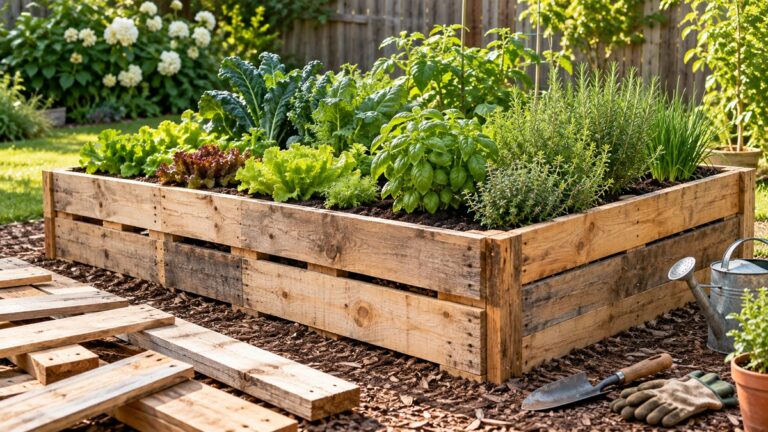
For a raised bed rather than an in-ground flower bed, see how to fill raised beds. For preparing beds before the cold sets in, see our guide to preparing raised beds for winter.
Bottom line
Clear the grass or weeds first, check drainage with the one-hour water check, add organic matter at about 25 to 30 percent by volume, and do the preparation in the fall if you can. Let your own soil check decide the pH step, and follow the label on any herbicide you use.
Sources
- Penn State Extension, “Starting a New Perennial Garden”: thorough clearing of turfgrass, digging, plowing and rototilling with raking out grass clumps, and solarizing under plastic or newspaper.
- Illinois Extension, “Perennials: bed preparation”: the drainage hole check, avoiding low-lying sites, organic matter at 25 to 30 percent by volume, and smothering with wet newspaper and mulch.
- UNH Extension, Chapter 14, “Herbaceous Landscape Plants”: fall preparation, the soil check and pH adjustment, and organic matter for drainage and heavy clay.