Black Friday Garden Tool Checklist: What to Check First
As an Amazon Associate we earn from qualifying purchases.
This Black Friday garden tool checklist is for the weeks before you buy, not for the day itself. It covers what to check on garden tools and planters: blade or head material, handle length, planter drainage, container size, and hose or fitting compatibility. It also shows what listings leave out, because the figures inside one listing do not always agree. Read the material, length and size lines first, then check that they match each other. Where a listing does not state a figure, this guide says so.
Quick answer
- Check the blade or head material and the cut or head size in the listing. If two lines of the same listing give different figures, treat the gap as open until you see the model number.
- Pick the handle length by your reach, not by the largest number on the page. The weed puller records in this guide state lengths from 39 inches to 60 inches.
- For planters, confirm the drainage holes, the usable depth, and how the capacity was measured. A stated capacity does not say whether it is an inside or an outside figure.
- For hoses and fittings, match each side of the connection. One adapter record lists a garden hose thread on one side and a pipe thread on the other.
Why check the listing before the Black Friday week
The checks in this guide do not change with the calendar. A listing read in a crowded week gets less attention than one read on a quiet afternoon, and the gaps are the easiest things to miss. The fix is to do the reading early, while nothing is rushing you.
Three steps help before the week starts. Write down the model number, because a title can describe one tool while a model field names another. Copy the length and cut or capacity figures into a note, so you can compare them with a second listing. And decide what the tool has to do, such as cut a stem of a certain thickness or reach a certain depth, before you open any product page.
The records behind this guide show why the reading matters. The Fiskars Bypass pruning shears record gives a length of 9.07 inches in one field and 11.5 inches in another. The DECERK record gives a cutting width of 20 millimeters in its specifications and a bullet point that says it cuts branches up to 3/4 inch. Those two figures are close but not the same, and the listing does not say which one is the limit.
Blade and head material, as listed
The table records only what each listing states. A cell that reads not stated means the record has no such figure. A cell that reads not applicable means the field does not fit that tool.
| Tool (ASIN) | Blade or head material | Cut or head size | Blade type | Warranty |
|---|---|---|---|---|
| Fiskars Bypass Pruning Shears (B00002N66H) | Alloy steel | Cutting width 0.63 inch | Bypass | Lifetime warranty |
| Felco F2 (B00023RYS6) | Metal, steel | Cutting width 1 inch | Anvil | 1 year (warranty field) |
| Corona BP 3180D (B00004R9YQ) | Alloy steel, carbon steel | Cutting width 1 inch | Bypass | Limited lifetime warranty |
| DECERK 8.5 inch (B0DKDBM3P8) | Titanium (specifications field) | Cutting width 20 millimeters | Bypass | not stated |
| Gerossi ratchet pruner (B0BSNSB4D3) | High carbon steel | Cutting width 0.75 inch | Anvil | not stated |
| Fiskars 28-inch loppers (B000BX1IB6) | Stainless steel | Cutting width 1.5 inches | Bypass | Full lifetime warranty |
| Oliynedy leaf rake (B0C8945NKT) | Metal head | Head size 17 inches | not applicable | not stated |
| Lilyvane weed puller (B0C5R59RH9) | All-metal steel, 4 steel claws | Claw depth 3.4 inches | not applicable | not stated |
Read the table across each row, not down a column. Each row comes from one record, so its figures belong together. The DECERK row shows a conflict inside a single listing: the specifications give titanium as the blade material, while the bullet points describe a Japanese SK5 blade with a titanium coating. The listing does not say which description is the base metal.
The Corona BP 3180D record has a similar gap. Its blade material field reads alloy steel and carbon steel, and its material type field reads metal and stainless steel. Those fields do not describe the same metal, so the record leaves the question open.
Bypass or anvil
Blade type is the field that decides how a pruner cuts. The University of Maryland Extension pruning tools page describes two types, anvil and by-pass. It says: “By-pass pruners are superior to anvil pruners because they reduce the tearing or crushing of tissues.” It describes the anvil design this way: “Anvil pruners have a straight blade that closes against a small anvil or block as the handles are squeezed.”
Sharpness changes the result as well. Felco’s sharpening guide says: “Dull blades do not slice cleanly. They crush and tear plant tissue, creating ragged wounds that heal slowly.” A dull pruner is a poor choice whatever its blade type.
The Felco F2 record is a case where blade type is unclear. Its blade type field says anvil, while its title says Precision Bypass Blade. Check the model number, F-2, against the manufacturer’s own product page before you decide which design you are buying. For a wider set of pruners, see our pruning shears guide.
Handle length and weight
Handle length matters most on long-handled tools, and the records state different lengths for similar tools. The weed puller records give a 60-inch splicing handle for Lilyvane, a 45-inch handle for Grampa’s, a 44-inch handle in the title for Papa’s Tools with a 39-inch product dimension, a 44-inch bamboo handle for WilFiks, and a 39-inch handle for Walensee. The Oliynedy rake record gives a handle range of 30 to 58 inches, and the Fiskars loppers are listed at 28 inches.
Measure your reach before you choose. A longer handle lets you stand while you pull, but it has to suit how you work, and the lengths above show the range the records state. The Walensee record also includes a usage note: keep the land moist before use and do not pull weeds in gravelly soil. That is a condition in the listing, and it limits where the tool works.
Weight is the other half of the handle check. Divide the item weight in ounces by the item length in inches to get ounces per inch. The method is rough, but it lets you compare tools on heft using only the figures each record gives.
| Tool (ASIN) | Item weight (as listed) | Item length (as listed) | Ounces per inch (calculated) |
|---|---|---|---|
| Fiskars Bypass Pruning Shears (B00002N66H) | 10.2 ounces | 9.07 inches | 1.12 |
| Felco F2 (B00023RYS6) | 8.8 ounces | 9.25 inches | 0.95 |
| Corona BP 3180D (B00004R9YQ) | 13.6 ounces | 8.5 inches | 1.60 |
| DECERK 8.5 inch (B0DKDBM3P8) | 0.25 kg (about 8.82 ounces) | 8.5 inches | 1.04 |
| Haus & Garten 8.5 inch (B00CD2WB3C) | 9 ounces | 8.5 inches | 1.06 |
| Gerossi ratchet pruner (B0BSNSB4D3) | 7.8 ounces | 8.1 inches | 0.96 |
| Fiskars SoftGrip Pruning Shears (B00K5IZRHI) | 7 ounces | 8.23 inches | 0.85 |
The formula is item weight in ounces divided by item length in inches. The Fiskars Bypass row shows why the method needs care. Its record lists two lengths, 9.07 inches and 11.5 inches. With 9.07 inches the result is 1.12 ounces per inch. With 11.5 inches it is 0.89, because 10.2 divided by 11.5 gives 0.89. The listing does not say which length the weight belongs to, so the honest answer is a range, not one number.
Planter drainage
Drainage is the check most often missed on a decorative planter, because the holes can be small and the pot looks finished without them. The Illinois Extension guide on container drainage says: “It allows water in the soil to drain freely so adequate air is available for the roots.” It adds a plain instruction: “So be sure there are holes for drainage.” The same guide notes that few plants can tolerate sitting in stagnant water.
The guide also makes a point about saucers. It says: “Beware of pots with permanently attached saucers where emptying the overflow is difficult or impossible.” And it adds: “It is much better to use a pot with a detachable saucer.” A saucer you cannot empty can keep the roots wet even when the hole is open.
The Fielda record lists drainage holes and a removable saucer tray. Its bullet point reads: “Each plastic plant pot includes a REMOVABLE SAUCER TRAY and strategic DRAINAGE HOLES to promote healthy root development.” The record also describes an elevated base and a breathable design. Those are listing claims. The sources we opened do not cover self-watering designs, so the claims stay with the listing.
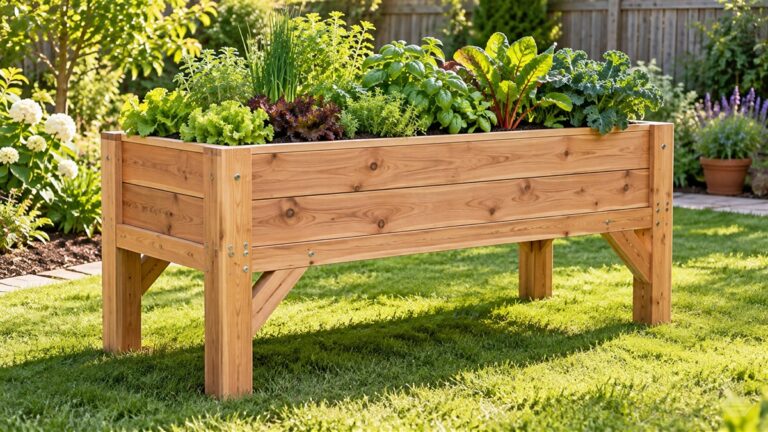
The Land Guard raised bed record takes a different route. Its bullet points say the bed has an open base, which can effectively avoid water accumulation and decay. The sources we opened do not cover raised bed bases, so this is also a listing claim.
Container size and volume
Container size has two numbers that should agree, and they often do not. The first is the usable depth, which is the soil a root can use. The second is the capacity, which is how much soil the container holds. Check both, and where the listing gives dimensions, calculate a volume and compare it with the stated capacity.
The Fielda record measures its round pots by top diameter, in 8, 10 and 12 inch sizes. Its bullet points state usable planting depths of 5.8, 6.1 and 7.6 inches, and say those depths are smaller than the overall heights because the self-watering reservoir takes up space. The record recommends the 8-inch pot for 4 to 6 inch nursery pots, the 10-inch for 6 to 8 inch, and the 12-inch for 8 to 10 inch nursery pots.
The Fielda dimension field reads 8 by 8 by 8 inches. A straight cylinder with an 8-inch top diameter and an 8-inch height holds about 1.7 gallons. The calculation is pi times 4 inches times 4 inches times 8 inches, which is about 402 cubic inches, and 402 divided by 231 cubic inches per gallon gives 1.74. The listing states a capacity of 2.5 gallons. It does not say which size that figure describes, or whether the reservoir is counted. The gap is worth asking about before you buy, and it does not show that the pot is wrong.
The Land Guard raised bed gives the same kind of check on a larger scale. Its record lists 48 by 24 by 12 inches and a capacity of 7 cubic feet. Multiplying the dimensions gives 13,824 cubic inches, which is 8.0 cubic feet after dividing by 1,728 cubic inches per cubic foot. The stated figure is smaller than the outside box. That could mean the capacity is measured inside the walls, but the listing does not say so. A second raised bed listing of the same 4 by 2 by 1 foot size states 7 or more cubic feet.
Once you have a bed size, the soil volume is a separate step. Our guide on how much soil a raised bed needs covers that calculation, and our guide on filling raised beds compares options for the fill.
Hose and fitting compatibility
Fittings fail by mismatch, not by blade. An adapter can fit one side of a connection and not the other. The brass adapter record (ASIN B087GKPMVG) describes a standard 3/4 inch garden hose thread female to 1/2 inch national pipe thread male. Its thread type field reads GHT, and its thread size field reads 0.75 inch. The same record notes that the 1/2 inch side is national pipe thread, not garden hose thread.
The listing names the GHT side as garden hose thread and the NPT side as national pipe thread, so this guide relies on those descriptions. The sources we opened do not define these thread standards, and the listing is the only basis for the labels here.
Check each side against the fitting you already own before you order. A connector that looks right on the hose end may not thread onto the tap or pipe end. Our guides on brass quick connect garden hose fittings and plastic water hose fittings and adapters cover the wider range, and our expandable garden hose and garden hose reel guides cover the hose itself. If you water by hand, see our watering can guide, and for the hose end, our hose attachment guide for watering plants.
Products in this checklist
Each card names the figures the listing states, one good use, one case to skip the product, and one limitation. The cards show the checks above. They are not a ranking.
Fiskars Bypass Pruning Shears, 5/8 inch cut capacity
Listing facts: bypass blade for stems and branches up to 5/8 inch; cutting width 0.63 inch; alloy steel blade and handle; 10.2 ounces; lengths of 9.07 inches and 11.5 inches in two fields; lifetime warranty; ambidextrous.
Good for: clean cuts on live stems and small branches, which is the use the listing names.
Skip if: you need to cut branches thicker than 5/8 inch.
One limitation: the two length figures disagree, so confirm the size against the model number, 91095935J, before you buy.
Felco F2 Pruning Shears, 9.25 inch
Listing facts: anvil blade type; cutting width 1 inch; blade length 2 inches; 8.8 ounces; forged aluminum handles; replaceable parts; hand orientation right; warranty field reads 1 year; model F-2.
Good for: a right-handed user who wants a pruner whose parts can be replaced, as the listing describes.
Skip if: you are left-handed, because the listing gives a right hand orientation.
One limitation: the title says bypass blade, while the blade type field says anvil, and the warranty field and a bullet point disagree.
DECERK 8.5 inch Pruning Shears
Listing facts: bypass blade with a straight edge; 8.5 inches long; 0.25 kg; cutting width 20 millimeters; aluminum and rubber handles; a replacement spring is included; a maximum opening of 3.6 cm (1.42 inches) in a bullet point.
Good for: pruning branches up to 3/4 inch, as the bullet points state, with a spare spring in the box.
Skip if: you need one stated blade material you can rely on, since the record gives two versions.
One limitation: the listing gives a 5,000-cut figure for the blade and does not say how that figure was measured.
Corona BP 3180D Forged Bypass Pruner
Listing facts: bypass blade with 1 inch cutting capacity; forged steel construction; 13.6 ounces; 8.5 inches long; spring-loaded action; built-in safety lock; limited lifetime warranty.
Good for: a heavier bypass pruner for stems and branches up to 1 inch, per the listing.
Skip if: you want a lighter tool. At 1.60 ounces per inch it has the highest ratio of the pruners in the table above.
One limitation: the blade material field reads alloy steel and carbon steel, while the material type field reads metal and stainless steel.
Fiskars 28-inch Garden Bypass Loppers
Listing facts: 28-inch steel blade; cutting width 1.5 inches; 2.9 pounds; stainless steel blade; alloy steel handle; full lifetime warranty.
Good for: thicker branches up to 1.5 inches, reached from a long handle, as the listing describes.
Skip if: you need a hand pruner for small stems. Our record notes that this is a lopper, not a hand pruner.
One limitation: the material type field reads wood, while the handle is listed as alloy steel.
Lilyvane Weed Puller Tool, 60-inch handle
Listing facts: 60-inch splicing handle; four steel claws with non-slip teeth; 3.4-inch claw depth; 5.7-inch foot pedal; 2.68 pounds; all-metal steel; product dimensions 62 inches.
Good for: pulling weeds while you stand, with no bending or kneeling, as the listing describes.
Skip if: you want a shorter handle, because this record lists a single length.
One limitation: the listing gives a 62-inch product size and a 60-inch handle, and does not explain the 2-inch gap.
Oliynedy Adjustable Metal Leaf Rake
Listing facts: metal head with a 17-inch wide head and a 9-inch small head; plastic handle; a 30 to 58 inch long handle; 16 ounces; poles that screw together without tools.
Good for: leaves on open lawn with the wide head, and pine straw or leaves around shrubs with the 9-inch head, per the bullet points.
Skip if: you need the tine count or tine material, because the listing states neither.
One limitation: the record gives the head size but no tine length.
Fielda 8, 10 and 12 inch Self-Watering Pots
Listing facts: plastic round pots in 8, 10 and 12 inch sizes measured by top diameter; usable depths of 5.8, 6.1 and 7.6 inches; removable saucer tray; drainage holes; water level indicator window; capacity 2.5 gallons.
Good for: potted herbs or flowers where the water level window and the drainage holes both matter, as the listing describes.
Skip if: the roots need more than about 7.6 inches of soil depth, which is the usable depth of the 12-inch size.
One limitation: the 2.5-gallon capacity does not say which size it describes, and a straight 8-inch cylinder comes to about 1.7 gallons.
Land Guard Galvanized Raised Garden Bed
Listing facts: galvanized metal; 48 by 24 by 12 inches; capacity 7 cubic feet; drainage hole as a special feature; open base; about 5 minutes to assemble; average thickness 0.78 mm in a bullet point.
Good for: a metal bed where the open base and the drainage hole are the features you want, as the listing states them.
Skip if: you need a stated inside volume, since the listing does not say how the 7 cubic feet is measured.
One limitation: the outside dimensions give 8.0 cubic feet against the stated 7, so the measuring method is the open question.
How we chose
The criteria are the figures a buyer checks on a garden tool or planter: blade or head material, cut or head size, length, drainage, capacity and thread type. The figures come from the listing records in our product folder, read between October 12 and October 18, 2026. A record that did not state a figure for one of these fields was left out of the comparison, not filled in.
The pruning-shears record lists nine products, and the hand-tool comparison adds one more pruner. Four pruners appear as cards, chosen to show different checks: a bypass pruner with a 5/8 inch cut, an anvil design, a pruner whose blade figures disagree, and a heavier bypass pruner with a 1 inch cut. Amazon Basics is left out of the cards because its record states no cut capacity.
The rest of the set covers the checks that pruners do not: length, depth and volume. The weed puller, rake, pots and raised bed records were chosen for those figures. The weed puller check excluded hoe-and-rake combinations, short hand weeders, crack weeders and tree pullers. The cards are not a ranking, and their order is not a score.
What we could not verify
The listings and the three sources we opened leave the questions below open. They are listed so you can check them before you buy.
- Seller pricing, stock and delivery dates are not in the records, and this guide does not use them.
- Blade life. The DECERK listing gives a 5,000-cut figure and does not say how it was measured. The sources we opened do not cover blade life.
- Which length the Fiskars Bypass weight belongs to. The record lists 9.07 inches and 11.5 inches.
- Whether the Felco F2 is a bypass or an anvil design. The records disagree.
- Which size the Fielda capacity describes, and whether the reservoir is counted. The listing does not say.
- Whether the Land Guard capacity is an inside or an outside measure. The sources we opened do not cover raised bed construction.
- The rake tine count and tine material. The record gives no figure for either.
- Hose thread standards beyond the listing’s own description. The sources we opened do not define these threads.
Mistakes to avoid
- Taking the first length as final. The Fiskars Bypass record gives 9.07 inches and 11.5 inches, and its ounces-per-inch figure moves from 1.12 to 0.89 depending on which you use.
- Assuming one warranty applies to everything. The Felco F2 record disagrees with itself: one field says 1 year, and a bullet point promises a lifetime guarantee on the handles.
- Trusting a capacity figure without a method. The Land Guard record states 7 cubic feet against 8.0 from its outside dimensions.
- Skipping the drainage check. The Illinois Extension guide says: “So be sure there are holes for drainage.”
- Choosing a weed puller for gravelly ground. The Walensee record says not to pull weeds in gravelly soil.
- Matching a fitting by size alone. The adapter record has a garden hose thread on one side and a pipe thread on the other.
FAQ
Should I buy a bypass or an anvil pruner?
For live stems, the University of Maryland Extension pruning tools page says by-pass pruners are superior to anvil pruners because they reduce the tearing or crushing of tissue. Read the blade type field, then check the model number, because one record in this guide gives two blade types.
Does handle length matter for a weed puller?
Yes. It sets how far you reach without bending. The weed puller records here state lengths from 39 to 60 inches, and the Walensee record says not to pull weeds in gravelly soil. Pick the length for your reach and your ground, not for the largest number on the page.
Does every planter need drainage holes?
For most plants, yes. The Illinois Extension guide says few can tolerate sitting in stagnant water, and it says “So be sure there are holes for drainage.” Check the special feature field for a drainage hole, as the Fielda and Land Guard records do, before you buy a planter for a spot where water collects.
How do I check a planter’s stated capacity?
Multiply the listed dimensions and compare the result with the stated capacity. A straight cylinder 8 inches across and 8 inches tall holds about 1.7 gallons, while the Fielda listing states 2.5 gallons without saying which size that is. The Land Guard bed gives 8.0 cubic feet from its outside dimensions against a stated 7 cubic feet.
Does a lifetime warranty cover every part?
The records here do not settle it. The Felco F2 record gives a 1-year warranty field and a bullet point that mentions a lifetime guarantee for the handles. Check the warranty terms on the manufacturer’s page before you rely on a part being covered.
Will a garden hose adapter fit any hose?
No. The brass adapter record lists a 3/4 inch garden hose thread female side and a 1/2 inch national pipe thread male side, and its note says the 1/2 inch side is pipe thread, not garden hose thread. Match each side to the fitting you already have before you buy.
Bottom line
Buy only when the listing states the figure you need and no other line in the same listing contradicts it. If the material, the length or the thread is missing or in conflict, write down the model number and check it before you order.
Sources
- University of Maryland Extension, “Pruning Tools”: https://extension.umd.edu/resource/pruning-tools (opened 2026-10-20)
- Illinois Extension, “Container Drainage Options”: https://extension.illinois.edu/container-gardens/container-drainage-options (opened 2026-10-20)
- Felco, “How to Sharpen and Maintain Pruning Tools”: https://america.felco.com/blogs/news/how-to-sharpen-pruning-tools (opened 2026-10-20)
Disclosure: As an Amazon Associate we earn from qualifying purchases.