How to Build a Simple Cold Frame for Raised Beds
As an Amazon Associate we earn from qualifying purchases.
How to build a cold frame for raised bed use starts with four choices: where it sits, how high its back wall stands, what the lid is made of, and how you will vent it on warm days. Extension publications from North Carolina, Oregon, Wisconsin, South Dakota and Colorado agree on most of these points. None of them gives a complete dimensioned plan for a classic cold frame sitting on a raised bed, so this guide notes where each step comes from.
Quick answer
- Put the frame in a sunny spot sheltered from wind, facing south where you can. Colorado State’s Pueblo County page gives that placement.
- Build the back higher than the front so the lid slopes toward the sun. South Dakota State University describes a slope of about 10 to 15 degrees.
- Use a clear lid, hinged or removable, made of UV-stable plastic or glass.
- Vent the frame on warm, sunny days and close it in the late afternoon.
What a cold frame does over a raised bed
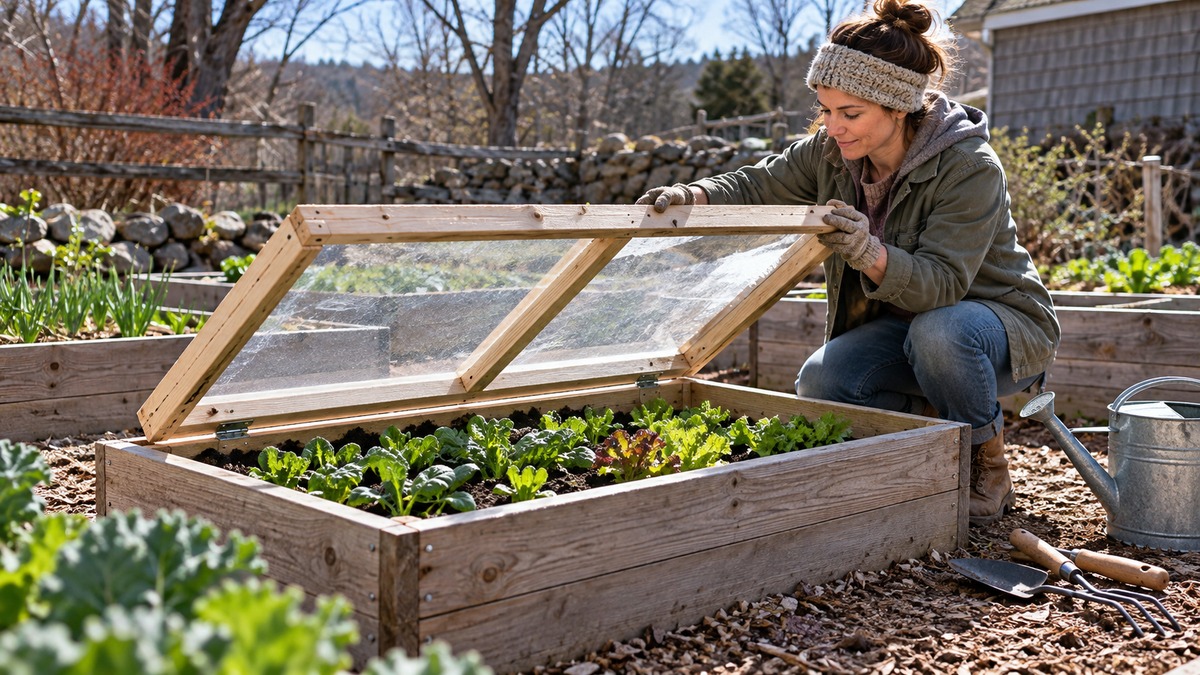
A cold frame is a low box with a transparent lid. North Carolina State’s handbook says that “Cold frames rely on the sun as their sole source of heat.” During the day the soil warms in the sun, and a cover slows heat loss at night.
South Dakota State University describes cold frames as structures “constructed over existing ground or raised beds.” Its example of a permanent frame is “built as a raised bed with a brick base and a glass lid that can be lifted for ventilation.” That is the raised-bed setup this guide covers.
Wisconsin’s extension article says cold frames are “simple, easy-to-make structures that can be used year-round to provide warmth from the sun, and prevent water loss and damage from the wind.” Many gardeners also use them to harden off transplants in the spring.
Materials and size
Lumber and wood choice
North Carolina says that “Cold frames can be built from a variety of materials. Wood and cinder block are the most common.” If you use wood, the same handbook advises that you “choose a species that resists decay, such as a good grade of cedar.” It also warns: “Never use wood treated with CCA, creosote, or pentachlorophenol, because these substances are harmful to growing plants.”
Colorado State’s growing-from-seed publication shows a simple frame of 2-inch by 2-inch lumber with a clear cover. Its figure for the material is: “An 8-foot frame requires 10 pieces of 2 inches x 2 inches of lumber, each 8 feet long.” Oregon State’s cloche design calls for boards treated with water-based preservatives. The sources do not name a preservative that is suitable for a bed that grows food, so this guide does not name one.
Lid and glazing
Wisconsin says that most cold frames “are constructed of wood and have a hinged cover.” Its warning on glass is direct: “Glass windows make great covers, but are heavy and breakable.” It adds that “Alternative covers made of plexiglass or double-layered clear plastic weigh less and can be more durable.”
South Dakota lists UV-stable plastic or glass as typical lid materials, and names upcycled options such as polycarbonate, polyethylene film and acrylic. Colorado State’s frame uses translucent (clear) polyethylene plastic on the lid and sides, and it suggests an airspace for insulation: “For better insulation against cold, cover both inside and outside to leave an airspace between layers of plastic.”
Size and layout
North Carolina says that “There is no standard-sized cold frame.” Its width advice is practical: “4 to 5 feet is about as wide as is convenient to reach across.” Colorado State’s Pueblo County page uses 4 by 8 feet as its example. Its author built a box from 2-by-4 lumber and sized it to an old window of 38 by 28 inches. The page also warns that older windows “have more easily breakable glass,” so check the glass before you reuse a window.
Build the frame step by step
Pick the spot
Colorado State’s Pueblo County page says to “Place the cold frame in a south-facing sunny location that is protected from wind.” Its tip is to set the frame beside a building: “Ideally you should place it next to a garage or building to take advantage of radiant heat.” North Carolina gives the same direction in more detail: a southern or southeastern exposure with a slight slope for drainage, and a wall or hedge to the north against winter wind.
North Carolina also says that “Sinking the frame into the ground also provides some protection and insulation.” A frame set on a raised bed sits above the native soil, so the sources do not say how to get that benefit on a bed. If you are still filling the bed, see the guide to filling raised beds. Portable frames can also be set on concrete blocks or bricks for taller plants, Wisconsin notes.
Build the slope and seal the gaps
South Dakota gives the clearest advice on shape: “To optimize sunlight exposure, the back wall is typically built higher than the front, creating a slope of about 10 to 15 degrees.” It adds that “This design improves light capture, allows water runoff, and easy snow removal.” Colorado State’s Pueblo page says that “almost all designs use a sloping lid to allow the best capture of sunlight.”
Seal any visible gaps to reduce drafts, South Dakota advises, and weigh the edges down so the frame stays put. Its wording is that the edges can be “weighed down with bricks or sandbags” to keep the frame secure. The Pueblo author found hinges unnecessary, since the lid can be lifted off and set back on. Wisconsin recommends hinges, because lids should be “hinged so that they can be easily propped open” to let cool air in. Choose the approach that suits how often you will open the frame.
A hooped alternative from Oregon State
Oregon State’s publication EC 1627 describes a hooped raised-bed cloche, not a classic cold frame. It is used here only for its build steps, which are the most complete in the sources. Its finished size is “approximately 8 feet long and 4 feet wide at the base, and 5 feet high at the center”. Its materials list includes 2-by-12 boards for the base, three 10-foot lengths of 0.75-inch PVC for hoops, and 6-mil polyethylene sheeting for the sides, ends and roof.
The steps run in order. Fasten the base boards, bend the hoops into the corners and the center, lay a backbone board across the hoops, clip plastic to the ends, drape the roof sheet, and screw down side curtains. The publication calls for “UV-treated 6-mil clear polyethylene plastic to reduce clouding.” The side curtains leave an overhang, because “The overhang prevents rain from entering the cloche.” Wisconsin describes hoop houses as similar to cold frames, only larger, with hoops “attached to raised beds.” Oregon State also warns that “Even near the coast, a warm day may increase the temperature in a closed cloche to 100°F.” Its figure caption says that in warmer areas the top 6 to 12 inches of each end should be cut out and left open.
Ventilate, shade and insulate
Vent on warm days
South Dakota says that “Because closed cold frames have limited air circulation, ventilation is essential.” On warm, sunny days, the lids should be vented or removed entirely, and then “closed again in the late afternoon before air temperatures drop.” North Carolina says ventilation is “most critical in the late winter, early spring, and early fall on clear, sunny days.” It advises raising the sash partway on warm days and lowering it early enough to keep some heat for the evening.
Colorado State’s Pueblo page sets a clear threshold: “You need a lid for the frame that can be lifted during warm days (over 50 degrees) to keep the plants from overheating.” Colorado State’s publication says the same thing in its own terms. Prop the lid open on warm, sunny days at 50F or warmer, and close it in the late afternoon to trap heat for the evening.
Cold nights
North Carolina describes a simple cover for cold nights: throw “burlap sacks filled with leaves, old blankets, or tarps over the frame at night to provide some protection and aid heat retention.” In winter, South Dakota says lids should stay closed more often, and that “a light layer of mulch can be added for additional insulation.” North Carolina also recommends a thermometer, because one “can be used to monitor the daily maximum and minimum temperatures.”
Summer shade and watering
The sources also warn about summer. North Carolina says “In summer, extreme heat and intensive sunlight can damage plants.” Shading with lath sashes or old bamboo window blinds can prevent that damage. A nearly airtight frame slows evaporation, which is why the same handbook says the frame is “easy to overwater.”
Timing the season
Colorado State’s publication says cold frames allow starting plants “as much as six weeks before planting-out time.” Its Table 1 gives six weeks in a cold frame for broccoli, cabbage and lettuce, and four weeks for tomato and pepper. The table’s footnote says to “delay planting or use artificial heat to keep temperatures above 50F” if nights fall below 20F outside.
In early spring, North Carolina says a cold frame is “useful for hardening seedlings that were started indoors or in a greenhouse.” Wisconsin agrees that many gardeners use frames this way. In fall, South Dakota says cold frames “can provide an ideal environment for fall sowing of hardy annuals and perennials that require cool temperatures for germination.” North Carolina adds that with adequate moisture and fertilizer, most cool-season crops keep growing “through early winter in the protected environment of the cold frame.” After the season, the steps for preparing raised beds for winter cover the bed itself.
Common mistakes to avoid
- Skipping the vent. South Dakota calls ventilation essential, and Wisconsin notes that plants can wilt when sunny days get extremely hot inside a frame.
- Overwatering. A nearly airtight frame slows evaporation, so North Carolina warns it is easy to overwater.
- Using fresh manure for warmth. Wisconsin does not recommend it “due to potential safety issues surrounding the use of fresh manure, particularly for food crops.”
- Using the wrong wood. North Carolina says to avoid wood treated with CCA, creosote or pentachlorophenol.
- Building a frame too wide to reach across. North Carolina suggests 4 to 5 feet.
- Leaving drafts. South Dakota says to seal visible gaps.
- Starting too early. Colorado State warns that plants may become “crowded and spindly before they can be planted safely outdoors.”
How we chose
This guide relies on six extension pages, all opened with curl on 2026-10-22, and each returned HTTP 200. They are North Carolina State Extension’s appendix on season extenders, Oregon State University Extension’s publication EC 1627, University of Wisconsin Extension’s article on extending the garden season, South Dakota State University Extension’s cold frames article, Colorado State University Extension’s Pueblo County page on making a cold frame, and Colorado State University Extension’s publication on growing annual plants from seed. Each quoted sentence was checked against the text of the page it came from.
Each source was chosen because it is a university or county extension page that describes building, placing, venting or using a cold frame or raised-bed cover. Oregon State’s page describes a hooped cloche, so it is used only for its build steps. The Pueblo page is a county page written by one gardener, so its advice is limited to what it says. Wisconsin’s article was revised June 6, 2009, so its figures should be read with that date in mind. A Cornell Cooperative Extension county page on cold frames returned a PDF that the text check could not read, so it is not cited. Commercial blogs in the search results were not used.
What we could not verify
The sources give the parts of a cold frame, not one complete plan for a classic frame on a raised bed. The Oregon State build is a different structure, and the gaps below remain open.
What the sources do not say
- No source gives a complete dimensioned plan for a classic cold frame set on a raised bed. North Carolina says there is no standard size.
- The sources do not name a wood preservative that is safe for a bed that grows food. North Carolina names treatments to avoid, and Oregon State specifies boards treated with water-based preservatives without naming a product.
- The sources give no cost, wind resistance figure or depth for a frame.
- The sources do not explain how to get the sinking benefit North Carolina describes when a frame sits on a raised bed.
- Wisconsin’s article was last revised June 6, 2009, so its details may not reflect newer materials.
Frequently asked questions
Can a cold frame sit on top of a raised bed?
Yes. South Dakota shows a permanent frame built as a raised bed, and Wisconsin says hoop houses can be attached to raised beds. The sources do not give a full dimensioned plan for a frame set on a bed, so check the fit against your bed before you cut any lumber.
What size should the frame be?
North Carolina’s handbook says a cold frame has no standard size. Choose the dimensions for your space and crops, and keep the width at 4 to 5 feet so you can reach across. Colorado State’s Pueblo County page uses 4 by 8 feet as its example.
Which lid material works best?
The sources give trade-offs rather than a single winner. Wisconsin calls glass “heavy and breakable” and says plexiglass or double-layered clear plastic weigh less. South Dakota names UV-stable plastic or glass as typical materials.
How can a cold frame avoid overheating?
Vent it on warm, sunny days and close it in the late afternoon. Colorado State says to prop the lid open at 50F or warmer, and South Dakota says the lids should be vented or removed entirely to prevent overheating. Wisconsin says lids should be hinged so that they can be easily propped open.
When can you start plants in a cold frame?
Colorado State says a cold frame lets you start plants “as much as six weeks before planting-out time.” Its Table 1 gives six weeks for broccoli, cabbage and lettuce, and four weeks for tomato and pepper.
Sources
- North Carolina State Extension, Gardener Handbook Appendix E, season extenders and greenhouses: https://content.ces.ncsu.edu/extension-gardener-handbook/appendix-e-season-extenders-and-greenhouses (opened 2026-10-22)
- Oregon State University Extension, EC 1627, how to build your own raised-bed cloche: https://extension.oregonstate.edu/catalog/pub/ec1627 (opened 2026-10-22)
- University of Wisconsin Extension, Extending the Garden Season: https://hort.extension.wisc.edu/articles/extending-garden-season/ (opened 2026-10-22)
- South Dakota State University Extension, Cold Frames: https://extension.sdstate.edu/cold-frames (opened 2026-10-22)
- Colorado State University Extension, Pueblo County, Making A Cold Frame: https://pueblo.extension.colostate.edu/making-a-cold-frame/ (opened 2026-10-22)
- Colorado State University Extension, Growing Annual Plants from Seed: https://extension.colostate.edu/resource/growing-annual-plants-from-seed/ (opened 2026-10-22)
As an Amazon Associate we earn from qualifying purchases.