How to Plant Peas
As an Amazon Associate we earn from qualifying purchases.
How to plant peas comes down to four choices: when to sow, how deep, how far apart, and what the vines will climb. Peas are a cool-season crop, so the sowing window opens as soon as the ground can be worked in spring. The extension pages we opened agree on that timing, but they give different depths and spacings, so this guide lists each figure beside its source instead of picking one as the rule.
No products are recommended in this guide. Each step below follows what the pages state, and it says so when a page is silent on a point.
Quick answer
- Sow when the soil is at least 45°F and dry enough to till, as soon as the ground can be worked in spring.
- Expect a seed depth between about ½ inch and 2 inches, because the pages do not agree on one figure.
- Give taller varieties a trellis, fence or wire netting at planting time, since they are more productive and easier to pick when supported.
- Sow new seed every two to four weeks for a steady supply.
Pick the pea type and check the seed
Peas come in two main groups. Illinois Extension says garden peas, also called English peas, need shelling, while edible-pod peas such as snow peas and snap peas are eaten whole. Penn State Extension describes snow peas as harvested while the pod is still tender and about 2 to 3 inches long. Utah State adds that pod shape and size vary among varieties, so read the description of the variety you choose before you sow.
Seed quantity is a planning figure. Utah State says that to plant 100 feet of row you need about 2 to 3 ounces of seed, and that extra seed can be stored and used the next year. It also warns that older or poorly stored seed may not germinate and emerge. Penn State says seed sown without soaking germinates in 6 to 17 days, and that the germination temperature may range from 40° to 85°F.
Choose the sowing window
Iowa State University Extension says peas should be planted as soon as the ground can be worked in spring, which is late March or early April in central Iowa. Your own timing will differ by region, so treat that date as an example rather than a rule for every garden. Illinois Extension gives a soil test instead. Its page says peas may be planted when the soil is at least 45°F and dry enough to till without sticking to garden tools. Peas are frost-hardy, which is why an early start works.
Utah State University Extension sets a calendar for its own state. It says to plant peas until April 1 in warm areas and until May 1 in cooler areas of Utah, and to repeat sowings every 14 to 21 days. Penn State Extension gives a similar pattern. A spring crop is direct sown in April, and new seed goes in every two to four weeks for a steady supply. Put together, the pages describe repeated small sowings through the cool season rather than one large sowing.
Heat ends the season sooner than the calendar does. Utah State says peas do poorly when temperatures exceed 80ºF, and that pea flowers are very sensitive to temperatures above that point. Dry conditions can also make plants drop their flowers. Utah State advises keeping the soil moist and mulching later plantings to limit those stresses.
Sowing depth and spacing, side by side
Depth and spacing are the figures where the pages differ most. The table lists what each page states, with ranges copied as written. Read it as a set of options, and keep to the figures from the one page you follow for the rest of the plan.
| Source | Seed depth | Spacing in the row | Spacing between rows |
|---|---|---|---|
| Iowa State, how to plant peas | 1 to 1½ inches | 2 inches | Single rows 2 feet apart for dwarf types and 3 feet for tall types; double rows about 6 inches apart |
| Iowa State, when to plant peas | 1 inch | 2 inches | Short varieties 2 feet apart; tall varieties 2 to 3 feet apart |
| Utah State | ½ to 1 inch | 1 to 2 inches | 12 to 24 inches |
| Illinois Extension | 1 to 1½ inches | 1 inch | 18 to 24 inches between single or paired rows; 8 to 10 inches between double rows in pairs |
| Penn State Extension | 1 to 2 inches | 1½ to 3 inches | 18 to 30 inches |
Two patterns stand out. Four of the five pages put the deepest seed at 1½ inches or less, and Penn State allows up to 2 inches. Utah State is the only page that starts at half an inch. On spacing, the two Iowa State pages give 2 inches between seeds while Illinois gives 1 inch, so the spacing in the row depends on which page a grower follows. None of the pages explains the gap, so the table keeps both numbers.
Set up the rows and supports
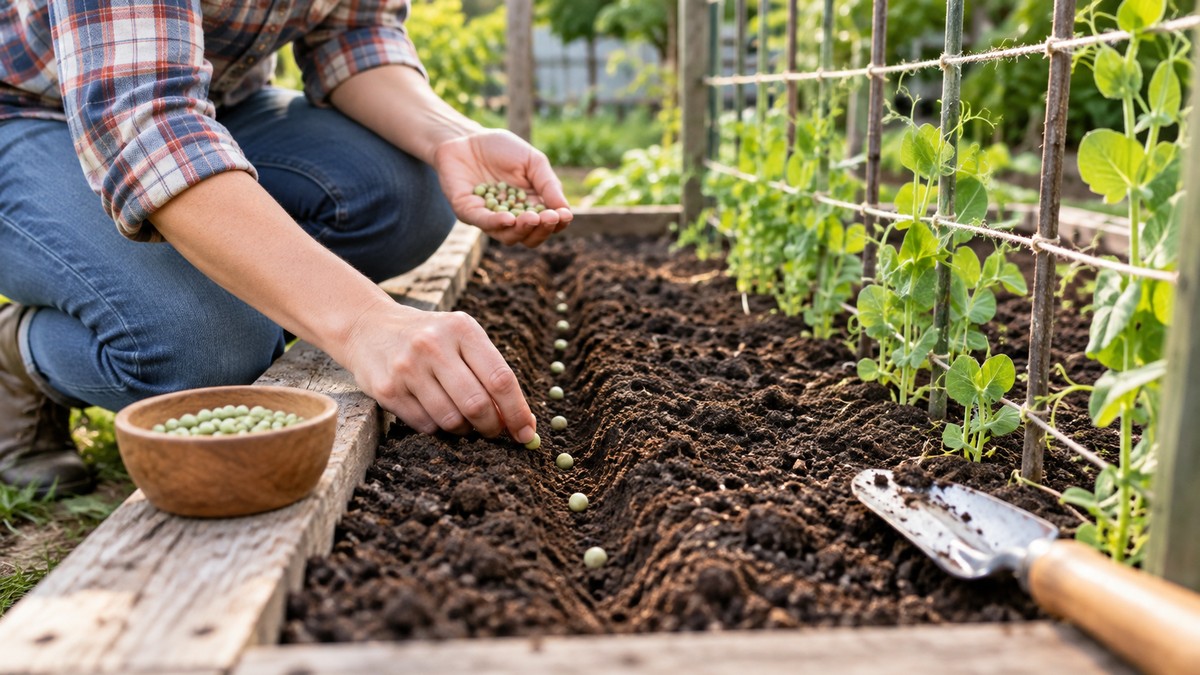
Iowa State describes two row layouts. Peas can go in single or double rows, and double rows should sit about 6 inches apart so that short types can cling to one another. For tall types, Iowa State says to place wire netting or a trellis between the double rows to give support.
Illinois Extension sorts the job by variety. Most dwarf and intermediate types are self-supporting, while the taller types are more productive and easier to pick when trained to poles or a fence. Utah State adds that snap and snow peas climb naturally, so the main job for those types is building the supports rather than training the vines.
Penn State gives the timing for stakes. It says to place them about 3 inches from the seed at planting, and to avoid pushing a support into the bed once the plants are growing, because that can damage the roots. Penn State lists metal, plastic and bamboo stakes as options, and Utah State names wooden poles, wire cages and other fencing as ideal supports.
If the rows will sit in a raised bed, check the bed depth first. See how much soil a raised bed garden needs before you fill it.
Feed, water and weed the bed
Utah State says peas grow in any soil that is rich in organic matter, well drained and fertile. Before planting, it recommends a soil test, and if fertilizer is warranted it advises working it into the top 6 inches of soil. If compost is the choice, Utah State says to apply no more than 1 inch of well-composted organic matter per 100 square feet of garden area.
Extra nitrogen is the usual mistake. Utah State says peas do not need additional fertilizer when fertilizer or compost went in at planting, because more nitrogen over-stimulates leaf growth, delays flowering and reduces pod set. Utah State also notes that peas fix nitrogen from the air through soil bacteria attached to their roots. Illinois Extension adds that when peas go on new land, inoculating the seed with a commercial formulation of nitrogen-fixing bacteria may raise the yield, while an established garden needs it less.
Keep fertilizer away from the seedlings themselves. Illinois Extension warns that germinating seeds and small seedlings are easily injured by direct contact with fertilizer, and it also says to cultivate and hoe shallowly early in growth.
Water is the next job. Utah State says to let the soil dry until half of the available water is used before rewatering to field capacity, and it names the period after flowering as the most critical time for water. Overwatering is a mistake to avoid, since Utah State says wet soil slows plant growth.
Weeding has its own rules. Utah State says to control weeds during the first 6 weeks of growth and to use shallow cultivation, because deeper digging can damage roots and slow growth. Utah State also recommends organic mulches such as grass clippings, straw and shredded newspaper in the heat of summer to control weeds and hold soil moisture. For other vegetables that suit raised beds, see the guide to vegetables to plant in raised beds.
Protect the crop from frost and heat
Illinois Extension calls peas a frost-hardy, cool-season vegetable, but very early sowings can still benefit from cover. Utah State says fabric row covers help protect very early plantings from frosts. The aim is to start early without leaving young plants exposed, rather than waiting for warm weather.
Heat stress shows up in the pods too. Utah State says stringy peas point to heat or water stress, because the fibers in the pods get tougher and make them less palatable. Keep the soil moist during flowering, and plan later sowings so that the flowers do not meet the hottest weather. That last step is an inference from the heat limits in the sources, not a rule any single page states.
Harvest on time and plan the yield
Harvest timing depends on the type. Utah State says snap peas are ready about 5 to 8 days after flowering, and garden peas about 18 to 21 days after flowering. Illinois Extension says snap peas should be picked every one to three days for peak quality, and that snow peas must be picked at least every other day. For garden peas, it recommends picking a few pods every day or two near harvest to find the right stage, because peas are best when fully expanded but still immature.
Utah State expects 2 to 3 pounds of shelled peas per 10 feet of row from garden types. It estimates that one person needs 15 to 20 feet of row for fresh use, with another 40 to 60 feet for canning or freezing. Penn State gives a broader maturity range, with most peas taking 50 to 70 days to harvest, and it advises checking the growing instructions for the specific cultivar.
Fresh peas do not keep long. Illinois Extension says fresh peas keep for 2 to 3 days in the refrigerator, so pick them shortly before you plan to eat or process them. After the crop is finished, Penn State says the plant may be cut down at ground level if it is free of pests, and that the roots should stay in the ground, because peas, like other legumes, fix nitrogen and store it in their roots.
Common mistakes to avoid
- Thinning the row. Utah State says “No thinning is necessary if plant stands are too thick.” Crowded seedlings do not need to be pulled out to make the row work.
- Adding nitrogen to a fertile bed. Extra nitrogen over-stimulates leaves and reduces pod set, according to Utah State.
- Setting stakes late. Penn State says inserting a support while the plants are actively growing may damage the roots.
- Digging deep around the plants. Utah State recommends shallow cultivation to avoid root damage that slows growth.
- Sowing late. Illinois Extension says early plantings normally produce larger yields than later plantings.
How we chose
The five pages in this guide came from university and extension sites, and each one returned HTTP 200 when we opened it with curl on 2026-10-22. We kept figures that a page states in plain words, such as a seed depth, a row spacing or a day count. We left out retail listings, seed catalogs and product pages, and we set aside the pest and spray advice on two of the pages. We did not rank the pages against one another. Where two pages state different figures, both appear in the table, and the text says so.
What we could not verify
The figures in this guide come from general extension pages. The pages do not say which depth gives the best stand in a particular soil, and the guide does not claim that one depth is right. Where a page gives a range, the range appears as written.
What the sources do not say
The pages do not agree on a single depth or spacing, so no one number is correct for every bed. The soaking advice is general, and Penn State says to follow the growing directions on the seed packet or in the seed catalog for the specific pea you grow. The pages give maturity and harvest ranges, not a date for your town. They do not give a trellis height for each variety, and the yield figures come from one state’s guide, which may not match your garden.
Frequently asked questions
How deep should you plant pea seeds?
The pages do not agree on one figure. Iowa State gives 1 to 1½ inches in one answer and 1 inch in another, Utah State gives ½ to 1 inch, Illinois Extension gives 1 to 1½ inches, and Penn State gives 1 to 2 inches. Pick a depth inside that range, and note which page you followed so the rest of the plan matches.
When can you sow peas outdoors?
Illinois Extension says peas may be planted when the soil is at least 45°F and dry enough to till. Iowa State says to plant as soon as the ground can be worked in spring. Utah State says to plant until April 1 in warm areas and until May 1 in its cooler areas, so the last date depends on where you live.
Do pea plants need a trellis?
Not always. Illinois Extension says most dwarf and intermediate varieties are self-supporting. Taller varieties are more productive and easier to pick when trained to poles or a fence, and Utah State says snap and snow peas climb naturally, so they need supports rather than extra training.
Should you soak pea seeds before sowing?
Soaking is optional. Penn State says seed sown without soaking germinates in 6 to 17 days, and that soaking it overnight, but for no more than 24 hours, reduces the germination time. Utah State says seedlings emerge in 7 to 10 days when the soil is between 55 and 65 degrees Fahrenheit.
Do peas need extra fertilizer?
Utah State says no, when fertilizer or compost went in at planting. Too much nitrogen over-stimulates leaves, delays flowering and reduces pod set, so adding more does not help.
Sources
- https://yardandgarden.extension.iastate.edu/faq/how-do-i-plant-peas (opened 2026-10-22)
- https://yardandgarden.extension.iastate.edu/faq/when-should-peas-be-planted-garden (opened 2026-10-22)
- https://extension.usu.edu/yardandgarden/research/peas-in-the-garden.php (opened 2026-10-22)
- https://extension.illinois.edu/gardening/peas (opened 2026-10-22)
- https://extension.psu.edu/a-gardeners-guide-to-peas (opened 2026-10-22)