Best Sprinkler for Lawn
As an Amazon Associate we earn from qualifying purchases. Details
The best sprinkler for lawn is the one whose spray pattern matches the shape you need to cover, and whose output you have measured. This guide compares six lawn sprinklers from six brands, using the titles, bullets and specification rows that Amazon lists for each. Two are oscillating heads, three are impact heads and one is a whirling head. Coverage figures in this group are the listings’ own claims, so the last step is always to measure the water your sprinkler actually puts out.
Quick answer
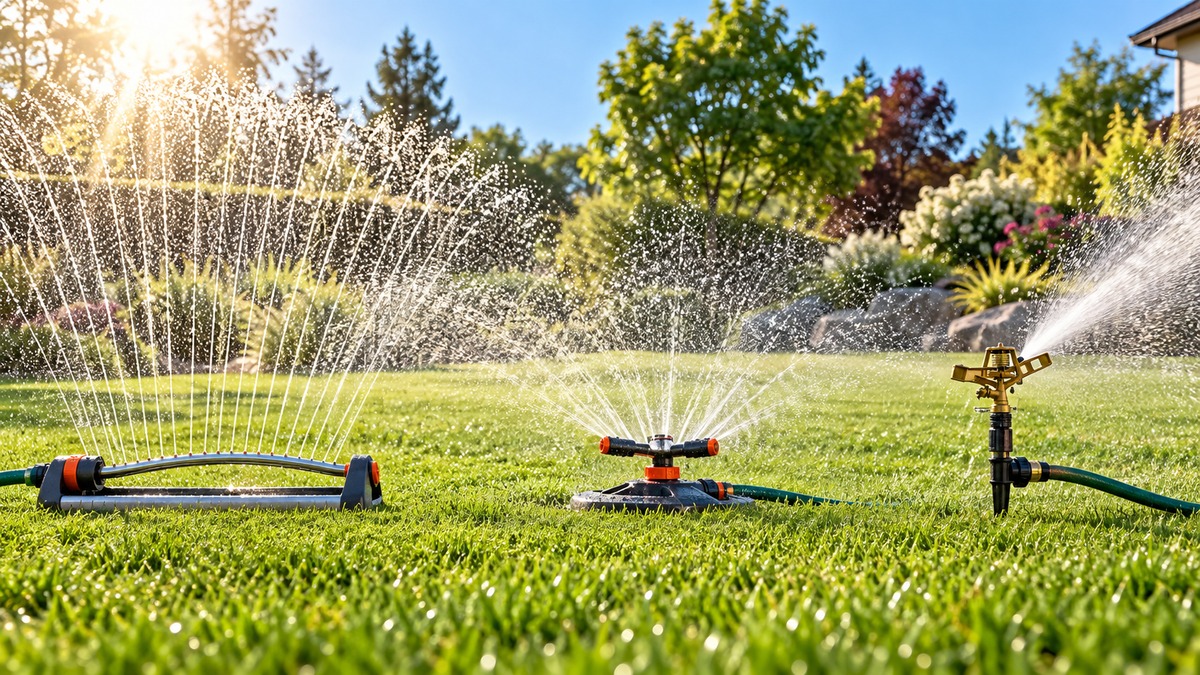
- Match the head to the lawn. The listings call Eden and Melnor oscillating sprinklers, Biswing, LIULO TOOL and FANHAO impact sprinklers, and Amazon Basics a whirling rotating sprinkler, so the spray pattern differs across the group.
- Treat coverage as a claim to check. Listed coverage runs from about 1,500 square feet on the Amazon Basics listing to 5,800 square feet in the FANHAO title, and only some of those figures appear in the bullets.
- Measure before you set the timer. Purdue and UC Agriculture and Natural Resources both describe a container test that turns run time into inches of water per hour.
- Water deeply, not daily. Purdue puts most Indiana lawns at 1 to 1½ inches a week, delivered as one thorough soaking or two applications three to four days apart.
Water use and your lawn
Outdoor watering is a large share of household water use. The archived EPA WaterSense page says that, depending on climate, up to 75 percent of a home’s total water use during the growing season goes outdoors. The share in your yard depends on your climate, your grass and how long the sprinkler runs, so that page gives a scale and not a schedule.
Purdue’s Indiana guide sets a weekly target of 1 to 1½ inches for most lawns, adjusted for weather, soil type and slope. It advises one thorough soaking, or two equal applications three to four days apart, over light watering every day. Daily light watering, the guide adds, leads to shallow roots and encourages crabgrass. Its timing advice is specific too. The ideal window is 4:00 to 8:00 a.m., when water pressure is usually highest and wind and evaporation losses are low. Watering in the early evening can raise the risk of disease.
The UC guide, written for two towns in Inyo and Mono Counties in California, comes at the same problem from another side. Water that goes past a plant’s root zone does the lawn no good, so a schedule only makes sense once you know how many inches per hour your sprinkler puts out. The guide also asks owners to fix leaks and broken sprinkler heads before they start measuring.
UC’s chart also limits how long you should run a sprinkler on a single day, based on how much water the soil can hold in the root zone. Its worked example is a cool-season lawn in June with a sprinkler that outputs 1 inch per hour. The chart turns that into 145 minutes a week, but the example caps any single run at 42 minutes, because a longer run would put down more water than that soil can hold in the root zone. The cap belongs to that soil, so treat it as a method to copy rather than a number to copy.
What the six listings say
Table 1 gathers the numbers each listing gives. Every cell uses the listing’s own words or figures. A blank-looking cell with “Not stated” means the bullets or specification rows we read did not give that figure.
| Listing | Head style (from title) | Coverage (from title or bullets) | Pressure or flow (from specs) | Item weight |
|---|---|---|---|---|
| Amazon Basics Whirling Rotating Lawn Sprinkler | Whirling, rotating | About 1,500 sq ft (bullet) | 60 PSI (bullet) | 1.44 pounds |
| Biswing Large Impact Sprinkler Head on Tripod Base, 2 Pack | Impact, tripod | Up to 90 feet in diameter at MAX (bullet) | 60 psi maximum | 9.7 pounds per set |
| LIULO TOOL Impact Sprinkler on Tripod Base, 2 Pack | Impact, tripod | 20 to 35 ft radius (bullet) | 80 psi maximum; 15 liters per minute flow | 8.18 pounds |
| Eden 96213 Weighted Essential Oscillating Sprinkler | Oscillating | Up to 3,600 sq ft (title and bullet) | 60 psi maximum | 1.3 pounds |
| Melnor MiniMax Spike Sprinkler | Oscillating, spike base | Up to 4,000 sq ft (bullet) | 15 gpm maximum flow | 1.37 pounds |
| FANHAO 100% Metal Impact Lawn Sprinkler | Impact, base | Up to 5,800 sq ft (title only) | Not stated | 1.58 pounds |
Two coverage claims can be compared directly. Dividing Eden’s 3,600 square feet by the Amazon Basics 1,500 gives about 2.4, so the Eden listing claims a little more than twice the area. The Melnor figure of 4,000 square feet is about 11 percent above the Eden figure. Both numbers are the makers’ claims, and neither listing shows how its coverage was worked out.
The FANHAO title gives 5,800 square feet, but the bullets we read do not repeat that number, so treat it as a title claim. The LIULO title says 2 Pack, and its first bullet says the set includes two sprinklers and two tripods, while the specification rows list one item. Check the count on the product page before you order.
Run the same arithmetic on your own lawn. A 2,000 square foot lawn is about 1.3 times the Amazon Basics figure of 1,500, so one whirling head at its listed coverage would fall short, while one Eden or Melnor head at its listed coverage would cover the same lawn on paper.
1. Amazon Basics Whirling Rotating Lawn Sprinkler with Adjustable Arms, 1500 sq ft Coverage, Black (Whirling lawn sprinkler with three adjustable arms)
Specs from the listing (checked ):
- Color: Black
- Item Weight: 1.44 pounds
- Model Number: AMZ622534
- Item Dimensions: 9.4 x 7.52 x 4.07 inches
Pros
- The bullets say three arms adjust from 45 to 90 degrees, with 12 multi-angle nozzles
- The bullets give about 1,500 square feet of coverage under 60 PSI water pressure
- The bullets describe a weighted, stay-in-place base and a 3/4-inch NH thread that fits standard hoses
Cons
- The bullets give a coverage figure but no spray width or flow number beyond it
- The specification rows list the color as Black while the item type name says Green, so check the box
Best for: A small lawn or patch that needs a simple, adjustable whirling spray
Skip if: You need coverage well beyond about 1,500 square feet, or you want a sprinkler with a height-adjustable tripod
View on Amazon (affiliate link)
2. Biswing Large Impact Sprinkler Head on Tripod Base, Adjustable Zinc Alloy Lawn Sprinklers for Yard (Two-pack impact sprinkler on a height-adjustable tripod)
Specs from the listing (checked ):
- Number of Packs: 2
- Maximum Pressure: 60 psi
- Item Weight: 9.7 pounds
- Material Type: Metal
Pros
- The bullets say the tripod extends from 16 to 37 inches and locks with quick release leg clips
- The bullets describe a head that adjusts from partial circles of 20 to 340 degrees to a full circle
- The specification rows list a metal construction and a maximum pressure of 60 psi
Cons
- The bullets give a diameter of up to 90 feet at the MAX setting, not a square-foot coverage figure
- The specification rows list 9.7 pounds per set, which is heavier to move than the plastic heads in this group
Best for: An owner with a large round area who wants a metal head on a tripod and a second unit in the set
Skip if: You need a square-foot coverage figure to plan the lawn, or you want a light sprinkler to move often
View on Amazon (affiliate link)
3. LIULO TOOL Impact Sprinkler on Tripod Base, 2 Pack Tripod Sprinklers with Head, 360 Degree Large (Impact tripod sprinkler with four spray settings)
Specs from the listing (checked ):
- Maximum Pressure: 80 psi
- Maximum Flow Rate: 15 liters per minute
- Item Weight: 8.18 pounds
- Number of Items: 1
Pros
- The bullets say the tripod height adjusts from 16 to 37 inches, with quick release leg clips
- The bullets describe a rubber O-ring filter that sieves out sand and gravel before the nozzle
- The bullets give a 20 to 35 foot radius and say the connector fits standard 3/4-inch hoses
Cons
- The title says 2 Pack, but the specification rows list one item, so confirm the count before you buy
- The specification rows give a flow of 15 liters per minute and an 80 psi maximum, but no square-foot coverage figure
Best for: An owner with an expansive yard that has fences, flowers or vines in the way, as the bullets describe
Skip if: You need a single sprinkler for a small lawn, or you need the count to be exactly one unit
View on Amazon (affiliate link)
4. Eden 96213 Weighted Essential Oscillating Sprinkler | Covers Up to 3,600 sq. ft., 16 Precision (Oscillating sprinkler with sliding range tabs and a quick connect set)
Specs from the listing (checked ):
- Maximum Pressure: 60 psi
- Item Weight: 1.3 pounds
- Unit Count: 16 Count
- Material Type: Plastic
Pros
- The bullets say the sprinkler covers up to 3,600 square feet with 16 precision nozzles
- The bullets describe sliding range tabs for changing the size of the watering area
- The bullets list a quick connect starter set, a weighted base and a built-in nozzle cleaning tool
Cons
- The bullets say the motor is quiet but give no sound level
- The bullets describe range and coverage only, with no width or flow setting
Best for: An owner who wants to change the watering area with sliding range tabs on one weighted head
Skip if: You need a flow setting or a width control, since the bullets describe neither
View on Amazon (affiliate link)
5. Melnor MiniMax Spike Sprinkler, 4000 Sq Ft: 360°, Flow, Width, Range Adjust (Spike-base oscillating sprinkler with four-way adjustment)
Specs from the listing (checked ):
- Maximum Flow Rate: 15 gpm
- Item Weight: 1.37 pounds
- Manufacturer Warranty Description: Limited Lifetime Manufacturer
- Material Type: Plastic
Pros
- The bullets say width, range and flow each adjust, which is the four-way control the title implies
- The bullets describe a metal spike base that inserts into soil to hold the sprinkler in place
- The bullets say the Flo-Thru base lets you link units together for a larger yard
Cons
- The bullets say the sprinkler covers up to 4,000 square feet, a figure the sources we opened do not confirm
- The specification rows give a maximum flow of 15 gpm and no pressure figure
Best for: A lawn that needs wide coverage with a spike base, or a yard that will link more than one unit
Skip if: You want to set the sprinkler on a hard surface, because the base is built around a spike in soil
View on Amazon (affiliate link)
6. FANHAO 100% Metal Impact Lawn Sprinkler for Yard, Covers Up to 5800 sq. Ft | 360° Rotation, Even (All-metal impact sprinkler with a 20 to 360 degree range)
Specs from the listing (checked ):
- Material Type: Metal
- Item Weight: 1.58 pounds
- Style Name: Pulsating
- Inlet Connection Size: 0.75 inches
Pros
- The bullets describe a zinc alloy base and head built to resist rust and corrosion
- The bullets say the coverage angle adjusts from 20 to 360 degrees, with a diffuser pin for spray from mist to jet
- The bullets say it runs on household water pressure without other power equipment
Cons
- The title gives coverage up to 5,800 square feet, but the bullets we read do not state that figure
- The specification rows list a Pulsating style, while a bullet describes rotating arms, so check the mechanism before you buy
Best for: An owner who wants an all-metal impact head on a base that stays put on the lawn
Skip if: You need the 5,800 square foot figure confirmed in the bullets before you buy
View on Amazon (affiliate link)
Three head styles and what each one is for
Oscillating heads. The Eden and Melnor listings both describe oscillating sprinklers, which sweep water back and forth across a set width. The Melnor bullets describe a four-way adjustment for width, range and flow, a metal spike base that inserts into soil, and a flow-through base that links units for a bigger yard. The Eden bullets describe sliding range tabs, a weighted base, a quick-connect starter set and a built-in nozzle cleaning tool. Only the Melnor listing claims a width control, so if width is the setting you need, that is the one to compare.
Impact heads. Biswing, LIULO TOOL and FANHAO are all listed as impact sprinklers. The Biswing bullets give a partial-circle range from 20 to 340 degrees and a diffuser screw that moves the spray from a jet to a fine mist. The LIULO bullets give a tripod height from 16 to 37 inches and four spray settings on the head. The FANHAO bullets give a coverage angle from 20 to 360 degrees and a diffuser pin for the same jet-to-mist range. Two of the three stand on tripods, and the FANHAO head sits on a metal base instead.
Whirling head. The Amazon Basics listing describes three arms with adjustable angles from 45 to 90 degrees and 12 multi-angle nozzles. Its base is plastic with a weighted, stay-in-place design, and it fits a standard garden hose through a 3/4-inch NH thread.
The listings do not describe how any head fits a specific lawn shape, so the rule below is a matching guide and not a product claim. A narrow rectangle is usually easiest to cover with a head that sweeps a set width. A large round zone suits a head that throws water in a circle. A small, open patch can be covered by the whirling head, provided its listed area is larger than the patch.
Before you buy: a short checklist
- Confirm the hose connection. Four of the six listings state a 3/4-inch connection: Amazon Basics, Biswing, LIULO TOOL and FANHAO. The Eden and Melnor data we read do not give one, so check their product pages.
- Compare the coverage claim with your lawn’s area and shape, not with the biggest number in the group.
- Measure the output with containers before you set run times, using the method in the next section.
- Check the count and the color on each page. The LIULO count conflicts with its title, and the Amazon Basics item-type name says green while its color field says black.
How to measure your sprinkler’s output
Before you set a timer, find out how many inches of water the sprinkler puts out per hour. The UC guide and the Purdue guide both describe a container method, and the two can be combined:
- Set several identical straight-sided containers, such as tuna cans, across the area the sprinkler covers. Purdue suggests a grid pattern around the sprinkler, and UC suggests random placement. Use whichever suits the lawn, and keep the containers at the same height.
- Run the sprinkler for a set time. UC uses 20 minutes.
- Pour the water from the containers into one, then measure its depth with a ruler. If the levels differ widely, UC advises improving the spray’s uniformity before you rely on the reading.
- Multiply the depth by 60, divide by the minutes you ran, and the result is inches per hour.
Here is a worked example. Suppose the water in the containers reaches half an inch after 20 minutes. Half an inch times 60, divided by 20, gives 1.5 inches per hour. At that output, one inch of weekly water takes about 40 minutes of run time, and the top of Purdue’s 1 to 1½ inch range takes an hour. Split the total into two runs three or four days apart, as Purdue advises, rather than running the sprinkler every day.
If your sprinkler feeds a raised planter bed rather than a lawn, our sprinkler setup for raised planter beds covers that layout in its own right.
Putting the numbers together
Take the worked example from the measuring section. A sprinkler at 1.5 inches per hour delivers 0.75 inch in half an hour, so two 30-minute runs deliver the full 1.5 inches. That total sits at the top of Purdue’s 1 to 1½ inch range, and each run stays under the 42-minute cap in UC’s example. Space the two runs three or four days apart, as Purdue advises, and keep an eye on the soil. UC ties its cap to soil type, so a yard that drains slowly may need shorter runs than the example.
Mistakes to avoid
- Buying on the biggest square-foot number. Only the Amazon Basics, Eden and Melnor square-foot figures appear in the bullets. The FANHAO figure is in the title alone, and the Biswing figure is a diameter, not an area.
- Running a sprinkler without measuring it. Both the Purdue and UC guides describe the container method, and the listing claims are not a substitute for it.
- Watering every day in short bursts. Purdue links daily light watering to shallow roots and crabgrass.
- Watering in the early evening. Purdue notes that this timing can raise the chance of disease.
- Skipping leaks and broken heads. UC advises fixing them before you start measuring, because a leaking head changes the reading.
- Assuming your tap matches the listed pressure. Purdue names low water pressure on municipal systems as a common problem, and the pressures in the table (60 psi and 80 psi) are the listings’ figures, not a reading from your home.
Hose fittings can be a source of leaks as well, so if the nozzle end is the problem, our hose nozzle for watering plants guide covers that part of the setup.
How we chose
We searched Amazon.com for best sprinkler for lawn in Chrome on 21 October 2026 and read the first results page. We dropped a soaker hose and a drip irrigation item, and kept only sprinkler heads meant for a lawn. From those, we kept one listing per brand and aimed for a spread of head styles. The final set is two oscillating heads, three impact heads and one whirling head, from six brands.
We read each listing’s title, its first five or six bullets, and its specification rows. Chrome gave us titles and bullets only, so this guide does not use prices, ratings, sales ranks or availability. The same results page showed second listings from Biswing, Eden and Melnor, and we did not open them.
What we could not verify
- Whether any listed coverage figure matches what a sprinkler delivers on your lawn. The sources we opened do not confirm a figure for any listing.
- The pressure and flow your home supplies. The listings give 60 psi, 80 psi and 15 gpm, and the sources we opened do not say what a given tap delivers.
- How evenly each head spreads water across its stated area. The bullets describe range and width controls, and none of them describes a spray map.
- The unit count for LIULO and the color and item-type conflict on the Amazon Basics page. The specification rows disagree with the titles or bullets, and we did not resolve those differences.
- Durability claims, such as the rust resistance of zinc alloy and brass, because we did not find an outside source for those claims.
- Anything below the first five or six bullets of each listing.
- Whether the Indiana and California figures in this guide apply to your region. Purdue and UC give their own climate and soil context, and we did not open a source for other states.
FAQ
Is an oscillating sprinkler better than an impact sprinkler?
Neither type is better in general, and the listings do not compare them with each other. The choice depends on the shape of the area you need to cover. An oscillating head suits a set width, and an impact head on a tripod suits a larger round zone with fences, flowers or vines in the way, as the LIULO bullets describe. Compare each listing’s coverage claim with your lawn, then measure the real output before you decide.
How long should I run a sprinkler?
Run it long enough to deliver the weekly amount you need. Purdue puts most Indiana lawns at 1 to 1½ inches a week. Find the run time by dividing that amount by your sprinkler’s measured inches per hour, then multiply the result by 60 to get minutes. Once you have the total, use one soaking or two runs spaced a few days apart.
How often should I water a lawn with these sprinklers?
Purdue’s frequency advice is to water only when the turf needs it, and to water infrequently but deeply. Its standard example is one thorough soaking, or two equal applications three to four days apart. The guide ties the exact interval to weather, soil and slope, so no listing or guide can give you one fixed number of days.
Can a whirling or impact sprinkler work with low water pressure?
The listings give pressure as a figure for the product, not as a promise for your tap. Purdue names low pressure on municipal water systems as a common lawn problem. Because the container method measures what the sprinkler actually delivers, it is the best check on whether your pressure is enough for the coverage you need.
Does the 1,500 square foot figure on the Amazon Basics listing hold for every lawn?
No source we opened confirms it. The bullets describe approximately 1500 square feet of coverage under 60 PSI, and that is a listing claim. Measure the output at your tap, and check the shape of the area against the head’s spray pattern before you rely on the figure.
Bottom line
Choose the head whose pattern fits the shape of your lawn, then measure its output in inches per hour before you set the timer. Water deeply rather than daily, and treat every listed coverage figure as the maker’s claim until you have checked it on your own grass.
Sources
- Purdue University Extension (Indiana), AY-7-W lawn watering guide: https://www.extension.purdue.edu/extmedia/ay/ay-7-w.pdf
- UC Agriculture and Natural Resources, Inyo and Mono Counties Cooperative Extension, Two-Day a Week Lawn Watering Guide: https://oc4h.ucanr.edu/sites/default/files/2020-01/318747.pdf
- EPA WaterSense, Water Efficiency For Residents (archived 2017 snapshot): https://19january2017snapshot.epa.gov/www3/watersense/pubs/res.html