Waist High Raised Garden Bed DIY: Height, Width and Soil
As an Amazon Associate we earn from qualifying purchases. Details
Updated 19 October 2026 | Author: Editorial team, homelycapers.com
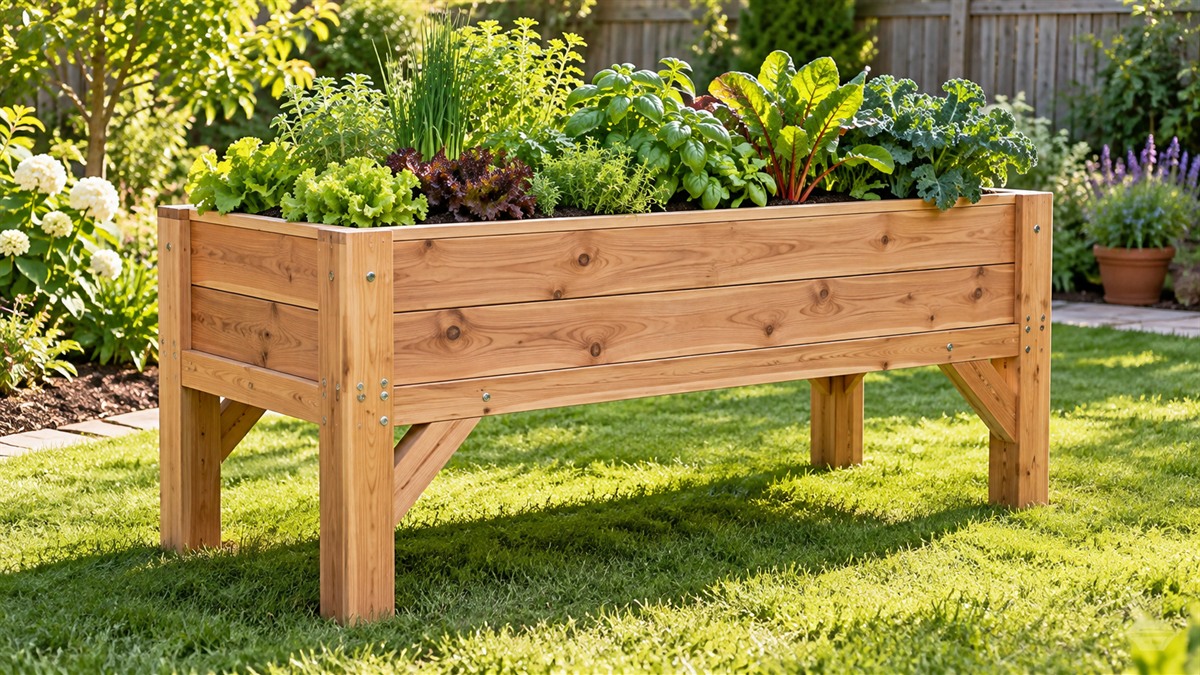
A waist high raised garden bed DIY build is a practical answer for gardeners who find ground-level beds hard on the back, knees or reach. The extension sources we downloaded give specific heights and widths, and they differ a little depending on whether the gardener stands or uses a wheelchair. This guide sets out those figures, the reason the width matters as much as the height, and the soil volume a taller bed needs. It also notes which numbers the sources leave open, such as a material list.
Quick answer
- Aim for about 3 feet for a standing gardener. Oregon State University Extension says “Easy access raised beds are 3 feet or more in height.”
- Use 24 inches for wheelchair access. Illinois Extension says “If constructing a raised bed with wheelchair access, they should be 24 inches tall.”
- Keep the width to 4 feet or less. Illinois Extension says beds accessed on all sides should be no wider than 4 feet, and no wider than 2 feet if only one side is reachable.
- Plan the soil by volume. A 4 by 8 foot bed at 3 feet deep holds 4 × 8 × 3 = 96 cubic feet, which is about 3.6 cubic yards.
Why height and width go together
Height is only half of the design. The Oregon State guide says that the work surface of a standing gardener should be no lower than the fingertips, which is why a bed can be tall enough to avoid stooping. That is the reason for the 3-foot figure. A bed that is too tall for the gardener’s reach is no better than one that is too low, so the target is the height at which the work surface meets the hands.
Width sets the reach. Illinois Extension says that a raised bed should be no wider than 4 feet if it can be accessed on all sides, and that if it can be reached from only one side, it should be no wider than 2 feet “to ensure one is able to reach everything in the bed without stepping on the soil.” A bed you can reach from all sides should be no wider than 4 feet, and a bed you reach from one side should be narrow enough to reach across. The width limit is the rule that keeps the bed usable, and it matters as much as the height.
The Oregon State guide gives the same width limit from a different angle. It says the width should be no more than 4 feet for adults and 3 feet for children. A family bed for children should be narrower than an adult bed, and the sources give that figure directly.
Choosing a height for your gardener
The sources give different heights for different users, and the table below sets them side by side. The right number depends on how the gardener stands, sits, or uses a wheelchair, so measure the gardener rather than choosing from a catalog.
| User or purpose | Height the source gives | Source |
|---|---|---|
| Typical raised bed | 6 to 12 inches, can be taller | Illinois Extension |
| Standing gardener, easy access | 3 feet or more | Oregon State University Extension |
| Seated gardener in a wheelchair | 24 inches (Illinois); about 2 feet, or 3 feet on legs (Oregon State) | Illinois Extension; Oregon State University Extension |
The Oregon State guide describes the seated case in two ways. It says raised beds for seated gardeners who use wheelchairs tend to be about 2 feet high, or elevated to 3 feet on legs. The Illinois figure of 24 inches for wheelchair access matches the lower end of that range. For a standing gardener the Oregon State figure of 3 feet or more is the easy-access target, and the work surface should sit no lower than the fingertips.
The Iowa State guide describes a related option for mobility needs. It says that accessibility “can be improved by building the wall with a wide ledge so people can garden from a seated position on the wall.” That ledge is an add-on to the frame, not a height, and it gives a seated gardener a place to sit beside the bed. Plan the ledge into the wall from the start rather than adding it afterward.
Soil volume for a taller bed
Taller beds need more soil, and the arithmetic is the same as for any raised bed. Multiply the length, the width and the depth in feet, then divide by 27 to get cubic yards. Each height in the table below uses a 4 by 8 foot bed, which is the width and length the sources allow.
| Height | Depth in feet | Soil volume (4 × 8 × depth) | Cubic yards (volume ÷ 27) |
|---|---|---|---|
| 24 inches | 2 | 4 × 8 × 2 = 64 cubic feet | 64 ÷ 27 = 2.4 cubic yards |
| 30 inches | 2.5 | 4 × 8 × 2.5 = 80 cubic feet | 80 ÷ 27 = 3.0 cubic yards |
| 36 inches | 3 | 4 × 8 × 3 = 96 cubic feet | 96 ÷ 27 = 3.6 cubic yards |
The heights are the ones the sources name: 24 inches for wheelchair access and 3 feet for easy standing access. The 30-inch row is an in-between height we chose to show the scale, and it is our calculation rather than a source figure. The volumes are straight arithmetic on the bed size, and they do not include settling. Plan for a little extra soil, and check the depth after the first watering.
The cost of height is the soil. A 3-foot bed holds 96 cubic feet, which is one and a half times the volume of a 24-inch bed on the same footprint. The sources do not give a price, and this guide does not give one.
Checking the reach before you build
Stand where the gardener will stand, and check that the far edge of the bed can be reached without stepping on the soil. Illinois Extension’s width rule is meant for exactly that check, since a bed reached from one side should be no wider than 2 feet to let the gardener reach everything in it.
A narrower bed also saves soil. A 2-foot-wide, 8-foot-long bed at 24 inches holds 2 x 8 x 2 = 32 cubic feet, which is 32 ÷ 27 = 1.2 cubic yards. The 4-foot-wide bed at the same height needs 2.4 cubic yards, as the table above shows, so the width choice halves the soil you need.
Building with the reach in mind
Build the frame so the top edge is at the height you chose, and keep the walls firm enough to hold the soil and to lean on. The Iowa State guide gives a basic rule for raised bed frames: choose a level site, and set the wall materials so the top is level. A bed at waist height that is out of level is harder to work, so check each side with a level as you build.
The sources do not give a material list for a waist-high frame. Taller walls carry more soil, so choose materials that suit the load, and check the frame after the first filling. If you add a ledge for a seated gardener, plan its width and its support before you build the walls.
How we chose
We chose the three sources that give the height and width figures for accessible beds: Oregon State University Extension’s EM 9403 on gardens for everyone, Illinois Extension’s raised bed news release, and Iowa State University Extension’s guide to creating raised bed planters. Each one gives a height, a width or an accessibility feature. We did not include product listings or kit comparisons, because the question is about the bed dimensions. Where the sources give a range, we show the range, and where a number is our calculation, we label it.
What we could not verify
The sources do not give one height for every gardener, and they do not give a height for a child’s bed beyond the width figure. The Iowa State and Oregon State guides do not give a material list or a frame design for a waist-high bed. The sources do not say how much a taller bed costs in soil or lumber, and this guide does not estimate it. The 30-inch row in the soil table is our example, not a source figure. The sources also do not say how to reach the middle of a bed from a wheelchair if the bed is wider than the reach limit, beyond the width rules above.
Who the bed helps and where it sits
Oregon State says that “Gardeners who use walking aides or wheelchairs or have difficulty kneeling or bending find raised beds beneficial.” That covers more than wheelchair users, which is worth remembering when you plan a bed for a family or a neighbor. The height and width figures in this guide apply to all of them, but the reach each person needs is different, so measure the reach before you set the top edge.
Placement matters as much as height for mobility. The same Oregon State guide says that smooth, level pathways give better access for people who use wheelchairs or scooters, and it adds that compacted gravel can also be used for paths. A bed at waist height is only as useful as the route to it, so plan a firm, level path before you set the frame.
Use the width limits to plan the route as well. Illinois Extension says a bed no wider than 4 feet can be accessed on all sides, and a bed reached from one side should be no wider than 2 feet. A bed you can reach from all sides should be no wider than 4 feet, while a bed you reach from one side should be no wider than 2 feet, so that you can reach everything without stepping on the soil.
FAQ
How tall should a waist high raised garden bed be?
Oregon State says easy access raised beds are 3 feet or more in height for a standing gardener. Illinois Extension says 24 inches for wheelchair access, and Oregon State says seated gardeners tend to use about 2 feet or 3 feet on legs.
How wide should a raised bed be for easy reach?
Illinois Extension says no wider than 4 feet if you can reach it from all sides, and no wider than 2 feet if only one side is reachable. Oregon State gives 4 feet for adults and 3 feet for children.
How much soil does a 3-foot raised bed need?
For a 4 by 8 foot bed at 3 feet deep, the volume is 4 × 8 × 3 = 96 cubic feet, or 96 ÷ 27 = 3.6 cubic yards. Add some extra for settling.
Should I add a ledge for a seated gardener?
Iowa State says a wide ledge on the wall lets people garden from a seated position. Plan the ledge into the frame so it can carry weight, and check the frame is level.
Is a 24-inch bed too low for a standing gardener?
Oregon State says easy access beds for a standing gardener are 3 feet or more, and that the work surface should be no lower than the fingertips. A 24-inch bed suits a seated gardener better than a standing one.
Related reading
For how a raised bed’s soil and volume work out for ordinary beds, see our guide to how much soil a raised bed garden needs. For bed materials that look good at a taller height, see our galvanized raised garden bed comparison.
Bottom line
For a standing gardener, build a waist high raised garden bed DIY at about 3 feet, keep the width at 4 feet or less, and plan the soil by volume. For a seated gardener, 24 inches is the Illinois figure, and about 2 feet or 3 feet on legs is the Oregon State range.
Sources
- Oregon State University Extension, EM 9403, “Gardens Are for Everyone”: easy access beds of 3 feet or more, the fingertip work surface, the 4-foot and 3-foot width limits, and the seated wheelchair heights.
- Illinois Extension, “Elevate your expectations with raised bed gardening” (news release): typical bed height, 24 inches for wheelchair access, and the width limits for one-sided and all-sides reach.
- Iowa State University Extension and Outreach, “Creating Raised Bed Planters”: the level top of the wall and the seated ledge for accessibility.