How Deep to Plant Tomato Seedlings
As an Amazon Associate we earn from qualifying purchases.
Knowing how deep to plant tomato seedlings matters because a tomato stem can make roots, and the depth you choose shapes the plant that follows. Several extension guides describe setting a sturdy seedling at about the level it grew in its pot, with the root ball fully covered. A leggy seedling is handled differently. It can be buried deeper or laid in a shallow trench. This guide sets out what each source says, where the sources differ, and the timing that comes first.
Quick answer
- For a stocky seedling, set it at the same level it grew in its container and cover the root ball. The New Hampshire guide describes that method.
- For a leggy seedling, bury more of the stem or lay it in a trench. South Dakota State describes both steps for transplants that have grown too tall.
- Wait until the frost danger has passed and the soil has warmed. Two guides put the soil threshold at about 60°F.
- Plant in the evening or on a cloudy day, and water the transplant in well.
Start with a stocky seedling
Depth is a decision you make only after the seedling is ready. Penn State Extension describes the target plant this way: “Whether started from seed at home or purchased from a nursery, tomato transplants should be short and stocky with stems about the width of a pencil.” Oklahoma State gives a size target for a home-grown plant: “The ideal tomato plant should be six to eight inches tall and dark green, with a stocky stem and well-developed root system.”
When you buy plants, the New Hampshire guide gives a parallel rule: “When purchasing tomato seedlings, select stocky plants with thick, straight stems and bright green leaves.” The same guide says that the ideal transplant is “less than six inches tall,” which points the other way from Oklahoma State’s six to eight inches. The two numbers are close enough that both can be useful, but the sources do not give a single height that fits every variety. Check the plant itself, not only the label.
Two of the opened guides place hardening off before planting. Penn State says to prepare the seedlings “for the rigors of the outdoors by hardening off over the course of a week”. New Hampshire puts the same step in more detail: “About ten days before transplanting, set plants outdoors for a few hours each day to acclimate them gradually to outdoor conditions.” The gap between a week and ten days is small, and the practical point is the same. Move the seedlings outside in short sessions, then increase the time.
Planting at the same level
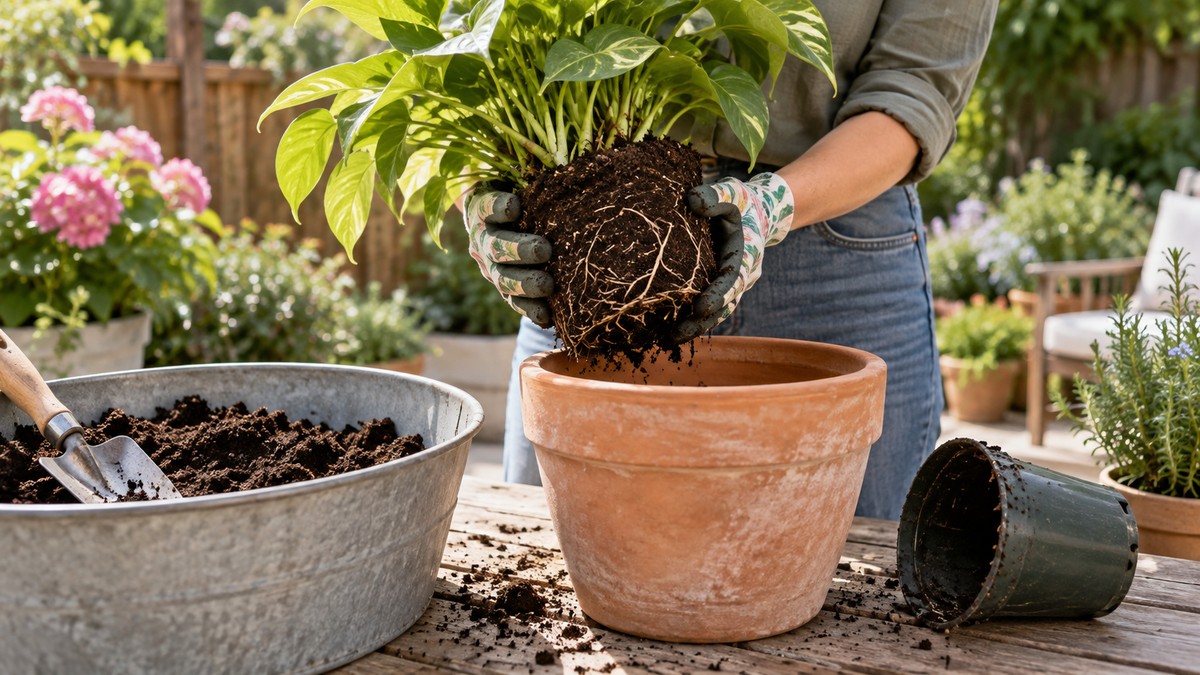
For a stocky seedling, the usual method is to plant at the depth it grew. The New Hampshire guide describes the hole: “Use a trowel to dig a hole about twice the size of the tomato seedling and its root ball; set the seedling into the ground at the same level as it grew in its container.” It adds: “Make sure to cover the root ball entirely.” That instruction is about the root ball, which has to sit fully below the soil surface. The method sets the stem at its original level, and the leggy method below is the exception.
Oklahoma State takes a slightly deeper line for transplants: “Set the plants slightly deeper than they originally grew so lower leaves are close to the ground.” That is a small change in practice, and it puts a little more stem below the surface. Oklahoma State also says: “Pack the soil loosely around the plant.” On pots, it notes that “Peat pots can remain” at planting, after the other pots or bands are removed.
The sources do not all describe the same depth. The simplest way to read them is that the same-level method suits a plant that already has a sturdy stem, and the deeper methods suit a plant that has grown too tall for its pot. The guides do not put a number on the difference for every variety, so use the stem and root ball as your guide.
Burying leggy stems and trench planting
Leggy seedlings are tall and thin because they stretched for light indoors. Tomatoes handle that well because they root from the stem. Penn State Extension says: “Tomatoes are unique in that any portion of the stem that touches the ground can root.” It also says: “If planted deeply, their root structure will increase.” The deep method therefore gives the plant more roots.
Penn State gives a concrete depth for the deep method: “Remove the lower leaves and plant 5-6 inches deep.” The lower leaves come off first. Penn State also describes horizontal or trench planting, which places the roots and lower stem in a trench a few inches deep. Its reason is that “Horizontal or trench planting is a technique that takes advantage of higher soil temperatures near the surface.” It adds: “This is a good planting method if your plants are leggy.”
South Dakota State describes the same idea in a different way. It says: “If the plants get too tall (leggy) before planting, lay them slanted along a five-to-six-inch deep furrow, cover half to three fourths of the stem with soil, and leave the top of the plant exposed.” Its reason for that step is direct: “The plants will root all along the stem.” Oklahoma State gives the same method for the case where a leggy plant is the only option: “If only leggy plants are available, lay them down in a trench long enough to leave only the top six inches of the plant exposed”.
The trench methods differ on how much of the plant stays above the soil. South Dakota State says to leave the top exposed, while Oklahoma State names the top six inches as the part to leave exposed. The choice comes down to how much stem you bury and how much stays above the soil, as both sources describe.
Holes, spacing and watering in
Once the depth is set, the hole and the first watering matter. Oklahoma State’s transplant instruction is: “Make the transplant holes three to four inches deep and two to four feet apart in the row.” Its guide then says: “Before planting, fill the transplant holes with water and let it soak in.” The hole depth in that line is a different measure from the planting depth in the Penn State method, so the sources do not give one number that covers every case.
Spacing figures differ by source. Utah State says: “Transplants should be planted 2 feet apart”. Oklahoma State gives a range of two to four feet for holes in the row, and says: “Space rows at least three feet apart for staked or caged plants.” The sources do not explain the difference, so choose the spacing that fits your support and your bed.
Watering the transplant in is the last step at planting. New Hampshire says the aim is to reduce transplant shock: “To reduce transplant shock and hasten establishment of seedlings, irrigate the newly-set transplant well”. Oklahoma State’s rule is simple: “Before planting, fill the transplant holes with water and let it soak in.”
If you plant into a raised bed, the depth you choose has to fit the soil you have. Our guide to vegetables to grow in raised beds covers which crops suit that setting, and our note on how much soil a raised bed needs explains how deep the soil should be before planting.
Timing: frost and warm soil
Depth does not help if the seedling goes out too early. New Hampshire says: “Wait until danger of frost has passed and soil temperatures have warmed to about 60°F before setting tomatoes into the garden.” Utah State gives the same threshold in different words: “Tomatoes should be transplanted when soils are warmer than 60°F or after all frost danger has past.” The two guides agree, which makes about 60°F a useful soil figure to aim for.
Time of day matters too. Penn State says: “It’s best to plant in the evening or on a cloudy day.” Oklahoma State gives the reason in its own words: “Set out tomato plants in the evening or on a cloudy day to keep the plants from wilting and getting too dry.”
Mistakes to avoid
- Planting a very leggy seedling at normal depth and leaving most of the stem above ground. Penn State and South Dakota State both describe burying stems so they can root.
- Setting plants out before the soil warms. New Hampshire puts the threshold at about 60°F.
- Skipping hardening off. Penn State says to harden off “over the course of a week,” and New Hampshire says about ten days.
- Leaving the transplant dry after planting. Oklahoma State says to fill the holes with water before planting and let it soak in.
How we chose
We opened five extension pages on tomato planting with curl on 2026-10-22. The sections we kept address transplant depth, stem handling, the size of the hole, spacing, timing and hardening off. A quoted sentence was used only when it matched the fetched text word for word. Pages that returned HTTP 403 were left out, and no product is recommended in this guide.
What we could not verify
The sources do not give one planting depth for every tomato. Penn State gives a deep planting depth of 5 to 6 inches after the lower leaves are removed, while New Hampshire says to plant at the same level as the container. None of the opened pages measures which depth gives the best yield in a given soil. The advice in these pages is written for home gardens, and none of them gives a planting depth for a specific variety.
What the sources do not say
The opened pages do not give a depth rule for tomatoes grown in containers, and they do not say how deep to plant in heavy clay compared with loose loam. They do not explain how much the planting depth changes the final size of the plant. Utah State gives a seed depth for direct sowing, but that is a different step from transplanting seedlings, and the sources do not say whether the seed depth carries over to transplants. Read each page as the method it describes.
Frequently asked questions
Should you bury tomato seedlings deeper than they grew?
Only when the seedling is leggy. Penn State says that any stem touching the ground can root, and South Dakota State says buried stems “will root all along the stem.” New Hampshire describes planting a stocky seedling at the same level it grew in its container.
How deep should you plant a tomato seed?
Utah State’s advice for seed is: “Plant 4-6 seeds ½ inch deep, and 18 inches apart in the row.” That is for sowing seed in the garden, which is a separate step from transplanting a seedling. Thin the seedlings after they have two leaves, as the same guide describes.
Can you plant tomato seedlings in the afternoon?
The guides recommend the evening or a cloudy day. Oklahoma State says that planting then keeps the plants “from wilting and getting too dry.” They do not say that planting in the afternoon will harm the plant, but they do describe the evening and cloudy-day window as the better choice.
How long should seedlings be hardened off?
Penn State says to harden off “over the course of a week,” while New Hampshire says to set plants outdoors for a few hours each day for about ten days before transplanting. The two are close. Start with short sessions in filtered light, and increase the time gradually.
How can you tell a seedling is ready to plant?
Look for a stocky stem and dark green leaves. New Hampshire describes a good transplant as “less than six inches tall,” and Oklahoma State describes the ideal as six to eight inches tall with a well-developed root system. Penn State adds that the stem should be about the width of a pencil. Use those features together rather than relying on one number.
Sources
- https://extension.psu.edu/tomatoes-from-seedlings-to-fruit (opened 2026-10-22)
- https://extension.sdstate.edu/tomato-how-grow-it (opened 2026-10-22)
- https://extension.usu.edu/yardandgarden/research/tomatoes-in-the-garden (opened 2026-10-22)
- https://extension.unh.edu/resource/growing-vegetables-tomatoes-fact-sheet-1 (opened 2026-10-22)
- https://extension.okstate.edu/fact-sheets/growing-tomatoes-in-the-home-garden-2 (opened 2026-10-22)