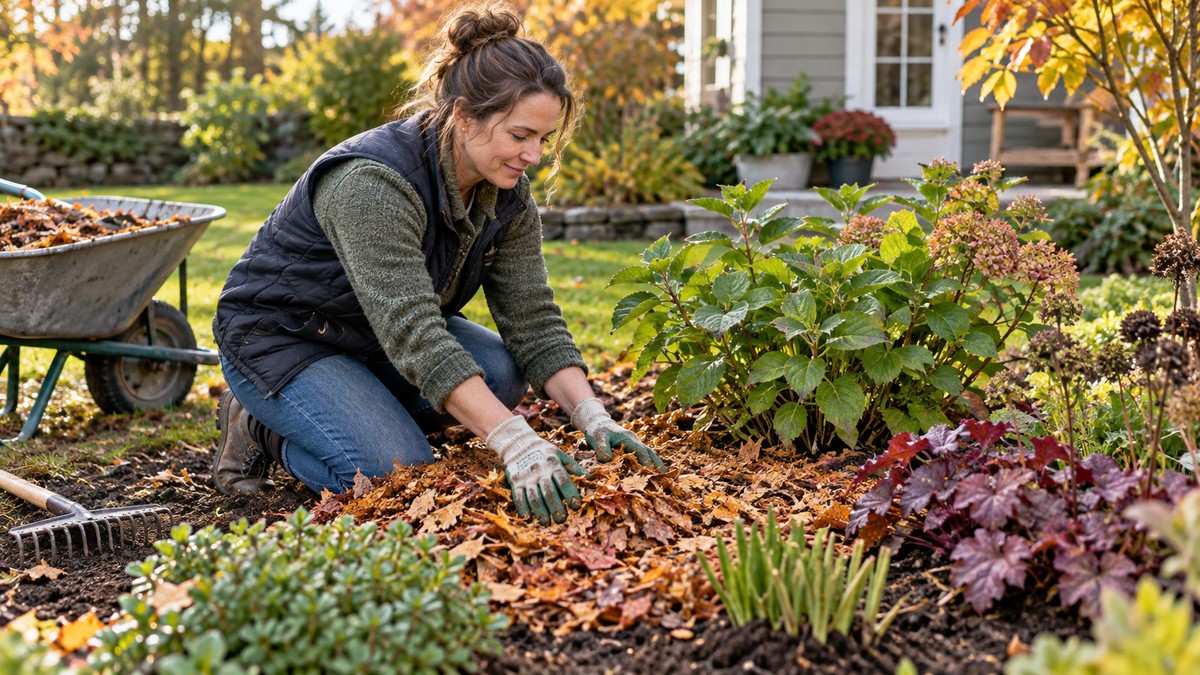
How to Use Leaf Mulch in the Garden
As an Amazon Associate we earn from qualifying purchases.
If you are wondering how to leaf mulch your beds, the extension sources agree on the core steps. Shred the leaves so they stay put, spread them about 2 to 4 inches deep around shrubs, trees and perennial beds, and water the layer in. Whole leaves can also be piled to make leaf mold, a slower route that Penn State Extension describes as similar to compost. The depth figures differ a little between sources, so this guide shows each one.
Quick answer
- Shred fall leaves before you use them as mulch, because shredded leaves mat down less and decay faster.
- Spread shredded leaves about 2 to 4 inches deep, and use the table below to pick the figure for your bed.
- Water the layer after you spread it, so it stays in place.
- Pile whole leaves for leaf mold if you have room, and keep them off an existing layer of fallen leaves in a wooded area.
Why leaves make a good mulch
Penn State Extension treats fallen leaves as a resource. Its article says: “Fallen leaves are a tremendous resource for the gardener, not something to be discarded or hauled off.” It adds that “With just a little effort, they can be turned into an excellent and free mulch for every part of your landscape.” The same article points out the cost of the usual alternative: leaves go to the curb in the fall, and bags of mulch or compost are bought in the spring.
The University of Delaware’s leaf factsheet lists what a shredded layer does. “Shredded leaf litter makes fantastic natural mulch that will suppress weeds, regulate soil temperature, conserve moisture, reduce soil erosion and compaction, and decompose over time to provide nutrients.” It also lists a practical benefit: “Reduces waste going to landfills.” The University of Maryland Extension page on mulching trees and shrubs says the same thing for shredded leaves: “Leaves make excellent mulch, especially when shredded.”
Illinois Extension notes that leaves work in more than one place. “Leaves can be used as a mulch in vegetable gardens, flower beds and around shrubs and trees.” The Illinois article was published on October 6, 2014, and the Delaware factsheet was reviewed in March 2025.
Shred first, because shredding changes how leaves behave
The leaf-specific sources all start with shredding. Penn State says: “Shredded leaves decay much more quickly than whole leaves.” Illinois Extension says shredded leaves “will decompose faster and are much more likely to remain in place than unshredded leaves.” Penn State adds a point about the layer itself: “Because they are shredded, they tend to mat down less than whole leaves; and watering the leaf mulch after application will also help it to stay in place.”
Delaware gives a threshold for when to act. “If your leaf layer is greater than one inch, recycle using one of the methods below.” The methods there are shredding the leaves for mulch, tilling them into the soil, or composting them.
Choose a depth for the bed
Depth is where the sources differ most. Delaware gives separate figures for two kinds of bed: “For best results, add 3-4 inches of leaf litter mulch around shrubs or trees and 2-3 inches over perennial beds.” Penn State gives one range for both: “Shredded leaves can also be applied as a 2 to 4-inch-thick layer of mulch around trees and shrubs or on perennial beds.” The table puts the two side by side.
| Location | Penn State Extension | University of Delaware Extension |
|---|---|---|
| Around shrubs and trees | 2 to 4 inches | 3 to 4 inches |
| Perennial beds | 2 to 4 inches | 2 to 3 inches |
A 3-inch layer falls inside both sources’ ranges for each location. A thicker layer goes past both ranges. The Illinois Extension tree-care sheet, which covers mulch in general, warns that “Thick layers of mulch can become matted, reducing water and oxygen penetration.” The Iowa State FAQ on mulch depth adds that “An excessively deep layer of mulch may result in water logging of heavy soils and may interfere with the movement of oxygen into the soil.” Heavy soil is the case where the depth limit matters most.
Spread the leaves, then water them in
Once the depth is set, spread the shredded leaves evenly over the bed. Penn State says the layer “will help to moderate soil temperatures, retain soil moisture, and keep down weeds.” The same article says the soil surface stays easier to work, so weeds that do come up are simpler to pull. Watering after application is the step that keeps the layer in place, as noted above.
Make leaf mold from whole leaves
Whole leaves have a different job. Penn State says: “To make leaf mold, form a pile of leaves, pack them down, water them, and wait a couple of years.” For a neater pile, it describes a container: “Although not essential, a wood or wire bin, 3 to 6 feet in diameter and at least 3 feet in height, helps keep the leaves contained.” For a small yard, the article offers a smaller option: “Fill the bag or can with leaves, moisten the leaves, close it up loosely (allow some airflow), and let it sit.”
Leaf mold is not the same as the shredded mulch. Penn State explains that “Essentially decayed leaves, leaf mold is similar to compost; it is dark brown in color, with a pleasant earthy smell and a crumbly texture.” It adds that “Although it is not high in nutrients, it is an excellent soil amendment that improves the structure of the soil, increases soil water retention”. Its uses are flexible: “It can also be used as mulch or added to potting soil.” The article also says that “And unlike compost or manure, leaf mold is mostly weed-free.”
The wait can be shorter. Penn State says that “You can speed up the decay process from years to 6 to 12 months by shredding the leaves, turning the pile occasionally, adding water occasionally, or covering the pile with a tarp, but it will happen eventually, even if you do nothing.” Shredding is therefore the one step that helps both routes, which is why it appears at the top of this guide.
Stockpile and compost the extra leaves
A full autumn can produce more leaves than a bin can hold. Penn State says: “If you have a compost bin, you may have too many leaves in the fall to fit in the bin, so stockpiling those leaves in a separate pile is a good way to save this valuable resource.” The same article describes using the stockpile later: in spring and summer, some of it goes into the compost bin as the brown material that layers with fresh green material, and the rest slowly becomes leaf mold.
Delaware’s factsheet covers the compost route. “Leaf litter makes fabulously rich compost.” Its tip matches the shredding advice: “For quickest results, shred the leaves first and turn the pile often.” If you want the full compost setup, see how to make a compost pile. The Delaware factsheet points to its own yard waste and composting publication for more detail.
Leave some leaves for wildlife
A full clean-up can remove more habitat than a yard needs to lose. Penn State notes that “There are many small insects and animals, including firefly larvae, overwintering insects, reptiles, amphibians, birds, and small mammals, that make use of that leaf layer for shelter, habitat, food, and protection.” It warns that “Dumping more leaves can disturb or disrupt the natural depth (6 to 12 inches) at which they survive.”
The same article gives a plain rule for wooded ground: “if you have a wooded area that already has a layer of fallen leaves, do not pile more leaves on top of that.” In a yard with woods or a natural leaf layer, Penn State’s advice implies leaving the existing layer alone, and using the leaves that fall on the beds for mulch or leaf mold.
Till leaves into vegetable beds
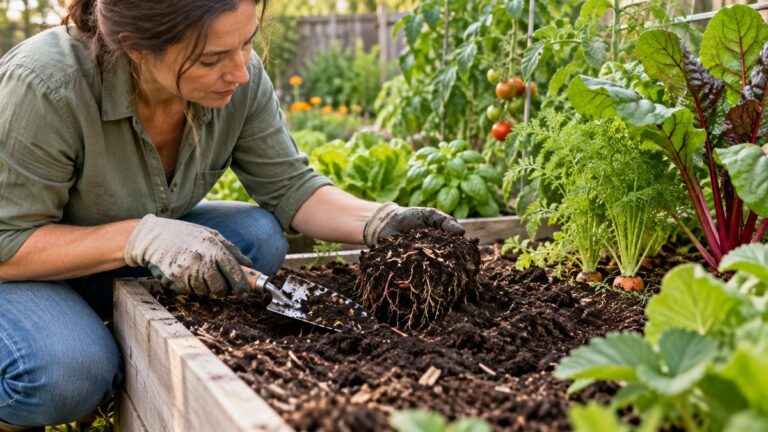
Vegetable and annual beds use a different method. Delaware says: “You can also spread them over annual and vegetable beds and till them in prior to planting in the spring.” It describes the same idea for fall planting beds: “In addition to using shredded leaves as mulch, you can spread them over fall planting beds and till them in to the soil, improving drainage as well as adding nutrients.”
Illinois Extension gives the amount and the soil effect. “A 6 to 8 inch layer of leaves tilled into a heavy, clay soil will improve aeration and drainage.” For a different soil, the same article says: “The same amount tilled into a light, sandy soil, will improve water and nutrient holding capacity.” Tilling is therefore the route for vegetable beds, while surface mulch suits shrubs, trees and perennial beds. For winter preparation of raised beds, see preparing raised beds for winter.
Mistakes to avoid
- Spreading whole leaves as a mat, since the sources say shredded leaves mat down less and stay in place better.
- Piling the layer far beyond the depth ranges, since an excessively deep layer can waterlog heavy soil.
- Piling more leaves on an existing leaf layer in a wooded area, which Penn State warns against.
- Bagging every leaf for the curb, when Penn State says either recycling method is better than removing the leaves from the property.
- Skipping the water after spreading, which helps the layer stay in place.
How we chose
We chose six pages that give leaf or mulch guidance for home gardens and that we could open and read. Three are leaf-specific: Penn State Extension, the University of Delaware factsheet and an Illinois Extension article. One is a University of Maryland Extension page on mulching trees and shrubs, which covers shredded leaves. Two are Illinois and Iowa State pages on mulch in general, and we cite them only for the general cautions about thick or deep mulch. We kept a figure only when a page states it in plain words, and where depths differ, the table shows each source’s figure. Some leaf advice in these pages covers lawns, and this guide leaves that out.
What we could not verify
What the sources do not say
The sources we opened do not say which tree species leave the best mulch, and they do not give a surface depth for vegetable beds. Delaware and Illinois describe tilling leaves into the soil for vegetables instead. The Delaware and Penn State depths differ, and the sources do not say which figure fits your soil. The Illinois article is a 2014 blog post, and the Maryland page is written for trees and shrubs, so its statement about leaves is general. The sources also do not say how long a shredded layer lasts on a given bed.
Frequently asked questions
Can you use whole leaves as mulch?
The sources recommend shredding for mulch. Penn State says shredded leaves mat down less than whole leaves, and it describes whole leaves as the material for leaf mold instead. Whole leaves can go into a pile or a bin while they wait to decay.
How deep should leaf mulch be?
For shrubs and trees, Penn State gives 2 to 4 inches and Delaware gives 3 to 4 inches. For perennial beds, Penn State gives 2 to 4 inches and Delaware gives 2 to 3 inches. A 3-inch layer sits inside both ranges for each location.
Do you have to rake up all the leaves?
No. Penn State says that either method, shredding for mulch or piling for leaf mold, “is better than removing the leaves from your property.” Piling leaves on a wooded layer, though, is one case the article warns against.
How long does leaf mold take?
Penn State says to “wait a couple of years” for a pile of whole leaves. It adds that shredding, turning, watering or covering the pile can bring that down to 6 to 12 months.
Can leaves go into a vegetable bed?
Yes, by tilling. Delaware says to spread leaves over annual and vegetable beds and till them in before spring planting. Illinois says a 6 to 8 inch layer tilled into heavy clay improves aeration and drainage.
Bottom line
Shred the leaves, spread them about 3 inches deep on shrubs and beds where the sources allow it, water the layer in, and pile the rest for leaf mold.
Sources
- https://extension.psu.edu/leaves-are-treasure-not-trash (opened 2026-10-22)
- https://udel.edu/content/dam/udelImages/canr/pdfs/extension/factsheets/Recycling-Leaves.pdf (opened 2026-10-22)
- https://extension.illinois.edu/blogs/ilriverhort/2014-10-06-recycled-leaves-make-inexpensive-mulch (opened 2026-10-22)
- https://www.extension.umd.edu/resource/mulching-trees-and-shrubs (opened 2026-10-22)
- https://extension.illinois.edu/sites/default/files/proper_mulching_techniques_infosheet.pdf (opened 2026-10-22)
- https://yardandgarden.extension.iastate.edu/faq/how-deep-should-mulch-layer-be-around-trees-and-shrubs (opened 2026-10-22)