How to Stack a Raised Bed Higher
As an Amazon Associate we earn from qualifying purchases.
How to stack a raised bed higher depends on four measurements: wall height, soil depth, width and drainage. University extension publications from Illinois, Tennessee, Oregon State and the University of Florida give common ranges for each one, and they agree on most of them. The steps below take those measurements in the order you need them when you plan the build.
Stacking adds height, and height changes the job. A taller wall holds more soil and more weight, so it needs stronger corners, bracing and drainage. The sections below set out what each source says, and where the sources stay silent, we say so.
Quick answer
- Choose the wall height first. Illinois Extension says raised beds are commonly built 6 to 12 inches tall, and they can be taller.
- Plan for more support as the stack rises. Tennessee’s publication says taller beds need more substantial construction and bracing.
- Add a frame once the soil goes beyond about 6 inches. Oregon State Extension says you can mound 6 inches without one.
- Check the wall material. Older treated lumber can leach metals into garden soil, and untreated lumber rots within a year, per UF/IFAS.
Measure the height you need
Illinois Extension gives the common range in one sentence: “Raised beds are commonly built to be 6 to 12 inches tall but can be built taller.” Tennessee’s publication says much the same: “Beds are generally constructed 6 inches to 12 inches in height but can be deeper.” Both leave the top end open, so the height you pick should match your crops and how you will reach them.
Access is the one place where the sources give a firm number. Illinois says that “If constructing a raised bed with wheelchair access, they should be 24 inches tall.” Oregon State makes a related point: “Beds elevated 2 feet or more can lessen lower back stress and provide wheelchair access.”
Soil depth is a separate measure from wall height. Tennessee’s publication notes that “Shallow-rooted crops – such as lettuce, spinach, kale and other leafy crops – may be produced in beds that are only 4 inches to 6 inches in depth.” That gives you a floor for leafy crops, but it does not say which crops need more soil than that.
| Measurement | What the source says | Source |
|---|---|---|
| Typical wall height | 6 to 12 inches, and taller is possible | Illinois Extension |
| Wheelchair access | 24 inches tall | Illinois Extension |
| Soil without a frame | About 6 inches mounded | Oregon State Extension |
| Leafy crops | 4 to 6 inches of soil depth | University of Tennessee publication W346-E |
Build the stack one course at a time
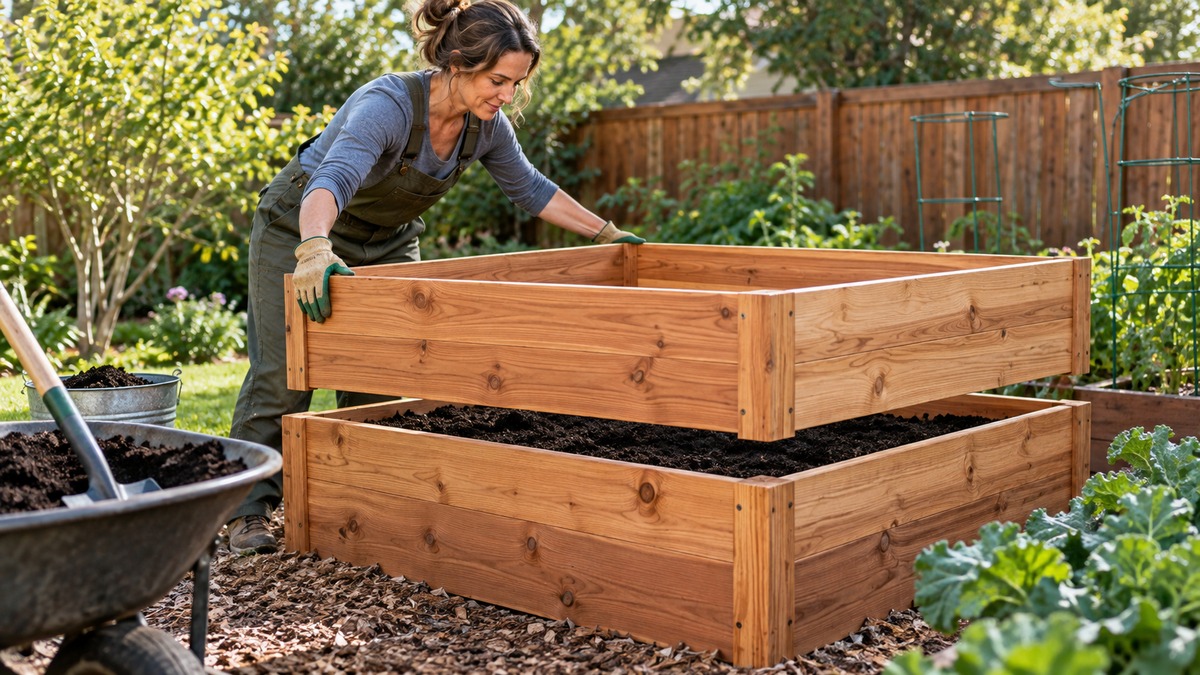
The University of Florida’s example is a 4-by-8-foot bed built from 2-by-8 boards with posts at the corners. Its construction text says that “There will be three boards stacked on each side of the bed with a total height of 21¾”.” The stack is built course by course, not by one tall board, and each course is fixed to the posts before the next one goes on.
The publication describes the fixing steps in order. “First attach the 4′ long boards to the post and then add the 8′ long boards using three screws for each connection.” It also says to “Alternate the placement of the screws that occur at right angles, so they do not hit one another when going into the post.” Those two steps keep each course tight as the stack rises.
Level the top as you go. The publication warns that “Make sure the tops of the six posts are at the same height,” and it adds that “Soil may need to be added or removed to level it.” If the ground slopes, correct the low side before you add the second course, so the stack does not lean.
Length brings its own load. UF/IFAS says that “If beds are made longer, additional supports are necessary to keep the boards from buckling.” A stack that is both tall and long needs supports along its length as well as at the corners.
Add a frame for soil deeper than 6 inches
Oregon State Extension sets the frame rule in one sentence: “You can mound 6″ of soil without a frame; deeper beds need a frame to stay intact.” It lists the materials that can make the frame: “Rot-resistant lumber, cinder blocks, bricks, or rock layers can make a frame.” Choose one that will keep its shape under the weight of wet soil.
Height also affects drainage. Oregon State warns that “Beds taller than 18″ may require extra drainage in the bottom.” Once a stack passes that height, plan a drainage layer or open bottom before you fill it. The sources do not say how deep that layer should be, so treat it as a question to check locally.
Pick the wall material with care
The material decides how the stack ages and what touches the soil. Tennessee’s publication gives a specific warning about older lumber: “Prior to December 2003, chromated copper arsenate (CCA) was used as a preservative in lumber for residential uses.” It continues: “So, use caution because this older treated lumber as well as railroad crossties can contain metals that can leach into garden soil.” If you reuse old boards or ties, check their age and origin first.
Tennessee also lists two options that reduce the risk. Its publication says that “Gardeners can line raised beds with plastic to reduce leaching concerns or chose cedar or redwood lumber that is more resistant to decay.” Lining the bed and choosing a naturally durable wood are both covered in that one sentence.
UF/IFAS takes a practical view of wood. It says that “Wood is the most common material and is relatively inexpensive, but untreated lumber starts to rot within a year.” The same publication recommends that you “use modern pressure treated lumber, also known as Alkaline Copper Quaternary (ACQ) lumber” for longevity and cost. Oregon State adds a contrast with masonry: “Cement block leaches lime, which is okay here; while treated lumber (creosote or pentachlorophenol) can injure plants.”
These statements can look contradictory, but they point to the same step. The treatment on the lumber matters, and the age of the lumber matters too. Read the label on each board, and follow the manufacturer’s directions for the product you buy.
Set the width so every plant is in reach
Width decides whether you can reach the middle of the bed without stepping on the soil. Illinois Extension sets two limits: “Raised beds should be no wider than 4 feet if they can be accessed on all sides.” Otherwise, “they should be no wider than 2 feet to reach everything in the bed without stepping on the soil.”
Width and height work together. Tennessee’s publication explains why taller beds cost more to build: “Taller and longer beds will contain more substrate and weight and require more substantial construction, support and bracing.” A wider footprint at the same height adds soil and weight too, so check both dimensions before you order materials.
| Bed height on a 4-by-8-foot footprint | Soil volume (cubic feet) | Soil volume (cubic yards) |
|---|---|---|
| 12 inches | 4 × 8 × 1 = 32 | 32 ÷ 27 = 1.19 |
| 21¾ inches | 4 × 8 × 1.8125 = 58 | 58 ÷ 27 = 2.15 |
| 24 inches | 4 × 8 × 2 = 64 | 64 ÷ 27 = 2.37 |
Our own arithmetic produces the table above, and it uses the same footprint as the University of Florida example. The 21¾-inch row gives 2.15 cubic yards, which matches the soil quantity that publication lists for that bed. The table leaves out compaction and settling, so add a margin when you buy.
Plan drainage and water for a taller bed
Soil in a raised bed drains quickly, which is a benefit until the weather turns dry. The University of Florida publication puts it plainly: “Irrigation is critical to success since soil used in raised beds is typically well drained and may dry quickly.” Tennessee’s publication says the same thing from the soil side: “The growing substrate will drain faster and require more frequent watering.”
For watering, the University of Florida publication lists a practical set of options. It says to “Install low-volume irrigation by using soaker hoses, microsprayers, or drip tubing.” A stack that is taller than the usual range holds more soil, so a short watering run may not reach the lower layers. Check the depth of wetting after each run, and adjust the time rather than assuming the first setting will hold.
Fill the stack and top it up
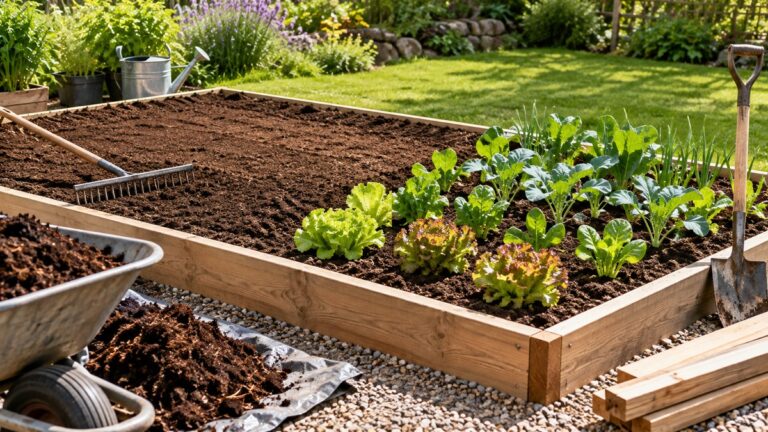
Illinois Extension gives a simple fill recipe: “Fill raised beds with a 1:1 mixture of compost and garden or topsoil.” It also explains why the level drops over time: “Over time the compost or other organic matter used will decompose, which causes the bed to settle.” Plan on adding soil and compost after the first season, and again each year that the bed settles.
For more on the soil volume a bed needs, see our page on how much soil a raised bed garden needs. For the filling step itself, see our guide to filling raised beds.
Common mistakes when stacking
- Going above 18 inches with no drainage plan. Oregon State says taller beds may need extra drainage in the bottom.
- Letting the post tops sit at different heights. UF/IFAS says they should be level.
- Skipping supports on a long bed. The boards can buckle without them.
- Using untreated lumber for a bed you plan to keep. UF/IFAS says it starts to rot within a year.
- Filling the bed once and never topping it up. Illinois Extension says the bed settles as its organic matter breaks down.
- Reusing old treated lumber without checking it. Tennessee’s publication warns about older CCA lumber.
How we chose
This guide is a planning method, not a product list. The pages we opened on 2026-10-22 were Oregon State Extension’s raised-bed publication, University of Florida IFAS publication EP472, the University of Illinois Extension raised bed gardening infosheet dated 07102023, and University of Tennessee publication W346-E. We kept the measurements and warnings that each page states in plain words. Where a source gave a range, we show the range, and where a source gave a single figure, we say so.
We also ran a search for a University of Georgia publication on raised bed construction. That page returned an error on fetch, so we did not use it.
What we could not verify
What the sources do not say
The pages do not give a maximum height for a stacked bed, and they do not give a load limit for the walls. They do not calculate the weight on the bottom course, so this guide does not give one. The pages we opened do not give a bracing design for a stack taller than the University of Florida example, so this guide does not supply one.
The sources also do not settle how long any treated lumber will last in a particular garden, and they do not compare current products. The sources name no product, and this guide names none. Read the label for the lumber you buy, and follow the manufacturer’s directions.
Frequently asked questions
How many boards high can a raised bed go?
The pages we opened give no maximum. The University of Florida example uses three boards on each side for a total of 21¾ inches, and Illinois Extension says beds can be built taller than the usual 6 to 12 inches.
Does a raised bed need a frame?
Oregon State Extension says you can mound 6 inches without one, and that deeper beds need a frame. It lists rot-resistant lumber, cinder blocks, bricks or rock layers as options for the frame.
Is untreated lumber a good choice for a raised bed?
The University of Florida publication says untreated lumber starts to rot within a year, so it is a poor fit for a bed you plan to keep for years. Tennessee’s publication points to cedar or redwood as more resistant to decay.
Does a taller bed hold more soil than a short one?
Yes, for the same footprint. On a 4-by-8-foot bed, our arithmetic gives about 1.19 cubic yards at 12 inches and about 2.37 cubic yards at 24 inches.
How often does a raised bed need more soil?
Illinois Extension notes that beds settle as their organic matter breaks down, so top-ups are a yearly task.
Bottom line
Build the stack in courses you can measure, keep the width within reach, and add drainage and a frame once the bed goes past about 6 inches. Check the lumber label before you buy, because the treatment and the age of the wood decide how the stack ages.
Sources
- https://extension.oregonstate.edu/sites/default/files/documents/12281/raisedbed.pdf (opened 2026-10-22)
- https://edis.ifas.ufl.edu/publication/EP472/pdf (opened 2026-10-22)
- https://extension.illinois.edu/sites/default/files/raised_bed_gardening_infosheet_07102023.pdf (opened 2026-10-22)
- https://uthort.tennessee.edu/wp-content/uploads/sites/228/2023/11/W346-E.pdf (opened 2026-10-22)