How to Clean Outdoor Planters Before Planting
As an Amazon Associate we earn from qualifying purchases.
How to clean outdoor planters before planting is a short job with three parts: clear out the old soil and roots, scrub off the salt film and grime, then rinse and dry the pot before it gets new soil. The extension and garden sources listed at the end agree on that order. Two of the five are university extension pages, and the rest are a society article, a publisher’s how-to and a botanic garden answer. They say less about timing and tools, so this guide gives the steps the sources share and says where they do not settle a question.
Quick answer
- Empty the planter and brush off the loose soil before you wash it.
- Wash in soapy water, scrub off any crusted salt, and rinse well.
- Let the pot dry in the sun, and soak clay pots in clean water before they get new soil.
- Check that the pot has drainage holes before you plant in it.
Empty the pot and brush out the old soil
Start with the loose material. Iowa State University Extension’s how-to page on plant containers tells readers to start by using “a brush or rag to remove all the loose soil particles” before any washing. The order matters because the washing and scrubbing steps only work on the surfaces that are already clear of loose soil.
Old roots are the other thing to clear. The American Orchid Society’s guide to cleaning clay pots gives the job in one line: “Use an abrasive pad to scrub away as much of the adhering roots, encrusted salt and other debris as you can.” That guide is written for orchid pots, but the same clearing step fits a garden planter that held roots and soil over the season.
While the planter is empty, look at its size as well. Oregon State University’s container gardening section frames the choice this way: “Start by finding a container large enough to support fully grown plants and with adequate soil-holding capacity to accommodate the plants’ root systems.” The same guide ties container size to the roots the pot has to hold, so a planter that is cramped inside is worth noting before it is refilled.
Timing is simple. The Almanac guide says: “Garden pots need a thorough scrubbing at the end of the growing season.” Cleaning at the end of the season, before the pots are stored, matches that advice.
Scrub off the salt film and grime
The white film that shows up on the outside of many clay and terracotta pots is salt. Iowa State’s page explains that salts leach through clay pots and form a white film on the outside, and it adds: “Mineral salts can be both unsightly and damaging to plants.” The same page notes: “Salt deposits on container rims can dehydrate plant stems resting there.” It also says: “Mineral deposits can frequently form around the upper inside rim of the pot near the soil line.” The rim is the first place to check.
The Chicago Botanic Garden’s answer on white residue is written for houseplant pots, but the cause it gives is the same one: “This is probably salt residue caused by an excess of soluble salts in the soil.” The same answer adds that “Soluble salts can also be found in fertilizers or in excessively hard water.” It then says: “If you live in an area with very hard water, you might want to water your plants with distilled water.” Outdoor planters get their water from different sources than houseplants do, so the water supply is worth a look before the next season starts. The answer also says: “Such residue can be prevented by occasionally watering your plant heavily and flushing out the salts.”
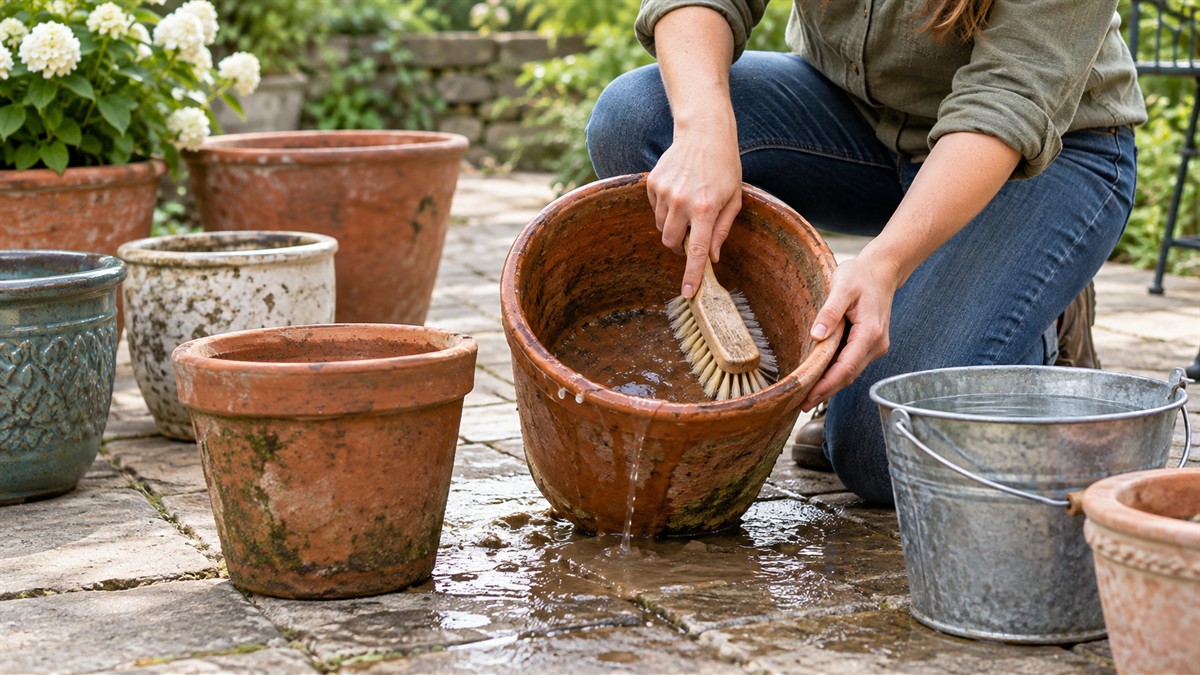
For the scrub itself, Iowa State’s steps are to wash the pot in soapy water and rinse it clean. The AOS guide adds a practical point: “You can add a little dishwashing liquid to the water if you like.” The same guide makes the salt point directly: “You need to remove any residual salts that have been absorbed into the porous clay pots.” The same page makes that point: clay pots “are porous so they can absorb salts”, so the clay itself needs scrubbing and not only the surface.
Some deposits will not come off with a scrub. Iowa State’s guide covers that case: “If mineral deposits remain, use a knife to scrape them off.” The sources do not say how much pressure a knife or pad can take before it marks the surface, so check the pot as you go and stop if the surface starts to change.
Rinse well and let the pot dry
Rinsing comes after the scrub. Iowa State says to rinse pots thoroughly after washing, and the Almanac guide says to rinse clean and then let the pots dry. The Almanac adds that the pots should dry in the sunshine if possible.
Once a pot is dry, the Almanac guide says: “When the pots are dry, stack and store them.” Plastic pots can be kept outdoors too, and the same guide says: “Plastic pots can be stored outside, but ensure they are covered and out of direct sunlight.” That keeps the cleaned pots ready for the next planting and separates them from pots that are still in use.
Soak clay pots before planting
Clay needs one more step before it gets new soil. Iowa State gives the reason: “Dry clay pots can wick moisture away from the potting medium dehydrating newly potted plants.” That is why the soak comes before planting. The fix Iowa State recommends is to soak the rinsed pots in a bucket of clean water until you are ready to use them. The Almanac guide says to soak pots in clean water too, which makes this one of the few steps that two of the sources describe in the same way.
Iowa State’s wicking warning is about clay, but its mineral-deposit section covers other pot types: “Remove this mineral deposit from plastic or glazed ceramic pots with a scouring pad.” That is the cleaning step the sources support for plastic and glazed planters. For a planter box rather than a pot, our guide to a DIY planter box for a deck railing covers the build side, while this page stays with cleaning.
Check the drainage holes before planting
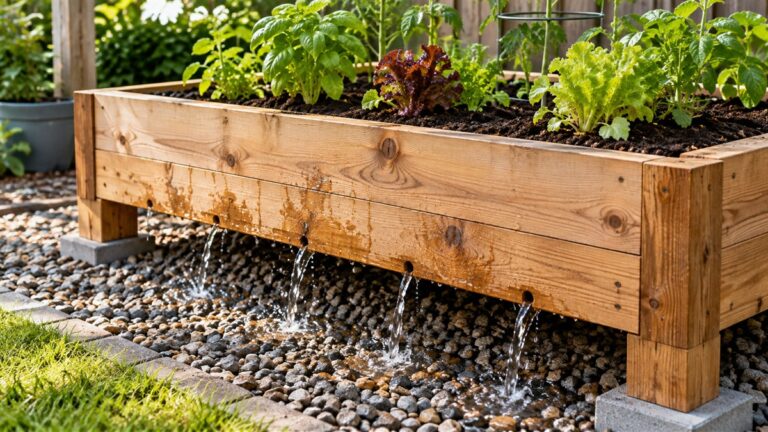
Cleaning is also the time to look at the bottom of the pot. Oregon State University’s container gardening section puts it plainly: “The container must have drainage holes.” That section is written for vegetables, and it adds that for most plants, containers should be at least 6 inches deep. A pot without holes needs a different plan, which this guide does not cover.
If the pot has holes but they clog with old soil, the brush and rinse steps above clear them. The sources do not say how often to check the holes during the season, so that question is left open.
Start the next season with fresh soil
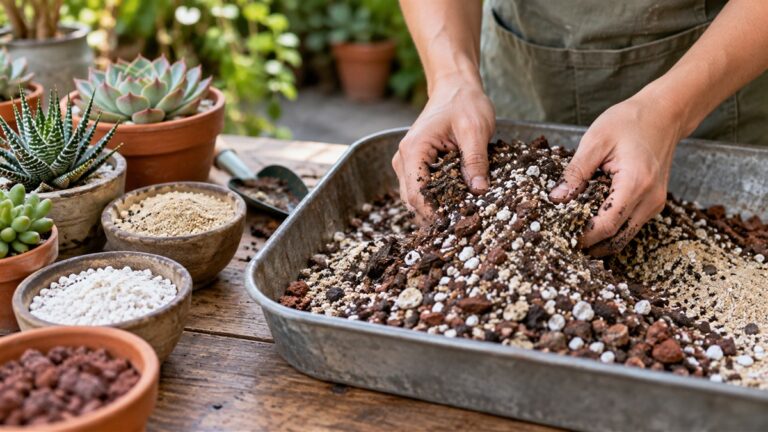
Cleaning does not replace fresh soil. The Almanac guide says: “it is best to start with fresh soil each spring.” Oregon State adds what the new mix should be like: “A fairly lightweight potting soil is the best growing medium for container plants.” The same section says “Garden soil is too heavy for container growing.” Once the pot is clean and dry, the soil is the next choice, and our guide to using raised bed soil in pots goes through that decision.
Mistakes to avoid
- Skipping the loose-soil step, which Iowa State lists first.
- Planting in a clay pot that is still dry. Iowa State says dry clay can pull moisture from new potting mix.
- Ignoring the rim. Iowa State says mineral deposits can form around the upper inside rim near the soil line.
- Reusing last year’s soil. The Almanac guide recommends fresh soil each spring.
- Assuming the pot has drainage. Oregon State says a container must have drainage holes.
What we could not verify
The sources above are good for the common cleaning steps, but they do not answer every question an outdoor planter raises. The points below stay open, and this guide does not guess at them.
What the sources do not say
- How long a pot should dry in the sun after washing. The Almanac says to dry pots in the sunshine if possible, with no time given.
- How much soap to use. The sources mention dish soap or dishwashing liquid, but give no amount.
- How hard to scrub. The Almanac suggests a stiff-bristled brush or steel wool, and the sources do not say when that is too rough for a given pot.
- How often to clean a planter during the season. The Almanac ties cleaning to the end of the growing season, and its spring advice is about fresh soil rather than cleaning.
- How to clean metal or fabric planters. The sources focus on clay, plastic and glazed ceramic pots.
- Whether cleaning changes how well a planter drains. The sources treat drainage as a separate check.
- Whether a cleaned planter will be free of pests or plant disease. The disinfecting steps on some of these pages are outside the scope of this guide.
- How much water a particular planter needs after planting. The sources do not give a watering schedule for outdoor containers.
How we chose
This guide uses five sources, all opened with curl on 2026-10-22. Iowa State’s page is an extension how-to on plant containers. The Almanac page is a how-to on cleaning and storing garden pots. The AOS article is written for orchid clay pots. The Chicago Botanic Garden item is a reader question about houseplant pots. The Oregon State publication is a practical gardening guide with a container section. Each quoted sentence was checked against the text that curl returned from the page.
A step is kept when at least one of the five describes it as a plain cleaning step: clearing loose soil, washing, scrubbing crust, rinsing, drying, soaking clay, and checking the holes. Two sources, Iowa State and the Almanac, describe a soak in clean water, so that step has the most support. Steps that depend on a bleach soak are left out, because this site does not give plant-disease treatment advice. The page does not recommend any product. Retail listings were not used, and no product names appear in the steps. The order of the steps follows the sequence that Iowa State and the Almanac both use: loose soil, washing, rinsing, then drying or soaking. It is not a ranking.
Frequently asked questions
Does a reused planter need cleaning before planting?
The Almanac guide treats cleaning as a seasonal job. It says garden pots need a thorough scrubbing at the end of the growing season, and that is the point to clean a planter before its next use. Pots that are stored should also be dry first, since the same guide says to stack and store them once they are dry.
Should clay pots be soaked before planting?
Yes, according to Iowa State and the Almanac. Iowa State explains that dry clay can pull moisture out of new potting mix, and both sources describe soaking rinsed pots in clean water until they are needed.
What is the white crust on an outdoor pot?
Iowa State says salts leach through clay pots and form a white film on the outside. The Chicago Botanic Garden answer ties this kind of residue to an excess of soluble salts in the soil, and it points to heavy watering to flush them out. Iowa State also places a common deposit point at the upper inside rim near the soil line.
Can dish soap be used to clean a planter?
Iowa State recommends washing pots in soapy water, and the AOS guide says a little dishwashing liquid in the water is fine. Neither source gives an amount, so use the amount on the product label and rinse well afterward.
Do outdoor planters need drainage holes?
Oregon State University’s container section says a container must have drainage holes. The same section says containers for most plants should be at least 6 inches deep, and that guidance is written for vegetables.
Sources
- https://yardandgarden.extension.iastate.edu/how-to/how-clean-and-disinfect-plant-containers (opened 2026-10-22)
- https://almanac.com/time-clean-and-store-your-pots (opened 2026-10-22)
- https://www.aos.org/orchids/articles/cleaning-clay-pots (opened 2026-10-22)
- https://www.chicagobotanic.org/plantinfo/white_residue_pots (opened 2026-10-22)
- https://extension.oregonstate.edu/catalog/pub/em-9027-growing-your-own (opened 2026-10-22)