Best Sprinkler Setup for Raised Planter Beds: Drip, Soaker or Spray
As an Amazon Associate we earn from qualifying purchases. Details
Updated 19 October 2026 | Author: Editorial team, homelycapers.com
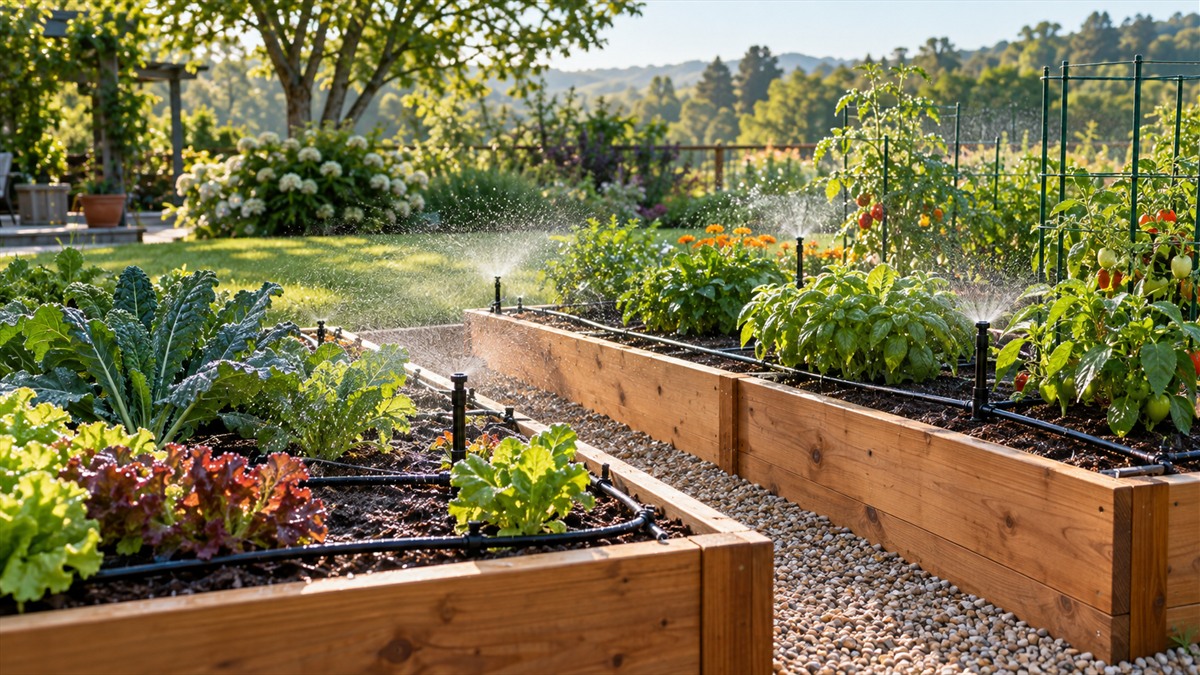
The best sprinkler setup for raised planter beds, according to the extension pages we opened, is usually not an overhead sprinkler at all. University of Nevada Extension says drip irrigation is the most efficient method of water delivery, and that water from high-pressure sprinklers can evaporate before it reaches the ground. Soaker hoses and drip lines that deliver water at the soil are the setups these sources favor for beds. This guide compares the options, shows how to judge how long to run them, and explains where the sources stop.
Quick answer
- Prefer drip or soaker lines for beds. Nevada Extension calls drip the most efficient method and says soaker hoses are easy for the beginning gardener.
- Avoid high-pressure overhead spray in the heat of the day. Nevada Extension says water from sprinklers can evaporate before it reaches the ground, and that water evaporates from the soil more quickly in hot, windy and dry weather.
- Water early and deeply, not often. Nevada Extension advises watering early in the day, and Regional Water Providers Consortium advises watering thoroughly but infrequently.
- Check the depth, not the clock. Nevada Extension says to check the depth of watering with a stake or trowel.
- Add mulch. Colorado State University Extension says mulching can reduce irrigation need by around 50 percent.
Why raised beds need a plan for water
Raised beds dry out faster than the ground around them. Iowa State University Extension says they dry out faster than other garden sites and have to be watered more frequently in dry weather. The University of Maryland Extension makes the same point and adds that faster drying requires more monitoring and irrigation, especially in hot, dry weather.
That is why the sprinkler question matters more for a bed than for a lawn. A bed is a small volume of soil that loses water quickly, so the method you choose has to get water to the root zone without losing much to the air or the path. The pages we opened compare methods on that basis.
The main options
| Option | What the extension pages say | What to watch for |
|---|---|---|
| Soaker hose | Easy for a beginning gardener; water seeps along the whole length of the hose | Water is delivered slowly, so it takes longer to reach deeper roots |
| Drip irrigation | Nevada calls it the most efficient method; ready-to-assemble drip kits provide what you need to start | Needs a kit and a connection to the water supply |
| Automatic or trickle system | Iowa State says it may be worth the investment for permanent planters | The pages do not give a cost or an installation time |
| Overhead sprinkler | Nevada says high-pressure spray can evaporate before it reaches the ground | Loses water to air and heat, and covers the path as well as the bed |
| Hand watering with a hose | Regional Water Providers Consortium gives a flow of 5 to 7 gallons a minute for a garden hose | Its output depends on how long you run it and how you spread it |
Two things stand out in the table. The first is the delivery point. Soaker and drip lines put water where the roots are, while spray does not. The second is the timing. A soaker or drip line that runs slowly needs to run longer, and the sources say so directly.
Illinois Extension also gives a practical reason to use drip in a raised bed. Its blog says drip irrigation is relatively affordable and makes mid-summer watering less of a task. For a gardener who waters a bed by hand every evening, that is the point of the setup.
How to run a soaker hose
The University of Nevada Extension gives the clearest instructions for a soaker hose. Set the hose along the length of the planting rows, or snake it around to cover the area in wider beds. Because water is delivered slowly, it takes longer to reach the deeper roots. The page advises leaving a soaker hose running longer than you would a sprinkler.
Then check the result. Nevada recommends checking the depth of watering with a stake or trowel. Push the stake or dig with the trowel after a session, and look at how far the moisture has gone. That check tells you more than any fixed time, because soil type, weather and bed depth all change the answer.
A worked calculation for hand watering
If you water a bed with a hose instead of a permanent line, the flow rate sets how much water you deliver. The Regional Water Providers Consortium says water flows from a garden hose at an average of 5 to 7 gallons a minute. Use the midpoint of 6 gallons a minute as a working figure. At 6 gallons a minute, 10 minutes of flow is 6 x 10 = 60 gallons, and a 5-minute session is 6 x 5 = 30 gallons.
The number tells you the volume, not the depth. The sources do not give a fixed number of minutes for a bed, so use the depth check after each session rather than trusting the timer.
Regional Water Providers Consortium also recommends a shut-off nozzle, which keeps the water on only while you need it. Its page says to add a hose nozzle with a shut-off feature, and it gives the flow figure above for that reason.
Timing: early, infrequent and deep
Timing is part of the sprinkler setup, not an afterthought. Nevada Extension says to water early in the day, and it explains that water is wasted when it evaporates during the heat of the day. The same page notes that cool-season vegetables usually need less frequent irrigation than vegetables grown in the heat of summer.
Regional Water Providers Consortium gives the rule that fits both cases. It says to water thoroughly but infrequently, and it describes the way to handle runoff. If runoff or puddling occurs, the page says to break longer watering sessions into several short sessions, which lets the water soak in between them.
Mulch reduces how much water you need
Mulch is not a sprinkler, but it changes how much the sprinkler has to deliver. Colorado State University Extension says mulching minimizes evaporation of water from the soil surface and, in general, reduces irrigation need by around 50 percent, depending on the material and how deep it is applied. The same page says wood or bark chips make excellent mulch between raised-bed boxes.
Mulch and the irrigation method work together. A soaker or drip line puts water at the root zone, and mulch keeps that water from leaving the soil surface. Neither replaces the other, but together they are the setup the extension pages describe.
Soil type changes the schedule
The soil under the bed sets how fast water moves and how long it stays. The University of Nevada Extension describes the difference. Sandy soils have large particles with large air spaces in between, so they drain quickly and need to be watered frequently. Silty or clayey soils have smaller particles and need less frequent irrigation because they hold more water.
The same Nevada page warns about clay. Clayey soils drain so slowly that you have to be careful not to provide water too rapidly, or the water will pool on the soil surface and run off before it can reach the deeper plant roots. That warning is the reason to split long sessions, as the Regional Water Providers Consortium suggests. A soaker or drip line that delivers water slowly gives the soil time to take it in, while fast spray is more likely to pool and run off.
Weather changes the schedule as well. Nevada Extension says plants take up more water, and water evaporates from the soil surface more quickly, in hot, windy and dry weather. It also says cool-season vegetables usually need less frequent irrigation than vegetables grown in the heat of summer, so the same bed may need a different rhythm in spring and in July.
Common mistakes the sources warn about
Running overhead spray in the middle of the day. Nevada Extension says spray can evaporate before it reaches the soil, and that water is lost in the heat of the day.
Watering on the clock without checking depth. Nevada recommends a stake or trowel check, and the sources do not give a fixed number of minutes for a bed.
Watering in short, frequent sessions. Regional Water Providers Consortium recommends thorough, infrequent watering, with longer sessions broken up only when runoff or puddling starts.
Leaving the soil bare between plantings. Colorado State says mulch cuts evaporation and reduces irrigation need, so a bare bed loses more water than a mulched one.
How we chose
We started from the question the phrase “sprinkler setup” usually hides: how should water reach a raised bed. We looked for university extension and water-provider pages that compare watering methods, and we used the Nevada, Iowa State, Maryland and Illinois pages for the method comparison, with Colorado State for mulch and Regional Water Providers Consortium for flow and timing. We kept only pages we could open and read in full, and we checked each quoted sentence against the saved page text before we used it.
We did not name a product, a brand or a kit. The pages compare methods, not brands, and we did not want to go beyond that.
What we could not verify
- The pages we opened do not give coverage, flow or spacing figures for any specific sprinkler head, so we cannot say how many heads a bed needs.
- The sources do not give a fixed number of minutes to run a soaker hose or a drip line for a given bed.
- The 5 to 7 gallons a minute figure is an average. Your hose bib pressure may give a different flow.
- The pages do not cover local watering restrictions, which can limit when and how you run any system.
- We did not find a price or installation time for drip systems in the pages we opened, so we do not give one.
- The University of Georgia publications on drip irrigation and water conservation returned errors when we downloaded them, so their guidance is not used here.
Related reading
For filling the bed before you set up the water, see how to fill raised beds. For sizing the soil order for a bed, see how much soil a raised bed needs. For choosing crops that suit the bed’s sun, see the best vegetables to plant in raised beds.
FAQ
Is an overhead sprinkler a good choice for a raised bed?
The University of Nevada Extension says water from high-pressure sprinklers can evaporate before it reaches the ground, and that water is wasted when it evaporates in the heat of the day. Soaker and drip lines that put water at the soil are the setups these sources favor for beds.
Is drip irrigation worth it for raised beds?
Nevada Extension calls drip the most efficient method of water delivery. Iowa State says a trickle or automatic system may be worth the investment for permanent planters, and Illinois Extension describes drip as relatively affordable and time-saving in a raised bed.
How long should I run a soaker hose on a raised bed?
The pages do not give a fixed time. Nevada Extension says to leave a soaker hose running longer than you would a sprinkler, and to check the depth of watering with a stake or trowel.
How often should I water a raised bed?
Regional Water Providers Consortium advises watering thoroughly but infrequently, and breaking longer sessions into shorter ones if runoff or puddling starts. Maryland and Iowa State both say raised beds need more frequent watering in hot, dry weather.
Does mulch help a raised bed with irrigation?
Colorado State University Extension says mulching minimizes evaporation from the soil surface and, in general, reduces irrigation need by around 50 percent. Wood or bark chips are a good choice between raised-bed boxes.
Bottom line
For raised beds, the extension pages favor a soaker or drip line at the soil over overhead spray, watering early and thoroughly, checking the depth after each session, and keeping mulch on the soil.
Sources
- University of Nevada Cooperative Extension, vegetable watering publication (4-H pub 3526): soaker hoses, drip irrigation, sprinkler evaporation and watering early in the day.
- Iowa State University Extension, “Creating Raised Bed Planters”: faster drying in raised beds and the value of trickle or automatic irrigation for permanent planters.
- University of Maryland Extension, “Growing Vegetables in Raised Beds”: the need for more monitoring and irrigation in raised beds.
- University of Illinois Extension, “Raised Beds: Benefits and Considerations”: drip irrigation for raised beds and its effect on mid-summer watering.
- Regional Water Providers Consortium, “Watering by Hand”: the hose flow rate, the shut-off nozzle, and thorough, infrequent watering.
- Colorado State University Extension, “Mulches for the Vegetable Garden”: the reduction in irrigation need from mulch and the use of bark chips between raised-bed boxes.