Best Plants for Raised Bed Planters: Sun Needs and Crop Choices
As an Amazon Associate we earn from qualifying purchases. Details
Updated 19 October 2026 | Author: Editorial team, homelycapers.com
The best plants for raised bed planters are the ones whose sun needs match the hours your bed actually gets. Oregon State University Extension says all vegetables need at least 6 hours of direct sunlight, and that fruiting plants such as tomatoes, peppers and eggplants need more. Iowa State University Extension says leafy greens can still produce on 3 to 4 hours of sun. This guide sorts the common crops by those thresholds, explains how bed size and depth affect what you can grow, and notes where the sources stop.
Quick answer
- Count the direct sun first. Oregon State says all vegetables need at least 6 hours of direct sunlight, and Iowa State says most vegetables and flowers need at least six hours of full sun for peak performance.
- Sunny beds (6 hours or more): tomatoes, peppers, eggplants, squash, melons and green beans. Oregon State says the sun-loving crops need more than the minimum.
- Shadier beds (3 to 4 hours): leaf lettuce, spinach, collards, Swiss chard and kale, according to Iowa State.
- Partial-shade options: Iowa State also lists radishes, kohlrabi, beets, cauliflower and broccoli. Its page does not give hour counts for them.
- Herbs are not covered. The pages we opened do not give sun needs for herbs, so we do not give a herb rule.
Start with sunlight, not the seed packet
The extension pages put sun first when they describe where a vegetable bed should go. The Oregon State Ask Extension answer on siting a vegetable garden says the best place is where it gets the most sun and has the best soil, and it notes that a southern exposure is ideal. Raised beds are often placed in open yards, but a fence, a shed or a tree can shade one side enough to change which crops work.
Iowa State explains why raised beds are usually built in sunny spots. It says raised bed planters are usually in sunny locations because most vegetables and flowers require at least six hours of full sun for peak performance. The point is not that a bed cannot be shaded at all. It is that the crop list changes quickly once the bed drops below six hours.
Because sun changes through the season, count the hours at the time you plan to grow. A bed that gets full sun in spring may be shaded by a growing tree by midsummer. The sources do not give a method for tracking that change, so this guide relies on the hour counts they state.
Sun needs by crop group
The table groups the crops the extension pages name, with the sun figure each page gives. Where a page does not state an hour count, the table says so.
| Crop group | Examples named | Sun the sources give | Source |
|---|---|---|---|
| Fruiting vegetables | Tomatoes, peppers, eggplants | Need more than the 6-hour minimum | Oregon State Ask Extension |
| Vines and beans | Green beans, squash, melons | Need more than the 6-hour minimum | Oregon State Ask Extension |
| Lettuce and some cabbage family | Lettuce, some members of the cabbage family | Can do with a little less than 6 hours | Oregon State Ask Extension |
| Leafy greens | Leaf lettuce, spinach, collards, Swiss chard, kale | 3 to 4 hours | Iowa State partial-shade FAQ |
| Partial-shade options | Radishes, kohlrabi, beets, cauliflower, broccoli | Listed as options for partial shade, no hour count given | Iowa State partial-shade FAQ |
| Herbs | Not covered in the pages we opened | No figure | None |
The gap between the first two rows and the leafy-greens row is the main decision. A bed with 6 hours or more can carry the fruiting crops. A bed with 3 to 4 hours is better suited to greens and the partial-shade list. A bed that falls between those figures can take a mix, but the pages do not give a line for the in-between hours, so plant the more shade-tolerant crops in the shadier end of the bed.
Sunny beds: the fruiting crops
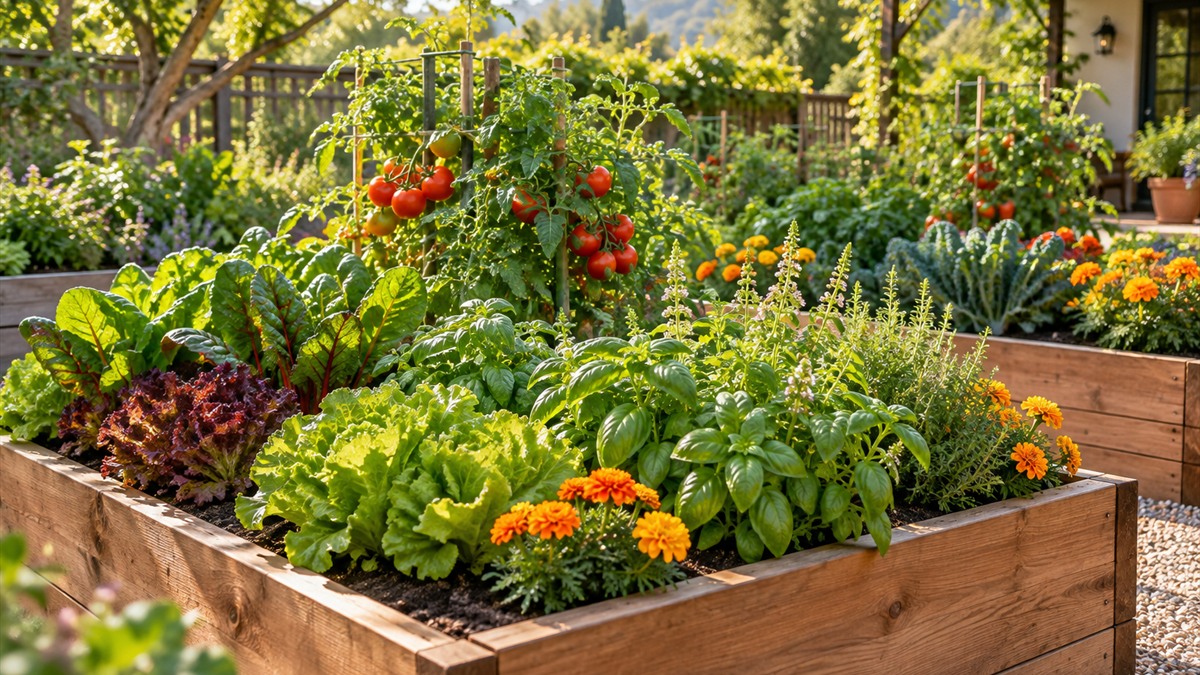
Tomatoes, peppers and eggplants are the crops that need the most light, and Oregon State names them specifically. Squash and melons belong in the same group, along with green beans.
Bed depth matters for these crops as well. The University of Maryland Extension describes raised beds as usually 2 to 12 inches tall, and says the added depth increases the available rooting area, which boosts plant growth and harvest yields. Illinois Extension recommends building beds 12 to 24 inches high.
Plan the bed width around reach. Illinois Extension recommends building beds no wider than four feet, because wider beds make it hard to reach every plant. Iowa State says beds that can be reached from both sides can be 3 to 4 feet wide.
Shadier beds: greens and partial-shade crops
Iowa State names the leafy greens that can grow on 3 to 4 hours of sun: leaf lettuce, spinach, collards, Swiss chard and kale. Those crops suit a bed that does not get the full six hours.
The same Iowa State page also lists radishes, kohlrabi, beets, cauliflower and broccoli as options for partial shade. The page does not give the hours these crops need, so treat the list as a set of possibilities rather than a sun figure. If your bed is shadier than six hours, these crops are worth trying, but check how the bed performs in your first season.
Lettuce is the crop that sits at the boundary of the two groups. The Oregon State page says some members of the cabbage family, and lettuce, can do with a little less than the 6-hour minimum. Iowa State puts leaf lettuce in the 3-to-4-hour group. Both pages point the same way for lettuce, so it is the best-supported crop for the shadiest bed.
Water and drying in a raised bed
Light is only part of the picture. Iowa State says raised beds dry out faster than other garden sites, and that they have to be watered more frequently in dry weather. Plan the watering along with the crop list.
The University of Maryland Extension makes the same point. It says the faster soil drying in a raised bed requires more monitoring and irrigation, especially when the weather is hot and dry. That is a reason to plan the bed’s watering before you choose the crops, since a thirsty crop in a fast-drying bed is harder to keep healthy.
Site, layout and reach
Placement sets how much sun a bed gets for the whole season. Oregon State University Extension says a southern exposure is ideal, especially if the ground slopes away from the garden so the heavier cold air flows away from it, which gives the garden its longest season with the best light and soil. The same page is the source for the sun thresholds above, so the site choice and the crop choice belong together.
Reach is the second layout question. Iowa State University Extension says raised beds should be constructed so an individual can reach everything in the bed without stepping into it. The University of Maryland Extension adds that the paths beside a bed matter too. Using the paths to stand and kneel when working in the bed avoids soil compaction around the plants, which helps keep planting at peak productivity.
Put those points together and the plan takes shape. Put the fruiting crops on the sunniest side of the bed, keep the bed narrow enough to reach across, and use the paths for standing and kneeling so the soil inside the bed stays loose. The pages we opened do not give a spacing for each crop, so use the spacing on the seed packet or plant label for that detail.
Common mistakes the sources warn about
Planting fruiting crops in a bed with 4 hours of sun. The Oregon State page says the sun-loving fruiting plants need more than the 6-hour minimum. The pages do not support expecting a full harvest of those crops in a shadier bed, so use that bed for greens.
Assuming herbs follow the vegetable numbers. The pages we opened do not give herb sun figures, so do not use the vegetable thresholds as a herb rule.
Building beds too wide. Illinois says beds wider than four feet are hard to reach from the path. A narrow bed keeps every plant within reach.
Ignoring how fast the bed dries. Iowa State and Maryland both say raised beds dry faster and need more watering.
How we chose
We started from the question a gardener asks when choosing crops for a new bed: what will grow with the light I have. We looked for university extension pages that give a sun threshold for vegetables, and we used the Oregon State and Iowa State pages because they give the clearest hour counts. We added the Illinois and Maryland pages for bed size, depth and drying. We kept only pages we could open and read in full, and we checked each quoted sentence against the saved page text before we used it.
We did not rank crops by yield or flavor, because the pages do not compare them that way. We did not name varieties.
What we could not verify
- The pages we opened do not give sun figures for herbs, so this guide cannot say how much light basil, mint or chives need.
- Iowa State lists radishes, kohlrabi, beets, cauliflower and broccoli for partial shade but gives no hour count for them.
- The sources do not name a single list that ranks every crop by shade tolerance. The figures above come from two extension pages and do not cover every crop.
- Sun varies with season, latitude and the trees and buildings around a yard. The pages we opened do not give a method for measuring hours in your own yard.
- The sources do not say which varieties tolerate shade better than others.
- We did not find a source on the exact yield a crop gives in a partly shaded bed.
Related reading
For a list of vegetables that suit raised beds in general, see the best vegetables to plant in raised beds. For a root crop that benefits from loose, deep soil, see planting carrots in raised beds. For laying out beds so the tall crops do not shade the short ones, see raised bed companion planting and garden layout.
FAQ
How many hours of sun do raised bed vegetables need?
Oregon State University Extension says all vegetables need at least 6 hours of direct sunlight. Iowa State says most vegetables need at least six hours of full sun each day to produce a good crop. Fruiting crops need more than that minimum.
Can I grow lettuce in a bed that gets only 3 or 4 hours of sun?
Iowa State lists leaf lettuce among the leafy vegetables that can be grown on 3 to 4 hours of sun. Oregon State says lettuce can do with a little less than 6 hours. Lettuce is the most shade-tolerant crop in the sources we opened.
Which vegetables tolerate partial shade?
Iowa State names leafy greens such as leaf lettuce, spinach, collards, Swiss chard and kale for 3 to 4 hours of sun. It also lists radishes, kohlrabi, beets, cauliflower and broccoli as partial-shade options, without giving an hour count for those.
Do raised beds need more water for these crops?
Yes, according to both Iowa State and the University of Maryland Extension. Raised beds dry out faster than ground-level soil and need more monitoring and watering in hot, dry weather.
What about herbs in a raised bed?
The sources we opened do not give sun figures for herbs, so we cannot say how much light they need. Check a local extension office for herb-specific guidance.
Bottom line
Match the crop to the hours of direct sun the bed gets: fruiting vegetables for beds with 6 hours or more, leafy greens and partial-shade crops for beds with 3 to 4 hours, and plan the watering before you plant, since raised beds dry out faster.
Sources
- Oregon State University Extension, Ask Extension, “Where is the best spot for my vegetable garden?”: the 6-hour minimum and the crops that need more or less.
- Iowa State University Extension, “Which vegetables will grow in partial shade?”: the 3-to-4-hour leafy greens and the partial-shade list.
- Iowa State University Extension, “Creating Raised Bed Planters”: sunny bed locations, faster drying and bed widths.
- University of Maryland Extension, “Growing Vegetables in Raised Beds”: bed height and depth, deep-rooted crops and the need for more irrigation.
- University of Illinois Extension, “Raised Beds: Benefits and Considerations”: the width limit and the 12 to 24 inch height recommendation.