Raised Garden Bed on Uneven Ground: Level, Grade and Drain
As an Amazon Associate we earn from qualifying purchases. Details
Updated 19 October 2026 | Author: Editorial team, homelycapers.com
A raised garden bed on uneven ground needs its top edge level before any soil goes in, and its fill graded so water runs off the bed instead of pooling in it. The extension sources we downloaded cover the same steps from different angles: a level site, a level frame, soil graded away from the center, and attention to the planting space that remains. This guide walks through those steps, shows the calculation for flat planting space on a sloped unframed bed, and sets out what the sources do not settle, such as how to join a bed to an existing frame.
Quick answer
- Start with a level site. Iowa State University Extension says to “Choose a level site to simplify the building process.”
- Level the top of the frame. The same Iowa State guide says to “Set the wall materials so the top is level,” so the bed can hold an even depth of soil even when the ground is not level.
- Grade the soil away from the center. Iowa State advises grading the fill “so that it slopes slightly away from the center of the bed to the edge and away from adjacent structures.”
- Count the flat space you keep. Oregon State University Extension gives a 48-inch-wide bed with about 36 inches of flat planting space once the elevated area is raked level, which is 75 percent of the width.
Why level matters in a raised bed
The reason to level a bed is the water. A raised bed is supposed to drain better than the ground beneath it, and the University of Maryland Extension growing guide says the soil in a raised bed drains well because of its looser texture and raised grade. That drainage only works if the surface is set so water can leave the bed. A top that tilts toward one corner concentrates water and soil in the low end, which is the opposite of what the raised grade is for.
Level also affects how the soil settles. The Iowa State guidance on raised bed planters tells you to choose a level site and set the wall materials so the top is level. That step does two jobs at once. It makes the frame easier to build square and firm, and it keeps the fill depth even along the length of the bed. A bed that is deep on one end and shallow on the other gives plants at the shallow end less root room than those at the deep end.
Level the site and the frame
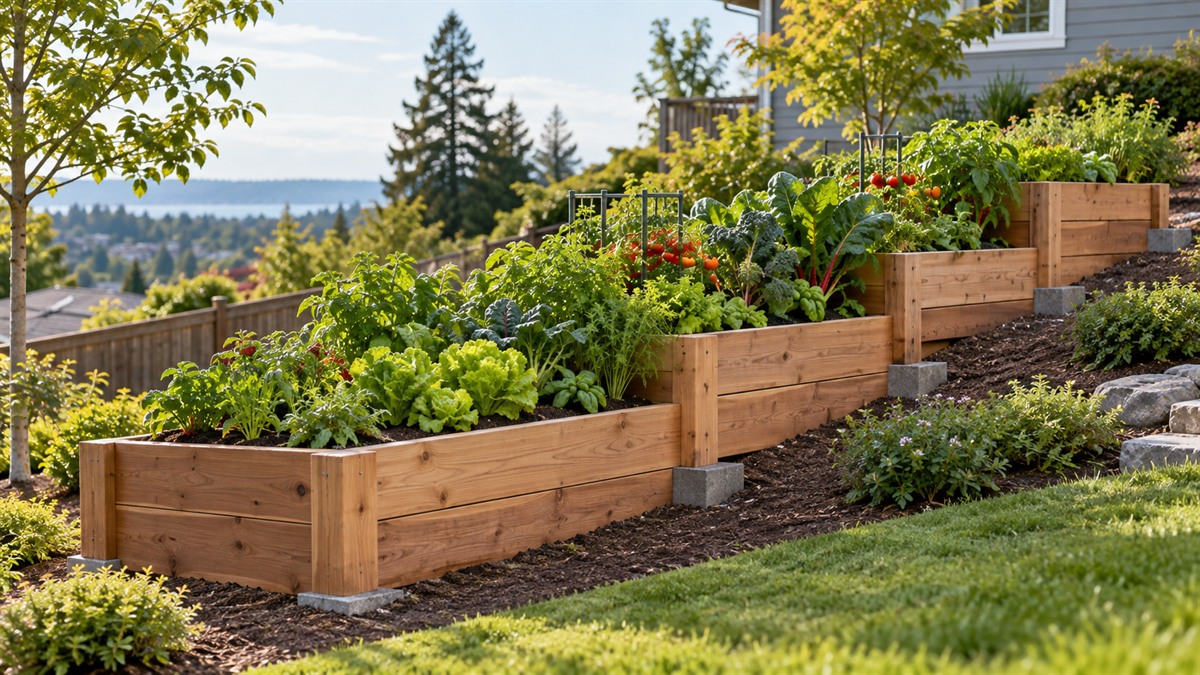
Start with the site. Iowa State says to choose a level site to simplify the building process, which is the simplest instruction in the sources and the most useful. If the site cannot be level, the same guidance tells you to level the top of the wall instead of the ground. Set the frame with a level, check each corner and side, and shim the low side until the top is even. The soil then sits at the depth you planned rather than following the slope.
A bed on a slope will sit higher on the uphill side than on the downhill side if you build from the ground up. Plan the frame height from the top edge, not from the ground, and let the low side take the extra depth of material. The sources do not give a rule for the exact height difference that is acceptable, so keep the top edge even by eye and by level and let the fill adjust.
Check the frame after the first filling and again after the first rain. Soil settles, and a frame that was level when empty can drift as the fill shifts. The Iowa State guidance says to grade the fill once it is in, so the settling step is part of the job, not a sign of failure.
Grading the fill
Once the frame is level, the fill needs a slope of its own. Iowa State says that “When filling the bed, grade the soil so that it slopes slightly away from the center of the bed to the edge and away from adjacent structures.” That slope lets rain run off to the edges rather than sit in the middle, and it keeps the bed from sending water toward a wall or a foundation.
The grade is slight, not steep. The Iowa State instruction says “slightly,” and the reason is the planting surface. A steep slope inside a bed puts soil on the lower edge and leaves the middle thin, which is the same unevenness you were trying to avoid. Rake the top level after the grade is set, so the planting area is flat and the drainage is still toward the edges.
Sloped, unframed beds and the planting space
A framed bed is not the only option, and the Oregon State guide on raised bed gardening compares the two. It says unframed beds are less expensive, but that “the mounds are prone to erosion and take up a larger footprint.” On a slope, an unframed mound is the setup most likely to lose soil downhill, so the sources give a planting calculation for it.
Oregon State gives the calculation directly. When the elevated area is raked level, the natural slope of the soil leaves about 36 inches of flat planting space on top of a 48-inch-wide bed. The planting fraction is the flat width divided by the total width: 36 ÷ 48 = 0.75, which is 75 percent of the bed’s width. The remaining 25 percent is the slope of the soil on each side, and that is the part that erodes. A wider bed keeps a larger share of flat planting space only if it is also built with the same slope.
The same calculation helps you choose the width. If you need 36 inches of flat planting space for a row of plants, a 48-inch bed gives you the space the source describes. If the bed is narrower, the flat part shrinks in proportion. Do the division for the width you plan, and check the result against the planting you want to do.
| Step | What the sources say | Calculation or action |
|---|---|---|
| Choose the site | Choose a level site to simplify the building process (Iowa State) | Start level if you can |
| Level the top | Set the wall materials so the top is level (Iowa State) | Check with a level at each corner and side |
| Grade the fill | Grade the soil slightly away from the center to the edge (Iowa State) | Rake the top level after grading |
| Plan the planting width | 48-inch bed with about 36 inches flat (Oregon State) | 36 ÷ 48 = 0.75, so 75% flat |
| Choose a frame or mound | Unframed mounds erode and take more footprint (Oregon State) | Frame the bed if the slope is steep |
Drainage and the lower edge
The lower edge of a sloped bed is where the water collects, and the sources point you to it. The University of Maryland Extension notes that the raised grade drains well, which is a benefit on a slope because the water moves downhill past the bed rather than into it. The lower edge still needs attention, because it is the part of the frame that takes the pressure of the soil and the water. Check that the downhill wall is sound and that the soil does not wash out under it after each heavy rain.
A bed on a slope also needs the paths and the bed edges to be firm. The Iowa State guidance does not give a detailed plan for downhill walls, so any retaining design beyond a simple frame is outside what the sources support. If the slope is steep or the wall would hold back a lot of soil, the sources do not say what is safe, so ask a local contractor or your extension office before you build.
How we chose
We chose the sources that answer the leveling and grading questions directly. Iowa State University Extension gives the site, frame and grading steps. The Oregon State guide gives the planting-space calculation and compares framed and unframed beds. The University of Maryland Extension growing guide explains why the raised grade drains well. We did not rank landscape kits or contractor services. Where the sources give a number, the guide shows the arithmetic, and where they give only a rule, we give the rule.
What we could not verify
The sources do not say how to join a new section of frame to an existing bed on a slope, and they do not give a maximum slope for a framed bed. They also do not state the height difference that makes a frame unsafe to build. The Oregon State figure of 36 inches of flat space applies to its specific unframed bed. A different width, slope or soil will change the flat share, so check the number for your own bed before you plant.
Mistakes to avoid on a slope
Three mistakes come up again and again in the sources, and each one has a fix.
- Filling a bed that slopes toward a wall or building. Iowa State says to grade the fill away from the center and away from adjacent structures, so that water does not run toward them.
- Relying on an unframed mound. Oregon State warns that unframed mounds are prone to erosion, which is why the 36-inch flat-space figure matters. On a steep site, a frame holds the soil where you put it.
- Assuming the raised grade solves drainage. The University of Maryland Extension says the raised grade helps the soil drain, but a bed that tilts strongly can still shed soil and water from one end. Check the level of the top after the first filling, and again after the first heavy rain.
The arithmetic from the Oregon State figure gives a quick check. A 48-inch bed with 36 inches of flat planting space has 48 – 36 = 12 inches of sloped width. The sloped share is 12 ÷ 48 = 0.25, or 25 percent. If the sloped share looks larger on your bed, the bed may need to be narrower or framed.
FAQ
Can I build a raised bed on a slope at all?
Yes, the sources describe leveling the top of the frame and grading the fill. The Iowa State guidance says to choose a level site if you can, and to level the top of the wall if you cannot.
How do I stop soil washing out of the lower edge?
The sources point to a sound frame and a graded fill that sends water toward the edges. The Oregon State guide notes that unframed mounds are prone to erosion, so a framed bed is the safer choice on a slope. Check the downhill wall after heavy rain.
How much flat planting space will a sloped bed keep?
Oregon State gives about 36 inches of flat space on a 48-inch-wide bed once it is raked level. That is 36 ÷ 48 = 0.75, or 75 percent. Use the same division for your own width.
Should I level the ground before I build?
Level the site if you can. Iowa State says to choose a level site to simplify the building process. If the site is not level, level the top of the frame instead.
Does a sloped bed drain better than a flat one?
The sources say raised beds drain well because of their looser texture and raised grade. On a slope, water runs downhill past the bed, but the lower edge still needs a sound wall and a graded fill to keep water from pooling in the bed.
Related reading
For how much soil a raised bed holds and how to fill it, see our guide to how much soil a raised bed garden needs. For filling a finished bed, see how to fill raised beds.
Bottom line
Level the top of the frame, grade the fill slightly away from the center, and plan the planting width with the flat share in mind. On a slope, a framed bed holds its shape better than an unframed mound, and the sources give you the numbers to check.
Sources
- Iowa State University Extension and Outreach, “Creating Raised Bed Planters”: choose a level site, level the top of the wall, grade the fill away from the center, and the seating ledge for accessibility.
- Oregon State University Extension, FS 270, “Raised bed gardening”: the 36 inches of flat planting space on a 48-inch bed, and the erosion risk of unframed mounds.
- University of Maryland Extension, “Growing Vegetables in Raised Beds”: the looser texture and raised grade that let the soil drain well, and the lower risk of waterlogging.