Starting a Compost Bin From Scratch
As an Amazon Associate we earn from qualifying purchases. Details
Starting a compost bin from scratch means three decisions: where the bin goes, what kind of enclosure you use, and how you build the first layers. This guide follows the U.S. EPA’s home composting guidance on each one, with the numbers stated in that page.
It does not name products, because the EPA page describes bin types rather than brands. The worked example shows how to size greens and browns for a month of scraps. Where a tip is our own practical suggestion rather than the source’s, the text says so.
At a glance: EPA figures for starting a bin
| Step | Figure (EPA home composting guidance) |
|---|---|
| Rodent-proofing gaps | No gaps or holes larger than 1/4 inch; a lid, possibly a floor |
| Base layer | 4 to 6 inches of bulky browns (twigs, dry leaves) |
| Greens-to-browns ratio | Greens at least 2 to 3 times the browns, by volume |
| Cover layer over food | 4 to 8 inches of dry leaves or other browns |
| Moisture target | Consistency of a “wrung-out sponge” |
| Internal pile temperature | 130°F to 160°F — helps reduce pathogens and weed seeds |
| Worked example | 6 gallons of greens in a month → no more than 3 gallons of browns (2 gallons at the 3x end of the range) |
Figures are from the U.S. EPA’s home composting guidance, as cited in this guide’s sources section. The worked example is this guide’s own arithmetic applying the EPA’s stated ratio, not a separate EPA figure.
Quick answer
Put the bin where you can reach it all year, with good drainage and a water source nearby. Use a bin with a lid and no gaps larger than 1/4 inch. Start with a base of 4 inches to 6 inches of bulky browns, then add greens at least 2 to 3 times the browns by volume. Cover food scraps with 4 inches to 8 inches of dry leaves, and keep the pile at the consistency of a wrung-out sponge.
Choose a spot and a bin
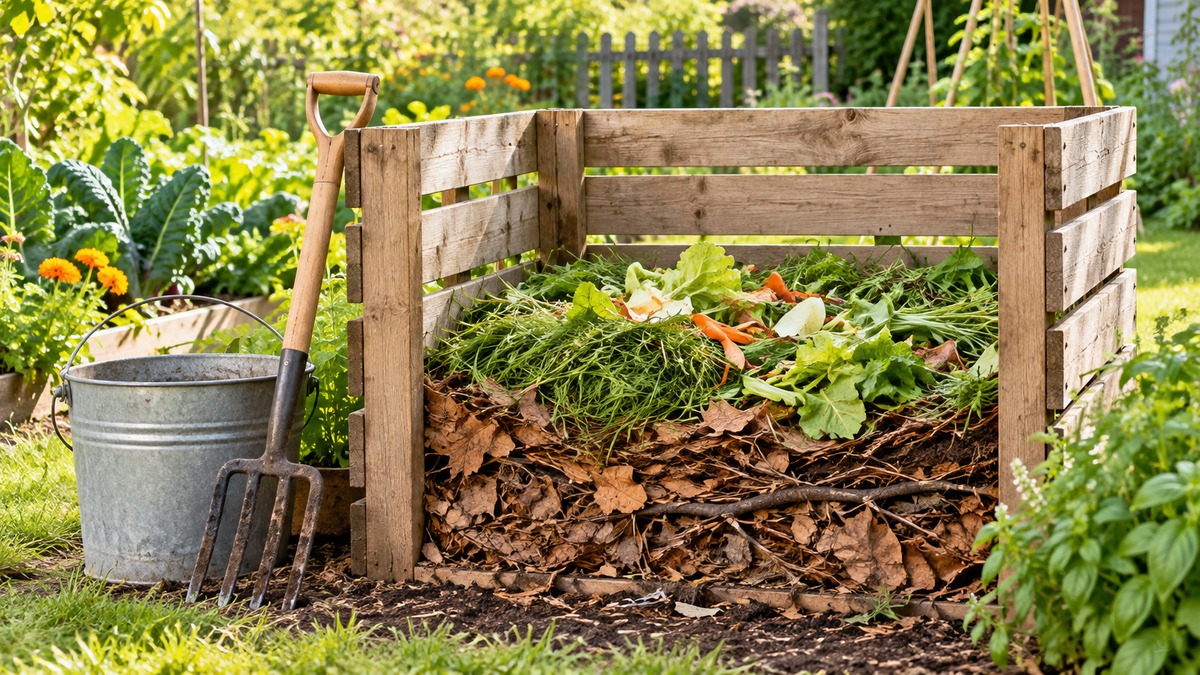
The EPA suggests a spot you can reach year-round, with good drainage, away from fences, and near a water source. Sun or shade both work. Bins can be made of wire, wood or cinder blocks, or you can use an enclosed barrel or a tumbler.
To keep out rodents, the EPA recommends a lid, possibly a floor, and no gaps or holes larger than 1/4 inch. For bin styles, see how to build a compost bin.
What goes in: greens and browns
The EPA splits the materials into two groups. Greens are nitrogen-rich: fruit and vegetable scraps, grass clippings, coffee grounds and paper filters, crushed eggshells, and paper tea bags without staples. Browns are carbon-rich: dry leaves, plant stalks and twigs, shredded non-glossy paper, shredded wax-free cardboard, and untreated wood chips.
Leave out meat, fish, bones, cheese, dairy, fats, oils and grease, which the EPA says can attract animals. Also leave out pet waste, cat litter, dryer lint, glossy paper, produce stickers, treated or painted wood, and plants treated with herbicide or showing disease or pests.
Build the first layers
Start with a base of 4 inches to 6 inches of bulky browns, such as twigs or dry leaves. Add the first greens on top, and chop tough scraps into smaller pieces to speed things up. Cover the food with 4 inches to 8 inches of dry leaves or other browns. Repeat the greens-and-browns pattern as scraps come in.
Worked example (arithmetic from the EPA ratio): Suppose a month of kitchen scraps adds up to 6 gallons of greens. The EPA asks for greens at least 2 to 3 times the browns by volume, so the browns for that month should be no more than 3 gallons, and no more than 2 gallons if you aim for the 3-times end of the range. Plan for 2 gallons to 3 gallons of browns, and keep a bag of dry leaves on hand so each food layer gets covered the same day.
Keep it moist and turn it
The EPA’s target is the consistency of a “wrung-out sponge.” If the pile is too dry, moisten it and turn it. If it smells bad, it may be too wet or need air, so add browns and turn it. If it is not heating, mix in greens and turn it. Turn the pile occasionally with a garden fork, moving material from the outside inward.
A well-maintained pile can reach 130 degrees to 160 degrees F, which the EPA says helps reduce pathogens and weed seeds.
How long it takes
Once the pile stops heating and no food scraps are visible, let it cure for at least four weeks. The EPA says the finished material shrinks to about one-third of its original size. A well-maintained pile is finished in about three to five months, and an untended pile may take a year. Screen the finished compost to remove anything that did not break down.
Mistakes to avoid
- Adding meat, dairy or oils. The EPA lists them as materials to avoid, and says some can attract animals.
- Using compostable bags or foodservice ware. The EPA says backyard piles generally do not heat enough to break these down.
- Leaving gaps larger than 1/4 inch. That is the EPA’s limit for keeping rodents out.
- Letting the pile dry out or stay soggy. Use the sponge test, and turn the pile when it smells or stops heating.
- Expecting finished compost in weeks. The EPA gives three to five months for a maintained pile.
For a bin that fits a small space, see how to start a compost bin and how to make a compost pile.
FAQ
Where should I put a new compost bin?
The EPA recommends a spot you can reach year-round, with good drainage, away from fences, and near a water source. Sun or shade both work.
What is the first layer?
Start with a base of 4 inches to 6 inches of bulky browns, such as dry leaves or twigs.
How much brown material do I need for kitchen scraps?
The EPA asks for greens at least 2 to 3 times the browns by volume. For 6 gallons of greens, that means 2 to 3 gallons of browns, as the worked example shows.
How do I know the pile needs attention?
The EPA says a dry pile needs moisture and turning, a bad smell means add browns and turn it, and a pile that is not heating needs greens mixed in and turned.
How long until the compost is ready?
The EPA says a maintained pile is finished in about three to five months. Cure it for at least four weeks after it stops heating.
Bottom line
A compost bin from scratch needs a sensible spot, a lid, and a steady routine of browns and greens. Start with a base of 4 inches to 6 inches of browns, keep greens at least 2 to 3 times the browns by volume, and turn the pile when it dries out, smells or stops heating. Expect three to five months for finished compost.
Sources
- U.S. EPA, Composting At Home (last updated December 8, 2025).