Building a Raised Garden Bed With Concrete Blocks
As an Amazon Associate we earn from qualifying purchases. Details
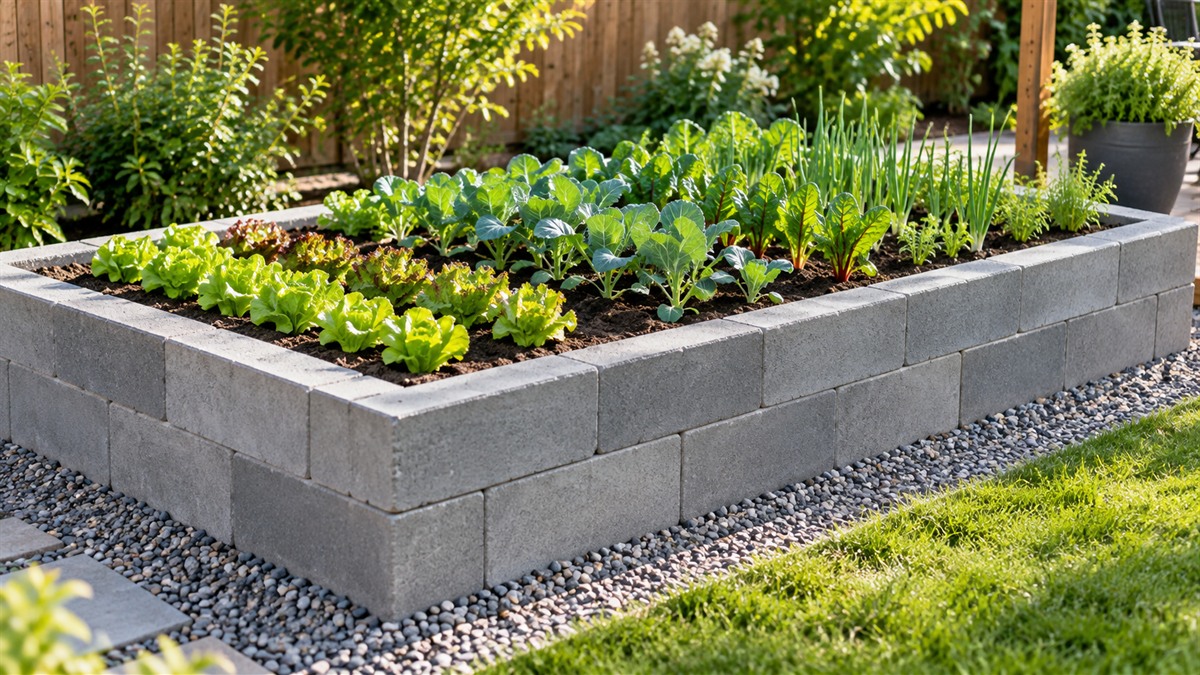
A concrete block raised bed is a ring of blocks around a bed of soil, and the main questions are what the blocks do to the soil and whether they are safe for vegetables. University extension sources agree that blocks are an accepted wall material. They also warn that blocks can raise soil pH over time and that older blocks may contain fly ash. This guide pulls together what eight extension pages say about block beds, shows where they disagree, and works out block counts and soil volume for a 4 by 8 foot bed. Source details are in the Sources section near the end.
Quick answer
Use new blocks, build on a level site that gets at least six hours of sun, keep the bed no wider than 4 feet so you can reach the middle, and test the soil pH after the first season. Lining the inside of the block walls with plastic is optional, and the bottom should stay open for drainage. The sources do not give a step-by-step method for laying blocks, so the steps below combine their site, size and reinforcement advice with plain layout arithmetic.
What the sources say about concrete blocks
- Accepted wall material. The Iowa State page lists concrete blocks among wall options, with decay-resistant wood, landscaping timbers, composite lumber, PVC, metal, rock and brick. Utah State, Oklahoma State, Alabama Extension, Maryland Extension and UF/IFAS also list concrete blocks.
- pH. UF/IFAS says concrete blocks “may result in an alkaline soil pH” but that the effect declines over time. An Ask Extension answer from 2015 says blocks slowly leach lime, which alters soil pH. A 2018 Ask Extension answer from Minnesota explains why it matters: it gives the ideal crop soil pH as 5.8 to 7.0 and says plants lose the ability to take up needed nutrients if soil gets too alkaline.
- Fly ash. The 2018 answer says older bricks and cinder blocks were made with fly ash, the residue from burning coal, which is not recommended for vegetable gardens, and advises using new materials. The 2015 answer says the fly ash raises the possibility that other compounds leach, but the expert found no conclusive research showing the blocks are dangerous and mostly anecdotal online claims.
- Liner. Both answers mention plastic. The 2015 answer says you can line the blocks with thick (6 mil) plastic and should not line the bottom, so the soil can drain. The 2018 answer says a plastic lining on the brick sides is an option if you worry about lime.
- Cracking. Oklahoma State says soil expands and contracts when it freezes and thaws, wood can bow out and masonry may crack, and reinforcing rods help give structural stability.
- Size. The Alabama Extension table lists concrete blocks in 8 by 8 by 16 inch and 4 by 8 by 16 inch sizes, and says frames from 4 by 4 feet to 4 by 12 feet are ideal, with a soil depth of 6 to 12 inches.
Where the sources disagree
UF/IFAS says used bricks, concrete blocks and other recycled materials “are an option” (it advises against recycled lumber for edibles). The 2018 Ask Extension answer says to use new materials because of the fly ash concern. Both are extension pages, and neither gives a test for telling a fly ash block from another block. Our reading: buy new blocks, or ask the seller what the blocks contain, instead of reusing old ones for food crops.
The sources also leave gaps. None gives a pH shift in numbers, none says how many years the lime effect lasts, and none gives a block-laying method. Treat any such figure you find elsewhere as unverified.
What you need
- New concrete blocks, such as the 8 by 8 by 16 inch size in the Alabama table. Measure yours, because the count below depends on block length.
- Soil mix or topsoil and compost. Maryland Extension suggests compost and garden soil or topsoil in a 1:2 or 1:1 ratio, and a soil test, including a lead test if you will grow food.
- Optional 6 mil plastic for the inside faces, cut to leave the bottom open.
- Rebar or reinforcing rods if your area freezes, per the Oklahoma State advice.
- A soil pH test kit or a lab test.
Steps
- Pick the site. Choose a spot with at least six hours of full sun (Iowa State) that is level and near water. UF/IFAS gives 6 to 8 hours and says the most convenient sites are flat.
- Remove the turf. UF/IFAS says to remove the top layer of grass or cover the turf with cardboard or newspaper.
- Set the size. Keep the width at 4 feet or less (UF/IFAS, Alabama). For access from one side only, Iowa State gives a maximum of 1.5 to 2 feet.
- Lay the first course level. Iowa State says to choose a level site and set the wall materials so the top is level. Check each block with a level before adding the next course.
- Reinforce. Iowa State says to secure walls firmly to prevent outward movement, and Oklahoma State recommends reinforcing rods where frost can crack masonry.
- Line the sides if you choose to. Use plastic on the inside faces only, and leave the bottom open.
- Fill and test. Fill with soil mix, then test pH. Iowa State gives a target of about 6.0 to 6.5, adjusted with lime or sulfur.
Worked example
This is planning arithmetic for a 4 by 8 foot bed, using 8 by 8 by 16 inch blocks. Your blocks and layout will differ.
- Perimeter along the wall centerline: 4 + 8 + 4 + 8 = 24 feet = 288 inches.
- One course of 16 inch blocks: 288 / 16 = 18 blocks. Two courses: 36 blocks, which gives a wall 16 inches high.
- The Alabama table lists 14 blocks for a 4 by 4 foot bed and 22 for a 4 by 8 foot bed. Our division gives 12 and 18 for one course, so the table’s counts are higher. It does not explain the difference, so count your own layout and buy a few spare.
- Soil for a 4 by 8 foot bed filled to 8 inches deep: 4 x 8 x (8 / 12) = 21.3 cubic feet. At 16 inches deep: 4 x 8 x (16 / 12) = 42.7 cubic feet.
- Reach check: a 4 foot width puts the middle 2 feet from each side, which matches the 2 foot reach Oklahoma State describes for an average adult.
Who should skip block beds
Skip them if you cannot confirm the blocks are new and cannot test the soil pH. Skip them for acid-loving plants unless you plan to test pH often; the sources do not name specific plants, but the pH reasoning above applies to any crop that needs acidic soil. Also skip them if you may want to move the bed later; Maryland Extension lists “relatively permanent” as a disadvantage of raised beds in general, and blocks are heavy to relocate.
Mistakes to avoid
- Reusing old blocks of unknown origin for food crops.
- Lining the bottom of the bed with plastic, which blocks drainage.
- Making the bed wider than 4 feet.
- Skipping the pH test after the first season.
- Assuming the block counts in a table fit your layout.
Products
This guide does not name any product. No Amazon listing was used.
Sources
Sources opened for this guide (opened 2026-10-18):
- Creating Raised Bed Planters, Iowa State University Yard and Garden (last reviewed March 2024).
- Raised Bed Gardening, Utah State University Extension (February 2012).
- Toxicity of concrete/cinder blocks used as a raised bed material in gardens, Ask Extension (answer by Deryn Davidson) (October 2015).
- Raising vegetable garden bed, Ask Extension (May 2018).
- Building Raised Beds, UF/IFAS Gardening Solutions (no publication date shown).
- Raised Bed Gardening (ANR-1345), Alabama Cooperative Extension System (April 2024).
- Raised Bed Gardening, Oklahoma State University Extension (no publication date shown).
- Building Raised Beds for Vegetable Gardening, University of Maryland Extension (updated November 2023).
FAQ
Are concrete blocks safe for a vegetable garden?
The extension pages we opened accept concrete blocks as a wall material. One 2015 Ask Extension answer found no conclusive research showing blocks are dangerous, and a 2018 answer advises new blocks because older ones may contain fly ash.
Do concrete blocks change soil pH?
UF/IFAS says they may result in alkaline soil pH, with the effect declining over time. Test the soil after the first season; Iowa State gives about 6.0 to 6.5 as a target.
Should I line a concrete block bed with plastic?
It is optional. The 2015 Ask Extension answer says to use thick 6 mil plastic on the block sides if you want a liner, and not to line the bottom so soil can drain.
How many blocks do I need for a 4 by 8 foot bed?
One course of 16 inch blocks needs about 18 by our arithmetic, and the Alabama Extension table lists 22. Count your own layout before buying.
Related guides
After the walls are up, see Best Way to Fill Raised Beds, Best Raised Bed Garden How Much Soil, and Best DIY Planter Box for Deck Railing.