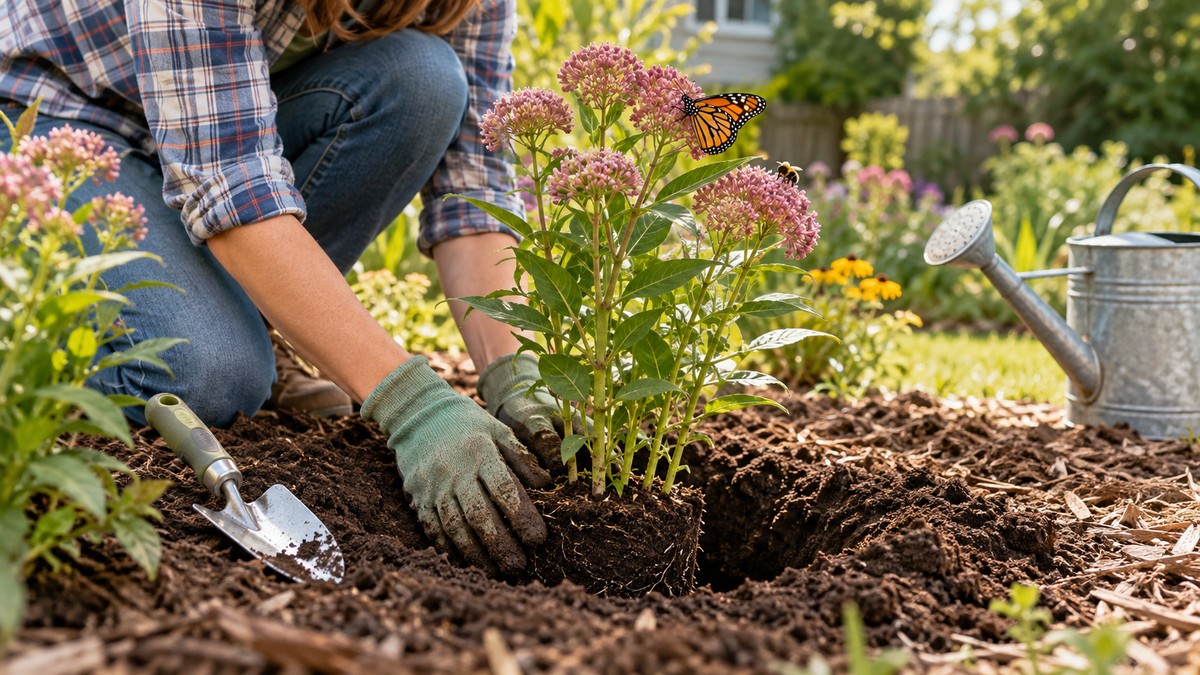
How to Plant Milkweed for Pollinators
As an Amazon Associate we earn from qualifying purchases.
Learning how to plant milkweed is mostly about matching the plant to your site, giving it room and choosing a sowing method that fits the season. Milkweed is the larval host plant for the monarch butterfly, and it draws bees and other pollinators to its flowers. The guidance below comes from three sources written for different places: a University of Florida guide, a University of Vermont Extension article and a USDA Natural Resources Conservation Service guide for Georgia. Where the advice is regional, the text says so.
Quick answer
- Choose a native species that fits your light, soil and moisture. The Florida guide calls this the best decision for planting.
- Give plants room. Monarchs reach milkweed more easily when there is clear ground around it, and the Florida guide describes about 3.3 to 5 feet from surrounding vegetation.
- Sow seed in fall, or cold-treat it before a spring sowing. Set transplants out after the danger of frost has passed.
- Do not plant tropical milkweed where it keeps growing through winter, and keep livestock away from milkweed.
Start with a native species that fits your site
The Florida guide puts the choice of species first: “First and foremost, the best decision for production or planting is to choose a milkweed that is native to the area and adapted to local water, sun, and soil conditions.” It gives examples that show how much moisture needs differ. The table lists them with the conditions the guide states.
| Milkweed named in the Florida guide | Moisture or soil need the guide gives |
|---|---|
| Swamp milkweed (Asclepias incarnata) | Moderate to moist soils |
| Aquatic milkweed (Asclepias perennis) | Much wetter environments |
| Butterfly milkweed (Asclepias tuberosa) | Dry, sandy soils |
The guide’s advice for matching species to a spot is direct: “When choosing a native milkweed, pay close attention to the light, soil, and water requirements for each species to match the right plant to the right planting site.” The Vermont article takes the same line on sourcing. It says that “It is important to purchase locally sourced seeds or plants.” Local stock is one practical way to follow the native-species advice.
Native species also differ in the space they need. The Florida guide warns that “These milkweeds tend to spread via underground rhizomes to quickly form large colonies, which can be good for large spaces but bad for smaller spaces where you want to maintain other plant species.” Compact species are a better fit for small beds: “Other milkweeds, like butterfly milkweed or aquatic milkweed, are compact and low-growing and thus more appropriate as garden edge plantings or even container plantings.” Taller species suit looser plantings, since the guide notes that “Some milkweeds grow very tall and are well-suited for more natural landscapes or less manicured plantings”.
If you want a bed that can sit between a formal garden and a meadow, the guide offers a middle option: “Monarch waystations can be a happy medium between highly manicured gardens and more naturalistic wildflower patches, and these waystations can fit in typical garden beds or smaller gardens that may be limited in space.” For the bed work before planting, see our guide to creating a flower bed from scratch.
Give monarchs room to reach the plant
Placement changes how many monarchs use the plants. The Florida guide says that “Milkweed plants will be most frequently colonized by monarchs when more of the plant’s vegetation is visible and accessible to adults.” It recommends clear ground around the plants: “when possible, planting milkweed with at least some clear area around it can allow monarch butterflies to easily access the entire plant, not just the top.”
The guide cites a two-year study that compared spacing directly. It describes milkweed gardens “structured with adequate space to allow butterflies full access to the plants, about 1-1.5 m (3.3-5 ft) from surrounding vegetation,” which “attracted approximately five times more eggs and larvae than did milkweed gardens with unstructured, crowded planting arrangements.” That figure comes from a Florida study, so treat it as a regional result that suggests a principle for other places.
Layout matters as well. The guide’s design advice is to plant “milkweed on the perimeter to increase use by monarch butterflies, with plentiful nectar plants inside the perimeter”. It explains the reason for nectar: “It is important to plant plenty of nectar sources to attract adults as well as ample milkweed for the larvae to consume.” Adults feed on nectar, and larvae feed on the milkweed itself, so a bed needs both.
Sow seed in fall, or cold-treat it first
Timing depends on whether you sow seed or plant transplants. The Vermont article says that “If sowing seeds, the ideal time to plant is fall as the seeds require cold stratification.” The USDA guide gives the reason: “Fall planting exposes the seed to cold and moist conditions (stratification) triggering germination in most native seeds.” Fall sowing lets winter do the cold treatment outdoors.
If you miss the fall window, you can cold-treat seed indoors. The Vermont article gives its method: “place the seeds in moist paper towels in a plastic bag or container in a refrigerator with the temperature at 40 degrees Fahrenheit for a minimum of three weeks to three months.” The USDA guide describes a different method, with seed mixed into sand, sawdust or vermiculite in a sealed bag and kept at “35-40oF” for “4-6 weeks,” and then planted at once. The two cold periods differ, so the table shows both.
| Method | Cold treatment the source gives | Source |
|---|---|---|
| Fall sowing outdoors | Winter cold and moisture trigger spring germination | University of Vermont Extension; USDA NRCS Georgia |
| Refrigerator, moist paper towels | 40 degrees Fahrenheit for three weeks to three months | University of Vermont Extension |
| Refrigerator, sealed bag with sand or vermiculite | 35 to 40 degrees Fahrenheit for 4 to 6 weeks, then plant right away | USDA NRCS Georgia |
The Vermont article also warns about spring sowing: “You can sow seeds in the spring, but they will need to be cold-treated for a high germination rate.” The USDA guide makes the same point with its own wording, saying that “Artificial stratification is recommended for spring planting to enhance germination.”
Set transplants out after the last frost
Transplants follow a different calendar. The Vermont article says that “For transplants, wait until early spring after the danger of frost has passed to plant.” It also warns about fall transplanting: “Fall planting may not give them adequate time to get established before winter.” If you buy plugs or containers, follow the transplant timing.
The USDA guide gives spacing for planting live material, which is aimed at larger plantings than a home bed. It says to “Plant seedlings in clumps of 10 to 20, 2-5 feet apart.” The same guide notes that “Seedlings: Live plants in the form of plugs, or containerized material can be used if available.” For a single home bed, the clearance in the Florida study is the more relevant figure, and the clump spacing is a larger-scale option.
Look after the plants while they establish
Water and heat matter during the first season. The Florida guide says that stress is more likely “if the milkweed is stressed due to a mismatch between its environmental requirements and its planting site, or if the plant is experiencing water stress, extreme heat, or extreme cold.” The guide ties that stress to the species and site mismatch described above.
If you water by hand or with a hose, our post on hose attachments for watering plants covers the options. The guide also recommends regular checks: “Scout plants frequently for pest infestations to detect them before they become a problem.” It does not give an interval for those checks, so the timing is yours to set.
Cut back and let the seed disperse
The end of the season has a simple rule in the Vermont article: “Milkweed can be cut back after it has gone to seed and the fluffy white seeds have dispersed, usually around mid-October.” If the pods still hold seed by then, the article says that “you can open the pods and help disperse them yourself.” The article ties the cut-back to the point after the seed has dispersed.
Avoid tropical milkweed where it stays green
Tropical milkweed needs its own rule. The Florida guide explains that “As a tropical species, A. curassavica does not senesce (die back) in the winter and grows year-round in warm climates like Florida if there is no hard freeze, unlike most native milkweed species.” Because of that habit, the guide notes that the plant “is listed as an invasive species in north, central, and south Florida” and concludes that it “should not be planted in Florida landscapes”.
The USDA guide for Georgia gives the same warning in plain terms: “Do not plant Tropical (Mexican) Milkweed (Asclepias curassavica) as this species continues to grow and produce flowers into the winter and fall which disrupts monarch migration.” The Florida guide also flags other non-native milkweeds. It lists giant milkweed and balloon milkweed as posing “High Invasion Risk” in the state’s natural areas, so check the invasive status of any milkweed before you buy it.
Keep livestock away from milkweed
Milkweed is a plant to keep away from animals that graze. The USDA guide says that “Milkweed plants contain cardenolides which is toxic to livestock.” It adds that “Milkweed poisoning is rare but may occur if fed hay containing milkweed or overstocking livestock in areas where milkweed is present.” The advice is to “keep milkweed out of livestock trails, or do not allow livestock in areas where milkweed is present.” That guidance is written for pasture and farm use, but the principle applies to any yard where animals graze.
Mistakes to avoid
- Choosing a species that does not match the site’s moisture. The Florida guide ties stress to that mismatch.
- Planting too close to other plants. The study the guide cites found that crowded plantings drew far fewer eggs and larvae.
- Planting only in the center of a bed. The guide’s design advice puts milkweed on the perimeter, with nectar plants inside.
- Planting tropical milkweed where it keeps growing in winter. The sources say it disrupts monarch migration and should not be planted in Florida landscapes.
- Planting transplants in fall. The Vermont article says fall planting may not give them time to establish before winter.
- Cutting back before the seed has dispersed. The Vermont article ties the cut-back to mid-October, after the seed is out.
How we chose
We chose three extension and agency guides on planting milkweed for monarchs and pollinators, and we opened each one with curl on 2026-10-22. The Florida guide is written for Florida, the Vermont article covers general planting timing, and the USDA guide is a Georgia habitat standard, so each one is labeled with its region. We drew on each guide for the points it states, and we checked every quoted sentence against its text. Where the advice differs, for example on the cold period for refrigerated seed, we show both figures. We did not use search results that we did not open, and we left out a commercial seed-seller page that appeared in search results.
What we could not verify
Milkweed planting depends on the species, the region and the local monarch population, and three guides cannot cover every combination. The notes below mark what they leave open for a planter to check.
What the sources do not say
The pages we opened do not give a planting depth for milkweed seed, so this article does not state one. They do not say how many years a planted milkweed takes to flower, and they do not give a seed rate for a home bed. The Florida guide is written for Florida conditions, and the USDA guide is written for Georgia habitat, so the clearance figure and the cold periods may not match every climate. Finally, the pages do not say which native milkweed species suits a given yard in a given state, so this article does not name one.
Frequently asked questions
Can you plant milkweed from seed in spring?
Yes, but the seed usually needs a cold treatment first. The Vermont article says that spring-sown seed “will need to be cold-treated for a high germination rate”, and the USDA guide says artificial stratification is recommended for spring planting.
When should you cut milkweed back?
After the seed has gone and the fluffy seeds have dispersed. The Vermont article says that is usually around mid-October, and it suggests opening any pods that still hold seed.
How far apart should milkweed plants be?
For a home bed, the Florida guide’s study points to about 3.3 to 5 feet from surrounding vegetation, so that monarchs can reach the whole plant. For larger plantings, the USDA guide suggests clumps of 10 to 20 plants spaced 2 to 5 feet apart.
Is milkweed safe around livestock?
Not in a grazing area. The USDA guide says milkweed contains cardenolides that are toxic to livestock, and it recommends keeping livestock out of areas where milkweed grows.
Should you plant tropical milkweed?
The sources advise against it in the places they describe. The Florida guide says it should not be planted in Florida landscapes, and the USDA guide says not to plant it because it can disrupt monarch migration.
Sources
- https://ask.ifas.ufl.edu/publication/IN1482/pdf (opened 2026-10-22)
- https://www.uvm.edu/extension/news/marvelous-milkweed (opened 2026-10-22)
- https://efotg.sc.egov.usda.gov/api/CPSFile/41431/420_GA_GD_Monarch-Habitat_2023_pdf (opened 2026-10-22)