How to Grow Tomatoes in Containers
As an Amazon Associate we earn from qualifying purchases.
Learning how to grow tomatoes in containers comes down to three choices: the plant, the pot and the watering routine. Container tomatoes dry out faster than tomatoes in the ground, so the pot and the watering habit matter as much as the variety you pick. Most extension guides agree on the basics, and they differ mainly on pot size.
This guide draws on five university extension pages from Clemson, Wisconsin, Oregon State, Maine and North Carolina. Where they disagree, we show the difference in a table rather than choosing one number for you.
Quick answer
- Choose a compact or determinate plant. Clemson warns that a tall indeterminate plant “will not be successful in a 12-inch pot.”
- Use a container of at least 5 gallons with drainage holes, and place it where it gets six to eight hours of direct sun.
- Fill it with a soilless potting mix rather than garden soil, then water until it drains and wait until the mix no longer feels moist.
- Feed on a schedule, and expect to water daily in the heat of summer.
Pick a plant that fits a pot
Growth habit decides how much room the plant needs. Clemson explains that indeterminate types “will continue growing taller until frost, making them difficult to grow in containers.” Its advice is to look for names that signal a compact habit, such as “patio,” “balcony” or “bush”. Read the expected height on the label before you buy.
North Carolina A&T uses the same split. It notes that determinate types “will grow to a certain size and stop growing”, while indeterminate or vining types “will continue to grow and produce fruit all season long.” The extension team says that this constant growth “is difficult to manage in a container.” A cherry tomato can still work, but the NC A&T guide says that those plants need to be pruned. North Carolina A&T also advises that you “Look for compact varieties, as they lend themselves better to container production.”
Wisconsin’s Marinette County guide adds that indeterminate varieties “may also need some type of support to keep the growth somewhat upright.” If you choose one anyway, plan for a stake or cage at planting time, not after the plant has flopped over.
Choose a container and drainage
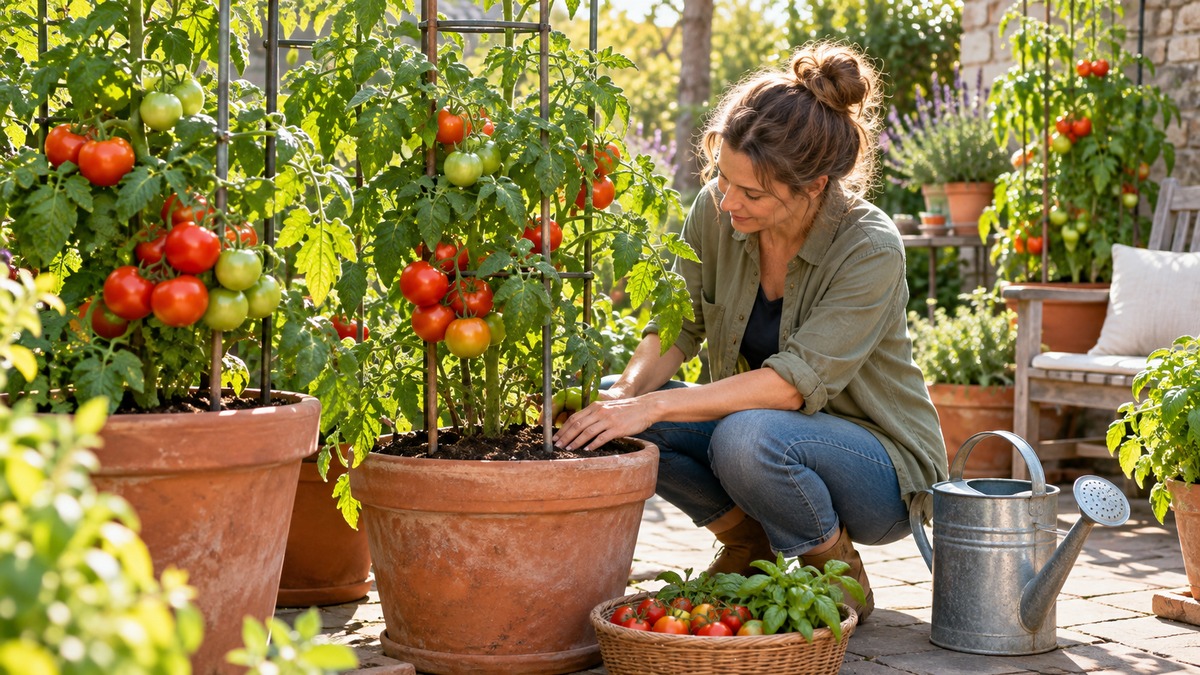
Size is where the sources differ most. Oregon State says that “For deeper roots – tomatoes, peppers and eggplant – five-gallon containers are best”, and the University of Maine table lists a 5-gallon bucket for one tomato plant. Wisconsin says the pot “should be bigger than a 5 gallon bucket” for a plant that keeps growing through the season. Clemson accepts a smaller range for compact plants: “A 14-inch to 20-inch container is suitable for most compact cultivars.” It also says that “A five-gallon bucket with holes drilled into the bottom would also work.”
The table below puts the size guidance side by side. Each row uses only what that page states, and the growth habit column shows which type the figure applies to.
| Source | Container size the source gives | Plant type the figure applies to |
|---|---|---|
| Clemson HGIC | A 14- to 20-inch container, or a five-gallon bucket | Most compact cultivars |
| UW-Madison Extension, Marinette County | Bigger than a 5-gallon bucket | Plants that keep growing through the season |
| Oregon State Extension | Five-gallon containers | Tomatoes, peppers and eggplant |
| University of Maine Extension | 5-gallon bucket for one plant | Tomatoes |
| NC A&T Cooperative Extension | At least five gallons | Tomatoes, peppers and eggplant |
Almost any container can work. Oregon State lists “bushel baskets, metal drums, gallon cans, plastic tubs, wooden boxes and well-rinsed cutoff jugs”, but the size guidance above still applies when the plant is a tomato.
Drainage is not optional. North Carolina A&T says to “Make sure containers have drainage holes on the bottom to avoid the possibility of drowning plants.” Oregon State suggests that you “make sure the potting mix drains well”, and it advises to “Elevate pots on bricks or boards so water can escape.” Wisconsin offers a workaround for large pots: you can “put drainage holes a few inches off the bottom on the sides, instead of the bottom”, which “creates a water reservoir that the tomato roots can utilize.”
Container color and material matter as well. North Carolina A&T advises a light color for plastic pots, because “Dark-colored plastic containers hold excess heat, increasing soil temperature and possibly damaging roots in summer.” It also notes that “Porous containers, such as clay or terra cotta, will require more frequent watering.” Choose the material with the watering habit you can keep.
For planter options, see our roundup of extra large planters.
Fill the pot with the right mix
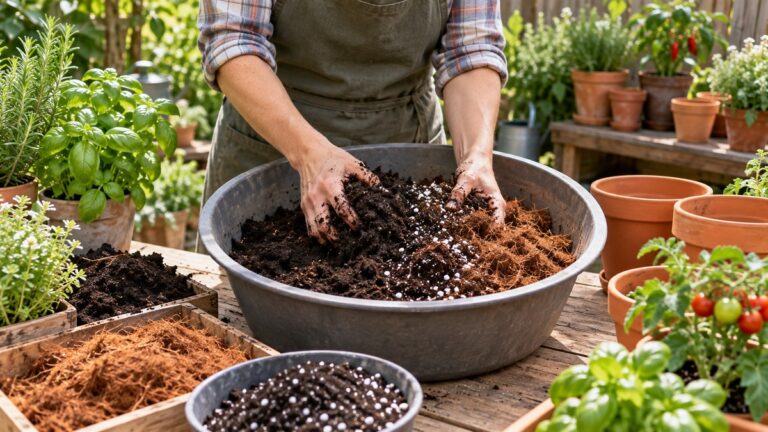
Use a potting mix, not soil from the yard. Oregon State says “Do not use topsoil”, and that topsoil and general planting mixes “can be heavy and drain poorly.” Wisconsin explains the reason for a light mix: “This mix is much lighter than soil from the garden, allowing you to move the container around if needed.”
North Carolina A&T describes a good mix as one that is “free of disease and weed seeds, hold moisture and nutrients, drain well, are lightweight, and have good fertility.” Oregon State adds that these mixes are “lightweight, sterile and well-draining.”
The University of Maine suggests that you can “mix your own with garden soil, compost, peat, and vermiculite” if you do not want to buy a bagged mix. Wisconsin also accepts a homemade blend. It says that if the compost “allows sufficient drainage, it can actually be used as the only material.” Whichever mix you choose, fill the pot to within about an inch of the rim after the first watering, so there is room for water.
Place the pot in full sun
Sun is the first requirement. Clemson states that “Tomatoes need a minimum of six hours of full sun exposure.” Wisconsin is more precise about what counts: “Full sun is considered to be direct sunlight (not partial shade) for more than 6-8 hours daily.” Oregon State says tomatoes “need six to eight hours of direct sun each day”, and Maine recommends that the container get “at least 6 hours of sun each day.”
Clemson also recommends a spot that is “easy to access for watering and harvesting”, which matters when a pot needs water every day in summer.
Heat is the other side of sun. Oregon State warns that “Containers dry out quickly, especially on concrete in full sun.” Wisconsin notes that “In full sun and off the ground, the soil media may actually get too hot, causing significant problems,” and suggests thinking about soil temperature when you place the pot.
Water on a steady schedule
Water is where most container plants go wrong. Wisconsin recommends a simple routine: “Each time you water, you should add enough water so that it begins to drain out of the bottom of the container.” Then “wait until, when you push your finger into the soil, it does not feel moist before you water again.” It adds that in summer this “may be twice a day, particularly with smaller containers.”
Clemson sets the summer expectation directly: “Container-grown tomatoes will require close monitoring for moisture, needing daily watering in the height of summer.” North Carolina A&T gives a weekly target: “Tomatoes need about one inch of water per week”. Oregon State advises that you “Water when the soil feels dry and continue until water runs from the drainage holes.” Maine warns that “Plants in containers dry out more quickly than plants that are in the ground: you may have to water them daily.”
Wisconsin links blossom end rot to “inconsistent watering, which is a very, very common occurrence with containerized tomatoes.” The same guide says that a lack of calcium in the mix can cause the same problem, so an uneven watering schedule and a poor mix can produce the same damage. Water on a schedule you can keep, rather than a heavy soak once a week.
Feed the plant through the season
A pot runs out of nutrients faster than a garden bed. Wisconsin says that a soilless mix “may not have enough nutrients added to give adequate food to the plant for the whole season”, and recommends that you “Check the label.” Clemson suggests “a balanced fertilizer applied as a timed-release pellet at planting and at intervals according to package instructions.”
If you prefer liquid feeding, Oregon State recommends “A soluble, all-purpose fertilizer mixed with water”, applied “every three to four days at half-strength of the labeled mix.” Maine takes a slower schedule and suggests that you “water with a balanced (20-20-20), water-soluble fertilizer, mixed as directed, every other week in summer.” Pick one approach, follow the label, and write the dates down so you do not double up.
Plant, space and support
Set one plant in each container. North Carolina A&T says “Set one plant per container”, and Maine asks you to “Keep all plants at least one inch away from the side edge of the container so they don’t get too hot.” Fill the pot to within an inch of the top, and press the mix down lightly around the stem.
Plan support before the plant gets heavy. Wisconsin says indeterminate types may need support, and Clemson notes that “It is important that whatever container you choose is large enough and has drainage holes.” A cage or stake placed at planting is far easier than tying up a sprawling plant later. For cage options, see our roundup of tomato cages.
Watch for problems the pot can cause
Many container problems start with the pot rather than the plant. Wisconsin notes that a plant which dries out too much cannot move enough calcium to the fruit, and it describes blossom end rot as a common result. Heat is the second problem. Wisconsin notes that soil in a pot that sits in full sun and off the ground can overheat, and North Carolina A&T says that dark plastic containers “hold excess heat”. Use a light-colored pot if it is plastic, and keep the water schedule steady.
Pick often and keep the pot clean
The University of Maine guide says to “Pick your vegetables when they are ripe so the plant will continue to set more fruit.” It also says to “Pull any weeds out of your container.” Oregon State gives a seasonal note for the same pot: after the spring and early summer harvests, you can “replant containers with late-summer and fall vegetables.” Planning the next crop before the first harvest ends keeps the pot in use through the season.
Frequently asked questions
What size pot works best for a tomato?
Start with five gallons. Oregon State and North Carolina A&T both recommend at least five gallons for tomatoes, and the University of Maine lists a 5-gallon bucket for one plant. Clemson accepts a 14- to 20-inch container for compact plants, but says that indeterminate plants will not do well in a 12-inch pot.
How often should container tomatoes be watered?
Check the mix with your finger. Wisconsin advises that you wait until the mix no longer feels moist before watering again. Clemson expects daily watering at the height of summer, and North Carolina A&T puts the weekly target at about one inch.
Do tomatoes in pots need full sun?
Yes. Clemson gives a minimum of six hours, while Wisconsin and Oregon State use six to eight hours of direct sun. A spot with less sun may still grow a plant, but the sources do not promise a full harvest from it.
Is garden soil usable in a container?
Avoid it on its own. Oregon State warns that topsoil and general planting mixes can drain poorly, and Wisconsin says a potting mix is much lighter than garden soil. If you blend your own, the University of Maine lists garden soil alongside compost, peat and vermiculite.
Why do the fruit ends turn black in a pot?
Wisconsin describes blossom end rot as the result of a lack of calcium in the mix or of uneven watering. The guide calls inconsistent watering a very common cause with containerized tomatoes. Keeping the watering schedule steady is the practical step the sources support.
What we could not verify
The sources do not agree on one pot size. Clemson accepts a 14- to 20-inch container for compact plants, while Oregon State and North Carolina A&T recommend at least five gallons. The table lists each figure, and we did not decide which one is right for every plant.
What the sources do not say
The pages we read do not give a yield per container, so this guide makes no promise about how many tomatoes a pot will produce. We also did not confirm that any of the five pages is the most current edition of its guidance.
How we chose
We chose five extension pages that we could open and read on 2026-10-22: Clemson’s Home and Garden Information Center page, the Marinette County Extension guide to a tomato in a container, the Oregon State news release on container vegetables, the University of Maine bulletin on container vegetable gardening, and the North Carolina A&T guide on fruiting vegetables in containers. We kept only statements that appear word for word in the fetched text. Other search results were not opened and are not cited.
Sources
- https://hgic.clemson.edu/tomatoes-in-containers/ (opened 2026-10-22)
- https://marinette.extension.wisc.edu/horticulture/container-gardening/tomato-in-a-container_sr (opened 2026-10-22)
- https://extension.oregonstate.edu/es/node/146716/printable/print (opened 2026-10-22)
- https://extension.umaine.edu/publications/?p=4567 (opened 2026-10-22)
- https://www.ncat.edu/caes/cooperative-extension/covid-19/files/growing-fruiting-vegetables-in-containers.pdf (opened 2026-10-22)