Best Garden Stakes
As an Amazon Associate we earn from qualifying purchases. Details
The best garden stakes for most beds are the ones that match the plant you are supporting, the height you need and the way you plan to join the pieces. This guide compares six plant support stakes from five brands. A search for garden stakes on Amazon returns mostly landscape staples, which are ground pins for fabric, so this guide covers only stakes that hold up plants. Steel, bamboo and fiberglass are the three materials on the page, and the bullets describe each one differently. Check the length and the connector count before you order.
Quick answer
- Choose by the plant. Tall climbing plants need a longer stake or a set that joins, and the listings with connectors describe that use.
- Pick the material from the listing. PROWORX and the 20-pack from SupKing describe steel, HAINANSTRY and BOVITRO describe bamboo, and the 17-inch SupKing set and MAXPACE describe fiberglass.
- Count the length in the pack. Twenty stakes at 17 inches add up to 28.3 feet, and 25 stakes at 36 inches add up to 75 feet.
- Clean the stakes before you store them. Illinois Extension advises cleaning the cages and stakes before they go back into the garden.
What a plant support stake has to do
A plant support stake has to hold a stem upright while the plant grows, and it has to stay in the ground while the wind pushes on it. The listings describe those two jobs in their bullets: “support,” “climb,” “upright,” “stable” and “stays put” appear throughout. Most of them also describe how the stake is joined to a second stake, because a tall plant rarely fits one piece. The rest of this guide uses those bullet statements as listing claims and does not add performance figures the pages do not give.
The first decision is length. The stakes in this group run from 17 inches up to a 36-inch single piece, and the joined sets reach 3, 4 or 5 feet, or longer with more connectors. HAINANSTRY lists sizes of 16 inches, 18 inches, 3 feet, 4 feet and 4.8 feet. SupKing’s steel stakes are described as extendable to 36, 54 and 72 inches. A single stake is the simplest setup, but a joined set gives you the height that a tall vine needs.
The second decision is how the stake enters the soil. PROWORX describes a “pointed tip design” that makes the stake “easy to insert into the ground.” BOVITRO describes bamboo pieces that are “manually cut,” so each stake may differ slightly in size, and the bullets say this “does not affect its usability.” That difference is the kind of detail that matters for a row of identical stakes, so check the tip and the diameter before you order a large set.
The third decision is the tie and the clip. HAINANSTRY and BOVITRO both include green ties. The SupKing 20-pack describes ring buckles that “can be freely moved up and down on the garden stake,” and the steel SupKing set includes 20 rotating clips and 30 plant straps. The MAXPACE kit includes 14 rotatable clips and 14 plant clips. The clip is what keeps a stem against the stake, so count the clips against the number of stems you need to support.
Steel, bamboo and fiberglass
Steel is the material for the widest spread of heights in this group. PROWORX describes “premium steel construction” with a “rust-resistant” green coating, and says its 3-foot stakes suit “climbing plants-cucumbers, tomatoes, and eggplants.” The steel SupKing set describes a steel pipe with a “fade-resistant green plastic coating” and says the coating has “excellent UV resistance and chemical resistance.” Both listings describe the metal as more durable than bamboo, though neither gives a figure for how much longer it lasts.
Bamboo is the lightest option. HAINANSTRY describes “premium natural bamboo” and says its sticks are “built to last” and can be reused “season after season.” BOVITRO describes its bamboo as “very strong and durable” and says each stake was “inspected manually.” BOVITRO also includes a caution that matters for buyers: its bullets say the bamboo is “suitable for small potted plants, but not for large plants like money tree and ficus Iyrata.” That line is the clearest limit in the group, and it means bamboo is a choice for smaller plants rather than the heaviest climbers.
Fiberglass sits between them. The 17-inch SupKing set describes “high quality fiber-glass material that will not rot easily like wood and does not rust like iron while using in damp or rainy environments.” MAXPACE describes its fiberglass as “incredibly sturdy and durable,” says the stakes “will never rust,” and adds that the green color “won’t fade.” Those are the listing statements. This guide does not verify them, and it does not compare the fiberglass sets against the steel or bamboo sets on strength.
The material choice comes down to the plant and the use. For a tall tomato or a long climbing bean, the steel sets give the widest height range in the listings. For a potted orchid, a small herb or a light vine, the bamboo sets describe the right size and weight. For a damp bed where the listing’s claim about rust matters, the fiberglass sets describe the material most directly.
Length, connectors and the count
The table below lists each listing’s pack count, length as stated, and the joining parts that come with it. Use it to decide how many stakes you need before you compare the materials.
| Listing | Pieces | Length as listed | Joins or ties included | Material as listed |
|---|---|---|---|---|
| PROWORX | 25 | 36 inches | Not described | Steel, rust-resistant coating |
| HAINANSTRY | 20 | 18 inches, with 16 inch, 3 foot, 4 foot and 4.8 foot sizes | 20 green ties | Bamboo |
| BOVITRO | 20 | 18 inches | Green ties | Bamboo |
| SupKing (fiberglass) | 20 | 17 inches | 16 ring buckles and 10 connectors | Fiberglass |
| SupKing (steel) | 20 | 18 inches | 13 extension connectors and 20 clips | Steel with green plastic coating |
| MAXPACE | 20 stakes in a 62-piece kit | 17 inches | 14 connectors, 14 rotatable clips and 14 plant clips | Fiberglass |
The count arithmetic shows how much stake a pack really gives you. The SupKing fiberglass set has 20 stakes at 17 inches, so 20 times 17 is 340 inches of stake. Divide that by 12 and you get 340 divided by 12 is 28.3 feet. PROWORX lists 25 stakes at 36 inches, so 25 times 36 is 900 inches, and 900 divided by 12 is 75 feet. These totals are the length you hold in your hands, not the height any one plant reaches, and they are a quick way to compare packs that list different lengths.
Connectors change the height. The SupKing fiberglass pack includes 10 connectors, and the MAXPACE kit includes 14. A joined stake is only as tall as the number of pieces you join, and the bullets say the SupKing steel set can reach 36, 54 and 72 inches with its connectors. That is a listing claim. It tells you what the parts allow, not how tall any given plant will grow.
Check the piece count against the number of plants. A bed with 6 tomato plants that need two stakes each needs 12 stakes, which fits a 20-piece set with spares. A row of 25 plants with one stake each needs 25 stakes, which is the reason PROWORX’s 25-piece pack is the one to look at.
Setting stakes in the bed
Set the support as part of planting, not after the plant has grown into the space. The listings describe the tip and the joins, but none of them says when to set the stake, and the Illinois Extension post does not give a planting-time rule.
Space the stakes with the plants in mind. In one Illinois Extension post, the author writes, “If staking, I tend to space them with a stake every two plants.” That is one gardener’s practice, and it is a useful starting point for a row rather than a rule. Longer climbers may need one stake per plant, and a light herb may need only one stake for several plants.
Clean the stakes at the end of the season. The same Illinois Extension post advises, “Before they go back into the garden, you should clean the cages and the stakes.” That advice applies to the bamboo, steel and fiberglass sets in this group, and it takes only a few minutes with a cloth before the stakes go into storage.
The ties and clips need as much attention as the stakes, because the listings count them differently. HAINANSTRY includes 20 green ties with its 20 stakes, and BOVITRO includes green ties in its 20-stake package. The steel SupKing set lists 20 rotating clips and 30 plant straps, which gives more straps than stakes, so the extra straps are the ones to keep for re-tying a stem as it grows. The MAXPACE kit lists 14 rotatable clips and 14 plant clips for its 20 stakes, so a row of 20 plants with one clip each would need more clips than the kit includes. Count the clips against the stems before you order.
1. 36 Inch 3 Ft Plant Support Garden Stakes for Outdoor Plants, 25 PCS (25 steel plant support stakes, 36 inches)
Pros
- The bullets describe premium steel construction with a green rust-resistant coating
- The bullets give a 36 inch item length and a pointed tip for insertion into the ground
- The bullets say the raised ridges offer grip for climbing plants such as cucumbers and eggplants
Cons
- The bullets do not describe connectors, so a single piece is the height you get
- The bullets do not say whether ties or clips are included in the 25-piece pack
Best for: A gardener who wants a single-piece steel stake for climbing crops in a row
Skip if: You need a stake taller than 36 inches without buying joins
View on Amazon (affiliate link)
2. Plant Stakes 18inch, HAINANSTRY 20Pcs Natural Bamboo Sticks Garden Stakes (20 bamboo stakes in five sizes with green ties)
Pros
- The bullets say each package includes 20 bamboo stakes and 20 green ties
- The bullets list 16 inch, 18 inch, 3 foot, 4 foot and 4.8 foot sizes
- The bullets describe the stakes as suitable for potted orchids, young tomato plants and beans
Cons
- The bullets do not give a stake diameter or a load rating
- The bullets do not say how the bamboo performs in wet soil over a season
Best for: A grower with several small plants who wants bamboo stakes with ties in one pack
Skip if: You need a stake for a large climbing plant
View on Amazon (affiliate link)
3. Plant Stakes,18IN Natural Garden Bamboo Sticks, 20Pcs Plant Support Stakes (20 natural bamboo stakes, 18 inches, for small plants)
Pros
- The bullets say the bamboo is high quality, strong and durable and inspected by hand
- The bullets describe the stakes as suitable for tomatoes, beans and potted plants
- The bullets include 20 green ties with the 18 inch stakes
Cons
- The bullets say the stakes are not for large plants such as money tree and ficus
- The bullets say each stake may vary slightly in size because the bamboo is hand cut
Best for: An owner of small potted plants who wants a natural bamboo stake with ties
Skip if: You need a stake for a heavy or tall climber
View on Amazon (affiliate link)
4. 20Pcs Plant Support Stakes 17 inch SupKing Garden Orchid Sticks Extended to 3ft 4ft 5ft Plant Poles (20 fiberglass stakes that extend to 5 feet)
Pros
- The bullets describe fiberglass sticks that the listing says will not rot like wood or rust like iron
- The bullets say the pack includes 16 ring buckles and 10 connectors to extend the length
- The bullets describe clips and ties for indoor and outdoor plants such as tomatoes, roses and orchids
Cons
- The bullets give a 0.25 inch diameter but no load rating for the sticks
- The bullets do not say how many joins the connectors can take
Best for: A grower who wants fiberglass stakes that join into a taller support
Skip if: You want a single-piece steel stake for a row of climbing crops
View on Amazon (affiliate link)
5. Sturdy Garden Stakes 18 Inch SupKing DIY 3/4/5/6/7ft Tomato Support Stake Green Plastic Coated (20 green steel stakes with 13 extension connectors)
Pros
- The bullets describe steel pipe with a fade-resistant green plastic coating and UV resistance
- The bullets say the stakes extend to 36, 54 and 72 inches with connectors
- The bullets include 20 rotating clips and 30 plant straps in the set
Cons
- The bullets do not give a coating thickness or a warranty period
- The bullets describe the stakes as Heavy Duty without a load rating
Best for: A gardener building a tall frame for tomatoes, cucumbers or beans with clips included
Skip if: You need stakes for a small pot or a low bed
View on Amazon (affiliate link)
6. MAXPACE 62pcs Garden Stakes Kit: Includes 20 Sets of Fiberglass Plant Sticks Supports & Accessories (62-piece fiberglass stake kit with 14 connectors)
Pros
- The bullets describe 20 fiberglass stakes, 14 connectors, 14 rotatable clips and 14 plant clips
- The bullets say the stakes will never rust and that the green color will not fade
- The bullets list uses for tomato stakes, cucumber posts and fence posts as well as plant support
Cons
- The bullets state the stakes are 17 inches long and give no longer single piece
- The bullets describe the material as sturdy and durable without a load figure
Best for: A gardener who wants a kit with clips and connectors for a row of tomatoes or cucumbers
Skip if: You need a single long piece rather than joined sections
View on Amazon (affiliate link)
Mistakes to avoid
- Choosing bamboo for a large plant. BOVITRO’s bullets say its bamboo is not for large plants, so use the steel or fiberglass sets for a heavy climber.
- Buying one length for every plant. The packs range from 17 inches to 36 inches as listed, and a tall vine needs joins or a longer piece.
- Forgetting the clips and ties. HAINANSTRY and BOVITRO include ties, the SupKing and MAXPACE sets include clips and connectors, and PROWORX’s bullets do not describe any tie at all.
- Counting the total length as plant height. A pack of 25 stakes at 36 inches adds to 75 feet of stake, but no single plant grows to that height, and the joins do not make one stake taller.
- Leaving stakes out after the season. The cleaning advice from Illinois Extension is short, so it is easy to fit into the end-of-season work.
Matching stakes to a bed or a row
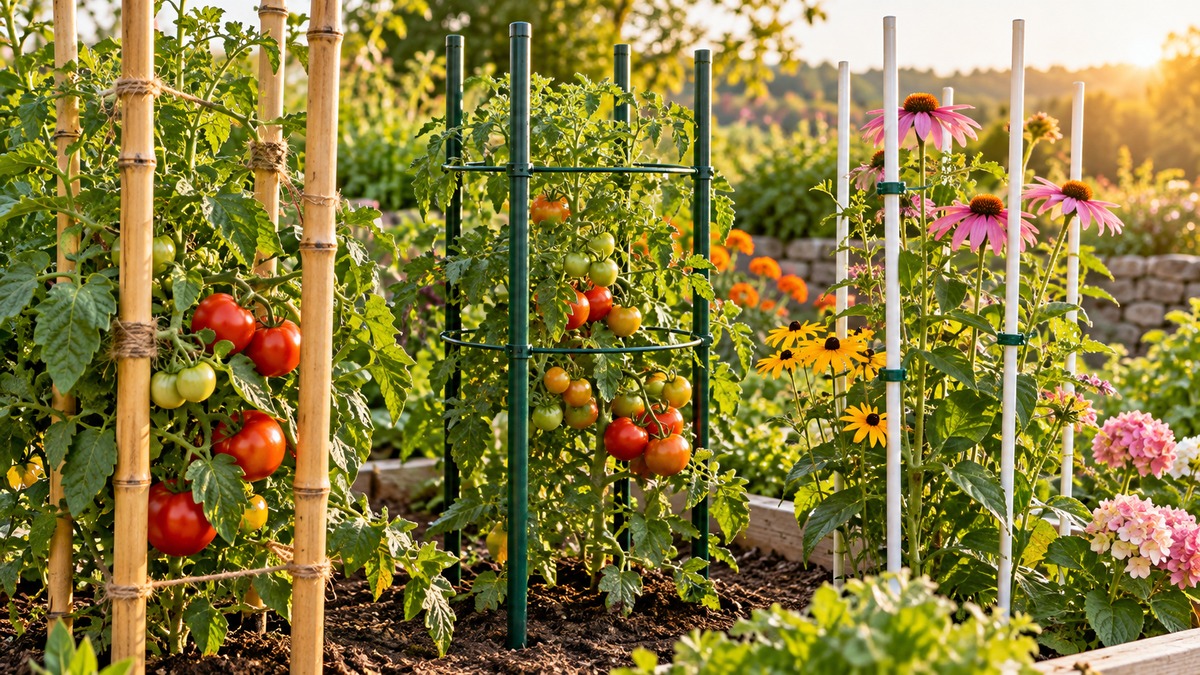
For a row of tomatoes, the steel or fiberglass sets give the height and the joins to keep the stems upright, and the clips hold each stem to its stake. For a bed of herbs or small flowers, the bamboo sets are described for smaller plants, and their 16 and 18 inch lengths suit a low bed.
For a row of climbing beans or cucumbers, the PROWORX 36-inch stake is the single-piece option, and its raised ridges are described as giving the plant “optimal grip.” The SupKing steel set adds the joins for a taller frame. Plan the frame before you put the stakes in, because a stake set in the wrong place is harder to move once the roots have started.
For a container or a patio pot, the 18-inch bamboo and the 17-inch fiberglass sets are the sizes the listings describe for smaller plants. The steel sets are the heavier choice and suit a large pot where a stake may need to stand against a strong stem.
How we chose
We searched Amazon.com for “garden stakes” in Chrome on 21 October 2026 and read the first results page. The page was dominated by landscape staples, which are ground pins for fabric, and by edging stakes. Those are a different product, so this guide does not use them. We ran two supplementary searches, “plant support garden stakes” and “tomato plant stakes”, and kept only listings that describe stakes for holding up plants. Tomato cages, stake connectors and a moss pole were left out because they are not stakes.
We read the title and the first five feature bullets of six plant support stakes from five brands, along with any spec rows the product page showed. Chrome gave us titles and bullets only, so this guide does not use prices, ratings, sales ranks or availability.
What we could not verify
- How long any of the stakes lasts in the ground. The listings give no figure, and the Illinois Extension post does not cover the lifespan of these products.
- Whether the fiberglass and steel coatings resist rust or fading over a season. The bullets state the claim, and this guide does not check it.
- The thickness of the bamboo or the diameter of the steel. The SupKing steel set gives a 0.39 inch diameter, and the fiberglass set gives 0.25 inch, but the bamboo bullets give no diameter.
- How much weight a stake holds. None of the listings gives a load rating, and the bullets say only that a stake is “thick enough to support tall and heavy plants.”
- Whether the joins hold when a joined set carries a heavy vine. The listings do not say.
- The 20-pack SupKing and MAXPACE claims about tie and clip quality, which are not described beyond the piece count.
FAQ
Is bamboo good enough for tomatoes?
The bullets for both bamboo sets name tomatoes as a use. HAINANSTRY lists “young tomato plants” among its uses, and BOVITRO lists “tomatoes” among the plants it supports. BOVITRO also says its bamboo is for small potted plants, not large plants. For a determinate tomato that stays low, bamboo is one option. For an indeterminate tomato that grows tall, the steel or fiberglass sets give the height the plant needs.
How many stakes do I need for a row?
Start with the number of plants and whether each one needs one stake or two. Multiply the two numbers, then pick a pack that covers the total with a few spare. A 20-piece set is the standard size in this group, and the 25-piece PROWORX pack gives a little more for a long row.
Can I join garden stakes to make them taller?
Yes, if the set includes connectors. The SupKing fiberglass pack includes 10 connectors, the SupKing steel pack includes 13 extension connectors, and MAXPACE includes 14. The bullets describe joins that extend the length, and the steel set is described as reaching 36, 54 and 72 inches. The listings do not say how many joins a set can take before the stake becomes unstable.
Should I clean stakes before I store them?
Yes. Illinois Extension advises cleaning the cages and stakes before they go back into the garden, and the same post notes that disease-causing organisms can survive over the winter in tight spots on cages and stakes. The advice is easy to follow, and it applies to all the materials in this group.
Bottom line
Choose the stake by the plant you are supporting: steel for a tall climber, fiberglass for a damp bed where the listing’s rust claim matters, and bamboo for a small plant. Count the pack in total length, check the joins and clips, and set the stakes before the plant is large. For a row layout that uses supports, see the raised bed companion planting guide and the vegetable guide for raised beds.
Sources
- Illinois Extension, “Tomato Cages Vs. Stakes” (Raise, Grow, Harvest, Eat, Repeat, May 30, 2018). https://extension.illinois.edu/blogs/raise-grow-harvest-eat-repeat/2018-05-30-tomato-cages-vs-stakes