Best Hedge Shears
As an Amazon Associate we earn from qualifying purchases. Details
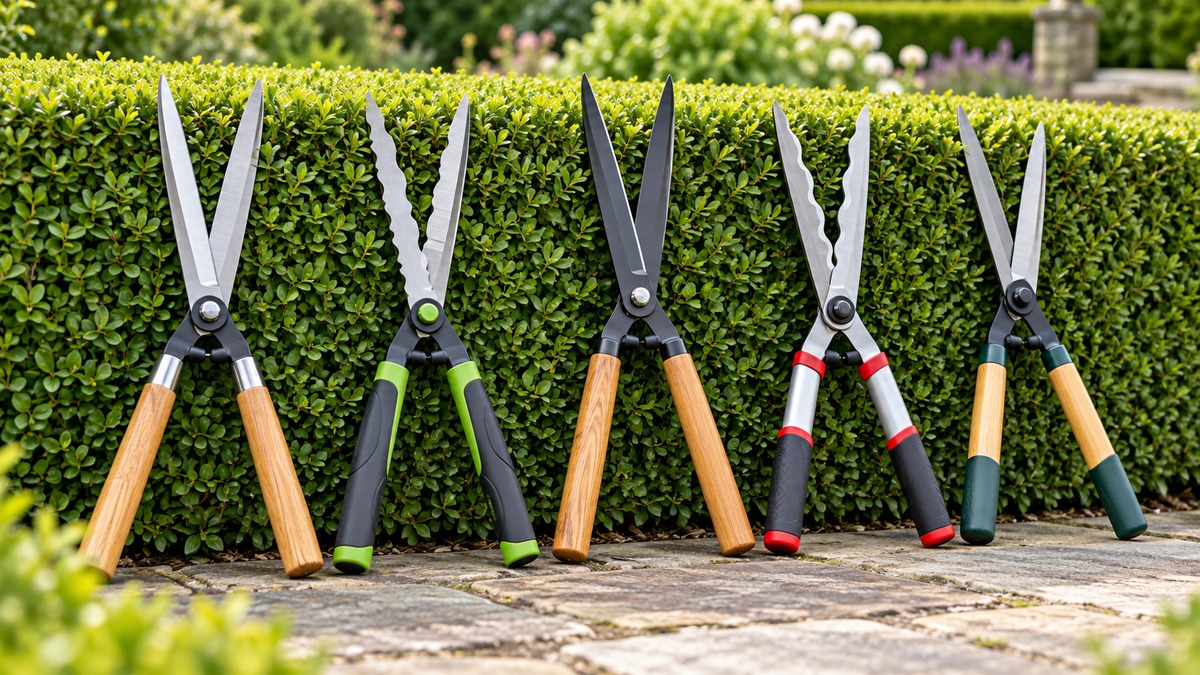
If you are looking for the best hedge shears, look first at the blade type and the reach, because those decide whether the tool trims a hedge evenly and whether you can use it without leaning or climbing. Hedge shears have long blades and two handles for shaping shrubs. We read six hedge shear listings on Amazon.com from four brands, and this guide compares them by blade type, extension length, steel, weight and what each listing says about its handles and coatings.
Quick answer
- For reach over a tall hedge, choose an extendable pair. The TABOR listing gives a 25 to 33 inch telescopic range, and the PrunePro listing gives 27 to 35 inches in five positions.
- For a bypass blade, which five of the six listings state, check the blade type in the spec table. The Kimura and Fiskars listings state bypass blades.
- For a shorter, fixed-length pair, the Fiskars PowerGear2 listing gives a 23 inch length with 10 inch blades.
- For steel, read the spec table carefully. The Kimura telescopic listing gives high carbon steel in its spec table and Japanese SK5 steel in its bullets.
- If you also prune by hand, see our hand tools comparison of bypass pruners and our best pruner sharpener guide.
Hedge shears, not pruners
Hedge shears are long-bladed tools for trimming the outside of a shrub or hedge. A hand pruner is shorter and cuts individual stems. The listings here are all hedge shears, so the reach and the blade length matter more than the handle grip. We kept a listing only when its title or bullets describe shears for shaping hedges or shrubs, and we left out short bypass pruners that a search returned.
Colorado State University Extension separates the cutting designs, and that separation is useful when you read a hedge shear listing. The guide says: “The bypass or scissor-type pruner (cutting as the blade crosses past the hooked anvil in a scissor action) is considered the best type.” It also says: “The anvil type (cutting as the blade pushes against the anvil) is more prone to tearing and mashing the tissues.” Five of the six listings here state a bypass blade in their spec tables. The TABOR listing gives a wavy blade and a round point, but its spec table does not name the blade type as bypass or anvil.
The six shears side by side
| Listing (brand) | Blade and edge as listed | Length or reach | Weight (spec table) |
|---|---|---|---|
| TABOR, telescopic hedge shears | Wavy blade, carbon steel, serrated edge | Extendable steel handles, 25 to 33 inches in the title | 3.24 pounds |
| PrunePro, extendable hedge shears | Wavy blade, stainless steel, bypass | 27 to 35 inches in five positions | 3.09 pounds |
| Fiskars, Power-Lever extendable | Serrated steel blade, 10 inch blades, bypass | 25 to 33 inches in the title | 1 pound |
| Fiskars, PowerGear2 | Straight edge, alloy steel, 10 inch blades, bypass | 23 inches | 2.45 pounds |
| Kimura Pro, heavy duty 201 | SK5 steel per bullets, single bevel, bypass | 22 inches | 1.65 pounds |
| Kimura Pro, telescopic 202 | Bypass, high carbon steel per spec table | 25 to 34 inches in the title | 2.42 pounds |
The Fiskars Power-Lever spec table gives a weight of 1 pound for a tool with 10 inch blades and a telescoping handle, which is light for its size. We report the figure as listed. The PrunePro listing says its blades use “1.4031 German stainless steel” and that the blade design is lighter at the top to reduce top-heavy feel.
Reach, length and the telescoping handle
Length is the first thing most buyers check, and the telescopic listings give a range rather than a fixed figure. The TABOR range runs from 25 to 33 inches, the PrunePro range from 27 to 35 inches, and the Kimura telescopic from 25 to 34 inches. The bullets for the Kimura telescopic describe extending the handles from 650 millimeters to 850 millimeters with a twist lock.
Penn State Extension gives a useful rule for choosing a handle length. Its advice is that “It’s better to buy a too-long handle and shorten it than to work hunched over.” A telescopic pair suits that advice, because you can set the length to your height and shorten it when you work on a low hedge. That is the practical reason to prefer an adjustable pair if you trim both tall and low shrubs.
Telescoping handles also change how the tool feels. The PrunePro bullets describe a lighter blade design to reduce top-heavy imbalance, and the Fiskars PowerGear2 bullets describe a lightweight design with shock-absorbing bumpers. The sources we opened do not compare these designs, so the balance claims are the sellers’ own.
Blades, steel and coatings
The steel varies across the set. The TABOR bullets describe forged carbon steel wavy blades, and the spec table lists carbon steel. The PrunePro spec table lists stainless steel, and its bullets describe 1.4031 German stainless steel with a non-stick Teflon coating. The Kimura listings describe Japanese SK5 steel with PTFE coating. The Fiskars listings describe alloy steel blades with a low-friction coating that the bullets say reduces gumming.
The Kimura telescopic listing has a steel conflict. Its spec table lists High Carbon Steel for the blade material, while its bullets say Japanese SK5 steel. The two can both be true for a manufacturer’s steel family, but the listing does not reconcile them, so we report both. The Kimura heavy duty listing is cleaner, because its spec table and bullets both point to SK5 steel.
Coatings are a seller claim. The sources we opened do not compare PTFE, Teflon and low-friction coatings for sap buildup or rust. The Illinois guide says to “Scrub away dirt, rust, and sap from pruner blades with a wire brush, sandpaper, or steel wool.”
Cutting clean and keeping the edge
The Colorado State guide gives sharpening advice for bypass pruners: “For bypass pruners, sharpen only the beveled edge of the blade pointing toward the anvil, never the anvil side of the blade.” Hedge shears are not pruners, so check the bevel on your own pair before you sharpen it, and confirm the blade type in the listing.
The Illinois Extension garden tool maintenance guide says “Do not use power grinders. Heat generated by the friction can make the metal brittle.” Hand sharpening with a file or a stone keeps the metal intact. The same guide gives a check for cracks, nicks and burrs on pruner blades: “Look for blade damage such as cracks, nicks or burrs. Replace the blades if needed.” Hedge shear blades are longer, but the same check applies to every blade on the pair.
Loppers, which are a different tool, deserve their own caution. The Colorado State guide says loppers “are used for larger branches, generally up to two inches in diameter but should be used with caution as they can crush branches and damage tissues.” The Kimura telescopic bullets describe its tool as loppers in one line and as garden shears in its title. Read the blade size and the cut capacity in the listing before you use it on a thick limb.
Safety and cleaning
Protective equipment is the first step. The Illinois guide says “Always wear appropriate personal protective equipment such as gloves and safety glasses.” That advice sits in its section on sharpening and cleaning, so it applies when you grind, file or clean the blades.
Penn State Extension warns: “Use the wrong tool or the wrong form of the right tool, and you are more likely to become discouraged, exhausted, or injured.” For hedge shears, the wrong form is usually a pair that is too long for the job, too heavy for your arms, or dull. Check the telescopic locks before each use.
PrunePro’s listing says its extendable handle lets you reach high hedges “without a ladder.” The sources we opened do not address ladder safety for hedge shears, so this guide does not endorse that use.
Clean and store the shears after each use. The Illinois guide says “Oil metal surfaces lightly with a lubricant such as WD-40 to prevent rust.” It also says “Store tools off the ground and away from the elements in a shed, garage, or barn.” Those two steps help keep the blades from rusting, which is the reason the guide gives for oiling.
Blade edges in the set
| Listing | Edge as listed | Blade type as listed |
|---|---|---|
| TABOR | Serrated | Wavy Blade, not stated as bypass or anvil |
| PrunePro | Wavy Blade | Bypass |
| Fiskars Power-Lever | Serrated | Bypass |
| Fiskars PowerGear2 | Straight | Bypass |
| Kimura heavy duty | Single Bevel | Bypass |
| Kimura telescopic | Not listed | Bypass |
Two listings describe a straight or single-bevel edge, and the Colorado State bevel advice is written for bypass pruners. Confirm the bevel on your own pair before you sharpen it, and do not assume a hedge shear has the same bevel as a pruner.
Reach and weight, worked out from the listings
The telescopic range is the difference between the top and bottom of each listed range. For TABOR, 33 inches minus 25 inches is 8 inches of adjustment. For PrunePro, 35 inches minus 27 inches is 8 inches. For the Kimura telescopic pair, 34 inches minus 25 inches is 9 inches. The Fiskars Power-Lever range is 33 inches minus 25 inches, which is also 8 inches.
Weight works the same way. The TABOR pair is listed at 3.24 pounds and the Kimura heavy duty pair at 1.65 pounds, so 3.24 pounds minus 1.65 pounds is 1.59 pounds. The listings do not state a weight at full extension, so that figure is for the pair as listed, not for the telescopic handle at its longest setting.
Which pair for which hedge
| Need | Range or length stated | Listings that state it |
|---|---|---|
| Longest top end among the telescopic pairs | Up to 35 inches | PrunePro |
| Telescopic pair with the lowest stated bottom setting | From 25 inches | TABOR, Fiskars Power-Lever, Kimura telescopic |
| Fixed length for a lower hedge | 23 inches or 22 inches | Fiskars PowerGear2, Kimura heavy duty |
| Lightest pair whose listing looks consistent | 1.65 pounds | Kimura heavy duty |
Use the table as a starting point. Measure the highest and the lowest branch you need to reach, then choose the pair whose range covers both. The listings do not give a height chart, so the range and your own reach are the two things to compare.
Checklist before you order a pair
- Confirm the blade type as bypass or anvil, since the TABOR listing does not state it.
- Read the steel in the bullets against the spec table, especially for the Kimura telescopic pair.
- Check the handle material and the lock on any telescopic pair before you buy.
- Compare the stated range with the highest branch you need to reach.
Steel and coatings as each listing states them
| Listing | Steel in the spec table | Steel in the bullets | Coating or finish in the bullets |
|---|---|---|---|
| TABOR | Carbon Steel | Forged carbon steel wavy blades | Not stated |
| PrunePro | Stainless Steel | 1.4031 German stainless steel | Non-stick Teflon coating |
| Fiskars Power-Lever | Alloy Steel | Steel blades | Low-friction blade coating |
| Fiskars PowerGear2 | Alloy Steel | Hardened, precision-ground blades | Low-friction blade coating |
| Kimura heavy duty | Japanese SK5 Steel | Japanese SK5 steel blades | PTFE coating |
| Kimura telescopic | High Carbon Steel | Japanese SK5 steel blades | PTFE coating |
The table records what each listing says, not how the steel behaves in use. Two listings, PrunePro and the Kimura telescopic pair, name a coating that the bullets say keeps sap from building up, and the Fiskars pair names a coating that the bullets say reduces gumming. Those are the sellers’ own statements, and the sources we opened do not compare these coatings, so treat them as features to weigh rather than results.
1. TABOR TOOLS B212A 25-33 inch Telescopic Hedge Shears with Wavy Blade and Extendable Steel Handles. (Telescopic hedge shears with a wavy blade and shock-absorbing bumpers)
Specs from the listing (checked 2026-10-21):
- Blade Type: Wavy Blade
- Blade Material: Carbon Steel
- Item Weight: 3.24 pounds
- Cutting width: 84 centimeters
Pros
- The title gives a 25 to 33 inch telescopic range with a wavy blade and extendable steel handles
- The bullets describe shock-absorbing bumpers and an adjustable blade tension through the pivot bolt
- The spec table lists telescopic, shock guard bumpers and blade tension adjustment as yes
Cons
- The spec table lists the blade type as Wavy Blade and does not name bypass or anvil
- The spec table gives 84 centimeters for cutting width, a figure that needs checking against the blade length
Best for: A gardener who wants a telescopic pair with adjustable blade tension for shaping shrubs
Skip if: You need the blade type confirmed as bypass before you buy
View on Amazon (affiliate link)
2. PrunePro Extendable Hedge Shears Lightweight Ultra Sharp Blade for Bushes (Extendable hedge shears with a wavy blade and Teflon coating)
Specs from the listing (checked 2026-10-21):
- Blade Type: Bypass
- Blade Material: Stainless Steel
- Item Weight: 3.09 pounds
- Size: 27 inches to 35 inches
Pros
- The bullets say the handle adjusts from 27 to 35 inches in five positions
- The spec table lists stainless steel blades, a bypass blade type and 3.09 pounds
- The bullets describe a Teflon coating that resists sap buildup and rust
Cons
- The spec table gives Silver as the color and lists aluminum and polypropylene handles, so the handle description is mixed
- The item highlight includes a comfort claim about arthritis that we did not check
Best for: A gardener who wants a bypass pair with a five-position handle and stainless steel blades
Skip if: You want a fixed-length pair, since this listing is adjustable
View on Amazon (affiliate link)
3. Fiskars 25-33 inch Power-Lever Extendable Garden Hedge Shears, 10 inch Blades (Power-Lever extendable hedge shears with 10 inch blades)
Specs from the listing (checked 2026-10-21):
- Blade Type: Bypass
- Blade Material: Alloy Steel
- Item Weight: 1 pounds
- Manufacturer Warranty Description: Lifetime Warranty
Pros
- The title gives a 25 to 33 inch extendable range with 10 inch blades
- The bullets say the self-sharpening serrated blades stay sharp through heavy use
- The spec table lists a bypass blade type and a lifetime warranty
Cons
- The spec table gives a weight of 1 pound, which is light for an extendable tool and needs confirming
- The spec table lists the material as Steel while the blades are alloy steel, so the steel grade is not stated
Best for: A gardener who wants a bypass pair with a reach range and a lifetime warranty stated
Skip if: You want a heavier tool that feels solid for thick hedges
View on Amazon (affiliate link)
4. Fiskars 23 inch PowerGear2 Garden Hedge Shears, Hedge Clippers, 10 inch Blades (PowerGear2 fixed-length hedge shears with 10 inch blades)
Specs from the listing (checked 2026-10-21):
- Blade Type: Bypass
- Blade Material: Alloy Steel
- Item Weight: 2.45 pounds
- Size: 23 inches
Pros
- The title and bullets describe a 23 inch fixed length with a PowerGear2 gear mechanism
- The bullets say the shock-absorbing bumpers and SoftGrip handles reduce strain on the hands
- The spec table lists a bypass blade type and a full lifetime warranty
Cons
- The spec table lists the material as Plastic, but the handle is described as steel and wood, so the description is incomplete
- The spec table lists the blade edge as straight, while the bullets describe a low-friction blade coating
Best for: A gardener who wants a fixed 23 inch pair for smaller hedges with a gear mechanism
Skip if: You need reach beyond about two feet above the ground, since the length is fixed
View on Amazon (affiliate link)
5. Kimura Pro Heavy Duty Hedge Shears, Premium Garden Clippers with Patented Gearing Technology, Ultra (Kimura Pro heavy duty hedge shears with SK5 steel blades)
Specs from the listing (checked 2026-10-21):
- Blade Material: Japanese SK5 Steel
- Handle Material: Thermoplastic Rubber (TPR)
- Item Weight: 1.65 pounds
- Size: 22 inches
Pros
- The spec table lists Japanese SK5 steel for the blades and a bypass blade type
- The bullets describe PTFE coating and patented gearing that the seller says gives up to three times more power
- The spec table gives 1.65 pounds and a 22 inch size, a light pair for its length
Cons
- The bullets describe aluminium handles, while the spec table lists TPR for the handle material
- The spec table lists a single bevel edge, so the sharpening angle needs checking before you sharpen
Best for: A gardener who wants a light bypass pair with SK5 steel and a gearing mechanism
Skip if: You want telescopic reach, since this listing is a fixed 22 inch length
View on Amazon (affiliate link)
6. Kimura Pro Telescopic Garden Shears, Premium Hedge Shears, Patented Gearing Technology, Lightweight (Kimura Pro telescopic shears with extendable aluminum handles)
Specs from the listing (checked 2026-10-21):
- Blade Type: Bypass
- Blade Material: High Carbon Steel
- Handle Material: Aluminum
- Item Weight: 2.42 pounds
Pros
- The title and spec table give a telescopic 25 to 34 inch range with a bypass blade type
- The bullets describe a 650 to 850 millimeter extension with easy-twist locks
- The spec table lists 2.42 pounds, a moderate weight for a telescopic pair
Cons
- The bullets call the tool loppers in one line and garden shears in the title, so the tool type is unclear
- The spec table lists High Carbon Steel while the bullets say Japanese SK5 steel, a conflict the listing does not explain
Best for: A gardener who wants a telescopic bypass pair with an aluminum handle and a carry bag
Skip if: You need the steel confirmed before you buy, since the listing gives two different types
View on Amazon (affiliate link)
How we chose
We searched Amazon.com in Chrome on 21 October 2026 for best hedge shears, for hedge shears extendable garden, and for a related shrub-trimming phrase. For each search we read the first results page and kept listings whose title or bullets describe hedge shears for trimming shrubs or hedges. From those we chose six listings from four brands. Two brands appear twice, because each has two listings with different blade types or lengths. For each pick we read the product title, the brand line, the first bullets and the specification table on the product page.
We left out bypass pruners with short blades, a three-piece pruning set whose title names several different tools, and a pair of telescopic hedge clippers whose bullets were nearly identical in two places, which made the description unreliable. We did not rank the picks by price, rating or sales rank, because Chrome did not give us reliable values for those fields. The order below is the order we wrote the picks, not a score.
What we could not verify
- Price, availability and shipping were not captured, so this guide says nothing about cost or stock.
- Ratings and sales rank were not captured, and no popularity claim appears in this guide.
- The Kimura telescopic steel conflict is not resolved by its listing, and we could not check which steel the blade uses.
- The Fiskars PowerGear2 spec table lists Material Type as Plastic while its handle is steel and wood, so the material description is incomplete.
- The Fiskars Power-Lever weight of 1 pound is light for a 25 to 33 inch telescopic tool, and we could not confirm it.
- The PrunePro item highlight includes a comfort claim about arthritis, which we did not check against any health source.
- Warranty terms are only partly covered. The Fiskars bullets state a lifetime warranty, and we did not open a warranty page.
- How any of these shears perform on a real hedge is not covered. The sources we opened do not compare hedge shear brands or measure cutting performance.
FAQ
What is the difference between hedge shears and bypass pruners?
Hedge shears have long blades and two handles for shaping shrubs, while a bypass pruner is short and cuts single stems. Colorado State University Extension says a bypass design is “considered the best type” of pruner, and five of the six hedge shears here list a bypass blade. Check the blade type in the spec table before you buy.
Are telescopic hedge shears safe to use?
The sources we opened do not give a telescopic safety rule. Check the locks before each use, follow the protective equipment advice above, and note that this guide does not endorse ladder use.
How do I know if the blades are sharp enough?
The Illinois guide says “Sharp garden tools are more efficient at digging or pruning.” If a pair struggles to cut a stem, check the blade edge and the bevel, and sharpen by hand rather than with a power grinder.
Should I buy a pair with stainless steel blades?
The listings make their own claims. PrunePro states stainless steel and a Teflon coating, and the Kimura pair states SK5 steel with PTFE. The sources we opened do not compare these steels for rust or edge life, so judge by the steel named in the spec table and by how the pair cleans up after use.
What length should I buy?
Penn State Extension ties length to fit, and it recommends a handle you can use without bending over. A telescopic pair lets you set the length, which suits a mixed set of shrubs. A fixed 23 inch pair suits a smaller hedge where you do not need to reach high.
Bottom line
Choose a pair whose blade type, reach and steel match the hedge you trim, and check the spec table for conflicts before you buy. For a telescopic pair, set the length to your height rather than the longest setting, and keep the blades clean and oiled after each use.
Sources
- Colorado State University Extension, “Pruning Cuts”: https://extension.colostate.edu/resource/pruning-cuts/
- University of Illinois Extension, “Garden Tool Maintenance” (Mary Fischer, 2021): https://extension.illinois.edu/sites/default/files/garden_tool_maintenance.pdf
- Penn State Extension, “Using the Right Tool is Self-Care”: https://extension.psu.edu/using-the-right-tool-is-self-care
- Penn State Extension, “Healthy Tips to Garden with Fewer Aches and Pains”: https://extension.psu.edu/healthy-tips-to-garden-with-fewer-aches-and-pains