DIY Raised Bed Soil Mix
As an Amazon Associate we earn from qualifying purchases. Details
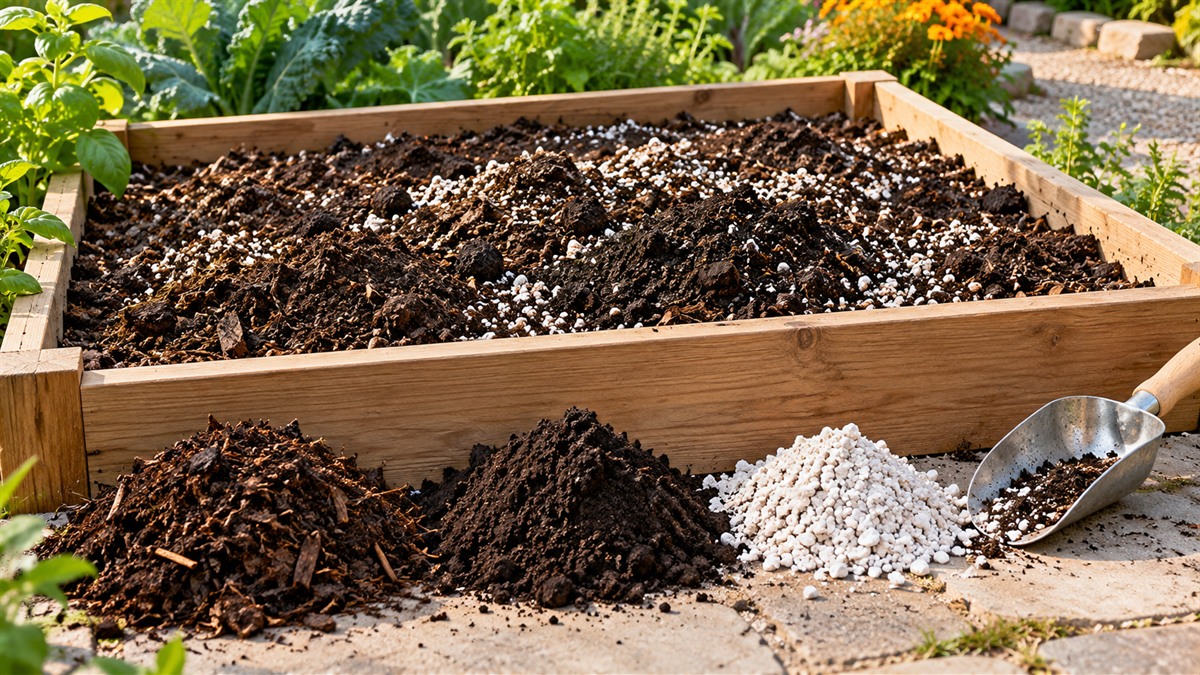
A DIY raised bed soil mix is a blend you make yourself from topsoil, organic matter and either coarse sand or more compost. The university guides give two starting recipes: equal parts topsoil, organic matter and coarse sand, or about 70 percent topsoil with 30 percent compost. Which one fits depends on the topsoil you can get, how deep the bed is and whether it sits on soil or on hard ground. The three extension pages below do not agree on every one of those points, and this guide shows where.
Quick answer
- Iowa State University Extension gives two recipes: equal parts topsoil, organic matter and coarse sand, or about 70% topsoil with 30% compost. The page was last updated April 20, 2026.
- University of Maryland Extension, for beds on hard surfaces, recommends compost and a soilless growing mix at 1:1, and allows topsoil up to 20% by volume in beds at least 16 inches deep.
- A 4 by 8 foot bed that is 12 inches deep holds 32 cubic feet. Divide that volume by the parts in the recipe you choose.
- Check the topsoil for soil-borne pathogens and contaminants, and check that the compost is mature and not too salty, before you mix.
The recipes side by side
The table gives only what each page states. Where a page gives no condition, the cell says so.
| Source | Recipe the page gives | Condition the page states | Date on the page |
|---|---|---|---|
| Iowa State University Extension | Equal parts topsoil, organic matter and coarse sand; or about 70% topsoil and 30% compost | Imported topsoil should be checked for soil-borne pathogens and contaminants; compost should be mature and not too salty | Last updated April 20, 2026 |
| University of Maryland Extension | Compost and soilless growing mix at 1:1; topsoil up to 20% by volume | The recipe is for raised beds on hard surfaces; topsoil only for beds at least 16 inches deep | Updated November 6, 2024 |
| University of Vermont Extension | Growing medium of 70 percent soil minerals and 30 percent compost | Compost applied in excess can be detrimental; the raised bed example is a 1 to 2 inch compost layer over a 6 inch soil layer | Published October 12, 2022 |
Measure the bed before you buy soil
Every recipe is a set of parts, so the bed volume comes first. The formula is length times width times depth, with all three in feet. Divide the cubic feet by 27 to get cubic yards, because bulk soil and compost are often sold by the yard.
Depth changes the answer as much as footprint does. A bed 12 inches deep uses 1 foot in the formula. The same bed at 16 inches uses 1.33 feet. Maryland’s topsoil condition is written around the 16-inch depth, so depth also changes which recipe applies.
| Bed size | Depth | Volume (cubic feet) | Volume (cubic yards) |
|---|---|---|---|
| 4 ft by 4 ft | 1 ft (12 in) | 16.0 | 0.59 |
| 4 ft by 8 ft | 1 ft (12 in) | 32.0 | 1.19 |
| 4 ft by 8 ft | 1.33 ft (16 in) | 42.7 | 1.58 |
The table uses volume = length x width x depth, then divides by 27 for cubic yards. For example, 32 divided by 27 is 1.19.
Worked example: a 4 by 8 foot bed, 12 inches deep
The volume is 4 x 8 x 1 = 32 cubic feet. Each recipe then splits that volume by its parts or percentages.
- Iowa State equal parts (three ingredients): 32 divided by 3 is about 10.7 cubic feet each of topsoil, organic matter and coarse sand.
- Iowa State and UVM 70/30 (two ingredients): 70% of 32 is 22.4 cubic feet of topsoil, and 30% is 9.6 cubic feet of compost.
- Maryland 1:1 compost and soilless mix: 32 divided by 2 is 16 cubic feet each. Maryland’s topsoil allowance does not apply at this depth, because its condition is a bed at least 16 inches deep.
The same footprint at 16 inches deep is 42.7 cubic feet. Under Maryland’s rule, topsoil could then make up to 20% of the volume, which is 0.20 x 42.7 = 8.5 cubic feet. Iowa State’s equal-parts recipe would give about 14.2 cubic feet of each ingredient at that depth.
Measure each ingredient in the same container, such as a bucket or a wheelbarrow of known volume, so the proportions hold from one batch to the next.
Check the ingredients before you mix
Topsoil
Iowa State advises checking imported topsoil for soil-borne plant pathogens and for contaminants such as lead and pesticides. The page does not describe how to test for either, so a soil test or a written statement from the supplier is the practical route. The page also gives no rule for telling a clean topsoil from a contaminated one by appearance.
Compost
Iowa State asks that compost be fully matured and that it does not carry too much salt. UVM warns that compost applied in excess can be detrimental to plants, and that a surplus can build up phosphorus and ammonium. UVM also says that continued use of compost, particularly manure-based compost, can be detrimental. None of these pages gives a salt level or a nutrient figure, so the safe reading is to keep compost to the proportion the recipe gives rather than adding more for good measure.
Organic matter
Iowa State lists well-rotted manure, compost or peat as the organic matter for the equal-parts mix. The page does not rank the three or say which suits a particular crop.
Mixing and filling, in the order Iowa State gives
Iowa State’s installation advice is short. Remove any grass sod, then work up the existing soil with a rototiller or spade. Add a few inches of the mix and blend it into the soil below, then keep adding and blending until the bed is full. The page says blending prevents distinct layers from forming in the bed. Grade the surface so it slopes slightly from the center to the edge and away from nearby structures. Finish by mulching around the plants to conserve moisture and control weeds.
Blending matters because it is the step that keeps the bed from forming separate layers. Mixing the whole batch in a wheelbarrow before you fill the bed gives you one consistent mix, but Iowa State’s method works in the bed itself, so the two are not the same instruction.
Where the sources disagree
The disagreement matters most for beds that sit on a hard surface or are shallower than 16 inches. Iowa State’s equal-parts recipe puts topsoil at one-third of the volume. Maryland’s recipe for a bed on a hard surface uses no topsoil in its main mix and allows topsoil only as an addition in deeper beds. UVM gives a 70/30 growing medium, and then a raised bed example: a 1 to 2 inch compost layer mixed into a 6 inch soil layer.
That UVM example works out to a compost share by depth of 1 divided by (6 + 1), which is 14%, to 2 divided by (6 + 2), which is 25%. The 70/30 figure is a ratio by volume, and the layer example is a depth ratio, so this guide does not treat them as the same measure. Read the two figures as a range, and use the recipe whose condition fits your bed.
In short, a recipe is only as good as the bed it was written for. Use each page’s condition as the reason for choosing, not the ratio alone.
Who should skip the homemade mix
Skip the homemade mix if you cannot check the topsoil or the compost, because Iowa State makes both checks part of its advice. If the bed is shallow and sits on hard ground, Maryland’s topsoil rule does not apply, so the mix is compost and soilless material, not soil. A bagged mix avoids the blending step, but none of the three pages rates bagged products, and this guide does not name any.
Mistakes to avoid
- Using topsoil without a check for contaminants. Iowa State names soil-borne pathogens and contaminants such as lead and pesticides as the risks.
- Using compost that is not mature or carries too much salt. Iowa State asks for mature compost with limited salt.
- Adding extra compost to be safe. UVM warns that compost in excess can be detrimental and can build up phosphorus and ammonium.
- Using a topsoil-heavy recipe in a shallow bed. Maryland’s topsoil allowance depends on a bed at least 16 inches deep.
- Mixing by guesswork. Each recipe is a ratio, so the amount of each part has to come from the bed volume.
Products
This guide names no product. The research for this keyword found no soil mix listing that the three pages support. An earlier straw mulch listing for this slug was not a soil mix, so it is left out.
How we chose
The starting point was the extension pages on raised bed soil. We opened four pages: Iowa State, Maryland, Vermont and Penn State. Penn State’s raised bed page did not contain the topsoil-to-compost ratios that a search summary had attributed to it, so that page is dropped and not cited. The three pages cited are the ones whose recipes and conditions appear in the text. The criteria were a recipe with stated parts, a stated condition for topsoil or compost, and a page date. Blogs and retailer pages were not relied on. The guide covers the recipes and the checks the pages give, and it shows the arithmetic for a 4 by 8 foot bed.
What we could not verify
- A salt level or nutrient threshold for compost. The pages describe maturity and salt only in general terms.
- How to test topsoil for pathogens or contaminants. Iowa State names the risks but gives no test method.
- Which mix works best for a particular crop, climate or drainage. None of the three pages ranks the recipes for a crop.
- Whether Maryland’s hard-surface scenario fits a bed set on lawn or bare soil, since its condition is written for hard surfaces.
- Whether the advice is current for your region. The pages are dated October 12, 2022, November 6, 2024 and April 20, 2026.
FAQ
Which mix should I use?
Iowa State gives equal parts topsoil, organic matter and coarse sand, or about 70% topsoil with 30% compost. Maryland recommends compost and soilless mix at 1:1 for beds on hard surfaces. The right one depends on the topsoil you can get and on whether the bed sits on soil or hard ground. None of the pages ranks them.
Do I need sand?
Iowa State’s equal-parts recipe includes coarse sand. Its 70/30 option does not list sand, and neither does UVM’s 70/30 growing medium.
Can I use the soil from my yard?
Iowa State asks that topsoil be checked for soil-borne pathogens and contaminants, and it does not say that yard soil is unsuitable. Test it before you use it, and treat that check as the minimum.
How much soil do I need?
Work out the bed volume in cubic feet, length times width times depth, then divide by the parts in your recipe. A 4 by 8 foot bed that is 12 inches deep needs 32 cubic feet, which is about 1.19 cubic yards.
Can I use manure as the organic matter?
Iowa State lists well-rotted manure as one option, along with compost and peat. UVM warns that continued use of manure-based compost can be detrimental, so keep the amount to the recipe.
Is more compost better for the bed?
The sources say no. UVM warns that compost applied in excess can be detrimental and can build up phosphorus and ammonium. Keep to the ratio the recipe gives.
Related guides
For how much soil a bed needs and how to plan the volume, read Raised Bed Garden: How Much Soil Do You Need?. For the filling step, read Best Way to Fill Raised Beds: Options Compared. For the end of the season, read Preparing Raised Beds for Winter: Covers Compared. For planning what goes in the bed, read Best Vegetables to Plant in Raised Beds: Easy Picks.
Bottom line
Pick one recipe, measure the bed in cubic feet, and check the topsoil and compost before you mix. If the bed is shallow or sits on hard ground, let Maryland’s condition decide whether topsoil belongs in the mix at all.
Sources
- Iowa State University Extension, “What would be a good soil mix for a raised bed?”, https://yardandgarden.extension.iastate.edu/faq/what-would-be-good-soil-mix-raised-bed (page updated April 20, 2026; opened 2026-10-21)
- University of Maryland Extension, “Filling raised beds”, https://extension.umd.edu/node/1087 (page updated November 6, 2024; opened 2026-10-21)
- University of Vermont Extension, article on soil health in raised beds, https://www.uvm.edu/extension/news/soil-health-raised-beds (published October 12, 2022; opened 2026-10-21)
Disclosure: links to Amazon on this site are affiliate links, and a qualifying purchase can earn this site a commission. The full policy is on the disclosure page.