How to Plant Hydrangeas in Pots
As an Amazon Associate we earn from qualifying purchases.
How to plant hydrangeas in pots comes down to three decisions: a container with drainage holes, a potting mix that drains but still holds moisture, and a spot that gives the plant morning sun and afternoon shade. The extension pages cited here address those decisions from different angles. None of them gives one set of numbers for every hydrangea, so treat this as a plan to adapt to your own pot and climate.
Quick answer
- Choose a container with drainage holes. The NC State container handbook says drainage holes are necessary in all containers.
- Repot into a pot one size larger, and use organic potting mix rather than garden topsoil.
- Water when the mix is dry a few inches down, and empty any saucer after watering.
- In winter, insulate the pot, because roots in a container are less protected from cold than roots in the ground.
Pick a pot with drainage holes
The NC State container handbook puts drainage first. Drainage holes keep roots from standing in water, and standing water is how root rot starts. Overwatering makes the problem worse, because excess water fills the pore space in the mix and the roots cannot get enough oxygen. A hole in the base is the simplest protection against both.
Do not add gravel to the bottom of the pot as a drainage fix. The handbook warns against it, because water collects in the mix just above the gravel, so the gravel does little to keep the soil above it from staying wet. Good drainage comes from the hole and the mix instead.
Decorative pots without holes need a workaround. The handbook describes double-potting, which places a pot with holes inside the decorative one, and it gives herbs and fruit trees as its examples. The sources here do not cover that method for hydrangeas, so check each pot’s drainage before you plant.
Size the pot for the root ball
The handbook gives two reasons pot size matters. Restricted roots slow plant growth, and flowering is reduced in small pots. It also asks gardeners to consider both the depth and the total volume of a container, not its width alone. When you repot a hydrangea, the starting rule is “The container selected for potting-up should be one size larger in diameter than the pot in which the plant is currently growing.” Vigorous plants may need two sizes larger, according to the same passage.
The Ask Extension reply, about a hydrangea that had spent almost ten years in one pot, gives the same answer: “You’ll want to find a well-draining pot one to two sizes larger.” Larger pots also make watering easier. The handbook says “Choosing larger containers is beneficial, however, as they do not dry out as quickly and require less frequent watering.” Perennial plants need large containers for adequate root growth, and a hydrangea is a perennial shrub.
The handbook’s sizing rule for small pots, a pot 1 to 2 inches wider than the root ball for pots 8 inches or less, is written for interior plants. Use it as a cross-check, not as a rule for a shrub on a patio. For planters that stay outside through winter, see our notes on outdoor planters for winter.
Build the potting mix
The NC State handbook describes commercial soilless mixes this way: “Most commercial mixes combine finely textured and coarsely textured components to create a balance of water retention and drainage qualities.” It advises reading each label and trying more than one mix if needed. Garden soil is the wrong choice in a pot. The Ask Extension reply recommends organic potting soil, not anything labelled top soil. Mississippi State Extension notes that “Hydrangeas prefer to grow in well-drained soils containing plenty of organic matter.”
Leave headroom at the top of the pot. The handbook calls the gap between the mix and the rim the reservoir, and it says “sufficient space is needed between the top of the potting mix and the top of the pot.” That space holds water and fertilizer while you water. The mix settles after the first watering, so check the gap once it has. For a larger planter, see our notes on soil for raised planters.
Plant the root ball, step by step
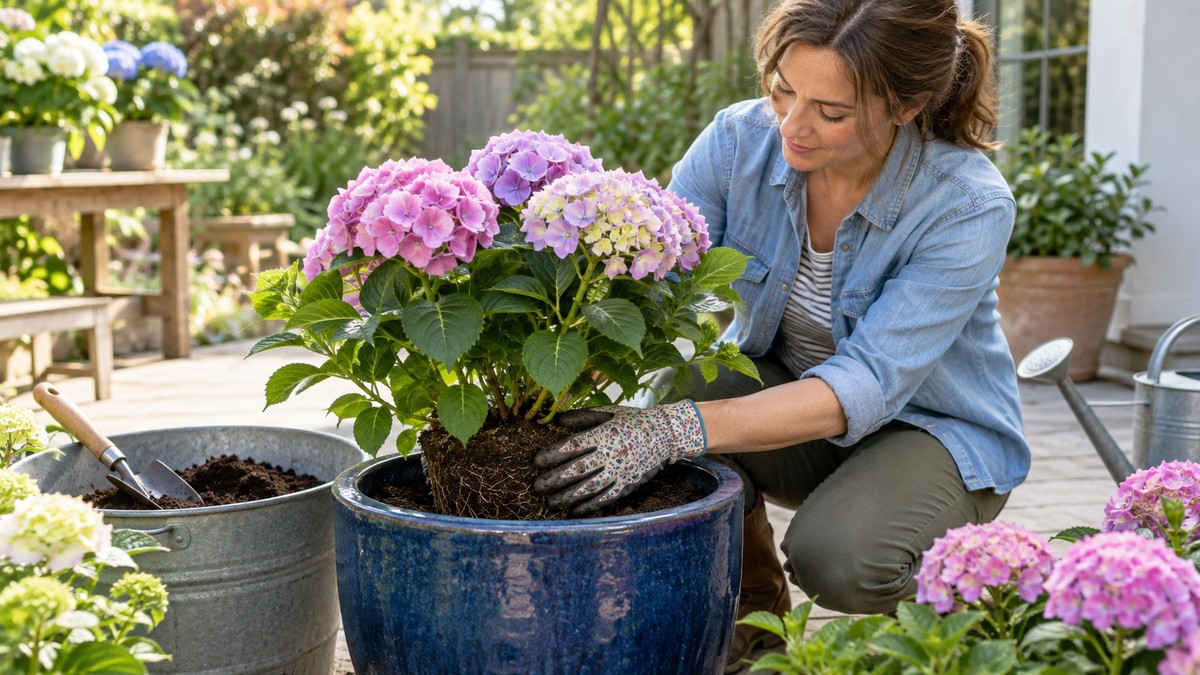
Water the plant and the new mix before you start. The Ask Extension reply says to “Water the soil around the plant, as well as the potting soil in the larger container.” To remove the plant from its old pot, the handbook suggests turning the pot upside down and gently tapping the rim: “gently tap the rim of the container on the edge of a table.” If the roots hold on, run a straight knife between the root ball and the container wall.
Check the root ball next. “A dense root ball is an indication that the plant needs to be potted up into a larger pot.” If roots have wound around the inside of the old pot, the handbook says to “Break this encircling growth pattern by teasing the roots apart or by cutting the roots vertically along the side of the root ball.” Loosened roots can then grow into the new mix instead of keeping the old shape.
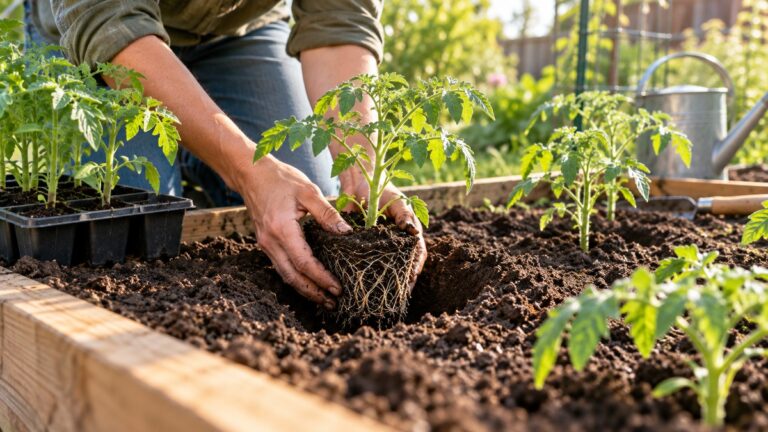
Set the plant at the same depth it grew at before, and fill around the root ball with fresh mix. The Ask Extension reply warns, “Do not push the soil down tightly.” It also suggests a light mulch: “You can add an inch of organic mulch, such as bark chips, on the soil, but not touching the stems.” After repotting, the handbook’s warning applies: “At this stage it is crucial not to overwater nor let the few remaining roots dry out.”
Choose a spot with the right light
Mississippi State Extension says that “Most species prefer warm, morning sun and cooler, afternoon shade.” The page adds “Avoid deep shade.” For flowering, it notes that “Flower production is better with about 5 hours of direct sunlight.” Leaves are the weak point in hot weather: “Their large, soft leaves wilt quickly in the hot sun, even when well-watered.” A patio spot with morning sun and afternoon relief fits that description.
Sun also changes the watering schedule. The NC State handbook says the water a container plant needs increases “if the weather is hot and windy or if the pot is small, dark-colored, or placed in full sun.” A dark pot in afternoon sun needs closer checking than a light pot in shade.
Water by feel, not by the calendar
Iowa State Extension’s advice for a potted hydrangea is to “Keep soil evenly moist and water just as the soil becomes dry to the touch.” The NC State handbook gives a way to check: “stick a finger 2 inches to 3 inches into the potting mix, and if the mix is dry, the plant should be watered.” Mississippi State Extension adds the balance: “All hydrangeas prefer consistent soil moisture, but do not overwater them.”
When you water, water fully. The handbook says to “water pots until the water starts to come out the bottom of the container.” Then empty the saucer, since “If there is a saucer under the pot, remove the water from the saucer after watering the plant.” Do not let the pot dry out completely either, because “Containers should never be allowed to dry out completely between watering as doing so damages feeder roots and leads to flower and fruit drop.”
Watch for root rot and waterlogging
Mississippi State Extension notes that “Plants grown in containers or in poorly drained soils are susceptible to” root rot. Its cultural advice is to “Maintain good drainage and uniform watering.” A pot with a hole and a steady watering routine is the practical protection the page describes. The same page says that “Root rot of hydrangeas is a common problem in poorly drained soils or after lengthy rains.” Check that a pot drains properly after heavy rain.
What color the flowers will be
Mississippi State Extension says that “Bloom color and intensity depends on the specific cultivar, weather condition, soil pH, and the aluminum content in the soil.” A potted plant’s color is therefore not fixed by the pot alone. The page also notes that “Remember that white-flowered cultivars do not respond to the pH of the soil.” Read the cultivar’s label before you buy for a particular color. The sources here give no mix recipe for changing color, so this guide does not offer one.
Florist hydrangeas and gift pots
Many potted hydrangeas arrive in bloom from a florist, and they need different care from a plant set in a garden pot. Iowa State Extension advises: “Place hydrangeas in bright, indirect light and cool temperatures (60 to 65°F).” Its page also warns: “Do not allow water to collect in the decorative plastic or foil pot cover.”
Iowa State Extension is also clear about outdoor use. “The cultivars used for florist plants are not reliably winter hardy in Iowa and if they survive the winter, they do not reliably flower.” Its advice is “For these reasons, discard plants once the flowers fade.” Check your variety and your winter conditions before you plant one outdoors.
Protect the pot in winter
The main winter problem is that roots in a pot are less protected than roots in the ground. The NC State handbook says “Root damage can occur because the root system is not as well-insulated from cold in a container as it would be in the ground.” Its suggestion is to loosely wrap the pot with chicken wire and fill the space with “inches of leaves or straw” for insulation. If you use quilt batting or household insulation, the handbook advises covering it with plastic so that wet weather does not soak it.
Keep the mix moist through the cold months, but check it rather than watering on a schedule. The handbook says “When overwintering plants, the moisture in the potting mix should be periodically checked and dry containers watered if the temperatures are going to be above freezing.” Species matters as well. Mississippi State Extension describes the mountain hydrangea as “a smaller, more compact shrub” and says that “It is also more winter hardy than bigleaf hydrangea.”
A quick checklist
| Step | What to check | Source |
|---|---|---|
| Pot | Drainage holes. A decorative pot without holes calls for double-potting. | NC State handbook |
| Size | One size larger for repotting; two sizes for vigorous plants. | NC State handbook; Ask Extension |
| Mix | Organic potting mix or a commercial soilless mix, not garden topsoil. | NC State handbook; Ask Extension |
| Planting | Same depth as before; fill without packing the soil down. | Ask Extension |
| Light | Morning sun and afternoon shade; avoid deep shade. | Mississippi State Extension |
| Water | Water when the mix is dry 2 to 3 inches down; empty the saucer. | NC State handbook; Iowa State Extension |
| Winter | Insulate the root ball; check moisture on days above freezing. | NC State handbook |
How we chose
We opened pages from university and cooperative extension offices, because those are the sources this site relies on for growing advice. We kept a page only when it states the point in plain words, and we checked each quoted sentence against the text of the page as fetched on 2026-10-22. Where no hydrangea page covers a detail, such as container size, the NC State container handbook fills that gap, and the text says so.
We left out pages that returned errors when opened. We did not rank hydrangea varieties or pots, and this guide does not recommend a product.
What we could not verify
The sources we opened do not give a single answer for every hydrangea in a pot. Several points below are missing or covered only in general terms.
What the sources do not say
- The pages do not give a pot diameter or depth for a hydrangea of a stated height.
- No source we opened gives a watering schedule in days for a potted hydrangea. Mississippi State Extension gives a weekly figure of one inch of water, but it states that figure for hydrangeas in general and does not tie it to containers.
- The NC State sizing rule of 1 to 2 inches is written for interior plants, not for shrubs on a patio.
- The Ask Extension reply is one answer to one question from 2019 about one plant. It does not describe how most hydrangeas perform in pots.
- The Iowa State advice is about potted florist hydrangeas in bloom. It does not describe planting one in a garden pot.
- The sources do not name a fertilizer or a potting-mix recipe for hydrangeas, so this guide gives neither.
Frequently asked questions
Can a hydrangea be planted in a pot without drainage holes?
The NC State handbook says drainage holes are necessary in all containers. It describes double-potting for a plant in a pot without holes, using herbs and fruit trees as its examples. The sources here do not cover that method for hydrangeas.
Is garden soil fine for a potted hydrangea?
No. The Ask Extension reply recommends organic potting soil and warns against anything labelled top soil. The NC State handbook describes commercial soilless mixes that balance water retention and drainage.
How often should a potted hydrangea be watered?
No source gives a number of days. Iowa State Extension says to water when the soil becomes dry to the touch, and the NC State handbook suggests checking 2 to 3 inches down with a finger. Water until it runs out the bottom, and empty any saucer.
Can a florist hydrangea be planted outdoors?
Iowa State Extension says the cultivars used for florist plants are not reliably winter hardy in Iowa, and it advises discarding them once the flowers fade. Check your variety and your winter conditions before you plant one outdoors.
How should a potted hydrangea be protected in winter?
Insulate the root ball, because roots in a container are less protected from cold than roots in the ground. The NC State handbook suggests wrapping the pot and filling the gap with leaves or straw, and it advises checking the mix on days above freezing.
Sources
- https://content.ces.ncsu.edu/extension-gardener-handbook/18-plants-grown-in-containers (opened 2026-10-22)
- https://yardandgarden.extension.iastate.edu/faq/how-do-i-care-potted-blooming-hydrangea (opened 2026-10-22)
- https://extension.msstate.edu/publications/hydrangeas-for-mississippi-gardens (opened 2026-10-22)
- https://ask.extension.org/kb/faq.php?id=605806 (opened 2026-10-22)