How to Grow Cucumbers on a Trellis
As an Amazon Associate we earn from qualifying purchases.
Learning how to grow cucumbers on a trellis comes down to four jobs: pick a suitable variety, build a support strong enough for heavy fruit, train the main stem up that support, and keep the vines watered and checked. The university sources we opened agree on these basics. They do not agree on how much a trellis adds to yield, and they do not give a height for a backyard frame. This guide separates the firm advice from the open questions.
Quick answer
- Build the trellis before planting, and make it strong enough for mature fruit.
- Set stakes at least 1 foot deep, then train the main stem up to the top wire.
- Water deeply and steadily, since cucumber roots typically reach 36 to 48 inches.
- Check the vines two or three times a week, and pick fruit before it turns yellow.
Choose a variety for the space you have
Cucumber varieties are usually grouped by how they will be eaten. Oregon State University Extension lists pickling, slicing and novelty types. Maturity also varies. The OSU guide says early-maturing varieties can need as little as 50 days at relatively high temperatures of 75 to 85°F, while late-maturing varieties may take up to 70 days. Compare the days to maturity on the seed packet with the length of your warm season.
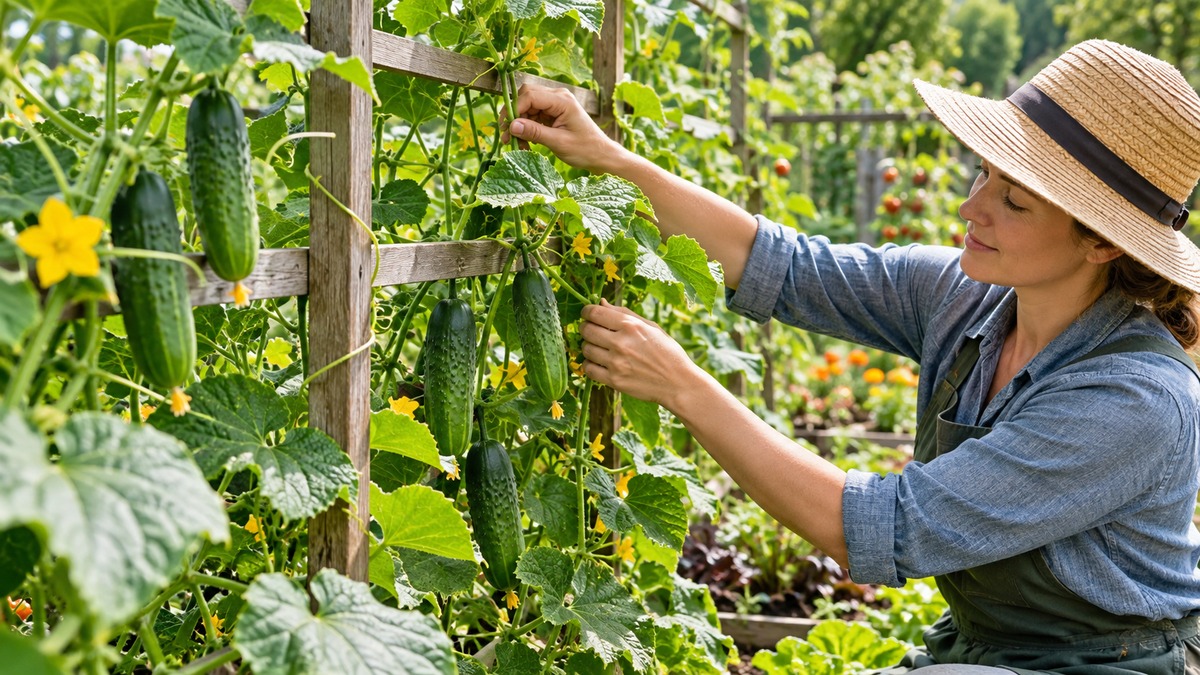
The same guide lists three small-space options: vertical growing, dwarf bush varieties and container growing. It defines vertical growing this way: “Grow vines vertically against a trellis or fence.” It also stresses that the support must be strong enough: “Ensure the support structure is sturdy enough to handle the weight of mature cucumbers.” This guide follows the vertical option, since that is the one that uses a trellis.
Iowa State University Extension says cucumbers “can be successfully grown on trellis systems to save space and make harvest easier.” If your trellis runs along a raised bed, see vegetables to grow in raised beds for other crops that can share that space.
Start seeds or transplants at the right time
The OSU guide says to plant seeds directly into the garden after the danger of frost has passed. It sets a soil target as well: “Ensure the soil temperature is at least 65°F for optimal germination.” For an earlier crop, it suggests: “Start seeds indoors about 2-3 weeks before transplanting.” When you buy transplants, look for bright green leaves, strong stems and no yellowing, wilting or pests, and skip leggy or root-bound plants.
For spacing, the guide gives “Space transplants 12–24 inches apart within rows that are spaced 48–72 inches apart.” The Alaska research note makes a related point: “Because vines do not sprawl all over the ground, plant spacings can be closer both within and between rows.” A trellis lets you use the closer end of that range.
Soil matters too. The OSU guide says cucumbers “adapt to most soils but grow best in fertile soil with plenty of compost”. It gives the target range this way: “The ideal pH for cucumber growth is between 6.0 and 6.8.” It also recommends black plastic ground mulch for weed control and soil warming, and it asks that cultivation stay shallow: “Cultivation should be shallow to remove competing plants without damaging the root system.”
Build a trellis that carries mature fruit
Start with the frame. The University of Maryland cucumber section describes one: “Erect the trellis so that it is 6 ft high with a top (No. 8) and bottom (No. 12) wire and plastic twine or netting tied between the two wires at each plant.” Its posts should be no more than 15 feet apart, with an extra brace when the fruit load gets heavy. That section is written for field and high tunnel production, so treat its dimensions as a reference rather than a fixed rule.
Anchoring comes next. The Dakota Gardener column from North Dakota State University says: “Anchor your trellis into the ground with metal or wooden stakes that are inserted into the ground at least 1 foot deep.” It adds that the material should be attached to the stakes with nails, staples, zip-ties or wire, and it warns that vines and fruit add weight.
The column says any material will do if it is sturdy enough to support the vines and fruits. It also warns to watch for fruit that might grow in between the spaces in your trellis. Check the openings before you buy. For one option, see our guide to garden trellis netting.
Plant and train the main stem
Plant once the frame is secure. The NDSU column puts it this way: “After the trellis is installed and secure, you can plant your cucumbers as you normally would.” Early on, you may need to guide young vines toward the support, and the column says “Then they will take-off and grow up the trellis.” Later in the season, “During the growing season, you might have to guide a few errant vines back to the trellis.”
The Maryland section puts the main stem first: “Training the main stem is required until it reaches and extends over the top wire.” For side shoots it describes two methods. One removes “The first 4-6 lateral runners that appear” near the base and lets later runners run. The other prunes the bottom of the plant and keeps one or two stems: “If pruning is done, the lower laterals (suckers) should be pruned on the bottom 2 ft leaving 1 or 2 stems per plant to trellis.” The guide says that pruning near the base “will result in higher yields”, but it does not say which method suits a backyard trellis.
The single-leader method needs more attention. The same section says: “If raising a single leader per plant, suckering, trellising, and lowering of the plants should be performed at least weekly.” That schedule is for single-leader plants, and the sources do not say how it applies to a backyard trellis.
Tie and check the vines
Trellising takes time. The Alaska research note, first published in 1995 and revised in 2014, calls the job labor-intensive: “Trellising is a labor-intensive task requiring individual vines to be tied up several times during the summer.” Plan several short tying sessions through the season rather than one setup day.
For a steady rhythm, the OSU guide says: “Familiarize yourself with the appearance of healthy plants and periodically observe them for signs of stress or pests, ideally two to three times per week.” A quick walk along the trellis at that pace gives you time to catch loose vines before the fruit gets heavy.
Water and feed trellised vines
Cucumbers root deeply. The OSU guide says they “typically have a rooting depth of 36–48 inches and require frequent watering.” It sets a floor of 65 percent of the soil’s water-holding capacity. For clay-loam soils, it suggests a squeeze check: a firm ball of soil should feel moist but not sticky, and it should crumble into medium-sized fragments when broken. The most common sign of trouble is wilting, which can come from too little or too much water: “The most common sign of stress is leaf wilting, associated with under- or over-watering.”
For feeding, the guide asks gardeners to adjust rates from a soil report. Its starting points include “Pre-plant fertilizer: Apply one pound of a pre-plant fertilizer (e.g., 10-10-10) per 100 square feet.” One week after flowering begins, it suggests: “Side-dress: One week after flowering begins, side-dress with 1.5 oz of ammonium sulfate per 10 feet of row.”
Give pollinators a clear path
Male cucumber flowers appear first. The OSU guide says: “Male flowers typically appear first and provide pollen, which is transferred to female flowers by pollinators like bees and other insects.” Weather can slow this. The guide notes that “Can reduce bee activity, impacting pollination” when temperatures drop below 10°C (50°F), and it lists rainy weather as something that hinders pollination efficiency.
The Maryland section adds: “Honey bees, squash bees, bumble bees and other wild bees are important for proper cucumber pollination and fruit set.”
Harvest from the trellis
The Maryland section lists benefits that show up at picking time: better fruit color and shape, with no yellow “ground spot” and “Easier harvesting than ground grown cucumbers.” It also cites “More consistent and thorough harvesting resulting in fewer jumbos and culls”. Those points describe commercial production, so treat them as growers’ reasons rather than promises for a backyard bed.
Timing matters too. The OSU guide says “Over-mature cucumbers often turn yellow, orange or white.” Check the vines often enough that fruit does not stay on the plant that long.
Does a trellis raise yield?
The sources disagree, so each claim needs its limits. The Maryland section says trellised slicers and pickles “may result in 2-3 times greater average yield than in non-trellised fields.” That figure comes from field production. The Alaska note reports a small garden experiment with three rows, each holding three trellised and three untrellised plants. It found that “Total fruit yield for the season was similar for trellised and untrellised plants”, and it says “variation among all plants was so great that any differences are insignificant.”
The same note says its season was short, and fruit ripened within about one month before frost. It also says: “Nevertheless, trellising will be useful where garden space is a premium.” Iowa State’s guide is more general. Read together, the sources support trellising for space and ease of harvest, while any yield gain depends on conditions they do not set out.
Mistakes to avoid
- Skipping deep stakes. The NDSU column asks for stakes inserted at least 1 foot deep.
- Letting fruit wedge into wide openings. The column warns about fruit growing between the spaces in the trellis.
- Waiting too long between tie checks. The Alaska note calls trellising labor-intensive and says vines need tying several times in a summer.
- Watering only the surface. The OSU guide puts cucumber rooting depth at 36 to 48 inches.
- Letting fruit over-mature. The OSU guide says over-mature cucumbers often turn yellow, orange or white.
How we chose
We opened nine pages with curl on 2026-10-22. Seven returned HTTP 200. Two did not count: one returned HTTP 202 and one returned 403. Of the seven, one was a digital collection page with no document text, and one was an archived Maryland bulletin that the site marks as no longer circulated. That left five sources: four university extension or research pages and one North Dakota State University column. Each one covers cucumbers grown at home or on a trellis. We did not rank varieties, and we did not name products.
What we could not verify
The sources we opened do not give a home-bed yield figure that compares trellised and ground-grown cucumbers. The two-to-three-times figure comes from fields. The one Alaska experiment found similar totals, and it was small. Neither source gives a trellis height for a backyard bed, or a mesh size that keeps every fruit inside the frame.
What the sources do not say
The sources do not say how many vines one trellis should carry, or which side-shoot method works best at home. NDSU says cucumbers “don’t need any extra support” because the fruit is small, while OSU says the support must carry the weight of mature cucumbers. We read that gap as a reason to build for the heavier fruit. The Maryland section also mentions single-stem systems, but it ties them to high tunnels, and the sources do not say whether a home bed should use them. None of the sources names a product, and this guide names none.
Frequently asked questions
Should the trellis go up before planting?
Yes, that is the order the NDSU column describes: install and secure the trellis, then plant as you normally would. Its warning about the weight of vines and fruit is a reason not to rush the frame.
How tall should a cucumber trellis be?
The Maryland section describes a frame 6 ft high. That guide is written for field and high tunnel production, and the other sources we opened give no home-bed height. Choose a height that fits your space, and check that the frame can carry mature fruit, as the OSU guide advises.
How often should the vines be checked?
OSU suggests looking at plants two or three times a week for signs of stress or pests. For a single-leader plant, the Maryland section calls for weekly work. The sources do not say which schedule suits a backyard trellis, so start with the OSU rhythm.
Will a trellis give me more cucumbers?
The sources do not agree. The Maryland section cites two to three times the average yield in fields, while the Alaska experiment found similar totals. The sources do not measure a backyard bed, so no single answer fits every garden.
Does a container work with a cucumber trellis?
OSU lists container growing as a small-space option, and it suggests large hanging baskets for compact growth. It does not describe a trellis inside a container, so that combination is outside what these sources cover.
Bottom line
Build a sturdy support before planting, train the main stem up it, keep the vines watered and checked, and pick fruit before it over-matures. The yield question stays open for a backyard bed, so judge the trellis by the space it saves and the picking it makes easier.
Sources
- https://extension.oregonstate.edu/gardening/vegetables/grow-your-own-cucumbers (opened 2026-10-22)
- https://extension.umd.edu/sites/extension.umd.edu/files/2026-02/Cucumbers.pdf (opened 2026-10-22)
- https://www.ag.ndsu.edu/news/columns/dakota-gardener/dakota-gardener-growing-cucumbers-on-a-trellis (opened 2026-10-22)
- https://uaf.edu/afes/places/gbg/research/files/pdfs/2014.-Holloway-Wagner.-Note.65-ocr.pdf (opened 2026-10-22)
- https://yardandgarden.extension.iastate.edu/how-to/growing-cucumbers-home-garden (opened 2026-10-22)