How to Attract Monarch Butterflies to Your Garden
As an Amazon Associate we earn from qualifying purchases.
How to attract monarch butterflies to your garden starts with one plant. Monarch caterpillars feed on milkweed and little else, so a garden without milkweed can draw adult monarchs for nectar but cannot raise them. The extension sources we opened agree on that point and on the wider plan: native milkweed for the caterpillars, nectar flowers for the adults, and a layout that keeps both in sight. They point to different species depending on the region, so check your state’s native list before you buy.
Quick answer
- Plant native milkweed, because monarch caterpillars eat milkweed and little else.
- Add nectar flowers for the adults, and choose plants that bloom at different times.
- Leave out butterfly bush, which Penn State Extension calls non-native and invasive.
- Match each milkweed to your sun and moisture, since Illinois lists twenty-two native species.
Know the two jobs of a butterfly garden
The Penn State York County article draws the key line: “Nectar plants (the flowers have nectar) typically feed a wide variety of adult butterflies.” Host plants do different work. The same article says: “Host plants (the leaves) however feed the butterfly young, caterpillars.” Those are separate jobs, so a bed full of blooms alone does not complete the monarch cycle.
The University of Maryland planning guide makes the same case: “In addition to nectar plants; however, a butterfly garden should include host plants: plants that serve as food sources for the butterflies in the caterpillar stage.” It explains why local plants matter: caterpillars and many other insects adapted over millennia “to feeding on a limited number of species of plants that were near where they lived”. It then adds: “Thus, to ensure the survival of our butterflies and to attract more of them to your yard, plan to include a few host plants.”
How the monarch life cycle shapes the plan
Monarch caterpillars depend on milkweed. The Oregon State Extension answer says: “Monarch butterflies lay their eggs on milkweed, and their larva (caterpillars) exclusively eat milkweed.” It adds that “While having a wide variety of flowering plants year-round helps other insects, only milkweed will specifically assist in keeping the Monarchs alive.” The answer treats milkweed as the one plant that matters most for the species, even though many other flowers help pollinators in general.
Illinois Extension describes the same dependence from the egg onward. The female lays eggs on milkweed leaves, so young caterpillars have food once they hatch. The caterpillars eat foliage for about two weeks, “eating about 200 times their birth weight”, and then form a chrysalis. The Illinois article gives the chrysalis stage as 10 to 14 days. The adult that emerges then needs nectar, and the same article says “The butterflies use chemical and visual cues from their sensory organs to identify milkweed plants.”
Choose native milkweed for your site
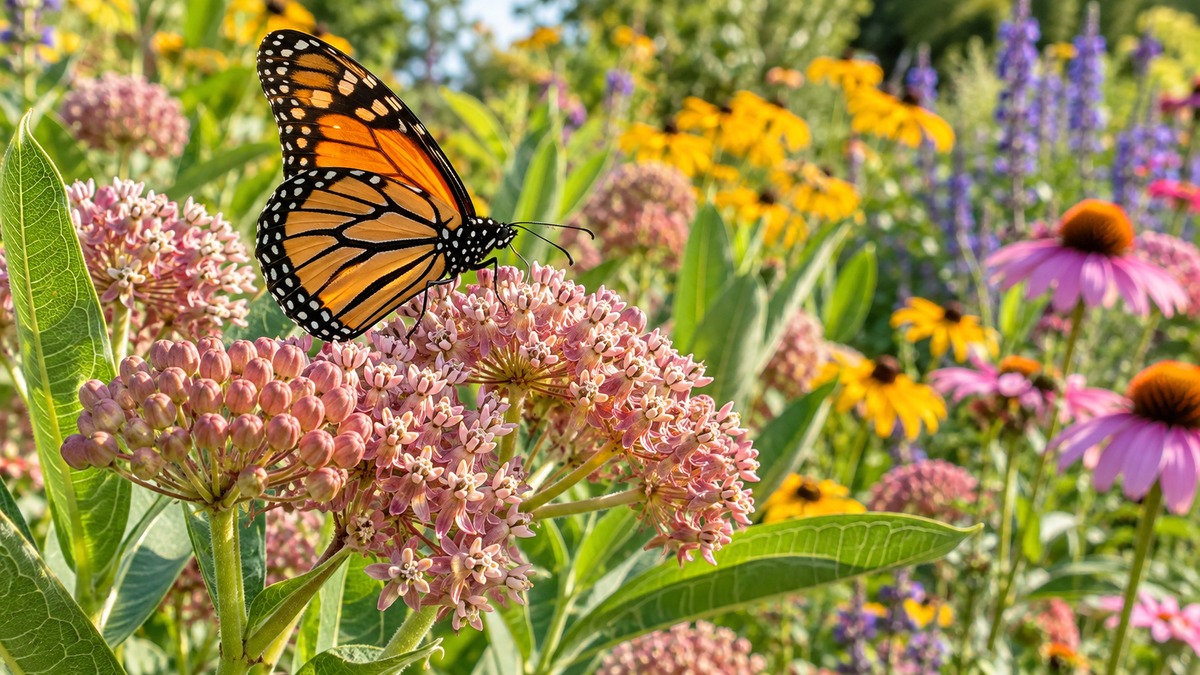
Illinois Extension says that “with twenty-two species of milkweed native to Illinois, every gardener can find a favorite alternative to common milkweed.” Its reasoning is that “No matter the size, sun exposure, or moisture level of your garden, there is a perfect milkweed for that spot”. Common milkweed is the familiar roadside plant. Illinois notes it can look weedy, yet it is the sole food source for the monarch caterpillar.
Penn State’s article describes common milkweed (Asclepias syriaca) as a plant that “thrives in dry, sunny locations”, and it says the plant grows 3 to 5 feet with a spread of about one foot. Flowering runs from June to August, and seed pods form in autumn. The article also notes that “The U.S. Fish and Wildlife Service encourages milkweed planting.”
Penn State adds that “There are over 100 species of milkweed native to the United States”, so most sites have more than one native choice. Regional choice matters, too. Oregon State’s answer is encouraging: “Planting milkweed certainly can’t hurt, and you may attract them and provide them with a habitat.” It names showy milkweed as the Willamette Valley variety, and it says the non-native Mexican milkweed “has generated debate among entomologists”. The sources do not give a single species list for every region, so use your state’s native list and ask your local extension office which species suit your soil.
Start with a small patch, then add variety
You do not need a large planting to start. Illinois says that “A huge patch of milkweed is not necessary to benefit the monarchs, a small patch can be a great resource.” Its advice for variety is to plant several species, which gives “season-long support of the monarch” because each one has its own bloom time. Its examples include butterfly weed, prairie milkweed, swamp milkweed, poke milkweed and whorled milkweed.
Penn State’s article gives sizes and site needs for some of these. Showy milkweed, which it lists as Asclepias speciosa, is “drought tolerant, and low maintenance.” Ice Ballet, a cultivar of Asclepias incarnata, grows in “medium to wet soil in full sun.” Butterfly weed, Asclepias tuberosa, has bright orange flower clusters. The Maryland guide adds that butterfly weed “grows in poor dry soil in sun”, which helps match it to a dry bed. Illinois says flower colors “vary from species to species but can be pink, purple, red, white, green, or orange.” Penn State says common milkweed’s pink flower clusters “smell like lilies.” Plants can be sown from seed in spring or bought as plants.
Plan nectar blooms for each season
Adult monarchs need nectar across the season. Illinois Extension notes that “Hungry adults will visit the milkweed flowers for nectar but will also frequent other nearby flowers that are high in nectar.” It also describes milkweed flowers as “a favorite food source for all local pollinators.” Milkweed flowers help the adults, and nearby nectar plants give them more options.
The Maryland guide sorts its native nectar plants by bloom time. Early choices include moss phlox and wild columbine. Summer choices include bee balm, black-eyed Susan, coneflowers and gayfeather, which the guide describes with “white and purple heads attract butterflies”. Mountain mint is listed as “outstanding for attracting butterflies and pollinators”, and the guide adds that it can spread vigorously. Native shrubs in the same list include summersweet, which blooms in mid-summer, and spicebush, which the guide names as a host for the Spicebush Swallowtail. Late in the year, the guide points to asters, goldenrods and Joe Pye weed.
The same guide makes a specific late-season point about obedient plant. Its ‘Vivid’ cultivar “provides an excellent late fall source of nectar for bees and late-migrating Monarchs.” Oregon State’s answer makes a broader timing point: a “wide variety of flowering plants year-round” helps insects in general. For a bed layout that keeps host and nectar plants together, see our guide to raised bed companion planting.
The Maryland guide also lists host plants beyond milkweed. Its list includes butterfly weed and swamp milkweed, and it also names thistles, sunflowers, parsley, Queen Anne’s lace and violets among caterpillar hosts. Penn State adds that dill and parsley feed the young of the Eastern Black Swallowtail. A mixed planting can therefore support more than one kind of butterfly in the same bed.
Leave out plants that do not feed native caterpillars
Penn State warns about butterfly bush, which is “often seen at plant nurseries” and has showy blooms and nectar. The article says it “is non-native and invasive.” The more serious problem is host use: “Most native American caterpillars cannot feed on the plant and die if the eggs are laid on the butterfly bush.” The article’s advice is to help the native environment by planting host plants instead.
The Maryland guide also says butterfly bushes “excel as butterfly and bee magnets”, but it adds that their nectar is high in sucrose and does not provide other nutrients. That is a reason to pair any such shrub with plants that do more.
Plan for spread, sun and seasons
Milkweed is a perennial. Illinois says milkweeds are “herbaceous perennials, dying down to the ground each winter and regrowing new foliage each spring.” Oregon State’s answer gives a planning point: some milkweeds spread through rhizomes underground, so “plant them where you won’t mind if they multiply.” Give each plant room before you place it.
Seasons matter too. Illinois describes how mature flowers turn into pods of seeds attached to white, fluffy floss. Knowing that sequence helps you judge how a clump will look across the summer and into autumn. Penn State describes the same stage: in autumn the pods open, and “seeds disperse on silken parachutes.” Illinois says the floss is “easily dispersed throughout the landscape by wind”, so the seeds can travel well beyond the bed where the plant grew.
Mistakes to avoid
- Planting only nectar flowers. Penn State says nectar plants feed adults, while host plants feed the caterpillars.
- Choosing one milkweed for every site. Illinois says sun, moisture and size shape the right species.
- Choosing butterfly bush for its blooms. Penn State calls it non-native and invasive.
- Planting milkweed without room to spread. The Oregon State answer warns about rhizomes.
- Buying Mexican milkweed without checking first. Oregon State notes that it has generated debate.
How we chose
We opened seven pages with curl on 2026-10-22. Four returned HTTP 200 with readable text, and the draft relies on those four: the Oregon State Ask Extension answer, the Penn State York County Master Gardener article, Illinois Extension’s 2022 blog post, and the University of Maryland planning guide. The Oklahoma State fact sheet returned HTTP 403, and two USDA NRCS PDFs did not return an HTTP 200 response. We chose the four for their state-level or regional guidance on milkweed and nectar plants. We did not rank plants, and we did not name products.
What we could not verify
The sources do not give a list of native milkweed species for every region, and they do not say how many milkweed plants a yard needs. The Maryland guide lists plants by bloom time and insect group, not by garden size. The Penn State article describes the monarch’s federal status only as the article states it, and we did not check that status against a federal page.
What the sources do not say
The sources do not give a planting density for milkweed, a count of nectar plants, or a bloom calendar for every climate. Oregon State’s species advice is for the Willamette Valley, and Illinois’s list is for Illinois, so neither carries over to every garden. Oregon State also notes that the Willamette Valley is slightly off the monarch migration route, and it does not say how many monarchs a backyard can support. None of the sources gives a fall plan that covers every region.
Frequently asked questions
What is the most important plant for monarchs?
Milkweed. The Oregon State answer says monarch caterpillars exclusively eat milkweed, and it says only milkweed will specifically help keep monarchs alive. Other flowers help insects more broadly.
Do monarchs also need nectar flowers?
Adults feed on nectar. Illinois says adults visit milkweed flowers and other nearby flowers that are high in nectar. Penn State describes nectar plants as feeding a wide variety of adult butterflies.
Which milkweed suits a garden?
Choose a native species that suits your sun, moisture and space. Illinois lists twenty-two native species, and Oregon State names showy milkweed as the Willamette Valley variety. Check your state’s native list, because the sources do not give one list for every region.
Is butterfly bush a good choice?
Penn State calls butterfly bush non-native and invasive. It says most native American caterpillars cannot feed on it, and that eggs laid on it can lead to their death. Penn State recommends planting host plants instead.
Will milkweed spread in my garden?
It can. The Oregon State answer says some milkweeds spread through rhizomes underground, so plant them where you will not mind if they multiply. For a bed with limited room, see our guide to outdoor hanging planters, which may suit smaller nectar plants.
Bottom line
Plant native milkweed for the caterpillars, add nectar flowers for the adults, and leave out plants that do not feed native caterpillars. Choose species for your own site, since the sources give regional advice rather than one list.
Sources
- https://extension.oregonstate.edu/ask-extension/featured/how-can-i-support-endangered-monarch-butterfly (opened 2026-10-22)
- https://extension.psu.edu/programs/master-gardener/counties/york/york-master-gardener-articles/native-plants-wildlife/help-the-butterflies-with-milkweed-parsley-and-dill (opened 2026-10-22)
- https://extension.illinois.edu/blogs/flowers-fruits-and-frass/2022-07-29-support-monarchs-plant-native-milkweeds (opened 2026-10-22)
- https://extension.umd.edu/sites/extension.umd.edu/files/2021-03/PLANNING%20A%20BUTTERFLY%20GARDEN.pdf (opened 2026-10-22)