How to Water Succulents Properly
As an Amazon Associate we earn from qualifying purchases.
Learning how to water succulents properly mostly comes down to one habit: wait until the soil is dry, then soak the pot until water runs out of the drainage holes and let it drain. Succulents store water in their leaves and stems, so they cope with drought better than they cope with soggy roots. Four extension sources from Kansas, California, Montana and Vermont describe this same rhythm in different words. This article turns their advice into a routine you can check against your own pots.
Quick answer
- Water only when the soil is dry. Montana State says succulents should be watered only once the substrate has dried out.
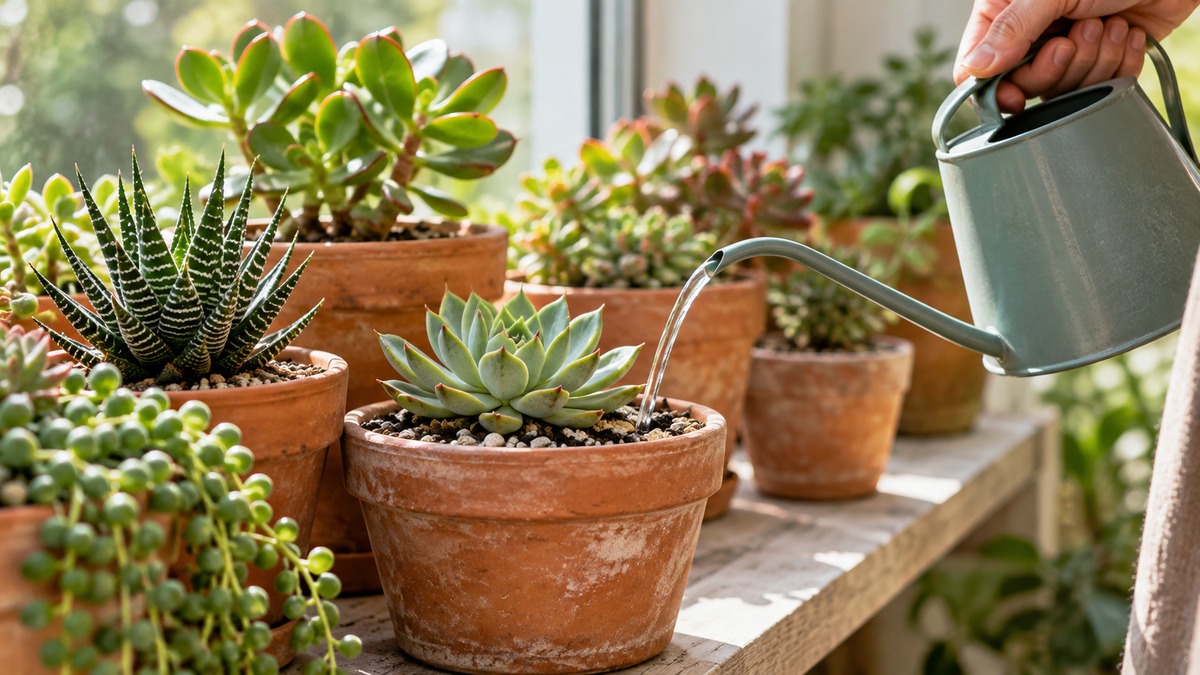
- Water thoroughly, then let the pot drain. Keep watering until water runs from the drainage holes, or until the mix is fully soaked if the pot has no holes.
- Cut back in winter. The University of Vermont houseplant item says winter care for houseplants starts with reducing water, and UC notes that winter-dormant succulents generally need no water while they rest.
Start with the pot and its drainage
The pot sets much of the schedule before any water goes in. Kansas State’s container guidance says water should run out of the bottom drainage hole. The same publication lists size, shape and the material a container is made of, along with sun and wind exposure, as factors that change how much water a plant needs. It does not rank those factors or give a number of days for each one, so treat them as reasons to check the soil rather than as a timetable.
Pot material matters too. Montana State notes that pots made from certain materials, terracotta among them, promote drainage and hold less water than plastic or glass. The University of California publication says terracotta pots help absorb excess water and reduce overwatering. It also warns that plastic is lightweight and inexpensive but not breathable, so overwatering is a real risk in plastic pots. Read together, the guides favor a pot and mix that let the roots dry out between waterings.
The mix counts as much as the pot. Montana State warns that overwatering, or planting in a poorly draining substrate, can stress the plant and may lead to bacterial or fungal root rot. A dense mix that holds water takes longer to dry, so the dry-down check in the next section matters even more in that case.
Check the soil before you water
The most useful habit in these guides is the dry-down check. UC advises watering deeply but not often, and letting the soil dry out before the next watering. Montana State gives the same rule more firmly: succulents should be watered only when the soil or substrate is dry, because that matches the conditions they evolved in. Neither guide sets a calendar. The soil tells you when the plant needs water, and a fixed schedule can miss that.
Kansas State suggests checking container gardens each day until you know how fast the mix dries, which in turn tells you how often and how much to water. That advice is written for containers in general, but the idea carries over to succulents. The University of Vermont houseplant item describes a simple test with a chopstick: if soil sticks to the chopstick, the mix is still moist and the plant does not need water yet. It also notes that a moisture meter can tell you whether houseplants need water. A meter is a convenience, not a requirement.
The sources do not give a number of days between waterings for succulents, and this article does not add one. Your pot, the light, the season and the species all change how fast the mix dries. Use the check, and keep a note of how many days a pot takes to dry during the first few weeks. Once you have that note, you have a schedule that fits your own space.
Soak the pot, then let it drain
When the soil is dry, the guides agree that you should water fully. Montana State says to keep adding water until it runs from the drainage holes in the container, if it has them, or until the mix is completely soaked. It also warns against a common habit: frequent light sprinkles do not supply enough water for a succulent to survive. A light splash across the top is not the same as a full soak.
Kansas State’s container advice matches this approach. It recommends watering a container to full capacity so that the water soaks through the entire pot. For container gardens in general, it adds that the pot should be left for about 30 minutes so the soil can take up free water from the bottom. That is general container advice rather than succulent advice, so treat it as a guide for the drainage step, not a fixed rule. For a pot with a hole, the test is simple: water should come out of the bottom.
Let the pot drain fully before you think about the next watering. Montana State links overwatering and poor drainage to root rot, so a pot that stays wet is the outcome to avoid. Letting excess water leave is the step that most of these sources share.
Adjust for winter and dormancy
Succulents do not all rest at the same time. UC divides them into summer-dormant and winter-dormant groups, and points to a table to show which plant falls into which group. It also says dormancy can last weeks or months depending on the variety, so it advises researching your plant’s variety before changing the routine. Summer-dormant plants still need some water during their rest, but UC says not to overwater them. Winter-dormant plants generally need no water during dormancy, because their roots do not absorb moisture.
Montana State describes what the colder months look like. Succulents enter dormancy in the colder, darker months of winter, and during that time they need only enough water to keep from shriveling. The guide says succulents can handle the cold while dormant, but that watering during dormancy can kill them. In practice, the winter routine usually means less water, and for a plant in deep rest it may mean none at all.
The University of Vermont houseplant item treats the change in daylight as the main trigger. It notes that some cacti and succulents may go into a deeper dormancy to cope with shorter days. For houseplants in general, it says winter care starts with cutting back on water. UC adds a reassurance: plants may stop growing or drop leaves in winter and look as if they are dying, and UC calls that normal, so a plant that looks poor in winter is not always in trouble.
Indoor and outdoor succulents need different checks
Outdoor plants need more attention, not less. Montana State says outdoor succulents need to be checked more often and will probably need more water. Kansas State lists sun and wind exposure, along with plant density and maturity, as factors that change water requirements. A plant in full sun or steady wind is a likely candidate for a faster dry-down, so it deserves more frequent checks than one in a shaded corner.
Indoor plants face a different problem. The University of Vermont piece advises holding off on watering houseplants until the potting mix is truly dry. That advice targets overwatering, which Montana State also names as the main risk for succulents. Indoors, the same dry-down check applies, along with the same caution about watering too often.
Signs the watering is off
The sources name two problems directly. The first is too much water, which Montana State ties to bacterial or fungal root rot. The second is too little water during the growing season, since light sprinkles do not supply enough. The only symptom these guides describe in any detail is shriveling during dormancy, when a plant needs just enough water to keep from shriveling. The guides do not give a full list of warning signs, so rely on the dry-down check and on the drainage of the pot.
A simple watering routine
The points above fit into one routine. Each step comes from a source named in this article.
- Check the pot for a drainage hole. Montana State treats drainage holes as something some pots have and others do not.
- Test the mix with a chopstick or a moisture meter before you water, following the University of Vermont houseplant item.
- If the mix is still moist, wait and test again later, since UC and Montana State both say to water only once the soil is dry.
- When the mix is dry, water until it runs from the holes or the mix is soaked, as Montana State and Kansas State describe.
- Let the pot drain before it goes back in place.
- In winter, find out which dormancy group your plant belongs to, then reduce water or stop if it is winter dormant.
Mistakes the guides warn about
The most common mistake is the light sprinkle, which Montana State says does not supply enough water for a succulent to survive. The second is a dense mix in a pot with no drainage, which Montana State ties to root rot. The third is watering a dormant plant in winter, which the same guide says can be fatal. The fourth is ignoring the pot material. UC advises caution about overwatering in plastic pots, since plastic is not breathable.
If you are comparing containers, the posts on bottom-watering planters and self-watering window box planters are related reads on how containers hold and release water.
How we chose
We started from university and state extension publications that cover succulents or container watering. Each source was opened with curl, and we kept only those that returned HTTP 200 and supported the points made here. Several extension pages returned errors and were left out, and so were retail listings and general gardening blogs, because their intervals were not tied to a named extension program. The four sources here come from different regions, Kansas, California, Montana and Vermont, so the advice does not rest on one climate alone.
What we could not verify
The guides describe principles and conditions. They do not give a schedule for any named succulent species, and none of them compares pots side by side. Where the sources are silent, this article says so rather than filling the gap with a guess.
What the sources do not say
None of the four sources gives a fixed number of days between waterings for succulents. None gives a volume of water for a given pot size. The text does not give a full list of symptoms for underwatering or overwatering. The Kansas State 30-minute guidance is for container gardens in general, so this article treats it as general guidance. The Vermont item is written for houseplants, so its points are applied to succulents by inference. Finally, the sources do not say how much water to pour into a pot without drainage holes.
Frequently asked questions
How often should succulents be watered?
No source gives a fixed number of days. Water when the mix is dry, and use the dry-down check described above to learn how fast your pot dries in each season.
Do succulents need a drainage hole in the pot?
Montana State treats drainage holes as something a pot may or may not have, and it links poorly draining mix and overwatering to root rot. Kansas State says water should come out of the bottom drainage hole. The sources do not say how much water to use for a pot without a hole.
Is terracotta better for succulents?
Terracotta is the material the guides name most often for drainage. UC says it helps absorb excess water and helps prevent overwatering. Montana State says terracotta holds less water than plastic or glass, so it dries faster.
Do succulents need water in winter?
Often less, and sometimes not at all. UC says winter-dormant plants generally need no water while dormant, while summer-dormant plants still need some. Check which group your plant is in before you change the routine.
Are light sprinkles enough for succulents?
No. Montana State says frequent light sprinkles do not supply enough water. Water thoroughly when the mix is dry, and let the excess drain away.
Sources
- https://bookstore.ksre.ksu.edu/download/watering-raised-beds-berms-containers-and-houseplants_MF2805 (opened 2026-10-22)
- https://innovate.ucanr.edu/sites/default/files/2025-08/331073.pdf (opened 2026-10-22)
- https://extension-store.montana.edu/assets/publications/montguidepdfs/mt202208ag-growing-succulents.pdf (opened 2026-10-22)
- https://www.uvm.edu/extension/news/houseplant-care-during-winter-months (opened 2026-10-22)