How to Plant a Hanging Basket
As an Amazon Associate we earn from qualifying purchases.
Learning how to plant a hanging basket takes four decisions: a basket with drainage, a light soilless mix, a planting plan that puts trailing plants at the edge, and a spot where the basket can be watered easily. The three extension pages we opened agree on each of these. They differ on how many plants fit and how often to feed, and the Illinois page adds a method for planting through the sides, so this guide shows the figures and where each one comes from.
Quick answer
- Choose a basket with drainage holes and fill it with a light, soilless potting mix rather than garden soil. Clemson says not to add pebbles at the bottom.
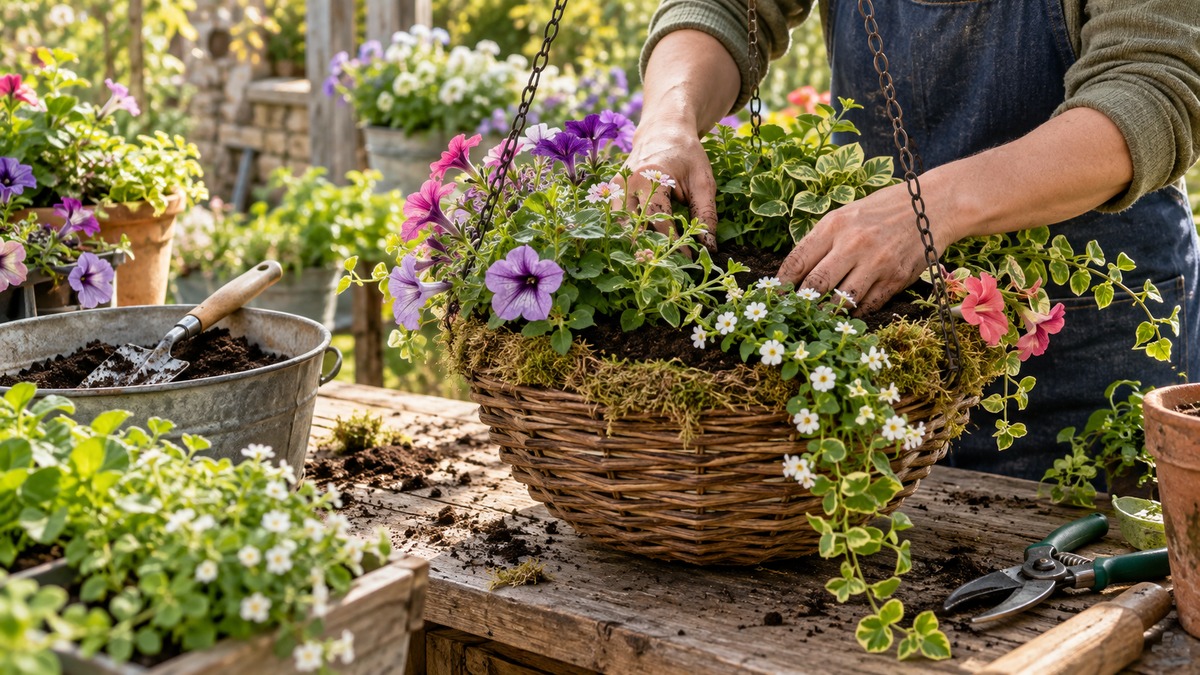
- Line a wire basket with moss or coir, fill it in layers, and plant trailing types at the edges with upright plants in the center.
- Hang the basket near eye level and water until it runs out the drainage holes. Feed every one to three weeks, as Iowa State advises, or every two weeks at half strength, as Clemson advises.
Pick a basket that drains
Drainage comes first on every page. Clemson says: “Be sure that your basket or window box has drainage holes.” Iowa State puts it the same way: “All hanging baskets need good drainage, and these hanging containers have drainage holes in the bottom.” Clemson also warns against a common shortcut: “Do not place pebbles or other material at the bottom of the container. They will not provide better drainage.” The reason is simple, since “Drainage is essential so that the planting mix will not become water-logged.”
Illinois Extension says the choice comes down to three materials: “As far as a choice of container there are basically three: solid plastic, wood and wire.” Clemson compares plastic and wire: “Plastic is inexpensive, easy to plant and is slower to dry out.” It adds that “Wire baskets allow more choices in size and planting arrangements.” Iowa State describes the classic option as “a metal basket or frame lined with coconut fiber, moss, burlap, or compressed fiber”. Each choice has a trade-off between drying speed and planting options.
Line a wire basket first
A wire frame needs a liner before any soil goes in. Illinois Extension explains: “With wire, you need to first line the container with something to keep the soil from falling out.” Clemson says liners “are used in wire hanging baskets to hold the soil and plants in position”, and that they “can be made of dried sphagnum moss or coconut fiber known as coir.” Illinois adds that “There are also pre-formed liners made from coir (coconut fiber)”, which can be pressed over the frame.
If you use moss, Clemson gives a clear method. Squeeze out the water first: “Squeeze as much water out of the moss as you can.” Then build the lining: “Make moss lining 1 inch thick, extending up 4 inches.” Illinois warns that lined wire baskets lose “a tremendous amount of moisture through the sides”, so they will need more frequent watering than a solid pot.
Mix and layer the soil
The mix is the second decision. Clemson says: “A lightweight potting mix is needed for container gardening.” It explains why garden soil does not fit: “Soilless planting mixes provide excellent drainage, aeration and water-holding capacity that ordinary garden soil can not supply.” Iowa State agrees: “The best mixes for hanging baskets do not contain garden soil.” Fill the basket to just below the rim, as Iowa State advises, “to create a lip that will make watering easier.”
Plant in layers rather than all at once. Clemson says to “Fill the lowest tier with flowers or foliage plants, and then add enough potting soil mix to cover the roots of plants completely.” It then gives the rhythm: “Continue to fill and plant the basket in 4-to 6-inch layers.” Illinois Extension notes that the method is close to ground planting: “Planting hanging baskets is not much different than planting containers that are on the ground.”
Plant the edges and the center
Placement follows a simple pattern. Clemson says: “Trailing plants should be planted at the edges and bushy or upright plants will go at the center or back.” Illinois Extension describes the same arrangement: “Locate upright or taller plants in the center with shorter and trailing material towards the middle and edge.” Choose small, healthy plants rather than large ones, since Clemson says: “Choose small, healthy young plants for planting.”
Density is where the pages sound different. Clemson says: “Plant much closer in a box or basket than you would in a flowerbed.” Iowa State gives counts by size: “Smaller hanging baskets with a diameter of 12 to 14 inches can accommodate 3 to 5 plants.” It adds: “Larger baskets with a diameter of 16 to 18 inches can have 5 to 7 plants.” Iowa State also warns: “Be careful not to overplant a hanging basket, or they may become overgrown and require frequent watering later in the season.” Plant closely, but stay within the count for the basket you chose.
If you want a full look without trailing plants, Illinois Extension describes planting through the sides of a lined basket: “Planting through the sides has its advantages if you want a completely full looking basket and only want to use non-trailing types of plants.”
Hang it where you can see and water it
Height matters for care as much as for looks. Clemson says: “Remember that most of the time the hanging basket will be viewed from below.” It recommends: “Hang the basket so that it will be close to eye level so that it can be admired and watered easily.” Illinois Extension gives the rule for planting: “If baskets will be hung at or slightly below eye level, follow a traditional planting scheme for ground containers.” For a basket above eye level, it says the tall center plants can go, and “use mainly rounded or trailing forms of plants.”
Weight is the other factor. Clemson says: “Window boxes and baskets call for a strong support system.” It adds: “Remember that the containers will be much heavier when watered.” Check the hook or bracket before you fill the basket, not after. If you need hardware, our guide to outdoor plant hangers is one place to start. For a ready-made option, our guide to outdoor hanging planters is worth a look.
Water and feed on a steady rhythm
Watering is the job that decides how the basket looks. Iowa State says: “Watering is one of the most important and frequent tasks for hanging baskets.” Illinois Extension notes that “Both solid baskets and especially moss lined baskets dry out quickly.” Clemson gives a finger test: “If the potting mix feels dry 1 inch below the surface, it is time to water.” When you do water, Clemson says to “Apply water until it runs out the drainage holes.”
Feeding is where the pages differ. Clemson says: “Feed baskets and boxes every two weeks from spring through summer with a complete liquid fertilizer diluted to half-strength.” Iowa State gives a wider range: “Apply soluble fertilizers every 1 to 3 weeks throughout the summer.” It also covers slow-release options: “Slow-release fertilizers can be added to soil in early spring and may need a second application mid-season.” Choose the schedule that suits your basket, and watch how the plants respond.
Keep it blooming
Blooms need upkeep. Iowa State says: “Some annual species require regular deadheading to keep plants in bloom throughout the season.” Clemson gives the same instruction in short form: “Remove flowers as they fade to keep flowering baskets blooming well.” By midsummer, a basket can get crowded, and Iowa State recommends this: “Pruning back trailing plants by one-third to one-half can help promote fresh new growth that will be more attractive and produce more flowers for the remainder of the growing season.”
Choose plants that suit the light
The plant list should follow the spot. Iowa State says: “Like any plant, matching the right plant with the site is essential.” It is specific about light: “Shade-loving plants will suffer in full sun, and sun-loving plants bloom poorly in shade.” Clemson lists more options, saying that “Many types of plants will grow in containers including annuals, vines, tropical plants, herbs and even some vegetables.” For a basket that gets sun, Iowa State notes that “Edibles in hanging baskets need full sun and consistent moisture to grow their best”, and that “Any compact variety of vegetable that grows well in a container can also be grown in hanging baskets.”
Common mistakes to avoid
- Adding pebbles to the bottom. Clemson says they do not improve drainage.
- Filling the basket with garden soil. Iowa State says the best mixes do not contain it.
- Overplanting. Iowa State warns that an overplanted basket may need frequent watering later in the season.
- Letting the mix dry out completely. Iowa State says to try not to let the soil dry out completely.
- Hanging the basket too high to water. Clemson says to hang it close to eye level so it can be watered easily.
How we chose
We started with university extension pages that came up in a search for planting hanging baskets, and kept those that describe the full planting process. We opened three of them on 2026-10-22: Clemson’s HGIC fact sheet, the University of Illinois Extension page on hanging baskets, and an Iowa State University Extension Yard and Garden guide. We read the sections that cover containers, liners, mixes, planting, hanging, watering, feeding and deadheading. We did not rank the three pages. An Oregon State University Extension PDF also opened with HTTP 200, but this article does not quote it. Search results from commercial sites were left out because they are not extension pages.
What we could not verify
The pages disagree on feeding frequency and on how many plants a basket should take. None of the pages gives a watering volume per basket or a weight for a finished basket, and none says how long a basket lasts through a season. Nothing in this guide is a product recommendation, and no basket, liner or hook is named as a best choice.
What the sources do not say
The pages do not give a soil depth for a plastic basket, and they do not say how many days a basket can stay in dry weather before it needs water. Clemson gives layer depths of four to six inches, and Illinois Extension does not, so the pages differ in detail there. None of the three pages says how a basket should be hung on a particular porch or wall. Check the support against the weight of a watered basket before you hang it.
Frequently asked questions
What kind of basket works best?
Any basket with drainage holes is a sound start. Clemson says plastic is inexpensive and slower to dry out, while wire baskets offer more choices in size and planting arrangements. Iowa State describes the classic option as a metal frame lined with coconut fiber, moss, burlap or compressed fiber. All three pages say the basket needs good drainage.
Does a wire basket need a liner?
Yes. Illinois Extension says wire baskets need a liner “to keep the soil from falling out.” Clemson recommends sphagnum moss or coir liners, and Illinois notes that pre-formed coir liners are also available. Line the basket before you add the soil, and expect a lined basket to dry out faster than a solid one.
How often does a hanging basket need water?
Often, especially in summer. Iowa State calls watering one of the most important and frequent tasks for hanging baskets. Clemson suggests checking the mix one inch below the surface and watering until it runs out the drainage holes. Illinois Extension notes that baskets dry out quickly, especially when lined with moss.
How often does a hanging basket need feeding?
The pages disagree. Clemson says to feed every two weeks with a complete liquid fertilizer diluted to half strength. Iowa State says to apply soluble fertilizers every one to three weeks through the summer, and it notes that slow-release fertilizer can be added in early spring. Start with the label and watch the basket to decide which schedule suits it.
Can vegetables grow in a hanging basket?
Some can. Clemson says that “Many types of plants will grow in containers including annuals, vines, tropical plants, herbs and even some vegetables.” Its example for hanging baskets is “leaf lettuce, parsley and miniature tomatoes.” Iowa State says that any compact vegetable that grows well in a container can be grown in a hanging basket, and that edibles need full sun and consistent moisture.
Sources
- https://extension.illinois.edu/container-gardens/hanging-baskets (opened 2026-10-22)
- https://hgic.clemson.edu/factsheet/hanging-baskets/ (opened 2026-10-22)
- https://yardandgarden.extension.iastate.edu/how-to/creating-and-growing-hanging-baskets (opened 2026-10-22)