How to Start a Worm Bin for Kitchen Scraps
As an Amazon Associate we earn from qualifying purchases.
Learning how to start a worm bin for kitchen scraps takes less room than many people expect. The core setup is a dark, lidded container with airflow holes, a bed of damp shredded paper, a batch of red worms and a steady indoor spot. The worms turn small amounts of food waste into a dark material called worm castings.
Penn State Extension, the Massachusetts Department of Environmental Protection and Illinois Extension describe this same basic method. Their figures do not always match, so this guide shows the differences instead of picking one silently.
Quick answer
- Use a dark, opaque bin with a lid, drilled for airflow and set on a tray.
- Fill it with about six inches of damp shredded paper, then add red worms.
- Keep it indoors, away from heat, cold and the laundry room.
- Feed small amounts by burying scraps in the bedding, sized to the worm count.
Why a worm bin works
The Massachusetts DEP fact sheet explains the idea in plain terms: composting is a controlled process of decomposition, and it works with kitchen scraps, yard wastes and paper products. Its point is that you can compost without a yard. Earthworms make the bin work faster, because the sheet says they speed up the composting process and aerate the organic material in the bin.
The same sheet says worms also enrich the finished compost. It says they add nutrients and enzymes from their digestive tracts. The sheet also describes vermicompost as high-quality compost. Illinois Extension makes the practical case in its Gardenbite segment: worm composting is a way to produce compost while putting kitchen scraps to use.
Choose and prepare the container
Worms avoid light, so the bin should be dark and opaque, with a lid. Penn State Extension recommends a dark-colored, opaque bin with a lid. The Massachusetts DEP fact sheet gives the reason in plain terms: worms do not like light. It says an opaque container is preferable to a translucent one, unless a translucent bin is kept covered with a dark cloth.
Size is the next choice. The Illinois Extension segment describes a 10 to 14 gallon bin as a good size to start with, and it says to make sure the bin comes with a lid. The Massachusetts DEP sheet adds that a deep bin is preferable to a shallow one, because it allows more room for layering and for burying fresh material. Depth matters for the feeding method covered further down this guide.
Airflow and drainage come from holes. Penn State Extension suggests a one-quarter-inch drill bit, with ten holes in the bottom and ten more in the sides near the top rim for ventilation. Illinois Extension describes half-inch holes on the sides of the bin and on the lid. The two sources disagree on hole size, so this guide lists both rather than choosing one.
Screen the holes. Illinois Extension says to cover the drilled holes with window screening so the worms do not escape.
Use a tray. Penn State Extension says to place a tray or another bin under the worm bin to protect the area beneath it. It also suggests deli containers or lids as spacers that lift the bin above the tray, which lets any leachate drain out. Leachate is the liquid that drains from the bin. Penn State recommends diluting it about 10 to 1 with water and using it on plants.
Material matters too. Penn State Extension says wooden boxes or drawers can be used as worm bins, but they will eventually decay from the moisture. It advises avoiding pressure-treated wood, cedar, cypress and redwood, because those woods are toxic to earthworm workers. The Massachusetts DEP sheet names the least expensive route: drill air holes in the sides and top of a plastic or wooden container.
Illinois Extension notes that you can simply use a plastic storage bin with holes drilled in the side.
Pick a steady indoor spot
Penn State Extension says red wigglers enjoy the same indoor temperatures people do, which it gives as 60 to 75 degrees Fahrenheit. The Massachusetts DEP sheet uses a wider range and says worms prefer temperatures between 40 and 80 degrees Fahrenheit. A spot inside the narrower Penn State range also sits inside the wider MassDEP range.
Penn State Extension also says to avoid placing the bin near heat or cold extremes. It advises against the laundry room, because washing machine or dryer vibrations may drive the worms out of their bins. Because it names a specific room, it is worth checking before the bin goes into a utility corner.
Bedding: how much and what kind
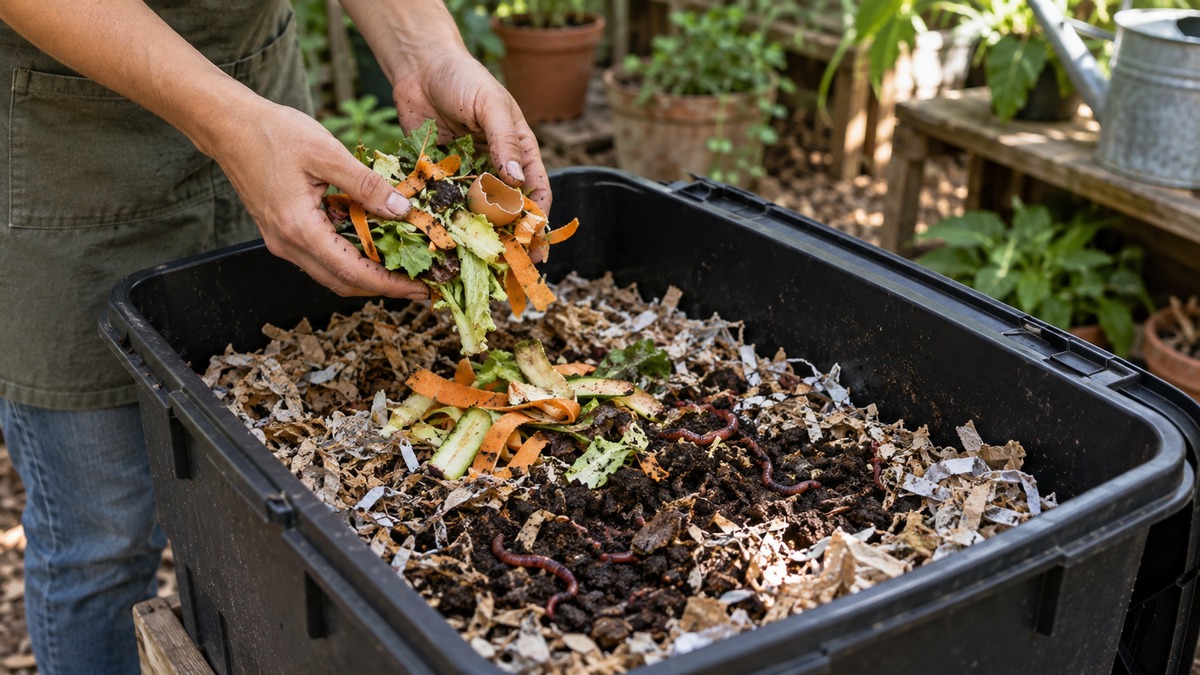
Penn State Extension describes the basic set-up as shredded paper bedding moistened with water, with kitchen scraps and a specific species of earthworm to do the work. For the bedding itself, it says narrow newspaper strips make excellent bedding for red wigglers in a worm bin. It also says you need about six inches of bedding on the bottom of the bin.
Moisture is added with a spray bottle. Penn State Extension says to use a spray bottle to moisten the bedding with water. That is the moisture method the page describes.
The shredder matters too. Penn State Extension advises avoiding paper shredders that cross-cut when you make worm bedding. The page describes narrow strips, and it rules out the cross-cut pieces.
Illinois Extension describes bedding in general terms. It says the bedding should be a non-toxic material that holds moisture while still letting air circulate, so that it does not compact too much. This guide reads that as a reason to keep the strips loose rather than packed into a dense mat.
Add the worms
Use red worms. Penn State Extension says not all earthworms are good at living in worm bins at household temperatures. That is why its guide centers on red wigglers. A worm dug up from the yard may not handle the indoor conditions described in these pages.
The Massachusetts DEP sheet also points to red worms. It says they thrive in decomposing organic matter such as leaf piles, compost heaps and old manure piles. Kitchen scraps are organic matter of the same kind.
The MassDEP sheet describes red worms as very efficient processors of organic waste. It says they eat and expel their own weight every day, and that even a small bin of red worms will yield pounds of rich compost, also known as worm castings. The feeding section below shows that Penn State gives a much smaller figure for intake.
What to expect in the first months
The Massachusetts DEP sheet gives a rough timeline for the worm population. It says it takes about three weeks for fertilized eggs to develop in a cocoon, from which two or more young worms can hatch. It also says that in three months the worms become sexually mature and begin to breed.
Penn State Extension says the earthworms will naturally reproduce. It adds that a bin owner will then have red wigglers to share with others, or can set up another bin. The page does not say how fast a particular bin will grow.
The timeline is a rough guide, and it does not say when a home bin reaches a stable population.
Feeding the bin
Penn State Extension describes the feeding method step by step. Dig a small hole in the bedding, add the food, and then cover it with bedding. Penn State describes this as its method for adding food to the bin.
Penn State also notes that freezing scraps helps break down the cell walls of plant material, so the material decomposes more quickly in the bin. The source presents this as a practice it uses, not as a rule, and it does not give a freezing time.
On amounts, Penn State Extension says a pound of red wigglers in an established worm bin will consume about a half-pound to one pound of scraps each week. The Massachusetts DEP sheet says red worms eat and expel their own weight every day. A pound of worms eating a pound of food each day would be seven times the top of the Penn State range, so these two figures cannot both describe the same bin.
Neither page sets a rule for how much food a household bin should receive. The rates above are starting points to check against your own bin, and the sources do not give a count of worms for a given bin size.
Common problems and fixes
Odor is the problem Penn State Extension describes most directly. Its author reports a bin that developed a very unpleasant odor after too many cabbage, broccoli, cauliflower and kale scraps went in. The page names that group as the cabbage family, Brassicaceae. The source does not say how much of that group is too much for a given bin.
Escaping worms are a second problem. Illinois Extension recommends window screening over the drilled holes so the worms do not get out. Penn State Extension adds that washing machine or dryer vibrations may drive worms out of the bin, which is another reason to keep the bin out of the laundry room.
Light is a third problem. Penn State Extension and the Massachusetts DEP sheet both treat light as something worms avoid. A clear container that lets light in should be covered with a dark cloth or swapped for an opaque bin, which is the choice the MassDEP sheet describes.
Leachate is a fourth issue, mostly a cleanup one. Penn State Extension suggests lifting the bin on spacers above a tray so the liquid can drain, then diluting it about 10 to 1 with water before using it on plants.
If you are comparing indoor bin options, the guide to DIY indoor worm compost bins covers that choice. For an outdoor setup in the ground, see the in-ground worm farm guide instead.
Harvest the finished castings
Penn State Extension says that after a few months, you push all the worms and bedding to one side of the bin. Add moistened fresh bedding and a small amount of food to the other half of the bin. The page then describes what follows: soon there will be a pile of vermicompost for your plants and a separate pile of worms ready to return to work in fresh bedding.
If you need the compost sooner, Penn State Extension says to dump the worms and bedding onto the lid instead. The page presents that option for when you are in a hurry.
The Massachusetts DEP sheet says even a small bin of red worms will yield pounds of rich compost, also known as worm castings.
How we chose
This guide draws on three public pages: Penn State Extension’s vermicomposting article, the Massachusetts DEP vermicomposting fact sheet, and an Illinois Extension Gardenbite page that includes a written transcript on composting with worms. They were chosen because they are extension or state pages about indoor bins for food scraps, and each one could be opened and read during this check.
Several other pages came up in search but returned errors or redirects, so they are left out. Commercial bin listings were not used, and this guide does not recommend a product. Each claim in the body traces to one of the three pages, and the research note lists the exact sentence behind it.
What we could not verify
The three pages do not agree on several figures. Penn State Extension gives a hole size of one-quarter inch, while Illinois Extension gives half-inch holes. Penn State gives a range of 60 to 75 degrees Fahrenheit, while the Massachusetts DEP sheet gives 40 to 80 degrees. Penn State gives a weekly feeding rate of about a half-pound to one pound of scraps for each pound of worms, while the MassDEP sheet says the worms eat their own weight every day. This guide shows each figure with its source and does not pick one as the rule.
What the sources do not say
This check found no cost figure for a bin in these pages, and none names a product to buy. The pages do not give a count of worms for a particular bin size, and beyond the phrase “a few months” they do not give a day count for when a bin is ready. Their guidance on foods is limited, so questions about meat, dairy or oily food are not answered here. Pest questions, such as fruit flies, are not covered in these pages.
Frequently asked questions
Can worms from the yard go in the bin?
Penn State Extension says not all earthworms do well in bins at household temperatures, so it recommends red wigglers. The Massachusetts DEP sheet also points to red worms and says they thrive in decomposing organic matter. A worm from the yard may not handle the indoor conditions these pages describe.
How long until finished compost is ready?
Penn State Extension says that after a few months, you push the worms and bedding to one side and add fresh bedding to the other. If you need compost sooner, the same page says to dump the worms and bedding onto the lid. The source does not give a date range beyond a few months.
Where should the bin go in the house?
Penn State Extension recommends an indoor spot that stays between 60 and 75 degrees Fahrenheit. It also advises avoiding heat or cold extremes and the laundry room, where vibrations may drive the worms out. The Massachusetts DEP sheet gives a wider 40 to 80 degree range, so the narrower range is the safer target.
What causes a bad smell in a worm bin?
Penn State Extension describes a strong odor after too many cabbage-family scraps, including broccoli, cauliflower and kale, went into one bin. The sources do not give a moisture target or a measure for how much of that group is too much.
Which wood should be avoided in a worm bin?
Penn State Extension says to avoid pressure-treated wood, cedar, cypress and redwood, because those woods are toxic to earthworm workers. It also says wooden boxes will eventually decay from moisture. The Massachusetts DEP sheet describes making a bin from a plastic or wooden container as the least expensive route.
Sources
- https://extension.psu.edu/vermicomposting-puts-worms-to-work (opened 2026-10-22)
- https://www.mass.gov/doc/massdep-fact-sheet-vermicomposting-indoor-composting-with-worms/download (opened 2026-10-22)
- https://extension.illinois.edu/podcasts/good-growing/gardenbite-composting-worms-indoors-goodgrowing (opened 2026-10-22)