How Often to Water a Raised Garden Bed
As an Amazon Associate we earn from qualifying purchases.
How often to water a raised garden bed depends mostly on soil, weather, and plant size. Raised bed soil usually drains quickly, so a bed can dry out faster than a garden planted in the ground. The three sources do not give one fixed schedule. They do give numbers to start from, along with habits that hold up: water deeply, water the roots, and check the soil before watering again.
Quick answer
- Check the top inch or two of soil first. Oregon State University says to water at least 6 inches deep and let the surface inch or two dry before watering again.
- Illinois Extension says a very well-drained raised bed may need water two or more times a week on hot summer days. Oregon State gives a thorough watering every 5 to 7 days in hot weather for plants with deep roots, so the sources disagree.
- Illinois Extension aims for about one inch of rain a week. North Carolina State Extension gives half an inch to one inch for young vegetables, rising to one to one and a half inches as they mature.
- Water the roots, not the leaves, and water in the morning to limit evaporation and leaf disease.
What raised bed soil does to moisture
Soil decides how fast water moves in and how long it stays. Illinois Extension notes that a raised bed soil may resemble native soil, but there are usually real differences. In its words, “Usually, a raised bed soil is very well-drained, similar to sandy soil.” Oregon State University says the soil and organic matter mix in raised beds dries faster than clay soil.
Clay works the other way. Heavy clay holds on to water and drains slowly, so a clay garden can often go longer between waterings. Illinois Extension says that for more clayey soils you could get away with irrigating perhaps once a week. Oregon State says sandy soil holds much less water than clay soils.
The sources do not say what soil mix a bed should use. For the mix itself, read how to fill raised beds before you set a schedule.
Gear for watering and checking
Rain gauge and weather records
Illinois Extension says a rain gauge may be the only equipment you need to buy. You can also check local weather station records or online precipitation records. The point is to know how much rain actually fell, because the weekly total decides whether you need to add water.
Hoses, nozzles, and wands
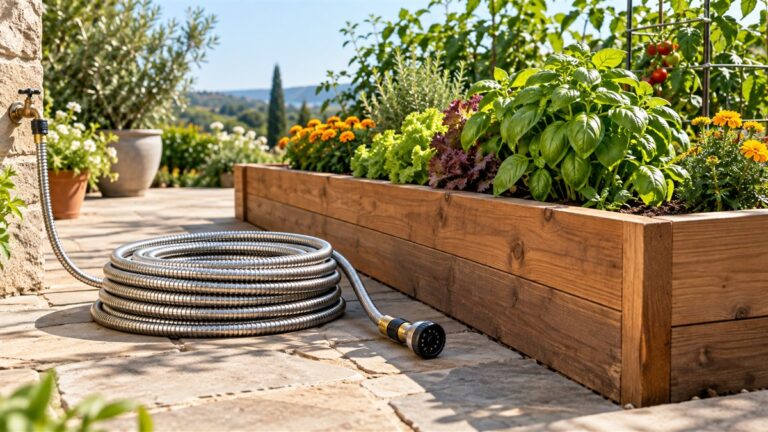
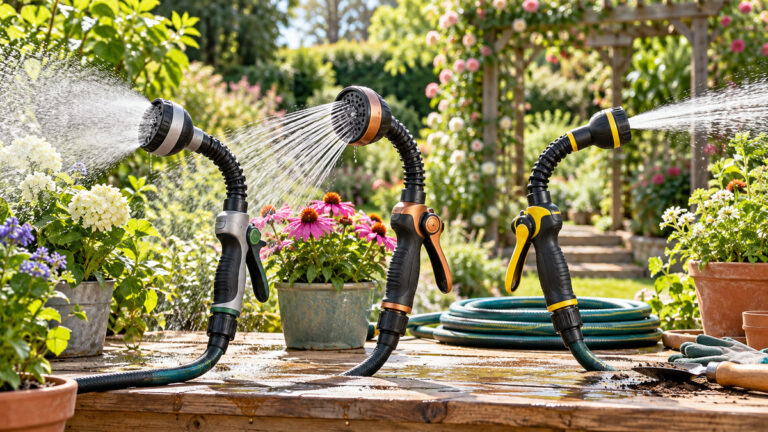
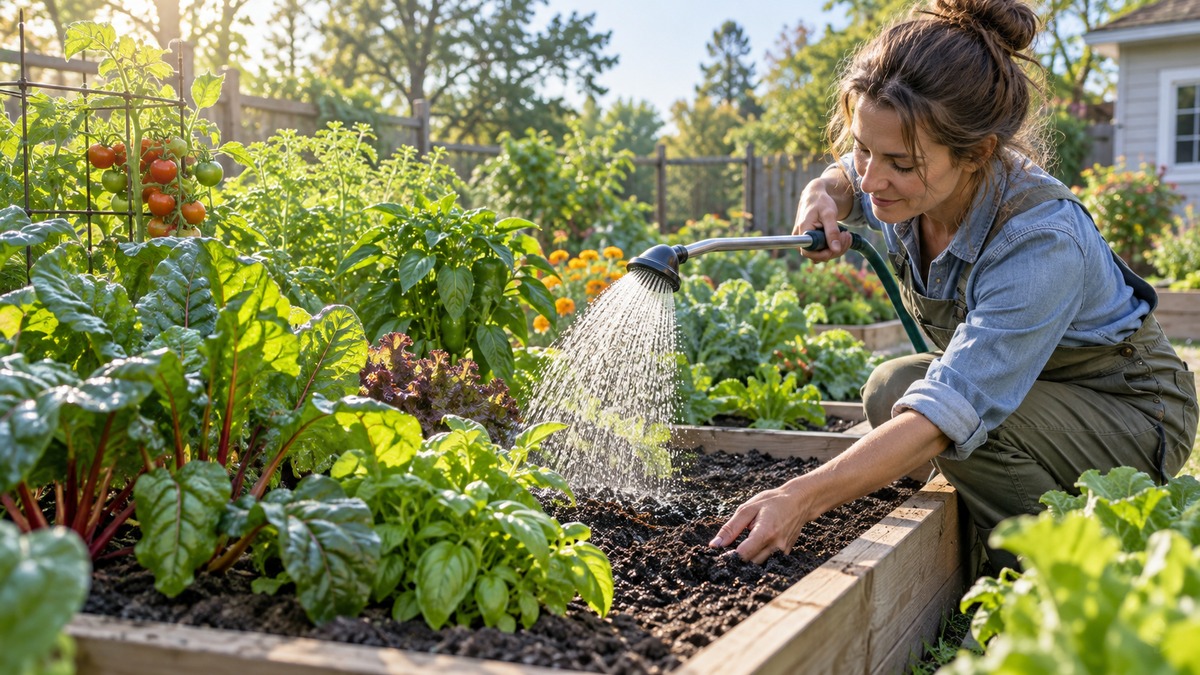
Illinois Extension recommends a nozzle at the end of the hose that slows the water, so it does not wash away soil and plants. The same page says that “Water wands are useful because they allow gardeners to water near the base of plants without bending over.” Oregon State says soaker or sprinkler hoses work well on a raised bed, because at low pressure they water only the bed.
Drip and soaker systems
Illinois Extension calls soaker hoses and drip irrigation a slow delivery method, and says drip is highly efficient, with 90 to 95 percent of the water applied soaking into the soil. North Carolina State Extension says drip is the most efficient method but requires the most investment. Its kits can hook to a single faucet and stay in place for the season.
Placement is the other advantage. North Carolina State Extension notes that because the water goes to the base of the plant, it goes only where the plant needs it. Oregon State says drip irrigation delivers water only where you want it, so the rest of the garden stays dry and weed problems are reduced.
Steps to find your weekly amount
Step 1: Track rain each week
Illinois Extension suggests tracking how much rain falls each time it rains. The page says ideally a garden receives one inch of rain per week. If rain comes up short of that and the soil is dry, you need to make up the difference. For reference, over a 100-square-foot garden, one inch of rain equals about 62 gallons of water.
Step 2: Time your hose
Illinois Extension describes a simple method. Use a water meter, or a five-gallon bucket if you have no meter, to time how long your hose takes to fill five gallons. Multiply that time by 12 to learn how long it takes to irrigate 100 square feet with your hose and sprayer. For overhead sprinklers, the page suggests timing how long the sprinkler takes to fill a rain gauge to one inch. It adds that a standard tuna fish can also works, because it is about one inch deep.
Step 3: Fill the gap
Subtract the rain you received from the one-inch target, then water the difference. Oregon State says runoff means you need to water at a slower rate. Illinois Extension says heavy clay takes in water slowly and can run off, so a slower delivery helps there too.
How often: the timing in the sources
Hot summer weather
For a very well-drained raised bed, Illinois Extension says you may need to water two or more times a week during hot summer days. Oregon State says garden plants with deep roots need a thorough watering every 5 to 7 days in hot weather. The two numbers conflict, and the sources do not explain the gap. Check the soil before you choose a rhythm for your own bed.
Seedlings and newly transplanted plants
North Carolina State Extension says newly transplanted plants and newly seeded areas need water to get established. Oregon State says germinating seeds and seedlings need to be kept uniformly moist, so a gentle spray every day or two is the guide. For vegetables in general, the North Carolina page says “A good watering once per week is better than lighter daily applications.”
Deep and shallow roots
Oregon State lists root depth by crop. Lettuce, beets, green beans, and chard draw water from the top foot or less of soil. Corn, tomatoes, asparagus, and rhubarb draw from the top 2 feet. The same guide says deep-rooted plants need water less often but need more water each time to reach their rooting depth.
Check the soil after each watering
Oregon State says to monitor the garden rather than build a schedule from charts. The guide’s wording is: “Instead of developing a watering schedule based on calculations and charts, monitor your garden to determine your watering needs throughout the growing season.” That means checking the soil and the plants, not only the calendar.
After you water, look at depth and runoff. Oregon State says to water at least 6 inches deep, then let the top inch or two dry before watering again. Runoff means the rate is too fast for the soil, according to Oregon State. Illinois Extension gives the same warning for heavy clay.
Common mistakes
Frequent, shallow watering is the first mistake. Oregon State says it promotes root development in the surface layers of the soil, which is not where a bed needs roots to go.
Too much water is the second. Illinois Extension says too much water can be as much of a problem as too little, because plant roots need oxygen and saturated soil holds little of it. Oregon State adds that overwatering can drown plants by filling soil pores with water.
Waiting too long is the third. Oregon State warns that postponing irrigation after plants show signs of needing water can damage them very quickly in hot weather.
Overhead sprinklers are the fourth. Illinois Extension says they use a lot of water, and much of it never reaches the soil. North Carolina State Extension says overhead sprinklers can give good coverage but are not very water-efficient. It adds that many sprinkler patterns water unevenly, with less water reaching parts of the bed farther from the source. Water left on the leaves can favor disease, which is why the Illinois page prefers watering the roots.
Watering the paths between rows is a fifth mistake. Illinois Extension says a sprinkler also soaks the paths, and wet paths can encourage weeds. Oregon State says sprinklers waste water by watering paths and other bare spots.
When to water in the day and season
Morning is the most consistent timing advice across these sources. Illinois Extension says watering in the morning reduces evaporation and the conditions that favor disease. Oregon State says to water in the morning so foliage can dry before nightfall. The North Carolina page does not give a time of day, so that advice rests on the other two.
Season matters too. North Carolina State Extension says the water demand of vegetables rises as the plant gets larger and starts to fruit. Oregon State says Oregon’s vegetable-growing season overlaps its dry season, so frequent watering may be needed there. The sources do not give a calendar for other regions.
How mulch changes how often you water
Mulch reduces how often you need to stand at the hose. Illinois Extension calls it a fantastic way to cut that work, and recommends organic mulches such as straw, coarse wood chips, or pine straw, because they insulate the soil and help conserve water.
The same page warns against using cardboard or newspaper alone under mulch. When those materials dry, they can repel water and create poor soil conditions. It also notes that some commercial growers use plastic mulch or landscape fabric with holes cut in it, so the plants can grow through. The sources do not say how that method changes watering.
How we chose
We picked the three pages below because each is a university or county extension guide that covers watering garden beds or vegetable gardens. Each page was opened with curl, returned HTTP 200, and was read for its watering passages before any claim in this article was written. The Oregon page is a full gardening guide, while the Illinois and North Carolina pages are shorter articles. The criteria were extension origin, watering content, and a page that could be opened. No product was compared, and no ranking is implied.
What we could not verify
The three sources give general guidance for gardens and raised beds. They stop short of several details a gardener might want.
What the sources do not say
- A single number of days per week that fits every raised bed in every climate.
- How the depth of soil in a raised bed changes the water it needs. For bed volume, see how much soil a raised garden bed needs.
- How long to run a drip system or soaker hose for one watering session.
- How accurate the bucket and timing method is at your water pressure.
- Whether a given soil mix will drain at the rate the sources describe.
- How much faster a raised bed dries than an in-ground bed. The sources say raised bed soil drains faster, but none of them gives a percentage or a number of days.
Frequently asked questions
How often should a raised garden bed get water in hot weather?
The Illinois page notes that very well-drained soil may call for two or more waterings a week on hot summer days. Oregon State’s figure is one thorough watering every 5 to 7 days for deep-rooted garden plants in hot weather. The sources disagree, so check the top inch or two of soil before each watering.
How much water does a raised bed need each week?
The Illinois page sets a target of about one inch of rain each week. The North Carolina page gives a range of half an inch to one inch for young vegetables, which rises to one to one and a half inches as plants mature. The sources do not say how these amounts change with the size of the bed.
Should a raised bed get water every day?
The North Carolina page says a good watering once a week is better than lighter daily applications for vegetables. Oregon State says seedlings need a gentle spray every day or two while they stay evenly moist. For established plants, the sources point toward fewer, deeper waterings.
Is a soaker hose or drip system better for a raised bed?
The Oregon guide points to low-pressure soaker or sprinkler hoses for raised beds. North Carolina State Extension says drip is the most efficient method, though it costs the most to set up, and that its emitters suit raised beds and containers. Illinois Extension also calls drip highly efficient.
How can a gardener tell whether a raised bed needs water?
Oregon State says to monitor the garden rather than follow a calculated schedule, and to let the surface inch or two dry before watering again. A rain gauge shows how much rain arrived. The sources do not give a moisture reading that marks the right moment to water.
Sources
- https://extension.oregonstate.edu/catalog/em-9027-growing-your-own (opened 2026-10-21)
- https://extension.illinois.edu/blogs/good-growing/2020-04-16-starting-garden-irrigation (opened 2026-10-22)
- https://henderson.ces.ncsu.edu/2024/06/tips-and-methods-on-watering-the-garden/ (opened 2026-10-22)