How to Set Up a Small Greenhouse at Home
As an Amazon Associate we earn from qualifying purchases.
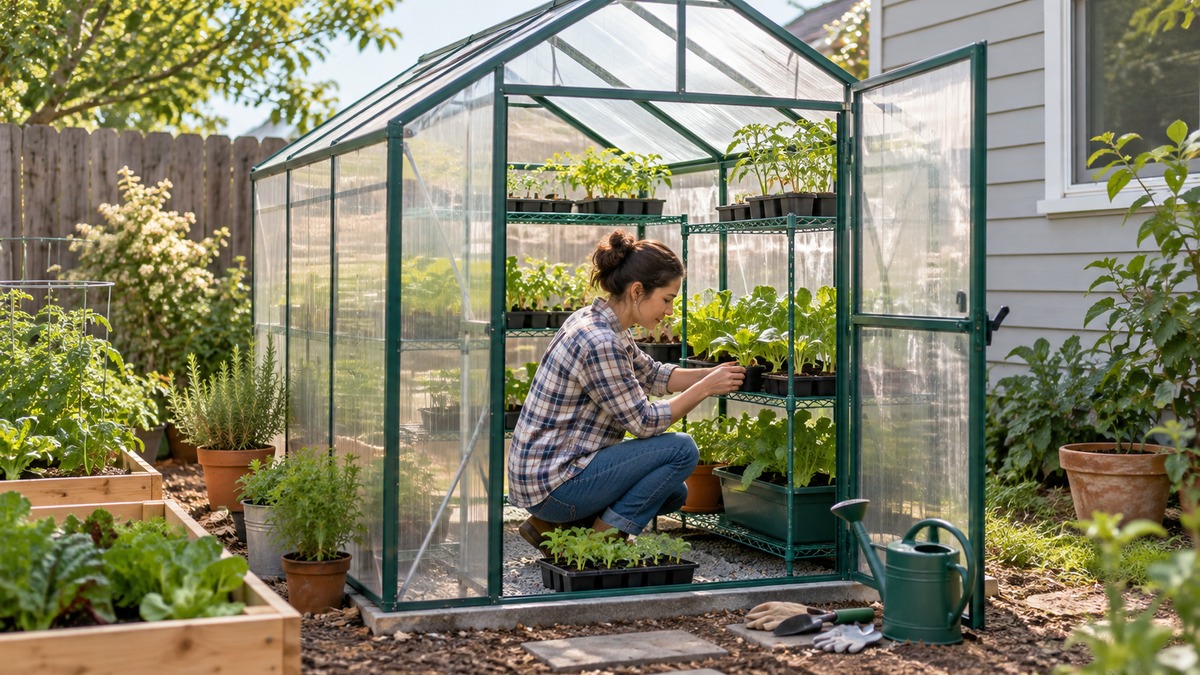
How to set up a small greenhouse comes down to four decisions: where the house sits, how the frame and cover go together, how air moves through it, and how you handle heat and power. The NC State plan for a 12 by 14 foot backyard greenhouse, the UF/IFAS guide on greenhouse ventilation and the NC State season extender chapter together touch on all four. None of them is a kit manual, and none gives a figure for every choice. Treat what follows as a sequence to check against your own yard and the manuals that come with your parts.
Quick answer
- Choose a level, well-drained site with enough sun for the plants you plan to grow, and make sure running water and electricity are within reach.
- Build the frame to carry wind and snow, and seal the cover well. The NC State plan uses a wooden base with PVC bows and clear 4- or 6-mil film.
- Plan ventilation before you plan heat. The sources say small greenhouses change temperature quickly, so air exchange matters in both summer and winter.
- Follow the manufacturer’s manual and your local rules for any heater, fan or electric item. The sources do not give heater sizes or clearances.
Choose the site first
The site decides how much work the greenhouse does for you. NC State Extension says to “Choose a level, well-drained plot for the greenhouse.” Sun needs depend on the job. “If it will be used primarily for plant propagation in the summer, place it in partial shade to minimize heat buildup.” For transplants or full-season crops, the house “will need maximum exposure to the sun.”
Air drainage matters too. The plan says the site should be one “where air drainage is good; avoid low areas surrounded by woods or buildings.” Appendix E warns that “Delays in watering, or lack of adequate and timely heat, ventilation, or pest control, can lead to disappointing results.”
Structure type changes the site. Appendix E says a lean-to “is the least expensive greenhouse structure” but brings “some limitations on space, sunlight, ventilation, and temperature control.” A free-standing house “can be set apart from other buildings to get more sun”. Size matters too. Appendix E says “Large greenhouses are easier to manage because temperatures in small greenhouses fluctuate more rapidly.”
Materials and frame
The NC State plan describes a house of 12 feet by 14 feet built on “a wooden frame to which are attached bows of polyvinyl chloride (PVC) pipe.” It recommends the heavier pipe: “Schedule 80 PVC pipe has a thicker wall and is stronger than schedule 40 pipe.”
Appendix E disagrees about plastic frames: “Plastic pipe materials generally are inadequate to meet snow and wind load requirements.” The plan’s own snow limit is “up to 4 inches of dry snow.” The sources do not reconcile the two, so read that limit as a limit for that one design, and ask your local extension office about the loads where you live.
The sources also disagree on lumber. The plan says “All lumber for construction should be treated for ground contact with an environmentally safe preservative such as CCA.” Appendix E’s cold frame section says “Never use wood treated with CCA, creosote, or pentachlorophenol, because these substances are harmful to growing plants.” The sources do not explain the difference. Read the treatment label and check current advice from your local extension office before you buy, since the plan dates from 1996.
Cement sets the pace. The plan warns that cement “should not be used when the temperature is below 50°F”, and that “Assembly is best done by two or more people to prevent overstressing the cemented joints.”
Level the base and anchor the frame
Start with a level base. “Unless the site is very flat, you will need to level the foundation boards.” The plan digs a trench on the high side instead of raising the low side, so that “the foundation boards should contact the ground at all points to ensure a good seal.” Corner posts are there “to anchor the greenhouse and prevent it from moving in high winds.”
Cover, floor and door
Clear 4- or 6-mil film is “generally best if the house will be used for growing plants.” For propagation or overwintering, the plan suggests “4- or 6-mil milky or white copolymer film” instead, which “reduces the amount of heat and light within the house”.
Film wears out first. Appendix E says “A utility grade of PE that lasts about a year is usually available at local hardware stores”, while commercial greenhouse grade PE “lasts 12 to 18 months.” The plan expects the structure to last longer: “Except for the covering, the structure should last 10 to 12 years.”
Fix the cover at the edges with “small tacks, but staples are much faster and more secure”, and cover the extra material “with packed soil to prevent the entrance of moles and rainwater.”
Ventilation in summer and winter
Ventilation does two jobs. In winter it controls humidity: “If moist air within the greenhouse is not removed, high humidities and excessive condensation will occur.” Condensation forms “when warm, humid air in the greenhouse comes into contact with a cold surface, such as glass, fiberglass, plastic, or structural components.” In summer it controls heat, which the UF/IFAS guide describes as preventing “the inside air temperature from rising too high above the outside air temperature.”
The air-change figures do not match. UF/IFAS gives winter ventilation “generally on the order of two to three air changes per hour”, says there is no benefit in “ventilating above four air changes per hour in the winter,” and gives “one air change per minute” as a summer minimum. Appendix E gives summer needs as “one to one-and-a-half air volume changes per minute”, with “Small greenhouses need the larger amount.” Its winter figure is “20% to 30% of one air volume exchange per minute”, which is “sufficient for mixing in cool air without chilling the plants.”
The winter figures serve different jobs, and the sources do not say which one fits a backyard house. The UF/IFAS worked example is a house of 254,448 cubic feet. Treat the numbers as a range, and check the result with a thermometer and a humidity gauge inside your own house.
Fans do the mixing. Appendix E says “Without air-mixing fans, the warm air rises to the top and cool air settles around the plants on the floor.” Small fans need “a cubic-foot-per-minute air-moving capacity equal to one-quarter of the air volume of the greenhouse”, placed “in diagonally opposite corners but out from the ends and sides.” Run them “continuously during the winter”, and turn them off in summer when the house is vented.
Natural vents are less dependable. The UF/IFAS guide says a natural system “will not be as dependable or satisfactory as a mechanical ventilation system”. Shade handles what air cannot. UF/IFAS says “Filtering out a portion of the incident solar radiation is very effective in reducing the inside air temperature of a greenhouse.”
Heat and power: follow the manuals
The plan wants the house “as tight as possible so that it will retain both heat and humidity”, so overheating needs a plan. Overheating “can usually be solved by simply opening the door.”
Fuel heaters need care. The plan says “even very small gas or oil heaters will usually overheat a greenhouse this small and may not burn well if not properly ventilated.” Appendix E says fuel-burning systems “must be properly vented to the outside”, and that “Unvented heaters (no chimney) using propane gas or kerosene are not recommended.”
Small volume makes heat swings worse. Appendix E says “So when the door is open, there can be a huge gain or loss of heat.”
Electric items need protection. “Any electrical devices used in the damp environment of a greenhouse should be connected only to a circuit equipped with an approved ground fault current interrupter (GFCI) outlet or circuit breaker.”
The sources do not give heater sizes, clearances or fuel output for a house this size. For any heater, fan, timer or controller, follow the manufacturer’s manual and your local rules. For control, Appendix E calls automatic control essential, and says hand watering is acceptable “if someone is available when the task needs to be done”.
Timing through the year
The NC State plan lists the seasons. “In the early spring, it can be used to germinate and grow bedding and vegetable plants earlier than would otherwise be possible.” “It can be used in the fall to start winter vegetable plants”, and in winter it “can protect patio plants and other hardy but containerized woody plants.”
Hardening is the step between the house and the bed. Appendix E says “In early spring a cold frame is useful for hardening seedlings that were started indoors or in a greenhouse.” When seedlings are ready to move, see our guide to which vegetables suit a raised bed. After the season, our winter covers for raised beds guide covers the bed side of the job.
Smaller options first
Appendix E describes lighter steps before a full house. Cold frames and hot beds are “relatively inexpensive, simple structures” that “rely on the sun as their sole source of heat.” Tunnels are ventilated “by manually rolling up the sides each morning and rolling them down in early evening”, and “High tunnels are a nice compromise between unheated low tunnels and a heated greenhouse.”
Common mistakes to avoid
- Placing the house in a low spot surrounded by woods or buildings, which the plan warns against.
- Keeping the house shut in warm weather. Overheating can be eased by opening the door.
- Using an unvented propane or kerosene heater, which Appendix E does not recommend.
- Cementing PVC below 50°F, which the plan advises against.
- Forgetting insect screens. UF/IFAS says screens “will need to be cleaned regularly.”
How we chose
We chose three extension publications that cover the setup decisions in one place: the NC State plan for a backyard greenhouse, first published in 1996 with a revision date of Sept. 9, 2026; the NC State Extension Gardener Handbook appendix on season extenders and greenhouses, published February 1, 2022; and the UF/IFAS guide on greenhouse ventilation. We opened each page on 2026-10-21 and read the sections on site, frame, cover, ventilation, heat and water.
The criteria were a university or extension source that says something specific about a greenhouse. Retail listings were left out. Two of the sources come from NC State, but they are different publications with different dates. We did not rank or recommend products, and where the sources disagree, we show both figures.
What we could not verify
We could not verify a heater size, a fuel choice, or a clearance from a heater to a plant or wall, because none of the three sources gives one. We could not verify a current cost, since the plan’s cost estimate dates from 1996 and is not repeated here. This guide covers no product, so nothing here rates weather sealing, sag or finish.
What the sources do not say
None of the three gives a door size, a frost date, or a snow limit for any build except the NC State plan. The sources disagree on winter air changes and on treated lumber, and they do not say which rule a backyard house should follow. The NC State plan describes one 12 by 14 foot design, so its numbers are one example, not a rule.
Frequently asked questions
Where should a small greenhouse go in the yard?
Choose a level, well-drained plot with enough sun for your plants, away from low areas surrounded by woods or buildings. The NC State plan also says running water and electricity should be easy to reach.
Is PVC pipe strong enough for a greenhouse frame?
The NC State plan uses PVC bows and supports up to 4 inches of dry snow. Appendix E says plastic pipe is generally inadequate for snow and wind loads. The sources disagree, so for a snowy or windy site, check the limits of the design you use with your local extension office.
Does a small greenhouse need a heater?
Appendix E says the heating requirement “depends on the desired temperature for the plants grown”. If you add heat, follow the heater maker’s manual and your local rules. Fuel-burning heaters must be vented to the outside.
How much ventilation does a small greenhouse need?
The sources give different figures. UF/IFAS gives “two to three air changes per hour” for winter, and NC State gives “one to one-and-a-half air volume changes per minute” for summer. The sources do not say which set fits a backyard house, so use them as a range and check the result inside the house.
What covering should a small greenhouse have?
The NC State plan says clear 4- or 6-mil film is generally best for growing plants. Appendix E notes that film is replaced more often than other coverings, and a utility grade “lasts about a year”. The plan expects the structure itself to last 10 to 12 years, so plan on replacing the covering on its own schedule.
Sources
- https://content.ces.ncsu.edu/a-small-backyard-greenhouse-for-the-home-gardener (opened 2026-10-21)
- https://edis.ifas.ufl.edu/ae030 (opened 2026-10-21)
- https://content.ces.ncsu.edu/extension-gardener-handbook/appendix-e-season-extenders-and-greenhouses (opened 2026-10-21)
As an Amazon Associate we earn from qualifying purchases.