How to Build a Trellis for Climbing Plants
As an Amazon Associate we earn from qualifying purchases.
How to build a trellis for climbing plants comes down to three decisions: how tall the support should be, how far apart the posts go, and what the vines will grip. The three university extension guides we read describe the same basic frame, with sturdy posts, a heavy wire across the top, and twine or mesh for the plants to climb. Their figures agree on most points, and where they differ this guide shows both numbers.
Those guides were written for vine-type vegetables such as pole beans, tomatoes and cucumbers. None of them covers ornamental climbers, so use their numbers as a starting point.
Quick answer
- Set the posts about 2 feet into the ground, 12 to 20 feet apart, with their tops about 6 feet above the soil, as the Wisconsin guide describes.
- Stretch heavy wire across the tops, then hang twine or fix nylon mesh for the vines to climb.
- For weaving and ties, use polypropylene or nylon cord, which the Wisconsin guide says does not stretch the way cotton or hemp does.
- Put the supports up before the plants begin to run and fall over, and check that fruit does not press into the wire.
What you need
The Wisconsin guide lists stake materials that include PVC pipe, electrical conduit, bamboo, galvanized pipe, and wooden or steel fence posts. Wooden stakes should be at least 1 inch square. Metal stakes can be thinner and, the guide says, last for many years. The guide also says not to use chemically treated wood for stakes.
For the top wire, the sources use heavy wire, and their gauges differ. The Oregon State guide stretches 12-gauge wire across the posts near the top, while the NC State leaflet calls for 10 to 12 gauge wire tightly stretched to the tops of the stakes. The Wisconsin guide also allows barbed wire, cable, or a wooden two-by-four. Expect the top wire to sag under the weight of the plants, as the Wisconsin guide notes.
For the climbing surface, the Wisconsin guide offers nylon mesh or hog wire with a 4-inch square grid, or twine dropped from the top wire. Plastic plant clips, sometimes called tomato clips, hold vines to either one. The guide says most of these materials can be found at a local hardware store, and that online garden sites sell plant clips and nylon mesh or netting. Our guide to vegetables to plant in raised beds explains which crops suit a bed, and it notes that sprawling squash and tall corn belong in larger plots unless a bed has a trellis and is deep.
Build the frame
Set the posts
The Wisconsin guide says to set sturdy support posts about 2 feet into the ground, about 12 to 20 feet apart, and to keep their tops about 6 feet above the soil. The Oregon State guide describes end posts 3 to 6 inches wide and in-row posts 3 to 4 inches wide, set every 12 to 20 feet. The NC State leaflet spaces its stakes every 15 to 20 feet in the row, and says that “At least 5 feet, preferably 6 feet, of the stake should be above ground.”
Post height is consistent across these sources. The Oregon State guide says that “All posts should reach to about 6 feet above the soil surface.” It also puts the top wire at about 5 feet. A post top about 6 feet high therefore matches the Wisconsin figure and the NC State preference, with the wire set a little below the top.
Where the trellis stands also matters. If it will sit in a raised bed with other crops, our raised bed companion planting and layout guide covers how to match plants that grow well side by side.
Run the top wire
Stretch the heavy wire between the tops of the posts. The Wisconsin guide says a double wire works especially well here, because it prevents twine from slipping to the center as the top wire sags with the weight of the plants. The Oregon State guide adds a bottom wire about a foot above the soil, while the NC State leaflet places its smaller wire or twine 5 to 6 inches above the ground. The sources do not say which bottom height suits which plant.
On the NC State layout, the twine runs in a crisscross pattern, tied to the top wire and to the bottom wire or twine on which the beans will climb.
Hang twine or mesh
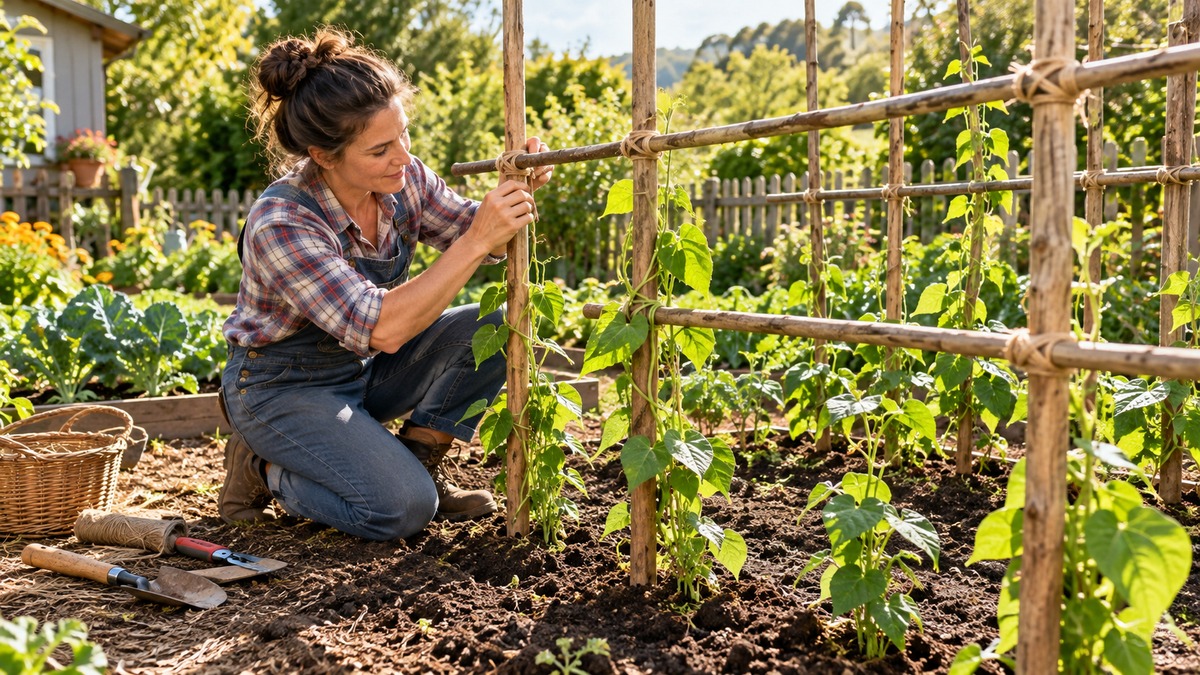
The Wisconsin guide describes two ways to hang the climbing surface. In the first, you drop vertical twines from the top support down to each plant, and tie each one to the base of its plant or to a bottom wire. In the second, you attach nylon mesh or hog wire with a 4-inch square grid to the upright posts and the upper supports. With mesh, the guide says to check that the fruit does not imbed itself into the wire, so watch for fruit that is pressed into the grid as it grows.
Train the plants
Training keeps the vines on the frame as they grow. The Wisconsin guide says to wrap plants around the twine as they grow, or to tie or clip them to it. On mesh, use the same ties or clips to train the vines onto the grid. The guide lists pole beans and peas, tomatoes, cucumbers, gourds, melons and squashes among the vine-type vegetables that grow best on supports.
The guide also notes that larger fruit, such as melons, may benefit from a mesh bag or nylon socks for extra support. Most vines, it says, grow strong enough to carry the fruit they bear.
Vining tomatoes need more help from you. The Oregon State guide says that vining tomatoes cannot wrap themselves around a trellis, so the gardener must tie their stems by hand. It advises tying the stems loosely to the stake with soft twine as they grow.
Simpler options: weaving and cages
Stake and weave
For a row, the Wisconsin guide describes a stake-and-weave method. Stakes go in about every 6 feet. You tie polypropylene or nylon cord to the first stake about 6 to 10 inches above the ground, wrap it around each stake in turn, and come back on the other side. Plants sit in the space between the cords, and three to five runs down the row should be enough for the season. The Oregon State guide describes a basket-weave system with a similar idea. It says to drive a stake at least 6 inches deep after every two plants, and it says indeterminate varieties need stakes at least 6 feet long, while determinate ones need stakes 4 feet long.
Cages
Cages are the third option, and the sources describe them mainly for tomatoes and other vegetables. The Wisconsin guide says a two-foot-diameter cage needs a 6-foot length of wire, and a three-foot cage needs 9 feet. It also says to cage vegetable plants at planting so their vines grow inside the cage. The Oregon State guide describes a homemade cage about 4 to 5 feet tall and at least 18 inches across, made from stakes driven into the soil and a coarse wire such as galvanized fencing. The Wisconsin guide notes that hog wire or woven wire panels with a 4-inch grid have the strength needed for healthy vines with heavy fruit.
Checks after the job
Walk the whole frame before you plant. Make sure the posts are set about 2 feet into the ground, the top wire is tight, and each twine is tied to its plant’s base or to a bottom wire. The NC State leaflet says to stretch the wire tightly, so check the tension before the plants grow onto it.
Then watch the plants as they grow. The Wisconsin guide asks you to check that fruit does not press into mesh. The Oregon State guide warns about tomatoes in particular: trellising “can result in earlier and larger fruit, but it can also increase sunburn and fruit cracking.” Watch the fruit for those two problems.
The Wisconsin guide makes a broader point. Supporting the vines with a proper structure, it says, is more important than supporting individual fruits. So get the frame right before you worry about any single fruit.
Common mistakes
Four mistakes come up across the guides. The first is using chemically treated wood for stakes, which the Wisconsin guide says to avoid. The second is picking a cord that stretches. The guide points to polypropylene or nylon for ties because they do not stretch the way cotton or hemp does. The third is waiting too long to build the frame, after the plants have already sprawled. The fourth is letting fruit press into the mesh, which the Wisconsin guide says to check for.
A fifth trap is a single top wire. The Wisconsin guide says a double wire keeps twine from slipping toward the center as the top wire sags under the plants. Plan for that sag from the start, rather than after the twine has drifted.
Timing and cleanup
Put the frame up before the plants need it. The NC State leaflet sets that moment as the point when bean plants begin to run and fall over. Build it before that point, not after.
At the end of the season, the Wisconsin guide suggests letting the vines dry and become brittle on their supports, which makes them easier to break apart and remove. Whether to take the structure down is up to you. Taking it down reduces wear over winter, especially on wooden structures, and lets you move the frame to another part of the garden. If you grow only one type of plant on the frame, the guide says to vary its location every year on a three-year rotation. It also says that “By utilizing crop-rotation strategies, however, a permanent trellis system can be used year after year.”
How we chose
We limited this guide to university extension pages that opened with HTTP 200 on 2026-10-21. We read three: the UW-Madison Division of Extension article on trellising, staking and caging (revision marked 03/2011), the Oregon State University EC 1333 publication on tomatoes and tomatillos (published September 2018, reviewed 2024), and the NC State Extension pole bean production leaflet (reviewed and revised May 22, 2024). We used a build step only when one of the three pages describes it, the checks come from the warnings the pages give, and we show the figures side by side where they differ. The NC State leaflet covers commercial and home pole bean production, so we attribute its row figures to it by name. We chose no products, and we left out retail pages, general websites and encyclopedia entries.
What we could not verify
The three guides do not cover every climbing plant. None of them addresses ornamental climbers such as clematis or roses. The Wisconsin article is marked as revised in 2011, so check whether its material advice still matches what you can buy.
What the sources do not say
The pages do not give a wind load, a weight limit for wire or mesh, or a post depth for other soils. They do not say how to anchor a post against wind, and they do not say how much fruit a trellis can hold. The Oregon State and NC State pages do not say which bottom wire height suits which plant. The sources do not say whether other treated materials are suitable for posts.
Frequently asked questions
How tall should a trellis for climbing plants be?
Plan on posts about 6 feet above the soil. The Wisconsin guide and the Oregon State guide both use that height, and the NC State leaflet asks for at least 5 feet of stake above ground, preferably 6. The Oregon State guide puts its top wire at about 5 feet, so the wire sits a little below the tops of the posts.
How far apart should the posts be?
The Wisconsin guide and the Oregon State guide both place posts 12 to 20 feet apart. The NC State leaflet places its stakes every 15 to 20 feet in the row. The sources do not give a spacing for a single vine grown against a fence or wall.
What should vines be tied with?
For the stake-and-weave method, the Wisconsin guide recommends polypropylene or nylon cord, since it does not stretch the way cotton or hemp does. The Oregon State guide ties tomato stems loosely to the stake with soft twine as they grow. The Wisconsin guide also mentions plastic plant clips for fastening vines to twine or mesh.
Can treated wood be used for trellis posts?
The Wisconsin guide says not to use chemically treated wood for stakes. The pages we opened do not discuss other treated materials, so this guide does not say whether they are suitable. Choose untreated stakes, as the guide advises.
When should the trellis go up?
Set the frame before the plants need it. For pole beans, the NC State leaflet puts that point before the plants begin producing runners and falling over. For cages, the Wisconsin guide suggests setting them at planting.
Sources
- UW-Madison Division of Extension, Trellising, Staking and Caging: Vertical Gardening Techniques for Vine-Type Vegetables. https://hort.extension.wisc.edu/articles/trellising-staking-and-caging-vertical-gardening-techniques-vine-type-vegetables/ (opened 2026-10-21)
- Oregon State University Extension, EC 1333, Grow your own tomatoes and tomatillos. https://extension.oregonstate.edu/catalog/ec-1333-grow-your-own-tomatoes-tomatillos (opened 2026-10-21)
- NC State Extension, Pole Bean Production. https://content.ces.ncsu.edu/pole-bean-production (opened 2026-10-21)