How to Plant Dahlia Bulbs in Containers
As an Amazon Associate we earn from qualifying purchases.
How to plant dahlia bulbs in containers is a question about the tuber, the fleshy root that dahlias grow from, and about a pot large enough to hold it. Oregon State and NC State both use the word tuber, and this guide does too. The extension pages agree on pot size, potting soil and the danger of rot. They disagree on planting depth, so this guide shows each figure and says which one applies to a pot.
Quick answer
- Use a pot about 12 to 18 inches deep and wide, filled with potting soil that drains well.
- Plant tubers outdoors in late spring, once the soil is around 60°F, or indoors early if you want an earlier bloom.
- Water lightly after planting and keep the pot from sitting wet, since Oregon State says dahlias do not like wet feet.
- Feed potted dahlias about every two weeks. The depth figures differ across sources, so use the pot and the crown level as your guide.
Pick a pot big enough for the tuber
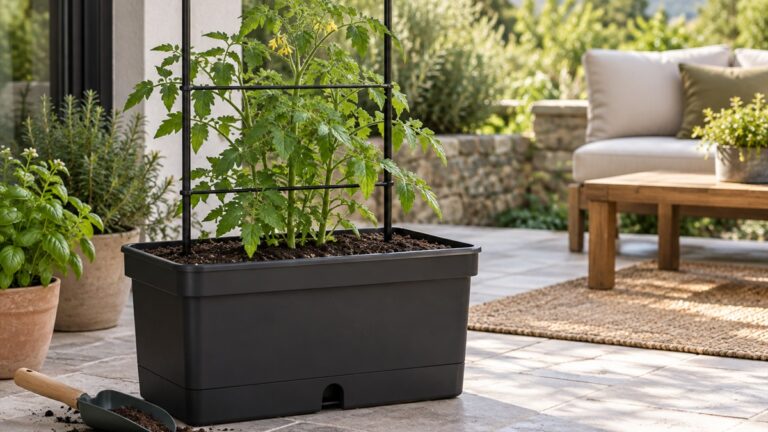
Dahlias suit containers. NC State’s Plant Toolbox says they “are at home in cottage, cutting, or container gardens.” Oregon State adds that growers “without a lot of garden space may decide to grow dahlias in pots or other containers.” The pot is the first real decision, and Oregon State gives a size: “Pots used for growing dahlias should be 12 to 18 inches deep and wide to accommodate their size.”
Plant size matters too. Oregon State says that “The best types of dahlias for container gardening are low-growing and dwarf varieties.” The pages do not say how tall a variety can grow in a given pot, so check the variety’s height before you choose the pot. For a larger planter option, see our guide to extra large planters.
Iowa State’s tender perennials page gives the same direction in shorter form: “Pot up the dahlia tubers in large pots using a well-drained potting mix.” Large is the working word, and Oregon State’s 12 to 18 inch figure gives the size.
Check the tuber before you plant
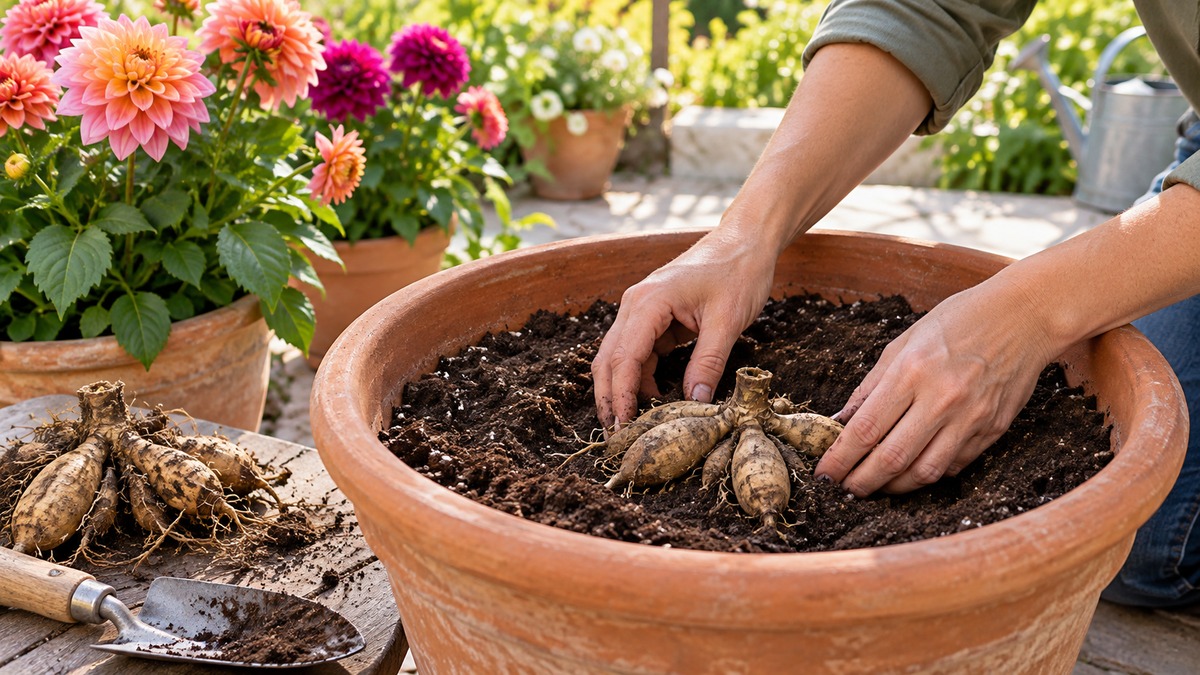
Buy firm tubers, and inspect the neck before you plant. Oregon State says: “Productive dahlia tubers are firm and plump with at least one eye and no broken neck.” Eyes develop along the crown, which Oregon State describes as a bulging ridge around the thin portion of the tuber called the neck.
Pot-grown stock needs a closer look. Oregon State explains that “Due to having been grown in a restricted environment, the pot tubers may have broken necks or other types of damage.” It adds that tubers with broken necks may not grow. Check the neck before you pay for the tuber.
If you start with a cutting or seed rather than a tuber, the sources give less detail. Oregon State lists tubers, pot tubers, cuttings and seeds as ways to propagate dahlias, and it says that planting tubers is “the most common way to propagate a dahlia plant.” This guide covers tubers only.
Start indoors, or plant out in late spring
Outdoor planting has a clear trigger. Oregon State says: “Plant tubers outside in late spring when the soil temperature is around 60°F or warmer consistently for several days in a row.” Iowa State gives the same rule in terms of frost: “Plant dahlias outdoors after the danger of frost is past.”
An early start gives more bloom time. Iowa State says: “For earlier bloom, start dahlia tubers indoors in early April.” It also says to “Plant dahlias indoors 6 to 8 weeks before the intended outdoor planting date.” The pages differ on the indoor pot. Iowa State suggests an 8-inch-diameter pot “about one-half full” with a commercial potting mix, while Oregon State suggests a “1-gallon pot with newly purchased or sterilized potting soil.” Either choice works if the pot holds the tuber comfortably and drains.
Before the plant goes outside, harden it off. Iowa State advises: “Before planting, harden or acclimate the dahlias to outdoor conditions for several days.”
Set the tuber at the right depth
This is where the sources disagree most. NC State says: “When planting, cover tubers to a depth of 3 inches.” Oregon State’s instructions are for planting in the ground: it says to dig “a hole about 4-6 inches deep next to the stake” and to lay the tuber horizontally, with the eye facing up. Iowa State’s instruction is written for a pot. It says to “Cover the tuber with 1 inch of soil, but leave the dahlia’s crown exposed at the surface of the potting mix.”
Iowa State’s indoor instruction adds a little soil over the tuber. It says to “place a tuber horizontally on the potting mix surface, then cover with an additional 1 or 2 inches of potting soil.” That is a start, not a final depth, and the sources do not say how deep the tuber should sit once the shoot is up.
An expert answer from the Anne Arundel County extension office adds a note on depth: “Dahlia are not as picky about depth like peonies are.” That answer is about overwintering in the ground, so it does not settle the pot question. For a pot, the only container-specific instruction we opened is Iowa State’s, and it leaves the crown at the surface.
Use potting soil that drains, and water on a steady schedule
Oregon State’s soil note is short: “The ideal soil composition for dahlias is loose, fertile and well-drained.” NC State puts it in similar terms: dahlias need “fertile, moist but well-drained soil, and full sun to partial shade.” Iowa State’s pot instruction asks for “a well-drained potting mix” as well. Oregon State adds: “However, dahlias can grow in almost any type of soil with the proper amendments.” It lists “compost, manure or coconut coir” among the amendments it has in mind. It also states that “Organic matter increases the capacity of the soil to hold water, air and nutrients for better plant health.” Its pH target is 6.5-7.0, which is a number to check with a soil test rather than guess. For mix choices in raised containers, see our guide to soil for raised planters.
Planting is simple once the pot is ready. Oregon State says to “Fill the pot with potting soil, plant your tubers, label them and water lightly until sprouts emerge.”
Watering needs two rules. Iowa State says that “Most are not drought-tolerant, so consistent watering, especially for those growing in containers (and more prone to drying out), is essential.” It also warns that “Dahlia tubers are susceptible to rotting.” Oregon State says the opposite risk matters too: “Do not overwater – dahlias do not like wet feet.” The two statements fit together when the pot is watered on a steady schedule and never sits in standing water. When water is needed, Oregon State advises that “water slowly so it seeps deep into the soil.”
The wet-soil risk is real. An Anne Arundel expert answer warns: “More so you want to make sure they are in well drained soil as if it is too wet or consists of too much clay, they can rot.” A pot that stays wet, whether from a full saucer or poor drainage, is the situation the expert warns about.
Feed about every two weeks, and go easy on nitrogen
Potted dahlias need more feed than dahlias in the ground. Oregon State says: “You will need to fertilize your dahlias in pots more frequently than you do in your row gardens – about once every two weeks.” The rhythm is simple.
Too much nitrogen causes problems that show up later. Oregon State warns: “Applying too much nitrogen promotes weak stems, small or no blooms and tubers that rot or shrivel in storage.”
Sun, placement and the first weeks
Dahlias want sun. NC State lists the light they need as “full sun to partial shade.” Put the pot where it gets the most sun the window or patio allows, since the range runs from full sun to partial shade.
Once a shoot appears indoors, light is the next question. Iowa State says: “When growth emerges, place the dahlias in a sunny window or under artificial lighting.”
Top the plant for a bushier pot
Potted dahlias can be shaped while they grow. Oregon State explains that “Topping, or removing the sprout between the upper two leaves on your dahlia plant, will create a bushier dahlia plant.” Pinching the sprout between the top pair of leaves encourages growth at the other leaf joints. Do this after the plant has several sets of leaves, so the pinch leaves enough growth to work with.
Common mistakes to avoid
- Using a pot that is too small. Oregon State gives 12 to 18 inches deep and wide as the size for dahlia pots.
- Overwatering. Oregon State says dahlias do not like wet feet, and Iowa State says tubers are susceptible to rot.
- Planting a tuber with a broken neck. Oregon State says those may not grow.
- Too much nitrogen. Oregon State links it to weak stems and few blooms.
- Planting before the soil warms. Oregon State says to wait for around 60°F in late spring.
Storing tubers and the cold season
Dahlias are often grown as annuals. NC State says that “These plants are most often grown as annuals as their tuberous roots can be injured at temperatures below 25 degrees F.” It also gives a storage route: “To grow dahlias as perennials in zones below 7, dig up the tubers in fall, dry carefully (do not wash), and store in vermiculite or dry sand at 35 to 45 degrees F.”
Oregon State gives the storage steps for divided tubers: “Store dry, divided tubers in storage containers with the medium of your choice, and keep storage containers in a dark location that will not freeze.” It also notes that “If there is a chance of frost, you can dig dahlias the same day you cut the stalks.” Oregon State’s sentence that “Dahlias can handle rain but will rot if the ground freezes” describes ground planting, not a pot, so do not apply it to a container without checking.
What we could not verify
The pages give pot sizes, timing and feeding, and they disagree on depth. They say much less about how a potted dahlia handles a cold season. The list below names the gaps.
What the sources do not say
- The planting depth for a pot is not settled. Iowa State says cover with 1 inch of soil, NC State says cover to 3 inches, and Oregon State gives 4 to 6 inches for ground planting.
- The indoor pot size differs. Iowa State suggests an 8-inch-diameter pot, and Oregon State suggests a 1-gallon pot.
- No source gives a number of tubers per pot, or a spacing for several dahlias in one container.
- The pages do not say how long a potted dahlia takes to bloom outdoors in any given region.
- No source gives winter steps for a dahlia that stays in a pot. The storage advice covers dug tubers.
How we chose
This guide draws on university and extension pages about dahlias and containers. We opened each one with curl on 2026-10-22, and each page we cite returned HTTP 200. The Anne Arundel County answer is an extension expert reply on a public question-and-answer service rather than a published guide, so it is cited only for the rot warning and the depth note, and it is labeled as such.
We did not open the commercial dahlia guides that appeared in the search results, because they are not extension sources. Where the sources disagree on a number, the guide shows both numbers.
Frequently asked questions
Can dahlias grow in containers?
Yes. NC State says dahlias are at home in container gardens, and Oregon State says growers without much garden space may use pots. Oregon State recommends low-growing and dwarf varieties for containers.
What size pot do dahlias need?
Oregon State gives 12 to 18 inches deep and wide for pots used to grow dahlias. Iowa State recommends large pots for tubers planted in containers.
How deep should a dahlia tuber go in a pot?
The sources do not agree on one number. Iowa State says to cover the tuber with 1 inch of soil and leave the crown exposed, while NC State gives 3 inches as the cover depth. Oregon State’s 4 to 6 inch figure is for ground planting.
How often should a potted dahlia be fed?
Oregon State says potted dahlias need feeding about once every two weeks, more often than dahlias in the ground. It also warns that too much nitrogen gives weak stems and few blooms.
Can a potted dahlia stay outside through winter?
The sources do not say for a pot. NC State says dahlias are most often grown as annuals, and that in zones below 7 the tubers are dug up in fall and stored. Those steps describe tubers, not a potted plant.
Sources
- Oregon State University Extension, Dahlias in Oregon: Planting for a Parade of Late-season Blooms: https://extension.oregonstate.edu/catalog/fs-95-dahlias-oregon (opened 2026-10-22)
- NC State Extension, Plant Toolbox, Dahlia: https://plants.ces.ncsu.edu/plants/dahlia/common-name/dahlia/ (opened 2026-10-22)
- Iowa State University Extension and Outreach, Yard and Garden FAQ on starting dahlias indoors: https://yardandgarden.extension.iastate.edu/faq/when-should-i-start-dahlias-indoors (opened 2026-10-22)
- Iowa State University Extension and Outreach, Planting and Caring for Tender Perennials: https://yardandgarden.extension.iastate.edu/how-to/planting-and-caring-tender-perennials (opened 2026-10-22)
- Ask Extension, Anne Arundel County, Maryland, expert answer on how deep to plant dahlia tubers: https://ask.extension.org/kb/faq.php?id=823442 (opened 2026-10-22)
As an Amazon Associate we earn from qualifying purchases.