How to Plant Geraniums in a Window Box
As an Amazon Associate we earn from qualifying purchases.
How to plant geraniums in a window box comes down to a few choices the extension pages agree on: a container with drainage holes, a well-drained mix, planting after the frost has passed, and watering by the feel of the soil. Clemson and Iowa State both list window boxes as a home for geraniums. They disagree on sun hours and on feeding, and this guide shows both figures rather than picking one.
Quick answer
- Use a large container with drainage holes and a well-drained potting mix, and do not let the pot sit in water.
- Plant outdoors after the danger of frost has passed. Iowa State gives mid-May as a safe time in central Iowa.
- Water when the soil surface feels dry, keep water off the leaves, and remove spent flowers.
- Feed on a set schedule. Iowa State says every two weeks, while Clemson’s geranium factsheet gives every four to six weeks.
Know which geranium suits a window box
Garden geraniums are a common choice for this job. Iowa State’s answer lists them for “beds, borders, containers, hanging baskets, and window boxes” and Clemson makes the same point about where they grow.
Ivy-leaf types are the trailing geraniums that many gardeners put on a sill or in a hanging basket. Clemson says that they “are used mainly in hanging baskets and window boxes.” The same factsheet says ivy geraniums prefer morning sun and afternoon shade where temperatures run above 85°F, and moderate soil moisture, which means not too much and not too little.
Regal geraniums are a different case. Clemson notes that the regal types “are not heat tolerant and are best grown as house plants during cooler months.” That makes them a poor match for a hot summer box.
Clemson observes that “There is great variation in the leaf, flower and growth habit of geraniums.” Trailing types belong at the edges of a box, and upright types at the center or back. Clemson’s window box guide sets that placement rule for mixed boxes.
Plants come in two ways. Clemson says that “Common and zonal geraniums are either seed-grown or cutting-grown.” Seed-grown plants arrive mainly in one form: “Geraniums from seed are available mainly in single-flowered form.” Clemson adds that their flowers “tend to shatter,” which it counts as an advantage, because “it isn’t necessary to pick off dead blooms.” Leaf pattern is another choice. Iowa State notes that “Several fancy-leaf geraniums possess silver, white, gold, red, or purple markings on their leaves.”
Pick a container that drains and holds enough soil
The container is the first decision. Clemson says: “When growing geraniums in containers, choose large pots to hold enough soil for a strong root system and to contain enough water to prevent wilting.” A box that is too shallow for the roots will dry out quickly, and the plant will wilt between waterings.
Drainage comes with the same rule. Clemson’s geranium factsheet says to “Select containers with adequate drainage holes, plant in a well-drained soil mix and do not allow pots to sit in water.” Iowa State makes the same point about the mix: “Geraniums perform best in fertile, well-drained soils in full sun.” Clemson’s soil note is shorter: “Soil for geraniums should be well-drained.” For a mix choice in a raised container, see our guide to soil for raised planters.
A plant that outgrows its box needs a bigger one. Clemson advises: “Repot into larger containers if they grow so large that they wilt frequently.” Check how often the plant wilts, since Clemson ties that sign to the need for a larger container. For a hanging option that uses the same ivy-leaf types, see our guide to hanging planters for outdoor use.
Plant after frost, in the right light
Timing is simple. Clemson says: “Plant geraniums outdoors after all danger of frost is past and the soil has warmed.” Iowa State puts it in the same terms: “Geraniums should be planted outdoors when the danger of frost is past.” For a specific date, Iowa State adds: “Generally, mid-May is a safe planting time for geraniums in central Iowa.” Other regions will have other dates, so use the frost date for your own area. Iowa State also notes that “Geraniums are easy to grow and provide color in the garden from May to frost.”
Light is where the two sources differ. Iowa State says: “For optimum flowering, geraniums should receive at least 6 hours of direct sun.” Clemson sets a lower bar of at least four hours of direct sunlight a day, and says that geraniums need that light to flourish and flower well. In very hot areas, Clemson adds, a few hours of shade may be best. Iowa State adds a point for a shaded sill: “Plants will grow in partial shade, but will not bloom well.”
Count the direct-sun hours your window gets on a clear day before you buy the plants. A window that gets four to five hours meets Clemson’s minimum but falls short of Iowa State’s figure for the best flowering. A window that gets six hours or more meets both. The sources do not say how a box should be placed to gain or lose sun, so check the window itself.
Water the soil surface, not the leaves
A box dries faster than a bed, and the soil surface is the best guide. Iowa State says: “Water geraniums in containers when the soil surface becomes dry to the touch.” It adds: “Plants in containers will require more frequent watering.” Clemson gives a fuller picture for new plantings: “Water abundantly after planting and continue watering regularly, allowing the soil to dry out between waterings.”
Keep the water off the foliage when you can. Iowa State advises: “If possible, avoid overhead watering as wet foliage encourages disease development.” Watering at the soil line rather than over the top is the practical step here, and it follows directly from the sentence above.
Overwatering has its own problem. Clemson describes it this way: “Edema causes corky spots on the leaves and occurs when plants are over-watered.” If you see corky spots, cut back on the water before you change anything else.
Feed on a schedule, and say which one you chose
Iowa State gives a clear feeding rule for containers: “Geraniums growing in containers should be fertilized approximately every 2 weeks with a dilute fertilizer solution.” Its container care page gives a different window for water-soluble products, saying “Apply water-soluble fertilizers every 1 to 3 weeks throughout the summer.” Both are reasonable starting points, and the choice is yours.
Clemson’s geranium factsheet gives a longer interval for the growing season, every four to six weeks. Its window box page sets a shorter interval for boxes and baskets, every two weeks at half strength. The two Clemson pages do not match each other, so note which one you follow and keep to it for the whole season.
Too little feed causes its own trouble. Clemson says geraniums “are stunted and yellowed if not provided enough nitrogen.” Too much nitrogen is the other risk. Iowa State’s container page warns that high-nitrogen fertilizers push growth into leaves at the expense of flowers. A box with lush leaves and few blooms fits the pattern Iowa State describes.
Deadhead and pinch for more flowers
Keep the box blooming by removing spent flowers. Iowa State says: “To keep plants blooming through the growing season, remove spent flowers on a regular basis.” It explains the reason: “Deadheading prevents seed development and encourages plants to produce additional blooms.”
Pinching shapes the plant. Clemson says: “Pinch to encourage well-branched, full plants.”
Planting day, in order
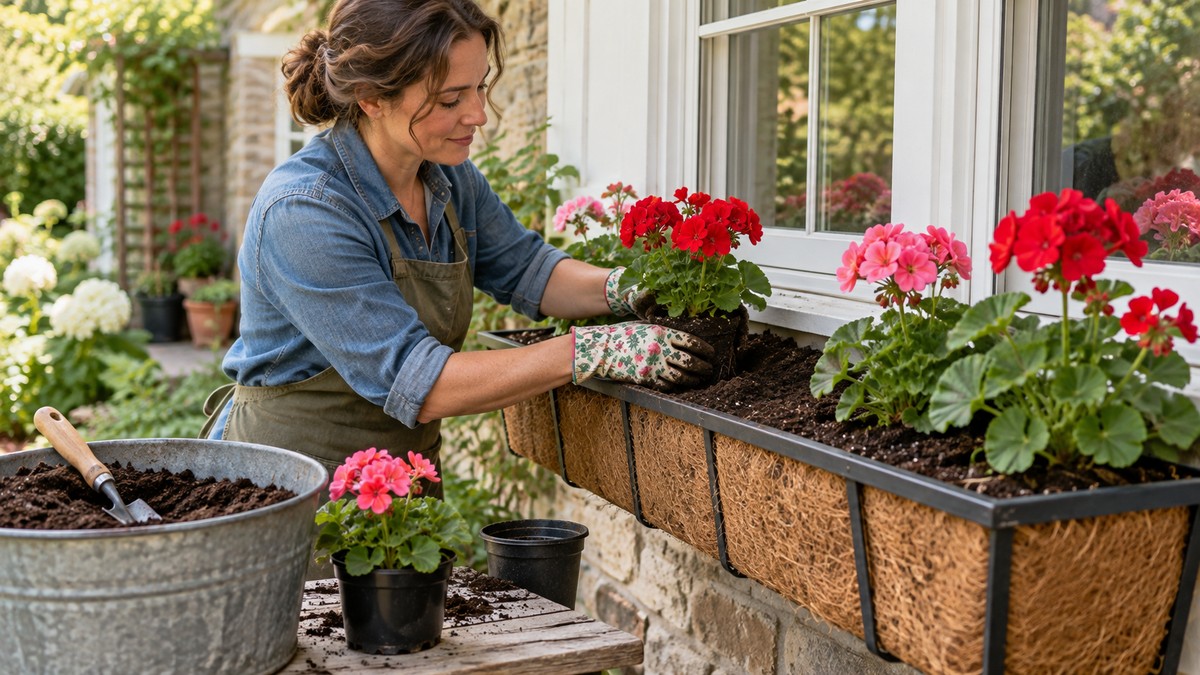
Set the box in its final place before you fill it, because a full box is heavy. Clemson’s window box guide stresses a strong support system, and the weight rises once the box is watered. Check the brackets or the rail first, then add the mix.
Fill the box with the well-drained mix described above. The sources do not give a fill depth or a number of geraniums per box, so use the size of the root ball as your guide and leave the spacing to your own window.
After planting, Clemson’s advice is to water abundantly and keep watering regularly, letting the soil dry between waterings. Then follow the light check and the feeding plan you chose, and keep a note of the planting date so the schedule is easy to follow.
After the season
Clemson’s overwintering guide says that geraniums can be overwintered by three methods. One of them is to take cuttings in the fall and keep the plants on a bright, sunny windowsill through the winter. That guide is written for South Carolina, so its timing will not match a colder yard. Check your own frost dates before you follow it.
Clemson’s mulch advice is written for beds, not boxes: “Mulch the bed to maintain moisture levels and keep the soil cooler in summer.” The sources do not say whether a box should be mulched, so this guide does not recommend it either way.
Common mistakes to avoid
- Using a pot that is too small. Clemson says a large pot holds enough soil and water to prevent wilting.
- Letting the pot sit in water. Clemson says not to allow it.
- Watering over the leaves. Iowa State says to avoid overhead watering.
- Overwatering. Clemson links edema, the corky spots, to over-watered plants.
- Leaving spent flowers on the plant. Iowa State says to remove them on a regular basis.
What we could not verify
The geranium pages we opened are clear on most care steps, but they leave several points open for a window box in particular.
What the sources do not say
- The sun figures conflict. Clemson gives four hours as the minimum, and Iowa State gives six hours for optimum flowering. No source reconciles them.
- The feeding intervals conflict. Clemson’s geranium page says every four to six weeks, its window box page says every two weeks at half strength, and Iowa State says every two weeks for container plants.
- No source gives a box size, a plant count or a spacing for geraniums in a window box.
- Iowa State’s planting date is for central Iowa. No source gives a planting date for other regions.
- Clemson’s mulch advice is written for beds. The sources do not say whether a box should be mulched.
- Two geranium pages returned HTTP 403 and are not cited. They were Oregon State’s geranium article and University of Georgia publication B 790.
How we chose
This guide draws on university and extension pages about geraniums, containers and window boxes. We opened each one with curl on 2026-10-22, and each page we cite returned HTTP 200. We did not use retail listings or commercial blogs from the search results, because they are not extension sources and they do not give the care steps this guide needs.
Where the sources give different figures, both appear in the body. The guide does not choose a winner between them.
Frequently asked questions
Are geraniums a good choice for a window box?
Yes, as long as the box drains and gets enough sun. Clemson and Iowa State both list window boxes as a home for geraniums, and Clemson adds that ivy-leaf types are used mainly in hanging baskets and window boxes.
How much sun does a geranium in a window box need?
The sources give two figures. Clemson says at least four hours of direct sun, and Iowa State says at least six hours for optimum flowering. A window with four to five hours meets the first figure, and a window with six or more meets both.
How often should a geranium window box be watered?
Water when the soil surface feels dry to the touch, and expect to water more often than a bed. Iowa State says plants in containers need more frequent watering, and it advises avoiding overhead watering.
How often should geraniums in a window box be fed?
The sources do not agree on one number. Iowa State says every two weeks for container plants, Clemson’s window box page says every two weeks at half strength, and Clemson’s geranium factsheet says every four to six weeks during the growing season. Pick one schedule, write it down, and keep to it.
Why does my geranium have corky spots on the leaves?
Clemson describes that condition as edema, which it links to over-watered plants. Its suggested fixes are cultural: water less often, keep water off the leaves, improve air circulation, and make sure the plant gets enough sun. Check the soil surface before the next watering.
Sources
- Clemson Cooperative Extension, Home and Garden Information Center, Geranium (Pelargonium spp.): https://hgic.clemson.edu/factsheet/geranium/ (opened 2026-10-22)
- Iowa State University Extension and Outreach, Garden geraniums care FAQ: https://yardandgarden.extension.iastate.edu/faq/how-do-i-care-garden-geraniums (opened 2026-10-22)
- Clemson Cooperative Extension, Home and Garden Information Center, Hanging Baskets and Window Boxes: https://hgic.clemson.edu/factsheet/hanging-baskets-window-boxes/ (opened 2026-10-22)
- Iowa State University Extension and Outreach, Care of Plants Growing in Containers: https://yardandgarden.extension.iastate.edu/how-to/care-plants-growing-containers (opened 2026-10-22)
As an Amazon Associate we earn from qualifying purchases.