How to Make a Potting Mix at Home
As an Amazon Associate we earn from qualifying purchases.
How to make a potting mix at home comes down to three jobs: a light base that holds moisture without going soggy, a coarse material that keeps air in the mix, and compost for nutrients. The university sources here agree on that structure. They disagree on one ingredient, which is whether garden soil belongs in a container mix at all. This guide gives the common base, shows where the sources split, and marks the amounts they do not give.
Quick answer
- Use a light base such as peat or coir, with a coarse material like perlite or sand. Oregon State says a lightweight potting soil is the best growing medium for containers.
- Add compost. The University of Maryland guide says compost is highly recommended for container mixes.
- Aim for a pH near 6.5 and add lime if needed. The sources give that target but no lime amount.
- Decide on garden soil before you mix. Oregon State and an Ask Extension answer include loamy garden soil, while the University of Maryland guide says garden soil is too dense for containers.
What a container mix has to do
A potting mix has a narrow job. The University of Maryland guide puts it this way: “Growing media (medium) or potting soil has three main functions”. The mix has to supply nutrients, air and water, and it has to physically support the plant. Roots grow in the spaces between particles, and air and water move through the same spaces.
Too much water in those spaces is the main risk. The same guide notes that “If excess water cannot drain away, fresh air cannot enter and roots will suffocate.” A mix that holds too much water leaves little room for air, and the roots pay for it. The guide also says to “Select light and fluffy growing media for good aeration and root growth.”
Colorado State’s container basics says the same thing from the watering side. It says “Potting soil should be porous,” and the mix should drain well while holding enough moisture so the plant does not dry out. That balance is the target for any home mix.
Start with a light base
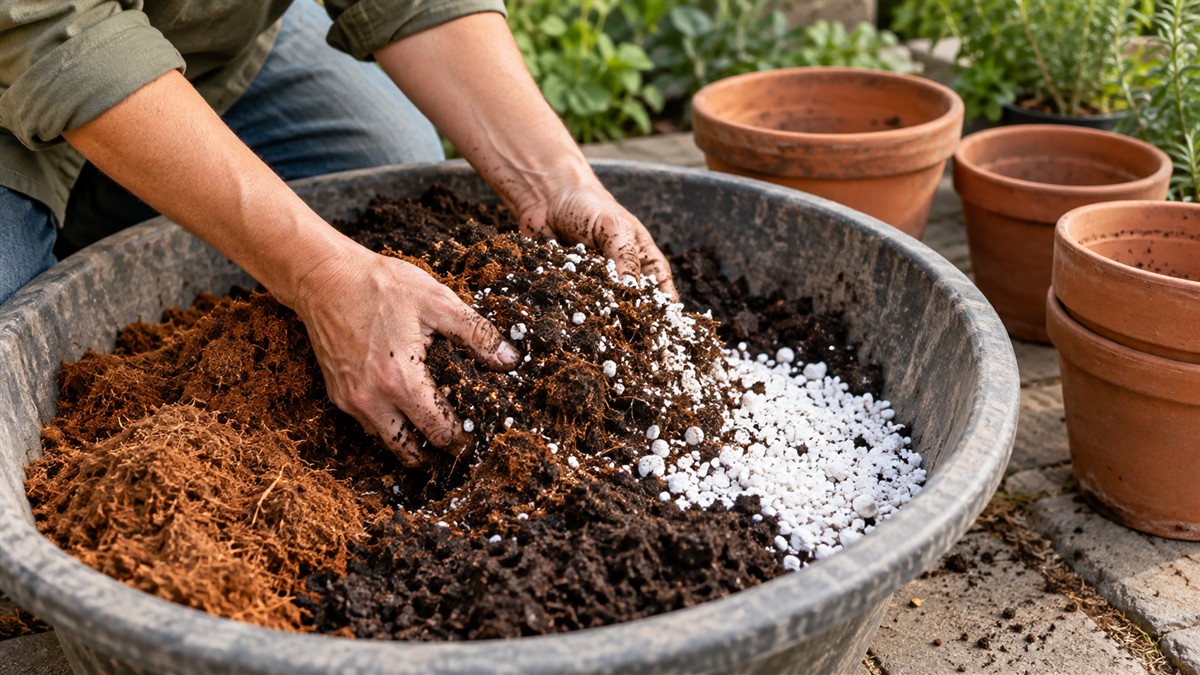
The University of Maryland guide describes commercial soilless mixes as “an excellent choice for containers” that “are lightweight, drain well, hold water and nutrients”. It names the usual ingredients: “sphagnum peat moss, perlite, vermiculite, composted bark, compost, and coconut coir.” A home mix built from the same kinds of ingredients follows the sources’ description of a soilless mix.
Oregon State’s advice points the same way. It says: “A fairly lightweight potting soil is the best growing medium for container plants.” It also says that “Most commercially sold potting mixes are too lightweight for garden plants because they don’t offer adequate support for plant roots.” Its answer is to add bulk rather than avoid light mixes: “If you buy a potting mix, add soil or compost to provide bulk and weight.”
When you choose ingredients, the University of Maryland guide gives buying tips for bagged mixes: “Avoid mixes that contain sedge peat, feel heavy or gritty, have very fine particles, or appear clumped.” Those are the signs of a mix that will work poorly in a pot, whether you bought it or built it.
Add a coarse material for air
Coarse material keeps the mix open. For sand, the University of Maryland guide is specific: “Use only coarse builder sand, not play sand.” It explains the reason: “Sand increases porosity because of the large particles.” The same guide calls sand “relatively inexpensive and heavy”, so it adds weight as well as air. Oregon State’s recipe uses the same kind of sand and calls for “clean, coarse builder’s sand.”
Perlite and vermiculite are the lighter additions in the sources’ lists, since sand is described as heavy. The University of Maryland guide lists both as ingredients in commercial soilless mixes. Colorado State says either one, or water-holding polymers, “may be mixed in prior to planting to extend the time between waterings.” That is a watering choice, not a drainage fix.
The UC Master Gardeners page gives a similar list of coarse additions. It advises: “Amend the potting mix by adding coarse materials such as perlite, crushed lava, or pumice”, which is one of its two options for better drainage in a container. The drainage holes are a separate requirement, and Oregon State says containers must have them.
Not every bulky material is a good choice. The University of Maryland guide says that “Bark fines and wood mulch” are “high in carbon and low in nutrients and not recommended for container vegetables.” If your mix relies on bark, keep it out of vegetable containers, or use it only as a minor part of the base.
Add compost for nutrients
Compost is the nutrient part of the mix. The University of Maryland guide says: “It’s highly recommended to include some compost in the growing media for your containers.” It also says “Compost contains all the major and minor nutrients that plants need for good growth.” The same guide says that “Compost is the dark, crumbly, earthy-smelling product of organic matter decomposition”, and it calls compost “an excellent substitute for sphagnum peat moss” for gardeners.
Oregon State’s recipe puts compost in the mix in equal parts with the other two ingredients. The Ask Extension answer repeats that recipe and points to the same Oregon State publication. For a homemade compost source, our guide to making a compost pile covers that step.
Garden soil: the sources disagree
This is the one point where the sources split. The University of Maryland guide says: “Soils are too dense to allow for good air and water movement when added to a container garden.” It limits garden soil in containers to very large pots: “Topsoil should only be added to very large containers and not exceed 10% of the volume.” Its list of commercial mixes does not include garden soil among the ingredients.
Oregon State takes the other side in its recipe. It says: “Or mix your own with equal parts well-rotted compost; loamy garden soil; and clean, coarse builder’s sand.” The same guide also says “Garden soil is too heavy for container growing”, so it treats garden soil as too heavy alone but uses loamy garden soil as one of three equal parts. The Ask Extension answer, which points to the Oregon State publication, repeats the three-part recipe.
Read together, the two sources give two options. If you follow Oregon State’s three-part recipe, loamy garden soil is one third of the mix by volume, since the three parts are equal. If you follow the University of Maryland guide, keep garden soil to 10 percent or less, and only in very large containers. The sources do not say which option suits a given pot, so decide before you measure.
Mix by volume and wet it well
The Oregon State recipe is written in equal parts, so the simplest way to measure is by volume, using the same scoop or container for each ingredient. Keep the parts equal so the mix matches the recipe you chose.
Wetting a soilless mix takes more effort than it looks. The University of Maryland guide says: “Soilless mixes tend to be hydrophobic – they repel water.” Its method is direct: “Work water into the media with your hands (it is best to wear gloves) until it is thoroughly wetted.” Water poured on top of a dry mix does not soak in evenly, so mix it until it is thoroughly wetted before you fill the pot.
If the bed you are filling is a raised bed rather than a pot, our guide to filling raised beds covers that job.
Check the pH and feed the mix
Oregon State gives a target: “Add lime to bring the mixture’s pH to around 6.5.” The Ask Extension answer gives a slightly wider target: “Add lime if necessary to bring mixture pH to 6.5-7.” The University of Maryland guide describes commercial soilless mixes as having “a pH of about 6.2”, which is a useful reference point if you are comparing with a bagged mix.
To check the pH, Oregon State says that “A soil test kit purchased from a garden center will help determine soil acidity.” The sources do not give a lime amount, so a test is the only way to know how much to add.
Feeding comes after the base is right. Oregon State advises: “Add a slow-acting, balanced fertilizer (slow-release synthetic or organic fertilizers work best) according to container size.” Colorado State adds that “Controlled-release fertilizer can be added at the time of planting, with water-soluble fertilizer used to supplement or replace time-release products as needed throughout the growing season.” The sources do not give fertilizer amounts, so follow the label of the product you choose.
Mistakes to avoid
- Using play sand. The University of Maryland guide says to use only coarse builder sand.
- Putting bark fines or wood mulch in vegetable containers. The same guide says they are not recommended for container vegetables.
- Using heavy garden soil in a container. The University of Maryland guide says it is too dense, and Oregon State calls it too heavy alone.
- Skipping the pH check. Oregon State and the Ask Extension answer both give a target near 6.5.
- Leaving out the feed. Oregon State treats a slow-acting, balanced fertilizer as a standard part of a container mix.
What we could not verify
The sources above give ingredients and targets, but they do not give a tested home recipe for every mix. The points below stay open, and this guide does not guess at them.
What the sources do not say
- Exact ratios for a peat-, coir- or bark-based soilless mix. The sources list ingredients but not proportions for that type of blend.
- How much lime to add to reach the target pH. The sources give the target only.
- How much fertilizer to add to the mix. Oregon State says “according to container size” without figures.
- Which of the two garden-soil recipes works better for a given plant. The sources disagree and do not compare the results.
- Whether a particular yard soil suits a container. The sources describe garden soil in general and do not test any soil.
How we chose
This guide uses five sources, all opened with curl on 2026-10-22: the University of Maryland Extension growing media guide, Oregon State University Extension’s EM 9027 gardening guide, an Ask Extension answer from January 2025 that points to the Oregon State publication, Colorado State University Extension’s container basics, and the UC Master Gardeners drainage page. Each quoted sentence was checked against the text that curl returned.
The Oregon State and University of Maryland sources conflict on garden soil, so the draft shows both rather than picking one. No product is recommended, and no retail listing or blog recipe was used. The Penn State and Mississippi State recipes that appear in search results were not used, because the pages opened with curl did not return a usable recipe.
Frequently asked questions
Can you make a potting mix without garden soil?
Yes. The University of Maryland guide lists soilless ingredients such as peat, perlite, vermiculite, compost and coir, and it says garden soil is too dense for containers. Oregon State and the Ask Extension answer include loamy garden soil in their three-part recipe, so the sources do not agree on whether it is needed.
Does a potting mix need compost?
The University of Maryland guide says it is highly recommended. It explains that compost contains the major and minor nutrients plants need. Oregon State’s recipe also includes well-rotted compost as one of three equal parts.
What pH should a homemade potting mix be?
Oregon State gives a target of around 6.5, and the Ask Extension answer gives 6.5 to 7. The University of Maryland guide describes commercial soilless mixes as having a pH of about 6.2. Test the mix with a kit from a garden center, since the sources give no lime amount.
Is perlite better than sand in a potting mix?
The sources do not rank them. The University of Maryland guide says sand adds porosity and is heavy, and it says to use only coarse builder sand, not play sand. Perlite and vermiculite appear in its list of soilless ingredients, and the UC page names perlite among the coarse additions it recommends.
How much fertilizer should go into a homemade mix?
Oregon State says to add a slow-acting, balanced fertilizer according to container size. It gives no amount, so follow the product label. Colorado State says controlled-release fertilizer can be added at planting, with water-soluble fertilizer used as needed through the season.
Sources
- https://extension.umd.edu/resource/growing-media-potting-soil-containers (opened 2026-10-22)
- https://extension.oregonstate.edu/catalog/pub/em-9027-growing-your-own (opened 2026-10-22)
- https://ask.extension.org/kb/faq.php?id=891729 (opened 2026-10-22)
- https://planttalk.colostate.edu/topics/annuals-perennials/1001-container-gardening-basics/ (opened 2026-10-22)
- https://ucanr.edu/site/uc-master-gardeners-santa-clara-county/drainage-containers (opened 2026-10-22)