Pots Without Drainage Holes: Options and Limits
As an Amazon Associate we earn from qualifying purchases.
How to drain a plant pot without drainage holes starts with a plain fact: a pot with no holes has no outlet, so water that reaches the bottom has nowhere to go. The sources here agree on that point. Their practical options are to add holes where the pot allows it, to choose a mix and depth that drain well, and to water with care. Where a pot cannot take holes, the sources do not offer a verified fix, and this guide says so.
Quick answer
- A holeless pot has no outlet. Oregon State’s container guide says containers must have drainage holes.
- If the pot can take holes, drill three or four small holes about 1/4 inch wide, as the Purdue advice quoted by Ask Extension suggests.
- Do not rely on gravel. UC Master Gardeners call the gravel layer a myth.
- Where holes are not possible, water less often and check the soil. The sources do not verify another fix for a holeless pot.
Why a pot with no hole cannot drain
Drainage is the main job of a pot. Colorado State University’s container basics say that “proper drainage is the most important consideration” when choosing a container. The same page adds that watering needs depend partly on whether the pot is porous or glazed, because a glazed pot allows less water evaporation through the container itself. A holeless glazed pot has no outlet at the bottom, and its glazed walls let less water out by evaporation, so the water it holds stays longer.
Oregon State’s container section is more direct: “The container must have drainage holes.” That section is written for vegetables, so it reads best as a general rule for containers rather than a complete one. It does not say that a holeless pot can be used for other plants, and the sources here do not claim it can.
The Chicago Botanic Garden’s reader answer on white residue is about houseplants, but it shows the cost of poor drainage: “If your plants do not have proper drainage, or if you are watering them too lightly and too frequently, a buildup of salts can occur.” A pot with no outlet is a clear case of poor drainage, so the same cost applies to a holeless pot.
Gravel does not fix a holeless pot
The fix many people reach for first is a layer of gravel in the bottom. UC Master Gardeners call that a myth: “It’s a common myth that we should put gravel or other coarse-textured material in the bottom of a container to improve drainage.” Their reason is about how water moves: “If a layer of such material is in the bottom of a pot, the downward movement of water (i.e., drainage) will stop when the water encounters the coarse layer.”
UC explains what happens inside the pot first: “A well-watered container of potting mix always has a saturated layer at the bottom.” Gravel does not remove that layer. “When you put a layer of gravel at the bottom of the pot, the saturated layer simply moves up.” In a holeless pot, that means gravel gives the water a place to sit above the coarse layer, not a way out. The gravel idea does not solve the problem the pot already has, which is the missing outlet.
Drill holes if the pot allows it
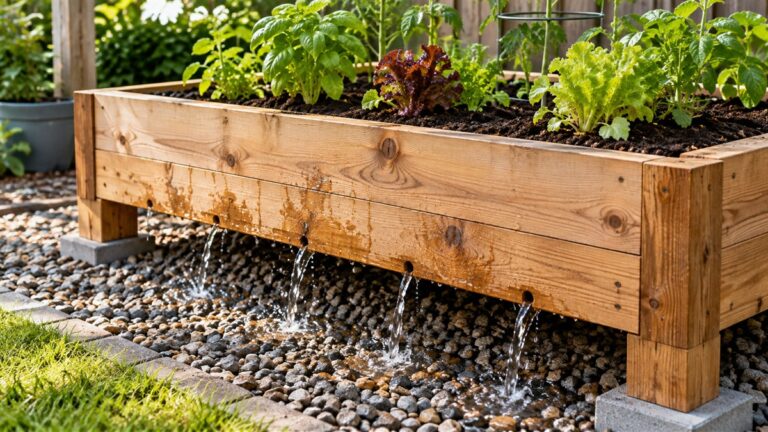
Drilling is the option the sources support most directly. Ask Extension’s expert answer quotes Purdue University’s container bulletin: “To provide drainage, drill three or four small (1/4 inch) holes in the bottom of the container.” The same answer adds that “Holes larger than 1/4 inch in diameter will allow too much soil to escape.” So the holes should be big enough to drain and small enough to keep the mix in.
Small holes can clog, and the answer names the risk: it is “easy for a piece of perlite or bark to block a tiny 1/4 inch hole”, so check the holes after the first watering. The answer’s test is simple: drill a few small holes, fill the container with soil, water it, and examine how well the excess water penetrates. Drill before you fill the pot, because having to empty the container to drill more holes would be a pain.
The expert also notes that online sources often use bits between 3/8 and 5/8 inch, and says the expert might lean toward that size for the same clogging reason. The sources disagree on the exact size, so a bit in that range is a judgment call that the first watering can settle.
Ceramic pots need more care. The answer passes along advice it describes as coming from internet sources: use masonry bits, avoid too much pressure on the drill and bit to avoid cracking the pot, and keep water on the ceramic to cool it and wash away the grit as you drill. The answer does not guarantee that a given pot will survive drilling. For a pot you cannot drill safely, the watering steps below are the practical route the sources cover.
When a pot cannot take holes
Some pots are too thick, too decorative or too fragile to drill, and for those the sources here do not offer a verified drainage method. The drilling advice above is the only way to give a holeless pot an outlet that the sources describe in any detail.
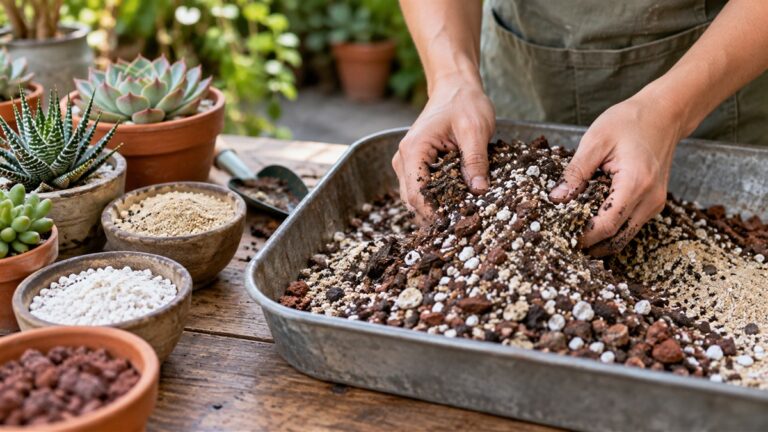
The other options are about the mix and the depth. UC Master Gardeners say to “Amend the potting mix by adding coarse materials such as perlite, crushed lava, or pumice”, which is one of their two suggestions. A coarser mix can help water move through the soil inside the pot, but it does not give the water an outlet at the bottom, so it is a mix choice rather than a full fix. Their second suggestion is to “Choose a deeper container, so the roots will have more soil depth that remains well drained and unsaturated”. In a holeless pot, that points toward a deeper pot with an outlet, not toward keeping a holeless one.
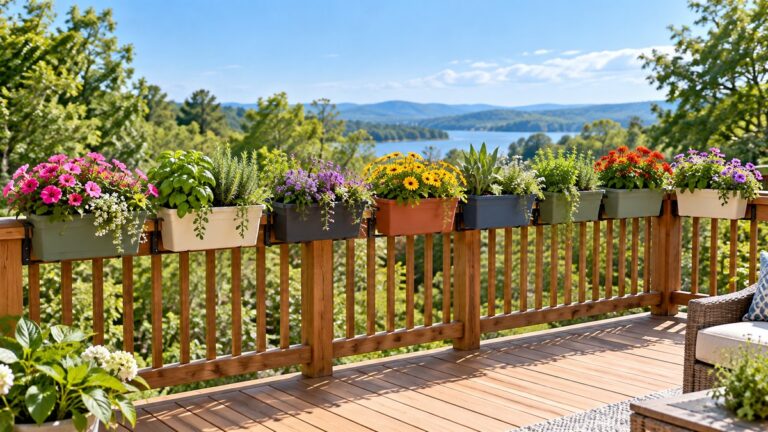
Oregon State’s container guidance sets a size floor for the pot. It says: “For most plants, containers should be at least 6 inches deep.” That is written for vegetables, so check it against the plants you have in mind before you choose a pot. The same guide also asks for room first: “Start by finding a container large enough to support fully grown plants and with adequate soil-holding capacity to accommodate the plants’ root systems.” Size and holes are separate checks, and a pot needs both. If you are planning a box rather than a pot, our DIY planter box for a deck railing guide covers that build.
Watering a pot with no outlet
Colorado State’s basic rule is that container gardening depends on “using soil that will drain properly while holding the moisture to prevent the plant from drying out”, along with the right container and enough watering. When the pot cannot drain, watering becomes the main control. Colorado State says: “It is important to group plants with similar moisture needs in one container, and check the soil daily, watering as needed.” That is a habit, not a schedule. The sources do not give a number of days between waterings for a holeless pot, so the soil check is the only guide they support.
The same page notes that “Vermiculite, perlite, or water-holding polymers may be mixed in prior to planting to extend the time between waterings.” That is a watering choice, not a drainage fix. It changes how often you water, so it does not give the water an outlet, and it should not be read as a way to make a holeless pot drain.
Oregon State’s guidance on the mix itself is short: “A fairly lightweight potting soil is the best growing medium for container plants.” It does not address holeless pots, so treat it as a mix rule, not a drainage fix. For the soil volume question, our guide on how much soil a raised bed needs covers the amount side of the job.
Mistakes to avoid
- Relying on gravel. UC says a coarse layer stops drainage where the water meets it.
- Drilling holes that are too large. Purdue’s advice, quoted by Ask Extension, says holes larger than 1/4 inch let too much soil escape.
- Drilling ceramic too hard. The Ask Extension answer warns about cracking the pot and suggests keeping water on the bit.
- Watering on a calendar. Colorado State says to check the soil daily and water as needed.
- Grouping plants with different moisture needs. Colorado State advises grouping plants with similar needs.
What we could not verify
The sources above give drilling advice and general container rules. They do not verify a method for a pot that cannot be drilled, and the points below stay open.
What the sources do not say
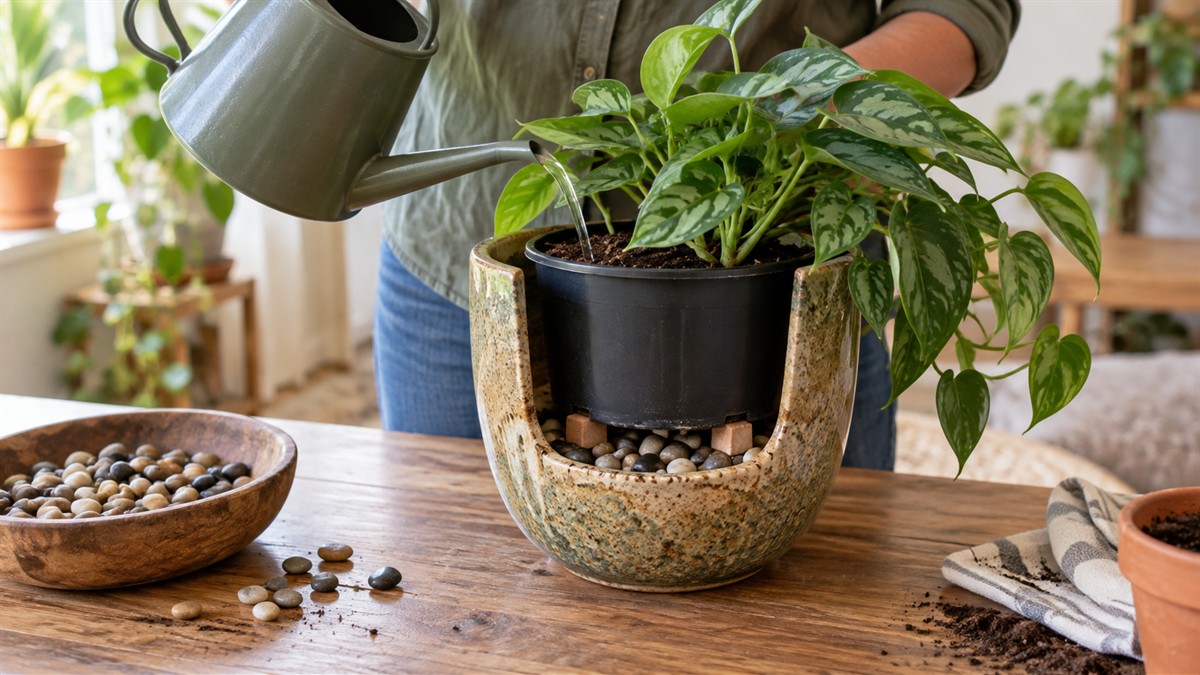
- Whether a plastic nursery pot with a drainage hole can sit inside a decorative pot with no holes, and how often to empty the outer pot. None of the opened extension pages covers that method.
- Whether a glazed or thick pot can be drilled safely at home. The Ask Extension answer describes cooling and light pressure, but does not guarantee a crack-free result.
- How many holes a pot of a given size needs beyond the three or four in the Purdue advice. The sources give no count for other sizes.
- How often to water a holeless pot outdoors, or how rain affects it. Colorado State advises checking the soil daily but gives no schedule.
- Whether sealing the inside of a pot changes its drainage. The sources do not address sealing.
- How to drill plastic or metal pots. The sources describe drilling ceramic pots only.
How we chose
This guide uses five sources, all opened with curl on 2026-10-22. The Ask Extension answer dates from 2014, so its hole sizes are treated as older guidance. The Oregon State guide was revised in August 2022. The sources are: Ask Extension’s 2014 answer that quotes Purdue, UC Master Gardeners’ drainage page, Colorado State University Extension’s container basics, Oregon State University Extension’s EM 9027 gardening guide, and the Chicago Botanic Garden’s houseplant answer on white residue. Each quoted sentence was checked against the text that curl returned.
A step is kept when at least one extension source states it. The nursery-pot method appears only as an unverified option. No product is recommended, and no retail or blog figure was used. The houseplant answer is used only to show the cost of poor drainage, not as a planter rule.
Frequently asked questions
Can a pot without drainage holes be used at all?
The extension sources here treat holes as the norm, and Oregon State says containers must have them. A holeless pot can be used with careful watering, but the sources do not give a verified way to make it drain fully. Drilling is the one fix they describe in detail.
Is a gravel layer enough to drain a holeless pot?
No. UC Master Gardeners call the gravel idea a common myth, because a coarse layer stops drainage where the water meets it. It gives the water a place to sit, not a way out.
How many drainage holes should a pot have?
The Purdue advice quoted by Ask Extension recommends three or four small holes, about 1/4 inch wide, for a container. Holes larger than that let too much soil escape, and small holes can clog. The expert notes that online sources often use bits between 3/8 and 5/8 inch, so the sources do not settle one size.
Can a ceramic pot be drilled at home?
The Ask Extension answer passes along advice to use masonry bits, avoid too much pressure, and keep water on the bit to cool the ceramic and clear grit. It warns that pressure can crack the pot, and it does not promise a crack-free result, so check the pot before you drill.
How often should a pot with no outlet be watered?
Colorado State advises checking the soil daily and watering as needed, and grouping plants with similar moisture needs. The sources do not give a fixed schedule for a holeless pot, so the soil check is the guide.
Sources
- https://ask.extension.org/kb/faq.php?id=220577 (opened 2026-10-22)
- https://ucanr.edu/site/uc-master-gardeners-santa-clara-county/drainage-containers (opened 2026-10-22)
- https://planttalk.colostate.edu/topics/annuals-perennials/1001-container-gardening-basics/ (opened 2026-10-22)
- https://extension.oregonstate.edu/catalog/pub/em-9027-growing-your-own (opened 2026-10-22)
- https://www.chicagobotanic.org/plantinfo/white_residue_pots (opened 2026-10-22)