How to Clean Concrete Planters
As an Amazon Associate we earn from qualifying purchases.
How to clean concrete planters starts with one question: is the white film a powder that brushes or hoses off, or a hard crust that needs more work? Most of that film is efflorescence, a salt deposit that water leaves on the surface as it dries. The sources below are mostly written for concrete walls, pavers, stucco and masonry, not planters. This guide applies their steps to planters only where the wording is general, and it says where the sources stop.
Quick answer
- Hose or brush off the powdery white film first, since the ARTO guide says that often works.
- Test any stronger cleaner on a small hidden area and let it dry before you judge the result.
- Avoid acid and harsh chemicals, which the ARTO guide says can remove sealers and damage concrete.
- Limit runoff and keep the planter elevated, so the salts have less water to carry them back to the surface.
What the white film is
ARTO, a concrete paver maker, puts it simply: “efflorescence is just a fancy word for salts that migrate to the surface.” The same post adds: “It is a normal phenomenon that can be seen in clay brick, concrete, mortar, grout, and in all types of masonry.” On a concrete planter, the film is a salt deposit that has reached the surface.
Sika’s technical bulletin states the cause in three conditions: soluble salts in the material, moisture to carry them to the surface, and evaporation or pressure to move the solution. The bulletin says “All masonry and concrete materials are susceptible to efflorescence.” It also gives the practical point: “Note: If any one of these conditions is not there, efflorescence cannot occur.” The same bulletin notes that “Watersoluble salts that appear in chemical analysis as only a few tenths of one percent are sufficient to cause efflorescence.” A planter that sits in wet soil or takes sprinkler spray can meet all three conditions, so the film can keep coming back.
Not every white stain is salt. The Masonry Advisory Council notes: “Another white stain that shows up on masonry projects is something called a lime deposit.” It says that stain “is harder to clean than an efflorescence stain and it requires a lot more scrubbing with chemicals to properly remove.” The sources do not give a simple home test to tell the two apart, so if a stain stays after the gentle steps below, treat it as the harder kind before you reach for a stronger product.
Where the salt comes from in a planter
The soil around the planter is one source. The ARTO guide says: “However, nearby soils and planter beds contain large amounts of salts and can lead to recurring efflorescence.” A planter sitting in a bed with salty soil can keep receiving salts, even after a clean.
The same post also says: “Efflorescence can sometimes occur outdoors but will usually exhaust itself as there is a finite amount of salts in mortar, grout, and concrete.” That can explain why a film fades over time, but the same post also warns about soil and runoff, which keep supplying salts.
Runoff is the other source. The same guide says: “Flower pots and planter can also transport efflorescence in runoff water.” Water that runs off a planter can carry those salts onto the concrete below it.
For a general picture of where the salt in a pot comes from, the Chicago Botanic Garden’s answer on white residue is written for houseplant pots but gives the same cause: “This is probably salt residue caused by an excess of soluble salts in the soil.” The same answer says: “Soluble salts can also be found in fertilizers or in excessively hard water.” A planter that gets regular feeding is worth checking for that reason too. The houseplant context is different, so treat the answer as background rather than a planter rule.
Brush or hose off the powder first
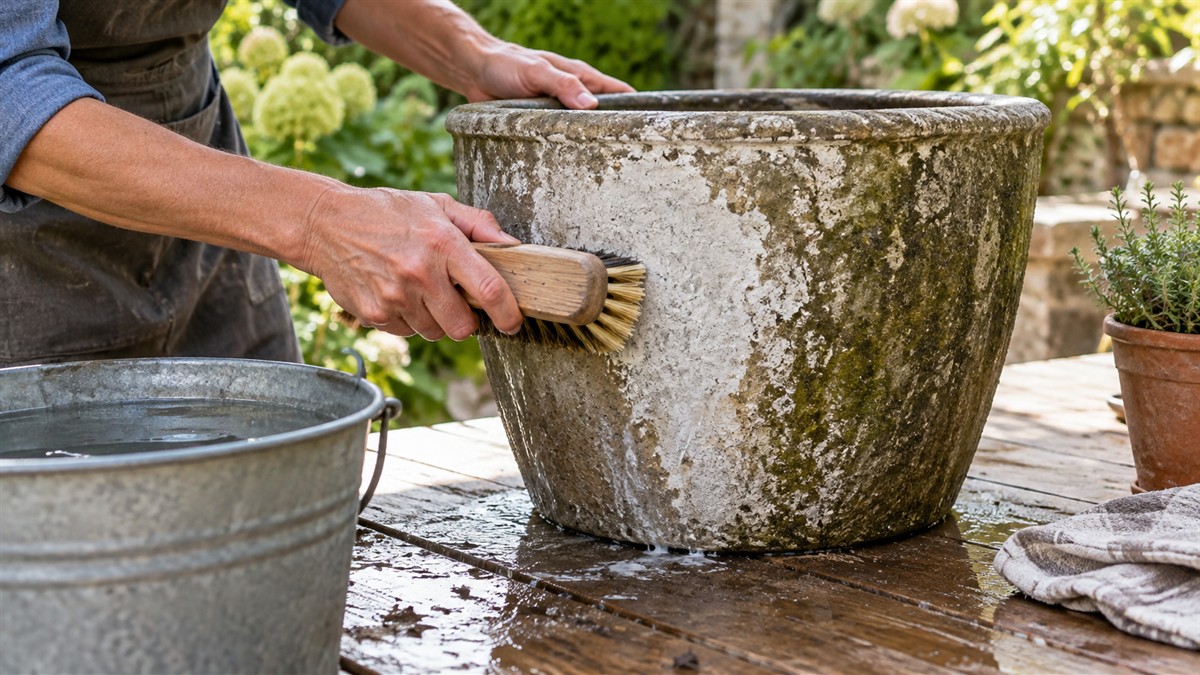
Start with the gentlest step. ARTO says: “In many cases efflorescence can simply be hosed off or brushed away when it is powdery.” Hosing and brushing remove the loose salt first, so any stronger step starts from a cleaner surface.
If you brush, be careful with the brush. The Sika bulletin says: “A soft nylon brush can aid in removal of the efflorescence but proceed with caution because it can cause removal of color from the finish.” A planter with a painted, stained or colored finish is the case where that warning matters most. Rinse between passes, because the bulletin says “Several applications may be needed. Rinse thoroughly between applications.”
Stronger cleaners: test first and avoid acid
Sometimes the powder does not come off. ARTO says: “Recurring or hardened efflorescence may require a specialized cleaner.” Before using any stronger product, the Sika bulletin gives a caution that applies to any surface: “Caution: Test a small area in an inconspicuous location and allow the tested area to dry.” Pick a spot on the back or underside of the planter, let it dry, and only then judge the result on the visible side.
The Sika bulletin also describes a wall method that could be tried on a planter after the test. It says the wall “should first be dampened with water to wet the wall.” Then, “While the wall is wet, try a sponge application of household 5% vinegar diluted 1:1 with water.” The bulletin adds: “Allow the vinegar solution to remain on the surface but do not allow it to dry.” Finish by rinsing: “Rinse the solution off with plenty of water.” The bulletin also warns: “Evaluate the results after drying and keep in mind that multiple applications are often needed.” That method is written for walls, so treat it as a test on a planter, not a settled routine.
The sources disagree on acid. ARTO says: “NEVER USE ACID OR HARSH CHEMICALS as these can remove sealers and damage concrete surfaces.” The Sika bulletin, by contrast, describes a vinegar method and names an acid-based commercial remover as one option for efflorescence. This guide does not settle that disagreement for planters. If the test area shows damage or the surface changes, stop and rinse.
Sealers and the come-back
Sealing is the step that can trap the problem. ARTO says: “Most topical sealers will trap efflorescence and moisture under the sealed surface.” The same post recommends a different kind for outdoor work, saying: “Use a high quality penetrating or breathable topical sealer for exterior installations.” That advice only makes sense once the salt is gone. That means a sealer applied over a salt film holds the salt and the moisture in place. Clean the surface, let it dry, and check that the salt is gone before sealing anything.
Even a clean surface can change. The Sika bulletin says: “Even when removal is complete, efflorescence can recur in time, although usually more lightly.” A planter that looked clean last season can show a faint film again, and the sources point to water management rather than harder scrubbing.
Stop the salt from coming back
ARTO’s advice is about water. It says: “Water management including proper drainage and sprinkler placement can minimize efflorescence by limiting water that can transport salts to the surface.” The guide names sprinkler placement and runoff as the water paths to watch.
The same guide recommends a setup change: “Keep flower pots and planters elevated and use drip irrigation systems to minimize runoff from these features.” Raising the planter and using drip irrigation are the two steps the guide names. Its reason is simple: “Remember, without water there is no way to transport the salts to the surface.”
The Chicago Botanic Garden answer is about houseplant pots, but it shows the same habit. “Such residue can be prevented by occasionally watering your plant heavily and flushing out the salts.” The sources do not say whether that flushing works for an outdoor concrete planter. If the planter is a box rather than a concrete pot, our guide to a DIY planter box for a deck railing covers that build. Once the planter is clean and dry, the soil that goes back in matters too, and our guide to filling raised beds covers that step.
Mistakes to avoid
- Reaching for acid or harsh chemicals first. ARTO says they can remove sealers and damage concrete.
- Skipping the hidden-area test. Sika says to test a small area in an inconspicuous location first.
- Using a brush on a colored or finished surface without a test. Sika warns a soft nylon brush can remove color from the finish.
- Sealing over a salt film. ARTO says most topical sealers trap efflorescence and moisture under the surface.
- Leaving the planter in its runoff. ARTO says planters can transport efflorescence in runoff water.
What we could not verify
The sources above cover the chemistry and the cautions well. They do not give a full cleaning routine for a concrete planter, and the points below stay open.
What the sources do not say
- How to clean a concrete planter that is painted, stained or sealed. The Sika note on color loss is the only finish warning in these sources.
- Whether the vinegar method is safe for a planter that will hold plants. The Sika method is written for walls.
- What concentration of any cleaner suits a planter. The only dilution given, 5% household vinegar at 1:1, is for walls.
- How to tell a lime deposit from efflorescence at home. The Masonry Advisory Council says the lime deposit is harder to clean but gives no field test.
- Whether hard water or distilled water changes the salt on an outdoor concrete planter. The Chicago Botanic answer is written for houseplants.
- Whether brown, black or orange marks on a planter have the same cause. The sources do not cover those stains.
How we chose
This guide uses five sources, all opened with curl on 2026-10-22: a paver maker’s efflorescence post (ARTO), a technical bulletin written for stucco walls (Sika), a masonry trade group’s efflorescence sheet (Masonry Advisory Council), a botanic garden reader answer about houseplant pots (Chicago Botanic Garden), and an extension how-to on cleaning plant containers (Iowa State University Extension). Each quoted sentence was checked against the text that curl returned.
A step is kept when at least one source describes it in terms that fit a planter: hosing or brushing the powder, testing a small area, rinsing between passes, avoiding acid, sealing with care, and controlling runoff. Steps written only for walls are labeled as wall steps. No product is recommended, no retail listing was used, and the cleaners named in the sources are not named here.
Frequently asked questions
Is the white film on a concrete planter harmful?
ARTO calls it a normal phenomenon and a salt deposit. Iowa State’s container page says mineral salts can be both unsightly and damaging to plants, so it is worth removing even when it is only a film.
Can vinegar be used on a concrete planter?
The Sika bulletin describes a diluted vinegar sponge method for walls, with a test on a small area first and a rinse afterward. ARTO warns against acid, while the Sika method uses vinegar, so the sources do not agree on this step. Test a hidden area before using vinegar on a planter, and the sources do not give a planter-specific answer.
Should a concrete planter be sealed after cleaning?
Be careful. ARTO says most topical sealers trap efflorescence and moisture under the surface, so a sealer over a salt film holds the problem in place. Clean and dry the surface first, and the sources do not give sealing instructions for planters.
Why does the white film keep coming back?
ARTO says nearby soils and planter beds keep supplying salts, and runoff can carry them onto the concrete. Sika says that even after removal is complete, efflorescence can recur in time, although usually more lightly.
What if the stain will not brush off?
It may be a lime deposit rather than efflorescence. The Masonry Advisory Council says a lime deposit is harder to clean and needs more scrubbing with chemicals. ARTO says recurring or hardened efflorescence may need a specialized cleaner, so test any stronger product on a hidden area first.
Sources
- https://blog.arto.com/?p=8034 (opened 2026-10-22)
- https://usa.sika.com/dms/getdocument.get/6b570805-f062-41bf-bf80-401165c59f8c/us-facades-tech-bulletin-effloresence-stucco-walls.pdf (opened 2026-10-22)
- https://masonryadvisorycouncil.org/wp-content/uploads/2023/10/Efflorescence.pdf (opened 2026-10-22)
- https://www.chicagobotanic.org/plantinfo/white_residue_pots (opened 2026-10-22)
- https://yardandgarden.extension.iastate.edu/how-to/how-clean-and-disinfect-plant-containers (opened 2026-10-22)