How to Winterize Raised Garden Beds
As an Amazon Associate we earn from qualifying purchases.
Learning how to winterize raised garden beds is mostly about protecting the soil you built during the season. Raised beds settle and lose structure over time, winter rain can still cause problems, and beds that have slumped or lost soil need attention before spring. The sources agree on a basic routine: clean up, add organic matter, cover the soil, and check drainage and the frame.
The steps below follow the extension sources in the order most useful for a bed you already have. Where the sources differ or stay silent, the text says so, so you can match the routine to your own climate.
Quick answer
- Top-dress the bed with finished compost or topsoil, a few inches at a time. Illinois Extension calls an annual top dressing the easiest way to keep up with settling.
- Cover the soil with mulch or a cover crop. North Carolina’s extension page recommends three to six inches of mulch for winter protection, and it says mulch still helps if you skip the cover crop.
- Check drainage after heavy rain and check the frame before spring. Standing water for more than 24 hours signals a drainage problem.
Why raised beds need winter attention
Raised beds settle over time. Illinois Extension notes that a hard winter can leave beds with significantly reduced soil levels, and it says that settling soil is simply a fact of raised bed gardening. North Carolina’s extension article gives the structural reason: research shows that raised beds tend to settle and lose structure because of extra aeration and more frequent cropping. Illinois Extension describes the spring surprise that often follows a hard winter, when beds show significantly reduced soil levels.
Winter is a good time to look at how much the bed has settled. The sources do not give a fixed measurement for how much top dressing a given bed needs, so judge the bed by its level and by its frame, then decide how much to add.
Clean up, then leave what helps
Start with the surface. Washington State University Extension’s fall handout says fall is a perfect time to clean up from the summer and start planning for spring. Clean up vegetable beds. If you grow cool-season crops, you can push bed clean-up later in the season.
Not everything has to come out. The same handout says some perennials are an ideal home for overwintering insects. For those plants, leave the plant intact, layer leaves or other mulches around the base, and leave the collar exposed. The handout adds that this gives good habitat for birds and insects throughout the winter. Clean up the other select perennials from the bed.
Planning is a winter task too. Once your beds are protected, winter is the perfect time to plan next year’s garden layout, according to the North Carolina article. For a look at winter covers that suit raised beds, our roundup on preparing raised beds for winter covers the product side.
Top-dress with organic matter
Winter is a good time to add organic matter. North Carolina’s article lists finished, weed-free compost, shredded leaves, aged manure that is not fresh, and fully finished compost from a home bin as suitable top-dressings. The word “fresh” matters here, because the list calls for aged manure, not fresh manure.
Work the material in lightly if the bed has leftover plant residue. The same article says healthy plant residues can be chopped and incorporated lightly into the top few inches of soil, which adds organic matter as they break down. Shredded leaves are on the same list, so leaves you rake in the fall are one of the top-dressing options the article names.
Avoid digging the bed up. Illinois Extension says to till new raised beds when needed to mix their fill components, and it notes that tilling can help with significant amendments. Its advice for an established bed is firmer: avoid tilling it, because tilling can destroy the developing soil structure. The Illinois article’s easiest method is annual top dressing, so that is the routine it points toward for a bed that is already working.
If you are topping up a bed and need to estimate the volume, our guide on how much soil a raised bed needs covers that side of the job.
Cover the soil: cover crops or mulch
Cover crops are one option. Illinois Extension says that sowing cover crops in the off-season helps build soil structure in the bed. It adds that cover crops will not stop settling, but they slow the process and build a richer growing medium. North Carolina’s article lists cover crops it commonly recommends for raised beds, including winter rye, crimson clover, Austrian winter peas and hairy vetch. It says cover crops protect the soil, suppress winter weeds, improve soil tilth, and can add nitrogen when legumes are used.
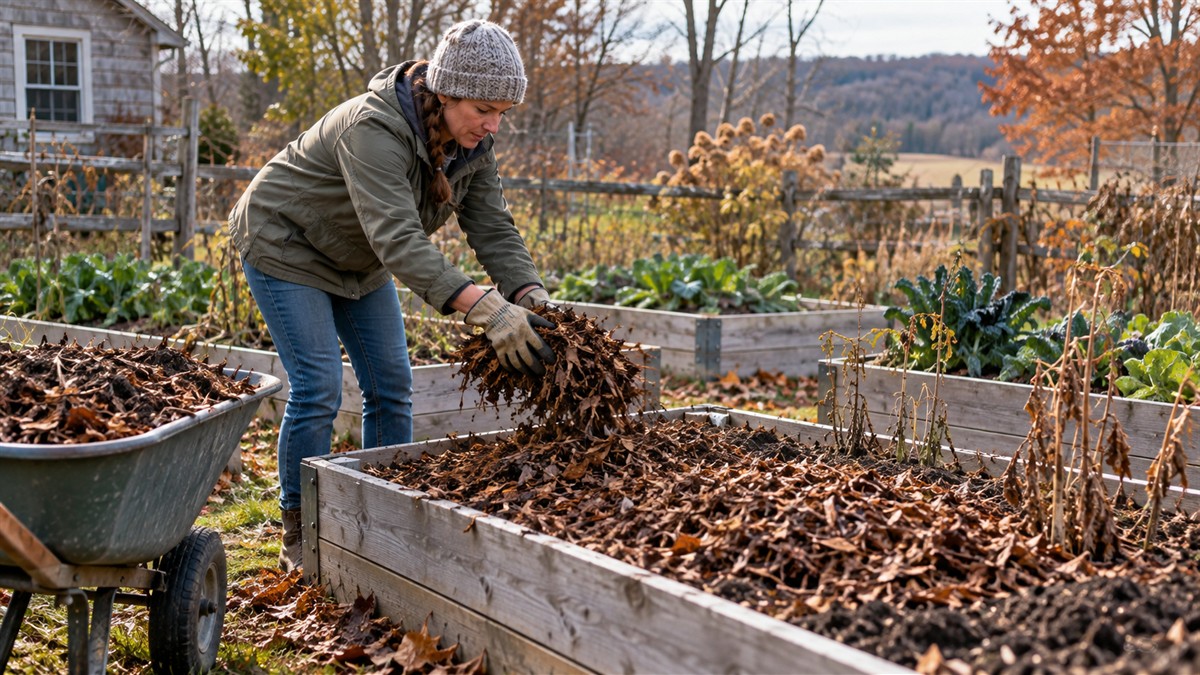
Mulch is the other option. North Carolina’s article calls mulching one of the simplest, most effective winterization steps. It recommends three to six inches of mulch for winter protection, and it lists straw (not hay), pine needles, chopped leaves and wood chips as suitable mulch options. Wood chips are listed only as a top dressing. The article says mulch protects beneficial soil organisms, insulates the roots of perennial crops, and shields the soil from heavy winter rain. If you prefer not to plant a cover crop, mulching still gives strong winter soil protection.
Material matters as much as depth. Iowa State University Extension calls wheat, oat or soybean straw free of seeds an excellent short-term mulch and overwintering insulation for cold-tender plants. Its guidance on shredded leaves is different: they are a poor winter mulch for strawberries and herbaceous perennials because they tend to mat down and smother plants. Choose the material for the plants that will sit under it.
How deep is too deep?
Depth has a limit, and the sources treat the high end with caution. Iowa State says an excessively deep mulch layer can lead to waterlogging, reduced soil oxygen levels, shallow rooting, and overly warm soils in winter. Colorado State University Extension adds that mulching may cool or warm soil temperatures. The sources do not say where a winter layer crosses from protective to excessive, so the three-to-six-inch figure from North Carolina is a starting point, not a ceiling.
The Iowa State warning about waterlogging is the reason to check drainage after a heavy rain, not just to add more material when the bed looks thin. The same Iowa State guidance adds a note for straw: avoid using it around trees and shrubs, because it may provide a winter habitat for mice and other rodents.
Check drainage and the frame
Winter rain is the real test. North Carolina’s article says raised beds improve drainage, but winter rains can still cause issues. Watch for standing water after heavy rain. The article says standing water for more than 24 hours indicates drainage issues, so treat that as the point to act.
Check the frame at the same time. Confirm the bed frame is intact and the soil has not slumped. If the soil has compacted, the article recommends adding compost or pine bark fines. Doing this before spring leaves time to fix a gap or a soft spot before planting.
Test the soil before spring
Winter is also a good time to test the soil. North Carolina’s article says winter is the ideal time to submit soil samples. It notes that lime benefits from several months in the soil, and it recommends applying lime well ahead of planting so it can adjust the pH. A winter soil test gives you time to make amendments before the spring rush, which is the reason the article gives for testing now.
Mistakes that undo the work
- Tilling an established bed. Illinois Extension warns that tilling can destroy the developing soil structure of a raised bed.
- Piling mulch too deep. Iowa State warns that an excessively deep mulch layer can lead to waterlogging and overly warm soils in winter.
- Leaving bare soil. Cover crops protect the soil, and mulch still gives strong winter protection if you skip a cover crop.
- Using shredded leaves as the only cover on strawberries or herbaceous perennials. Iowa State says they tend to mat down and smother plants.
- Adding fresh manure. North Carolina’s list calls for aged manure that is not fresh.
- Waiting until spring to lime. North Carolina’s article says lime benefits from several months in the soil, so apply it well ahead of planting.
- Skipping the drainage check. Standing water for more than 24 hours indicates a drainage issue, according to the North Carolina article.
How we chose
The sources are a county extension article, a university extension news release, a university extension handout, an extension how-to page, and a Colorado State University Extension resource. Each one was fetched with curl on 2026-10-22, and its winter, cover, mulch and settling sections were read before any sentence was used. Quoted lines were checked word for word against the fetched text. Retail pages, blog posts and pages that returned errors were left out, and no product is named or recommended.
Dates matter. The North Carolina article is dated November 18, 2025. The sources come from North Carolina, Illinois, Iowa, Washington and Colorado, so check your local extension office for frost timing and planting windows.
What we could not verify
The sources agree on the basic routine, but they do not agree on every detail. Cover crop choices differ by region, mulch depth has an unstated upper limit, and the timing of cleanup depends on the climate each source was written for.
What the sources do not say
The sources do not give a frost date, a closing date for the beds, or a fixed schedule for top dressing. They do not say which mulch suits a given frame material, and they do not give a cost for compost, topsoil, mulch or cover-crop seed. They do not say how much settling to expect in a given bed, beyond the general point that settling is normal. Their advice on pests is limited to overwintering insects in perennials in the Washington handout, so plan for any other pest problems on your own.
Frequently asked questions
When is the best time to winterize raised garden beds?
The sources point to fall for cleanup and winter for replenishing organic matter. Washington State’s handout says fall is a perfect time to clean up and plan for spring, and that cool-season crops allow cleanup to wait longer. North Carolina’s article calls winter a great time to replenish organic matter. None of them gives a calendar date, so tie the timing to your local frost.
Should a raised bed be tilled before winter?
Not if it is already established. Illinois Extension recommends tilling new raised beds when needed to mix their fill, and says tilling can help with significant amendments. For an established bed, it advises avoiding tilling because tilling can destroy the developing soil structure. Top-dressing from the surface is the routine the article points toward.
How deep should winter mulch be in a raised bed?
North Carolina’s article recommends three to six inches of mulch for winter protection. Iowa State warns that an excessively deep layer can lead to waterlogging, reduced soil oxygen levels, shallow rooting, and overly warm soils in winter. The sources do not say where the layer becomes excessive, so check drainage after heavy rain and adjust.
Is a cover crop required for winter protection?
No. North Carolina’s article says that if you prefer not to plant cover crops, mulching still provides strong winter soil protection. Cover crops do add value. Illinois Extension says they help build structure and slow settling, and North Carolina’s article says they protect the soil and suppress winter weeds.
What should you do if standing water lingers in a raised bed over winter?
Treat it as a drainage problem. North Carolina’s article says standing water for more than 24 hours indicates drainage issues. Check that the bed frame is intact and that the soil has not slumped. If the soil has compacted, add compost or pine bark fines, as the article recommends.
Sources
- https://wilkes.ces.ncsu.edu/2025/11/winterizing-your-raised-garden-beds/ (opened 2026-10-22)
- https://wpcdn.web.wsu.edu/wp-extension/uploads/sites/2056/2025/08/Fall-Composting-Handout.pdf (opened 2026-10-22)
- https://extension.illinois.edu/news-releases/refreshing-raised-bed-soil-generates-exceptional-results (opened 2026-10-22)
- https://yardandgarden.extension.iastate.edu/how-to/using-mulch-garden (opened 2026-10-22)
- https://extension.colostate.edu/resource/mulches-for-the-vegetable-garden/ (opened 2026-10-22)