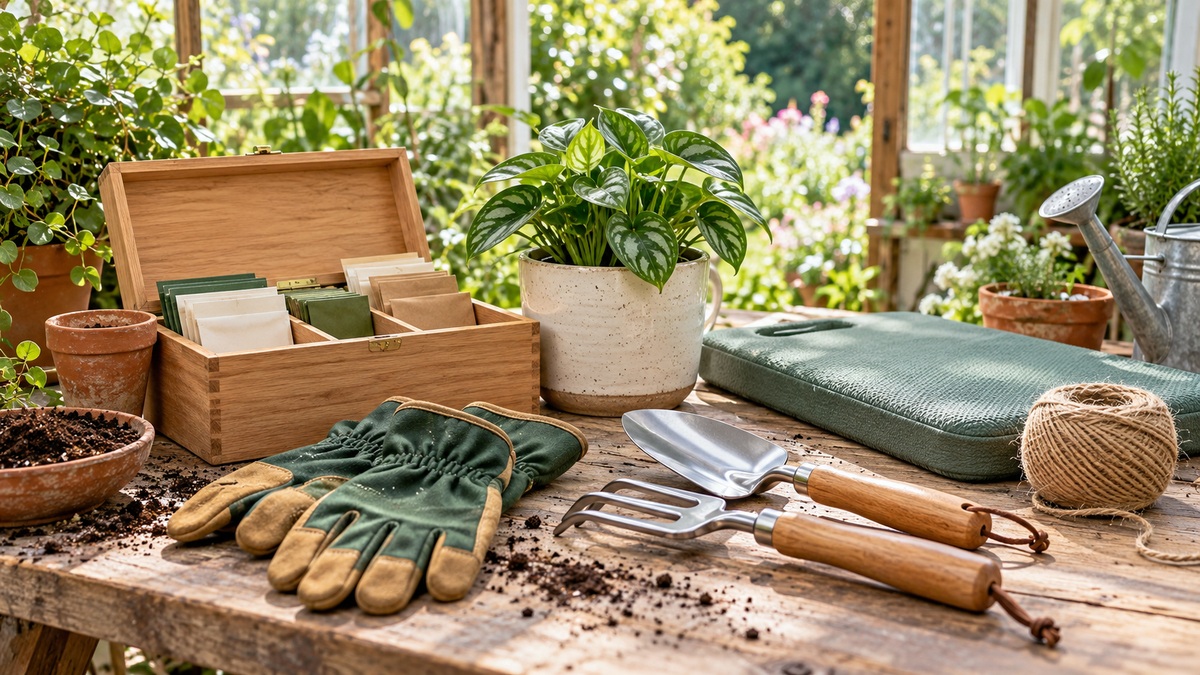
Gifts for Gardeners: Tools and Planters for Small Yards
As an Amazon Associate we earn from qualifying purchases.
Gifts for gardeners who work a patio or small yard should fit the space and do one job well. This guide covers ten items: hand tools, pruners, tool sets, a potting bench, planters and grow bags. For each one it gives the figures the listing states, the reason it could be the right gift, a skip-if case and a limitation. It is a shortlist, not a ranking.
Quick answer
- A pruner or a hori hori knife is the simplest gift for a small garden, because each has one stated size and one clear job.
- A tool set suits a gardener who has no basic kit. Count the pieces in the bullets, not only in the title, because the listings do not always agree.
- Choose a planter by drainage and footprint first. Illinois Extension and Oregon State University Extension both treat drainage as the starting check for containers.
- The potting bench is the heaviest item here at 82.5 pounds, so it works best where the gardener can receive it and set it down without a long carry.
Start with the space and the sun
A gift for a gardener with a patio, balcony or small yard has to fit three things: the floor or rail space, the hours of sun, and the way water leaves the container. Oregon State University Extension gives the sun figure plainly: vegetables grown for their fruit, such as tomatoes, green beans and peppers, “require 6 to 8 hours of direct sun daily.” Leafy and root crops such as lettuce, beets, cabbage and mustard greens tolerate some light shade. A gardener with a shaded balcony is better served by a hand tool or a planter for herbs than by a grow-bag set meant for tomatoes.
Size is the second check. The Illinois Extension guide gives a minimum top diameter for each crop: more than 20 inches for tomatoes, more than 16 inches for peppers, more than 12 inches for carrots, and more than 10 inches for leafy greens, herbs and flowers. Its soil-volume table lists 5 gallons of soil for a 12-inch pot and 10 gallons for a 16-inch pot. A planter 10 inches across is the size Illinois lists for leafy greens and herbs, and it is well short of the tomato and pepper sizes.
Drainage is the third check. The Illinois page makes the point with this line: “Gardeners are only limited by their imagination, willingness to experiment, and availability of drainage holes.” Oregon State University Extension says it more directly: “Almost any container will work if it has good drainage.” If a planter has no hole, the same OSU page suggests drilling holes along the side about ½ inch from the bottom, then lifting the pot slightly on bricks or wooden slats so it does not sit in a saucer of water.
Soil is the fourth check. Oregon State advises a commercial potting mix over garden soil, describing those mixes as lightweight, sterile and designed to drain well, and warning that garden soil or topsoil can be too heavy and may hold too much moisture. Containers also dry out fast, and in the words of the same page, “Soil in containers dries out quickly, especially on patios in full sun.” A planter gift therefore works best alongside a watering tool. The watering can guide and the expandable garden hose guide cover that side of the gift.
Hand tools: pruners, a knife and a weeder
Hand tools suit a gardener with little room because they store in a small space. The pruners are the easiest pair to compare, because both listings state a cutting figure. The Fiskars listing gives a 5/8-inch cut capacity. The Decerk listing gives a 20-millimeter cut width in its spec field, and its title says it prunes 3/4-inch branches. The conversion is 20 ÷ 25.4 = 0.79 inch, so the Decerk’s stated width is larger than the Fiskars’ 0.625 inch.
Pruners need a little care to keep working. University of New Hampshire Extension’s steps are to clean the blade, sharpen it with a diamond file, and oil the moving parts. On the edge it advises: “Only sharpen in one direction starting at the inside of the blade and working outward.” To check the result, cut a piece of paper: “If it makes a clean cut, the blade is adequately sharp.” The same page ends with “Store your pruners in a clean and dry location.”
1. PERWIN Hori Hori Garden Knife
Good for: a gardener who digs, divides and transplants in beds or containers. The listing says it is for digging, transplanting, dividing and measuring soil depth for planting.
Why it is on the list: a 7-inch blade with depth measurements in inches, a full-tang wood handle, and a sheath with a belt loop and a hanging hole. The listing gives the full length as 12.1 inches.
Skip if: the gardener already has a hori hori, or wants a complete set in one box.
Limitation: the listing says high-grade stainless steel but gives no alloy or hardness figure. Its bullets also market it for fishing and camping.
2. Fiskars Bypass Pruning Shears, 5/8-Inch Cut
Good for: live stems, flowers and small branches. The listing states a 5/8-inch cut capacity and describes a bypass blade design.
Why it is on the list: a lifetime warranty, a sap groove that keeps the blades from sticking, a non-slip handle and an easy-open safety lock. The listing gives a weight of 10.2 ounces.
Skip if: the gardener cuts branches thicker than 5/8 inch, or wants a lighter pair. The SoftGrip version of this pruner has a listed weight of 7 ounces.
Limitation: the listing gives two lengths, 9.07 inches in its dimensions and 11.5 inches in its size field.
3. Decerk 8.5-Inch Bypass Pruning Shears
Good for: a gardener who wants a little more cutting width than a 5/8-inch pair. The title says it prunes 3/4-inch branches, and the spec field gives a 20-millimeter cut width.
Why it is on the list: an 8.5-inch length, aluminum and rubber handles, a replacement spring in the package, and a listed weight of 0.25 kg.
Skip if: the gardener wants a stated warranty, since the record we read does not give one.
Limitation: the spec field lists the blade material as titanium, while a bullet describes a Japanese SK5 blade with a titanium coating. The listing does not settle the question.
4. CKLT 2-in-1 Weeder and Hoe, 61-Inch Handle
Good for: a gardener who weeds standing up, between plants in beds or in gravel. The listing names flower beds, vegetable gardens and gravel driveways, and says the tool lets the user weed without bending.
Why it is on the list: a handle that locks in four sections up to 61 inches, a 3.75-inch rake head and a trapezoid hoe head, tempered spring steel, and 304 stainless bolts and nuts. The spec weight is 3.08 pounds.
Skip if: the garden is a few containers on a balcony, where a long-handled weeder has little to reach.
Limitation: the title gives 61 inches and the spec field gives 60.5 inches.
Tool sets: count the pieces before you buy
A set gives a gardener a full kit in one box, but it also raises the question of what is inside. The MelonArt title says 10 pieces. Its itemized bullet lists a folding saw, a serrated trowel, a small trowel, a cultivator, a hand rake, a pruner, a weeder, gardening gloves and a tote bag. That is nine items, so the title and the bullet do not agree. The Wevelel set is described as nine tools, including a pitchfork, pruning shears, weeders and transplanters, with a tote that has a slot for each tool.
Tool sets also differ in what their listings say about metal. The Wevelel bullets describe stainless steel tools with non-slip wooden handles, but its spec field lists the material as wood. The MelonArt spec field lists aluminum for the material and plastic for the handle. Read the bullets for the working parts and the spec field for the handle, and do not assume either one has been confirmed.
Before you give a pitchfork, check whether the gardener has compost to turn. The Wevelel listing names turning compost as one of its uses. If the gardener already runs a bin, the stainless steel compost bin guide is the next read. If not, leave the pitchfork out of the gift.
5. MelonArt 10-Piece Aluminum Garden Tool Set
Good for: a first-time gardener with a balcony, patio or small bed. The listing says the tools suit balcony, backyard and indoor gardens.
Why it is on the list: aluminum alloy tools, non-slip handles with a hanging hole, and a tote bag with multiple compartments and pockets. The spec field gives an item weight of 2.6 pounds.
Skip if: the gardener wants stainless steel tools or long-handled tools for a large bed.
Limitation: the title says 10 pieces, the itemized bullet names nine, and the spec field lists the handle material as plastic.
6. Wevelel 9-Piece Gardening Tool Set with Floral Tote
Good for: a gardener who turns compost, or who wants a pitchfork along with pruners and weeders. The listing names turning compost as a use for the pitchfork.
Why it is on the list: nine tools, a tote with a designated slot for each tool, and a foldable design according to the spec field. The spec dimensions are 12.2 by 7.2 by 3.39 inches.
Skip if: the gardener has no compost to turn, since a pitchfork is then a tool with no job.
Limitation: the bullets say stainless steel, the spec field lists the material as wood, and the listing does not give a steel grade.
Potting bench and planters
The SERWALL potting bench is the largest item in this guide. Its listing gives an overall size of 17.7 by 34.8 by 45.5 inches. Multiplying the first two gives a footprint of 616 square inches, or about 4.3 square feet (17.7 × 34.8 ÷ 144). The listing gives 82.5 pounds for the bench and 220 pounds for the main shelf. A bench that size needs a route for delivery and a fixed place to stand. For anyone who will move a heavy item on a patio, the hand truck guide is the next read.
7. SERWALL 3-Tier Outdoor Potting Bench, Black
Good for: a patio gardener who wants potting space and storage off the ground. The listing says the legs have tool hooks and the main shelf holds 220 pounds.
Why it is on the list: an HDPE frame with a wood-grain finish, 304 stainless hardware, three tiers of storage, and an overall size of 17.7 by 34.8 by 45.5 inches. The footprint works out to about 4.3 square feet.
Skip if: the bench has to be carried up stairs. At 82.5 pounds, plan for two people to move it.
Limitation: the title says 2PC, and the listing does not say what the two pieces are.
Planters need the same checks, with more attention to the numbers. Two planters in this guide show a gap between figures. The Keter Urban Bloomer’s title says 12.7 gallons, while its capacity field says 22.4 gallons. The BIVODA raised bed states 10 gallons of planting space, but its outside dimensions multiply out to a much larger box. The calculation is 29.9 × 14.2 × 19.7 = 8,364 cubic inches, which is about 4.8 cubic feet, or about 36 gallons (4.8 × 7.48). An outside volume is not a planting capacity, and the listing does not explain how it gets from one to the other. Ask that question before you buy. For soil, see the guide to filling raised beds.
8. Keter Urban Bloomer Raised Planter, Dark Grey
Good for: a patio planter for herbs or flowers. The listing says the built-in water gauge indicates when plants need more moisture.
Why it is on the list: a drainage plug that can be opened or closed, a water reservoir, resin construction, and a 2-year limited warranty in the spec field. The dimensions are 32.3 by 14.7 by 30.7 inches.
Skip if: the gardener wants a deep bed for root crops, because the listing gives two different capacities.
Limitation: the title says 12.7 gallons and the spec field says 22.4 gallons. The weight field reads 16 ounces, which we could not confirm for a planter this size.
9. BIVODA Small HDPE Raised Garden Bed
Good for: a patio gardener who wants an elevated bed for herbs, flowers or small vegetables. The listing gives 10 gallons of planting space and a 250-pound weight capacity.
Why it is on the list: drilled drainage holes, pre-inserted nuts with 304 stainless screws, and HDPE that the listing says won’t splinter, crack, peel, rot or rust. The item weight is 9.57 kg, about 21 pounds.
Skip if: the gardener needs deep soil for root crops, since the listing gives only the 19.7-inch outside height.
Limitation: the outside volume is about 36 gallons while the listing gives 10 gallons of planting space, and the listing does not explain the gap.
10. FEED GARDEN 5-Gallon Grow Bags, Four-Pack
Good for: a patio or balcony gardener who wants containers that store flat through winter. The listing says the bags fold flat and can be stored indoors over winter.
Why it is on the list: a 5-gallon capacity, bags 12.2 inches across and 10.2 inches deep, 300 g/m² nonwoven fabric, and a 180-pound figure for the handles.
Skip if: the gardener wants a decorative planter. These bags are plain fabric.
Limitation: the spec weight is 15.04 ounces, while the bullet gives 16 ounces for the four bags.
The grow bags are the easiest item here to store, because the listing says they fold flat. Their 5-gallon capacity sits between two sources. Illinois Extension’s table lists 5 gallons for a 12-inch pot, which is close to the bag’s stated 12.2-inch width. Oregon State University Extension says larger plants with deeper root systems, including tomatoes, peppers and eggplant, need five-gallon containers, and it lists fabric grow bags among the containers that can work. For a gardener who wants to grow more than herbs, the easiest vegetables for raised beds guide is a useful companion, though it covers beds rather than bags.
The figures side by side
The table gives the figures the listings state, with the calculation used where we made one. Where a listing gives two figures for the same thing, both appear. Formulas: inches to millimeters uses 25.4 mm per inch; cubic inches to cubic feet divides by 1,728; cubic feet to gallons uses 7.48 gallons per cubic foot.
| Item | Stated figures | Calculation | Note |
|---|---|---|---|
| Fiskars Bypass pruner | 5/8-inch cut capacity; 10.2 ounces | 5/8 inch = 15.9 mm (0.625 × 25.4) | Length given as 9.07 inches and 11.5 inches |
| Decerk 8.5-inch pruner | 20 mm cut width; title says 3/4-inch branches; 0.25 kg | 20 ÷ 25.4 = 0.79 inch | Blade material given two ways |
| CKLT weeder | 61-inch handle (title); 60.5 inches (spec) | 61 ÷ 12 = 5.1 feet | Half an inch between title and spec |
| SERWALL potting bench | 17.7 × 34.8 × 45.5 inches; 82.5 pounds; 220-pound main shelf | 17.7 × 34.8 ÷ 144 = 4.3 square feet | Working height 44.5 inches in the bullets |
| Keter Urban Bloomer | 32.3 × 14.7 × 30.7 inches; 12.7 gallons (title); 22.4 gallons (spec) | Outside size is not used as capacity | Two capacities; weight field reads 16 ounces |
| BIVODA raised bed | 29.9 × 14.2 × 19.7 inches; 10 gallons planting space; 250-pound weight capacity | 29.9 × 14.2 × 19.7 ÷ 1,728 = 4.8 cubic feet, about 36 gallons outside | Planting space and outside volume do not match |
| FEED GARDEN grow bags | 5 gallons; 12.2 × 10.2 inches; 15.04 ounces (spec) and 16 ounces for four (bullet) | Illinois table: 12-inch pot = 5 gallons | Weight figures differ slightly |
How we chose
This is a shortlist, not a ranking. Every fact in the product cards comes from a listing record or from the four sources at the end. The product records on file hold 9 active tool-group entries, 6 potting-bench entries, 13 planter-group entries and 7 pot-group entries. Those groups overlap, and we did not score the records against each other.
We kept an item when its listing gave at least one size or capacity figure in plain numbers, when the item fits a patio, balcony or small yard as the listing describes it, and when the gift has one clear use. We left out listings that repeated an item already on the list, and a tool set whose bullets make a customer-satisfaction percentage claim, because we could not check that claim. The listing facts come from product records checked between October 12 and October 18, 2026. Where a listing’s own title and spec field disagree, we show both figures.
We did not use prices, star ratings or customer counts. The product records do not store them, and this guide does not state them.
What we could not verify
- Steel grades. The PERWIN listing says high-grade stainless steel, with no alloy or hardness figure. The Wevelel bullets say stainless steel, but the listing gives no grade.
- Blade material on the Decerk. Its spec field says titanium. Its bullet describes a Japanese SK5 blade with a titanium coating. The listing does not settle which is correct.
- Length on the Fiskars. Its dimension field reads 9.07 inches, and its size field reads 11.5 inches.
- The MelonArt count. The title says 10 pieces, and the itemized bullet names nine.
- The SERWALL “2PC” label. The title and spec say two items, but the listing does not say what the two pieces are.
- The Keter capacity. Its title says 12.7 gallons and its spec field says 22.4 gallons. Its weight field reads 16 ounces, which we could not confirm for a planter of this size.
- The BIVODA planting space. The outside volume is about 36 gallons, and the listing states 10 gallons without an explanation.
- Warranty terms for most items. The Fiskars listing states a lifetime warranty and the Keter listing a 2-year limited warranty. The records for the other items do not state a warranty in the fields we read.
- Coverage of the sources. The four pages we opened cover containers, pruner care and tool storage in general. None of them covers a brand, a weight limit for a planter or bench, or the best choice for any one garden.
Buying checklist
- Measure the spot first. The SERWALL bench needs about 4.3 square feet, and the Keter planter’s listing gives a 32.3-inch length.
- Check for drainage: a hole, a drain plug or a removable tray. The Oregon State advice on drainage applies to every planter on this list.
- Read the piece count in the bullets, not only in the title.
- Check the weight of anything that must be carried up stairs, including the 82.5-pound bench and the BIVODA bed at about 21 pounds.
- Keep the box and the packing slip until the size has been checked against the space.
Mistakes to avoid
- Choosing a 10-inch planter for tomatoes. The Illinois minimums put tomatoes above 20 inches across at the top.
- Filling a planter with garden soil. Oregon State says garden soil or topsoil can be too heavy and may retain too much moisture.
- Planning a bench for a balcony without checking the route it will take. The listing gives 82.5 pounds for the bench.
- Trusting one capacity figure. The Keter listing gives two, and the BIVODA listing gives a planting space that the outside size does not explain.
- Expecting a 5/8-inch pruner to handle thicker wood. The Fiskars listing states a 5/8-inch cut capacity, and the Decerk states 20 mm, which is about 0.79 inch.
- Leaving tools outside. UF/IFAS Extension says moisture from rain, dew or wet grass causes rust.
Keeping the gift in working order
Storage is the part of a tool gift that the gardener keeps doing. UF/IFAS Extension’s Hillsborough County page says: “Garden tools often get used hard and put away dirty or wet, which causes rust and damage.” Its storage advice is to keep tools off the ground and out of the weather, with hanging racks for long-handled tools and pegboards for smaller ones. It also says: “Dry the tools completely before storing them,” and “Wipe down small tools like pruners to remove moisture and sticky sap.”
For a pruner, the University of New Hampshire steps end with oil on the moving parts: “Finish by oiling your pruners to lubricate the moving parts and prevent the steel from rusting.” If the gardener wants more on this kind of tool, the Best Pruning Shears guide is the next read.
FAQ
What is a good gift for a gardener with only a balcony?
A pruner, a hori hori knife or a set of 5-gallon grow bags fits a balcony better than a bench. Start with the sun: Oregon State University Extension says vegetables grown for their fruit need 6 to 8 hours of direct sun daily, while leafy and root crops tolerate some light shade.
Does a planter need drainage holes?
Oregon State University Extension says almost any container will work if it has good drainage, and it suggests drilling holes along the side about ½ inch from the bottom if a planter has none. Illinois Extension lists the availability of drainage holes among the limits on container gardening.
Are fabric grow bags a sensible gift?
For growing, yes. Oregon State University Extension lists fabric grow bags among the containers that can work. The FEED GARDEN listing gives 5 gallons and says the bags fold flat for storage over winter, and Illinois Extension’s table lists 5 gallons for a 12-inch pot, which is close to the bag’s stated 12.2-inch width.
Which pruner suits thicker branches?
Neither pruner here states a cut capacity for large branches. The Fiskars listing gives a 5/8-inch cut capacity, and the Decerk record gives a 20-millimeter cut width, about 0.79 inch. If the gardener mostly cuts stems, flowers and soft growth, either one suits. For anything thicker, read the cut capacity in the listing before you buy.
How should a gardener look after a hand tool?
Keep it clean, dry and off the ground. UF/IFAS Extension says tools put away dirty or wet rust and damage, and it recommends hanging racks for long-handled tools and pegboards for smaller ones. University of New Hampshire Extension’s pruner steps are to clean the blade, sharpen it with a diamond file at the factory bevel angle, oil the moving parts and store the pruner in a clean and dry location.
Bottom line
Match the gift to the space the gardener really has, then check the stated figure and the drainage before you buy.
Sources
- Illinois Extension, “Small-space containers big with new gardeners,” news release dated April 12, 2021. Opened October 20, 2026. https://extension.illinois.edu/news-releases/small-space-containers-big-new-gardeners
- Oregon State University Extension Service, “Container gardening: Grow vegetables even without yard space.” Opened October 20, 2026. https://extension.oregonstate.edu/news/container-gardening-grow-vegetables-even-without-yard-space
- University of New Hampshire Extension, “How to Clean and Sharpen Your Pruners.” Opened October 20, 2026. https://extension.unh.edu/blog/how-clean-and-sharpen-your-pruners
- UF/IFAS Extension Hillsborough County, “Garden Tool Care: Take Care of Your Tools and They’ll Take Care of You,” posted December 2, 2025. Opened October 20, 2026. https://blogs.ifas.ufl.edu/hillsboroughco/2025/12/02/garden-tool-care-take-care-of-your-tools-and-theyll-take-care-of-you/
Disclosure: as an Amazon Associate, we earn from qualifying purchases made through the links in this guide.