Best Soil for Raised Planters: Mixes for Beds and Boxes
As an Amazon Associate we earn from qualifying purchases. Details
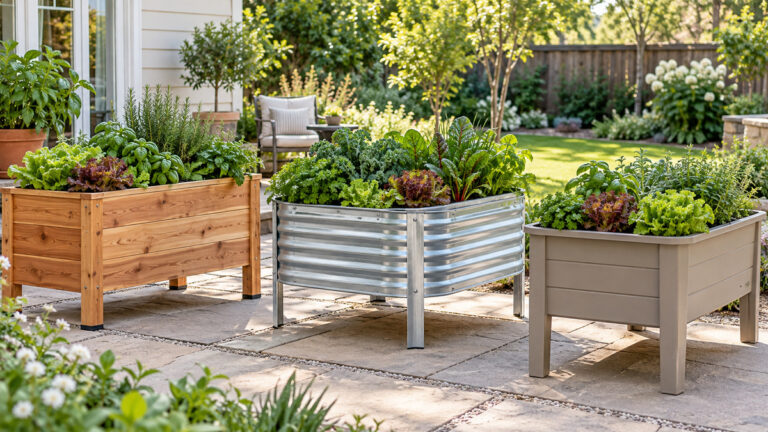
The best soil for raised planters depends on what sits under the box. A raised bed built on lawn or garden ground can use a garden mix of topsoil, compost and sometimes coarse sand. A raised planter on a deck, patio or other hard surface behaves more like a container, so a potting mix made for containers is the safer choice. This guide sets out both cases, gives the mix proportions that university extension pages publish, shows how to work out the volume you need, and lists the mistakes that weaken drainage.
Quick answer
- Box sits on ground: use a garden mix. Iowa State University Extension gives two options: equal parts topsoil, organic matter and coarse sand, or about 70% topsoil and 30% compost.
- Box sits on a deck or patio: use a potting mix. The University of New Hampshire Extension says potting mixes are “specifically made for growing potted plants.”
- Compost: keep it to no more than one third of a potting mix, and use compost that is well done and mature.
- Before you buy: multiply the inside length, width and depth to get cubic feet, then buy enough mix for that volume.
Start with what is under the box
The first question is whether the box has ground under it, because that decides how the soil drains. Iowa State University Extension’s container guidance puts it plainly: “Soil functions great in the ground, but it often lacks some of the important traits we need on containerized plants.” The reason is depth. “Since soil in the ground can be very deep, it provides a long column of area for drainage.” Put the same soil into a box with no ground beneath it, and “the lack of depth can deter drainage.”
So a raised bed on the ground and a raised planter on a deck need different soil, even when both are built as boxes with sides. Only the bed has a deep column of ground under the mix. The planter has to do the job of a container, and that changes which mix works.
Drainage is the reason to get the mix right. Iowa State’s raised bed guidance says “A properly prepared raised bed increases drainage, thereby promoting plant growth and increasing crop yields.” The same page warns that “Raised beds dry out faster than other garden sites.” “Accordingly, they have to be watered more frequently in dry weather.” The target is a mix that drains well and still holds moisture between waterings. Density alone is not the goal, and neither is the cheapest bag on the shelf.
Garden mixes for raised beds on the ground
Iowa State’s FAQ on raised bed soil starts with the specification: “Raised bed soils should be light and well-drained.” It then gives two mixes that meet that specification. The third row below is a shorter recipe from an Ask Extension reply.
| Option | Mix | What the page says |
|---|---|---|
| Three-part mix | Equal parts topsoil, organic matter (manure, compost or peat) and coarse sand | Iowa State calls it “An excellent soil mix” |
| Topsoil and compost | About 70% topsoil and 30% compost | Iowa State lists it as “Another option” |
| Short-form recipe | One third topsoil, one third compost, one third sand | Ask Extension, Licking County, Ohio, says “The recipe is simple” |
Iowa State presents both mixes as options. Either way, the organic part is what gives the soil its structure. Oregon State University Extension states the general rule: “Purchase or prepare a soil mix with high organic matter.”
Oregon State also describes where the bulk of the soil usually comes from: “Some options include native soil moved from other areas of the garden or bulk soil mixes purchased from garden centers or landscape supply companies.” The ratios above apply whether you buy bags or bulk. Only the delivery and the quantity change. For a method to turn a box size into an order quantity, see our guide to raised bed soil amounts.
Two checks apply to both mixes. Iowa State warns about topsoil brought in from elsewhere: “If bringing topsoil from other location, ensure that the soil is not infested with soil-borne plant pathogens or contaminants like lead, pesticides, etc.” The same page asks for compost that is mature: “Likewise, ensure that the compost is well done, mature and does not carry too much salt.” If you cannot confirm where the topsoil or compost came from, the pages we opened do not give a way to check it from the outside. Ask the supplier for what they can document, and skip any load you cannot describe.
How much mix to buy
Measure the inside of the box, not the outside frame. Volume is inside length times inside width times inside depth. A box that is 4 ft long, 2 ft wide and 1 ft deep holds 8 cubic feet, so a 70/30 topsoil and compost mix needs 5.6 cubic feet of topsoil and 2.4 cubic feet of compost. Convert those figures to the unit on the bag or bulk label before you order. For the full calculation across bed sizes, including settling and topping off, read Best Raised Bed Garden How Much Soil.
Potting mix for raised planters on a hard base
A planter on a deck or patio is a container, and container rules apply. The University of New Hampshire Extension separates the two types of product clearly: “Some are meant to be added to the garden or used to fill raised beds, while others are suitable for growing in containers or pots.” It explains that “Garden soils are typically intended for use in the ground and contain minerals and organic matter.” Garden soil is a poor fit for a box with no ground beneath it, because it “can quickly become compacted and waterlogged, reducing air space around the roots.”
Potting mix is the product made for this job. The same extension page says that “Potting mixes (also called soilless mixes), on the other hand, are specifically made for growing potted plants.” It also explains why air matters: “Air space is actually one of the most critical aspects of potting mix.” Iowa State’s potting media article makes the same point from the drainage side: “For these reasons, potting media is generally a better choice for containers.”
Most potting mixes share a few ingredients. The table below uses the wording of the UNH page for the three that come up most often.
| Ingredient | What the page says |
|---|---|
| Peat | Retains moisture without becoming waterlogged, is lightweight, and does not compress easily |
| Compost | Occasionally included for added nutrients, and should make up no more than one third of the mix |
| Bark | Provides good aeration but dries out faster than peat, so it needs more frequent watering |
These ingredients change how often you water. A mix with a high share of bark will dry faster than one based on peat, so plan your watering around the label. The page also notes that a general mix suits most plants: “General potting mixes will work fine for most annuals and vegetables grown in containers, but they may hold too much moisture for orchids, succulents or cacti.” If the planter is for succulents, a general mix may hold too much water. Read the ingredient list before buying, since “Knowing what is in the potting mix is key to determining whether it will be a good match for the plants you are trying to grow.”
Fill a raised bed on the ground, step by step
These steps apply to beds on ground. A planter on a deck has no ground to mix into, so skip the first two steps and fill the box with potting mix in one pass.
- Remove the sod and loosen the soil. Iowa State advises: “Before filling raised beds, remove the grass sod (if present) and work up the existing soil with a rototiller or spade.”
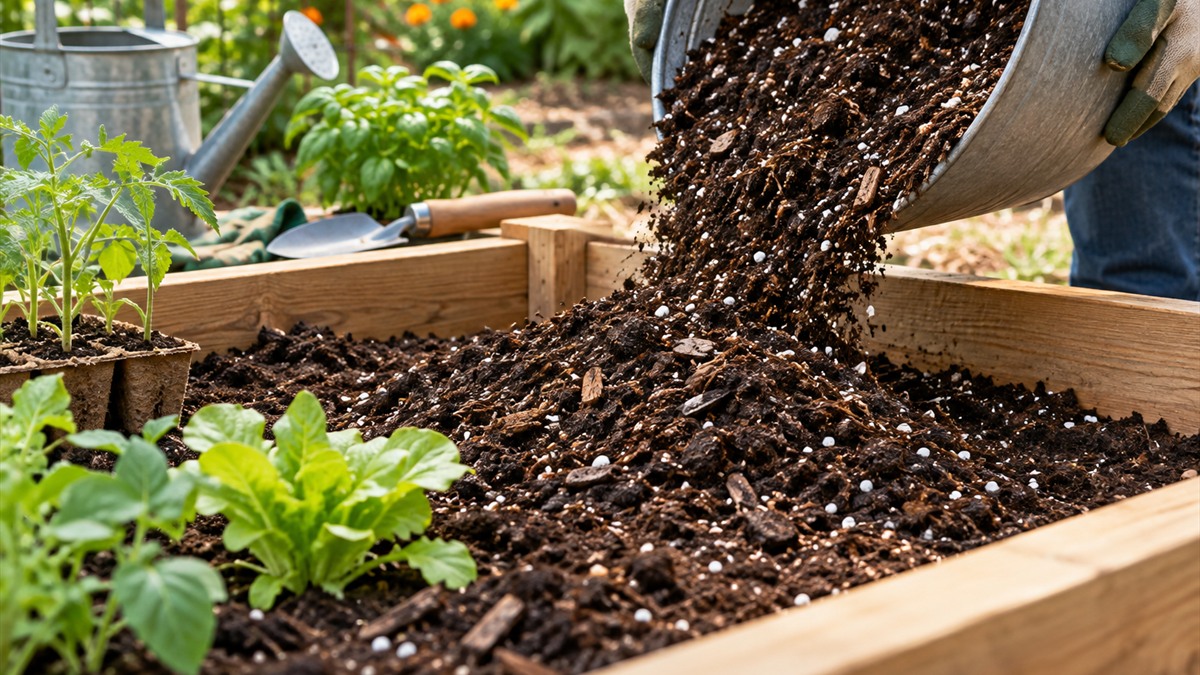
- Add the mix in layers and mix it in. The same page says: “Add a few inches of the soil mix, then incorporate it into the existing soil.”
- Repeat until the bed is full. Iowa State describes the same cycle: keep adding soil mix and incorporating it until the bed is filled.
- Grade the top. Iowa State advises: “When filling the bed, grade the soil so that it slopes slightly away from the center of the bed to the edge and away from adjacent structures.”
If the box has a base, the drainage details matter more. Iowa State’s raised bed page recommends a practical step for that case: “Drilling 1/2-inch holes every 6 inches across the base promotes good drainage.” It also describes a liner: “Lining the planting bed bottom with a piece of landscaping fabric before adding the soil mix allows only the water to drain through the holes.” The fabric lets water out while keeping the soil in.
Once the bed is full, our guide to filling raised beds compares fill options by dimensions and material, which helps when you decide between bulk soil and a bed kit that already includes a fill method.
Mistakes that weaken drainage or roots
- Garden soil in a box with no ground beneath it. The reason is covered above: compaction and waterlogging are more likely in a container. Use a potting mix for these boxes.
- Leaving layers in a ground bed. Iowa State says that “Distinct layers of soil impede water movement and discourage root growth.” Mixing the soil in is the fix.
- Bringing in topsoil without checking it. The Iowa State page asks gardeners to check for pathogens and contaminants before the soil goes into the bed, as covered above.
- Skipping the liner for treated wood. Iowa State says that “Treated wood can also be used, but depending on the treatment, the inside may need to be lined with woven geotextile fabrics that allow water to drain through but separate the soil/plant roots from absorbing potentially toxic chemicals.” The page does not say which treatments need a liner, so check the lumber label before you build.
- Watering on a fixed schedule. Iowa State notes that raised beds need watering more often in dry weather. The pages we opened do not separate planters on decks from beds, so check the soil moisture often rather than following a set calendar.
- Making the potting mix mostly compost. The UNH page limits compost to one third of the mix, and a mix built on peat or bark behaves differently from one that is mostly compost.
How we chose
We started from the two ways a raised planter can sit: on ground, or on a hard base such as a deck or patio. For each case, we looked for university extension pages that answer three questions: what the mix contains, how it drains, and how garden soil differs from potting mix. Pages from Iowa State University Extension, the University of New Hampshire Extension and Oregon State University Extension came first. An Ask Extension reply from a county extension expert is included because it gives a short recipe, and we treat it as one expert’s answer rather than as a rule.
We kept a sentence in this post only when the page we opened contains it, and every quoted line was matched against the saved text of that page. We chose no brands and no products, so this post has no product cards and uses no listing data. The ratios and steps come from the pages named in the source list.
What we could not verify
- The pages we opened do not name a best bagged soil or brand, so this post does not pick one.
- The pages we opened do not give a target pH or nutrient level for a raised planter mix. Iowa State asks for the mix to be checked for nutrients and pH, but the pages do not give numbers to aim for.
- The pages do not say how long a potting mix stays useful in a planter before it breaks down or needs replacing.
- The pages do not say which treatments of lumber need a liner, so the liner advice above applies to the case Iowa State describes, not to every treated board.
- The Ask Extension reply gives one recipe and does not explain why its ratios were chosen over the Iowa State options.
- Local rules on delivering topsoil or compost, and on what a supplier must disclose, are not covered by any page we opened.
FAQ
Can I put garden soil in a raised planter on a deck?
Not usually. The UNH page says garden soil in containers can compact and waterlog, which cuts the air around the roots. For a box with no ground beneath it, use a potting mix made for containers.
Is topsoil or potting mix better for a raised bed?
It depends on what is under the box. A bed on the ground uses a topsoil and compost mix that is mixed into the soil below. A planter on a hard base uses potting mix, because Iowa State’s potting media guidance treats that media as the better choice for containers.
How much compost should go into the mix?
For a garden mix, Iowa State shows about 30% compost in its topsoil blend, and its three-part mix puts organic matter at one third of the total. For a potting mix, the UNH page says compost should make up no more than one third, so keep it below that.
Should I test the soil mix before planting?
Iowa State says to check the mix for nutrients and pH. The pages we opened do not give a target number, so the test result should be read against the needs of the plants you are growing, not against a number from this post.
Why does mixing the soil in matter when I fill a bed on the ground?
Iowa State says that mixing the new soil into the old prevents distinct layers from forming. Those layers can slow water movement and root growth, so the step is part of filling a bed, not an extra one.
Bottom line
If the box has ground under it, fill it with a topsoil and compost mix and mix it into the soil below. If it sits on a deck or patio, fill it with a potting mix made for containers, and keep compost to one third of the mix or less.
Sources
- Iowa State University Extension and Outreach, “What would be a good soil mix for a raised bed?”: the two raised bed mixes, the sod and layering steps, and the topsoil and compost checks.
- Iowa State University Extension and Outreach, “Creating Raised Bed Planters”: drainage, faster drying, testing for nutrients and pH, the drilled base and fabric liner, and the treated wood note.
- Iowa State University Extension and Outreach, “Potting Media: Components and Handling”: why ground soil drains differently from soil in a container.
- University of New Hampshire Extension, “What is the best soil for potted plants?”: garden soil versus potting mix, peat, compost limits and bark.
- Oregon State University Extension, FS 270, “Raised bed gardening”: high organic matter mixes and bulk soil sources.
- Ask Extension, “New raised bed soil recipe” (question #892957): the one third topsoil, compost and sand recipe.