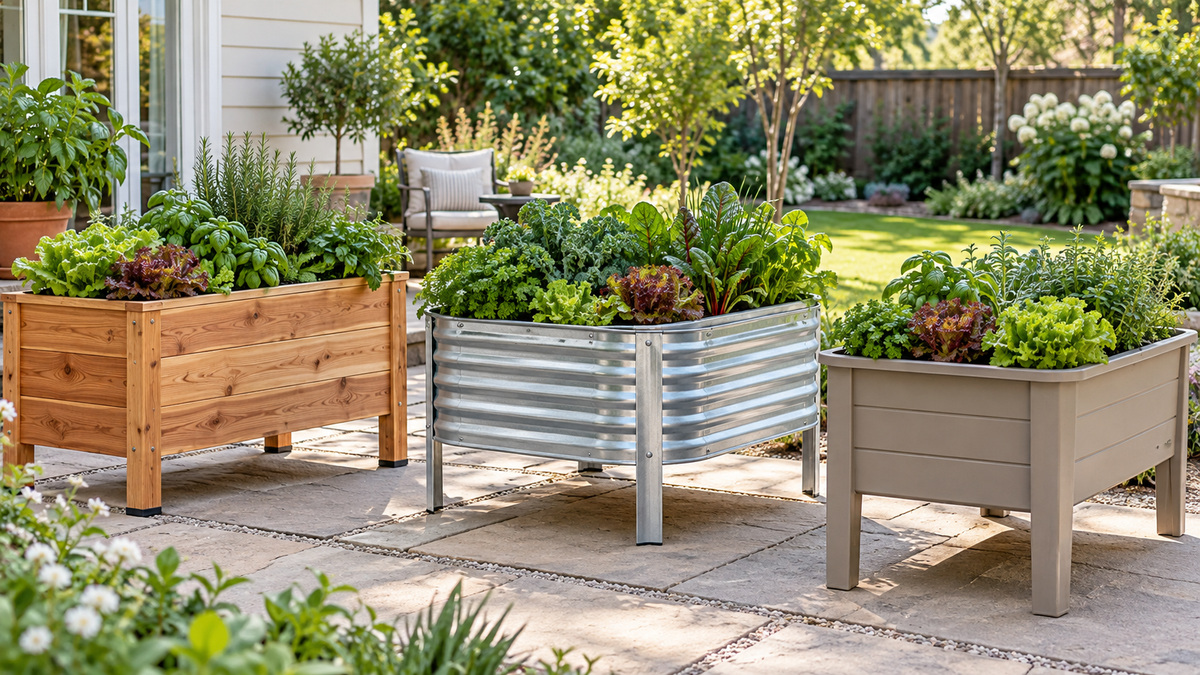
Best Elevated Planters: Wood, Metal and Plastic Beds Compared
As an Amazon Associate we earn from qualifying purchases. Details
Updated 20 October 2026 | Author: Ken
If you are looking for the best elevated planters, start with the soil. Raising a bed onto legs or a stand makes it easier to reach, but it does not tell you how much soil the bed holds or how well it drains. The 12 listings we read for this guide include wood stands, galvanized metal beds, a rolling metal bed, plastic and HDPE beds, a vertical trellis bed and a winter cover. Seven are used as cards. The capacity figures do not always match the stated sizes, and this guide shows where they do not.
Quick answer
- For the largest soil volume, look at the galvanized pair in 6 by 3 by 2 feet. Its listing says 36 cubic feet, but the gallon figure in the same listing does not match that volume.
- For a wood bed with a liner, choose one of the two Best Choice beds. Both list a liner that separates the wood from the soil.
- For a bed you can move, check the wheels. The Best Choice sage bed lists lockable wheels, and the AURORAKI bed lists wheels and a handle.
- For a stated soil depth, check the plastic set. The XHIKOWAT listing gives 5.85 inches of soil depth, the only soil-depth figure in this set.
What elevated means for the soil
Elevation changes three things: how far you bend, how much soil you need and how the bed is set on the ground. The Iowa State raised bed article says higher beds are easier to work in but require more soil to fill them. So a 32-inch bed saves your back and costs you soil. The beds in this set range from about 14 inches to 32 inches in outer height, and only some listings state a soil depth.
The University of Maryland raised bed article says the looser texture of a raised bed lets the soil drain well, which reduces the risk of waterlogging and root rot. That is a point about the soil in a raised bed, not a measurement of any listing. A bed on legs has an open or a closed base, and a closed base needs drainage holes for water to leave. The Iowa State raised bed article also says soil for raised beds should be light and well drained.
Material choices and what the sources cover
The University of Maryland safety page for raised beds lists decay-resistant woods such as cedar, redwood and black locust. It says that CCA-treated wood is no longer available for residential use as of 2004. For treated lumber, the page suggests painting or staining the wood, using a heavy plastic liner between the wood and the soil, or using a non-wood material such as stone or brick. The gray Best Choice bed is fir wood, the sage bed is described as a wood planter, and both listings describe a liner. The listings do not say whether the fir is treated, so ask the seller before you decide on a liner.
The Iowa State raised bed article says that treated wood can be lined with woven geotextile fabric that lets water drain through while keeping the soil from taking in the chemicals. That is background for a wood bed. It does not apply to the metal, HDPE or plastic beds, and the sources we opened do not cover their durability.
Galvanized steel, HDPE and polypropylene beds are described by their listings as rust-resistant, weather-resistant, or fade-resistant. Those are listing claims. The sources we opened do not confirm them, and this guide does not repeat them as facts.
The numbers: a table and the arithmetic
The table below uses the stated sizes, capacities and weight limits in each listing. Outer volume is length times width times height, worked out from the stated size. It is larger than the soil the bed holds, because walls and the base take up space. Where the stated capacity is close to the outer volume, the listing is consistent. Where it is far away, the listing needs a closer look.
| Listing | Stated size | Stated capacity or limit | Outer volume, worked out | What it tells you |
|---|---|---|---|---|
| Best Choice, gray fir wood | 48 x 24 x 30 in | 5 cubic feet | 48 x 24 x 30 = 34,560 cubic inches, or 20 cubic feet | The stated capacity is a quarter of the outer volume |
| Best Choice, sage wood on wheels | 48 x 24 x 32 in | 100 pounds (weight) | 48 x 24 x 32 = 36,864 cubic inches, or 21.33 cubic feet | No volume is stated |
| Land Guard, galvanized, two-pack | 6 x 3 x 2 ft per bed | 249 gallons | 36 cubic feet, or 36 times 7.48 = 269.3 gallons | The gallon figure is about 20 gallons below the listing’s own cubic feet |
| BIVODA, HDPE, black | 29.9 x 14.2 x 19.7 in | 10 gallons of planting space; 250 pounds (weight) | 29.9 x 14.2 x 19.7 = 8,364 cubic inches, or 4.84 cubic feet, or 4.84 times 7.48 = 36.2 gallons | The planting space is well below the outer volume |
| XHIKOWAT, PP, four-piece set | 62.4 x 15.6 x 14.4 in | 5.85 inches of soil depth | Not worked out, because the set has four separate boxes | The soil depth is the stated figure |
Two of these rows need a closer look.
The gray Best Choice bed has an outer volume of 20 cubic feet, from 48 x 24 x 30 = 34,560 cubic inches and 34,560 / 1,728 = 20. Its listing says 5 cubic feet and a bullet says 5CuFt. The listing does not give a bed depth, so there is no figure in the listing that explains the gap. A bed that is 16 inches deep would hold about 10.67 cubic feet, from 48 x 24 x 16 = 18,432 cubic inches and 18,432 / 1,728 = 10.67. In a 48 by 24 inch footprint, 5 cubic feet would fill a layer about 7.5 inches deep, since 5 divided by 8 square feet is 0.625 feet. So the 5 cubic foot figure implies a much shallower soil layer than the 30-inch outer height, or a different measure altogether. We cannot tell which from the listing.
The Land Guard two-pack is the reverse case. Its title and specification give 6 by 3 by 2 feet, which is 36 cubic feet. At 7.48 gallons per cubic foot, that is 36 times 7.48 = 269.3 gallons. The listing says 249 gallons, and one of its bullets repeats the 249 figure. A gap of about 20 gallons is not a rounding difference. The listing does not explain it, so check the figure with the seller before you plan the soil for this bed.
The wheels and the weight
The Best Choice sage bed lists lockable wheels, a storage shelf and a 100-pound weight capacity. Its sister listing, the gray bed of the same size, gives 200 pounds in its title. The two listings differ on the limit, and the sage listing is the one with wheels. The sage bed’s bullets say it can be moved to follow sun or shade, and the shelf keeps tools in reach. Check the limit against the weight of wet soil and plants, because the listings give only the limit, not the load it applies to.
The AURORAKI rolling bed lists wheels, a handle and a storage shelf. Its size is 38.2 by 14.56 by 32.2 inches, and the listing gives no capacity or soil depth. Its bullets describe rustproof metal and built-in drainage holes, and say the bed stands tall enough to avoid bending. The listing gives no weight limit, so the wheels are useful for moving an empty bed, and you should measure the soil you plan to add before you rely on them for a full bed.
Stated soil depth and what it means for root crops
Depth is the figure that most elevated listings leave out. The Iowa State potting media article says taller containers are generally easier to keep drained, and says that plants that need excellent drainage are generally easier to care for in taller pots than in shorter ones. A bed on legs is a larger container than a pot, so the same logic applies in a general way, but the article is about containers and potting media, not beds.
The XHIKOWAT listing gives 5.85 inches of soil depth for its four-piece set, and calls that suitable for medium-deep rooting plants such as vegetables and herbs. That is the only soil-depth figure in this set. The Best Choice gray and sage beds give outer heights of 30 and 32 inches, but no soil depth. For carrots and other root crops, you need the soil depth, so check it before you choose a bed for those plants.
The Land Guard listing gives a 2-foot height, and its bullets say the extra height gives more soil volume than a one-foot bed. That is consistent with the Iowa State raised bed article, which says higher beds need more soil to fill them. The point is simple: a deeper bed needs more soil, which costs more to fill and weighs more to move.
Five checks before you buy
- Choose the material for the place. Wood needs a liner or a non-wood barrier if it is treated, and the sources we opened do not cover metal or plastic durability.
- Measure the soil depth. Use the stated soil depth where the listing gives one, and ask the seller where it does not.
- Check the capacity against the size. Where the stated capacity is far from the outer volume, ask why before you plan a planting.
- Plan for the weight. Wet soil is heavier than dry, and the listings give limits without saying how the load is applied.
- Plan the drainage. Check for drainage holes, a removable tray or an open base. The University of Maryland container page says all containers need adequate holes or slits so that excess water drains.
Mistakes to avoid
- Using the outer height as the soil depth. The Best Choice gray bed is 30 inches tall, but its listing gives no soil depth.
- Trusting one figure in a listing. The Land Guard bullet gives 249 gallons and its title gives 36 cubic feet, which do not agree.
- Assuming the wheels carry a full bed. The listings give weight limits without a load for wet soil.
- Filling a closed base without holes. The University of Maryland container page says holes are needed for drainage.
- Treating a cover as a planter. The Alickwang listing is a winter cover for a raised bed, not a bed.
1. Best Choice Products 48x24x30in Raised Garden Bed, Elevated Wood Planter Box Stand for Backyard (Fir wood bed with a liner)
Specs from the listing (checked ):
- Material: Fir Wood
- Capacity: 5 cubic feet
Pros
- The listing says the bed liner separates the wood from the soil
- The listing gives an overall size of 48 by 24 by 30 inches with drainage holes
Cons
- The listing gives 5 cubic feet of capacity, about a quarter of the 20 cubic feet the outer size works out to
Best for: a patio or balcony wood bed where you want a liner and a 30-inch height
Skip if: you need the capacity to match the outer size, since the listing does not explain the gap
View on Amazon (affiliate link)
2. Small HDPE Raised Garden Bed, Elevated Planter Box with Legs, Outdoor All-Weather Planter Raised (Small HDPE bed on legs)
Specs from the listing (checked ):
- Material: High Density Polyethylene (HDPE)
- Item Dimensions D x W x H: 14.5″D x 29.6″W x 19.7″H
Pros
- The listing gives a weight capacity of 250 pounds and an overall size of 29.9 by 14.2 by 19.7 inches
- The listing says the bed needs no paint, stain or waterproofing
Cons
- The listing gives 10 gallons of planting space, far below the roughly 36 gallons its outer size works out to
Best for: a small elevated bed for herbs and flowers on a balcony with limited floor space
Skip if: you need a planting depth figure, since the listing gives only an overall size and a gallon figure
View on Amazon (affiliate link)
3. 32″ Rolling Raised Garden Bed with Wheels, Metal Elevated Planter Box (Rolling metal bed with a shelf)
Specs from the listing (checked ):
- Material: Metal
- Item Dimensions D x W x H: 38.2″D x 14.56″W x 32.2″H
Pros
- The listing describes smooth wheels and a handle for moving the bed
- The listing says built-in drainage holes help prevent waterlogging
Cons
- The listing gives no capacity and no soil depth, so the soil volume cannot be checked
Best for: a balcony or patio bed you move for sun, with a shelf for tools
Skip if: you need a soil volume before you buy
View on Amazon (affiliate link)
4. OYEAL Raised Garden Bed with Legs & & Trellis 32″ Tall Vertical Herb Garden Planter Indoor Outdoor (Tall bed with a trellis)
Specs from the listing (checked ):
- Item Dimensions D x W x H: 7.2″D x 35.1″W x 32.4″H
- Item Weight: 10.5 pounds
Pros
- The listing gives four planter boxes and a trellis in one 32-inch frame
- The listing describes a removable tray that helps drainage
Cons
- The listing gives only the overall depth of 7.2 inches, not the soil depth of each box
Best for: a tall herb bed with a trellis on a balcony or porch
Skip if: you need a deep box for root crops
View on Amazon (affiliate link)
5. Land Guard 2 Pack 6×3×2 ft Galvanized Metal Raised Garden Bed, 2FT Deep Root Elevated Planter Box (Large galvanized bed, two-pack)
Specs from the listing (checked ):
- Item Dimensions D x W x H: 72″D x 36″W x 24″H
- Capacity: 249 gallons
Pros
- The listing gives a size of 6 by 3 by 2 feet, which works out to 36 cubic feet
- The listing describes a 2-foot height and an open base that lets excess water drain
Cons
- The listing gives 249 gallons, but 36 cubic feet at 7.48 gallons each is about 269 gallons
Best for: a large elevated bed for a garden plot on a deck or patio where you have floor space
Skip if: you have less than 6 by 3 feet of floor space
View on Amazon (affiliate link)
6. Best Choice Products Raised Garden Bed 48x24x32-inch Mobile Elevated Wood Planter w/ Lockable (Wood bed on lockable wheels)
Pros
- The listing gives an overall size of 48 by 24 by 32 inches with lockable wheels
- The listing says the bed has four drainage holes and a liner that separates the wood from the soil
Cons
- The listing gives a 100-pound weight limit, while the gray bed of the same size gives 200 pounds in its title
Best for: a patio or balcony bed you want to move to follow sun or shade, with a shelf for tools
Skip if: you need a stated soil volume, since the listing gives none
View on Amazon (affiliate link)
7. 4Pcs Plastic Raised Garden Bed,62.4″×15.6″×14.4″ Elevated Wicker Planter Box with Self-Watering (Four-piece plastic set with a soil depth)
Specs from the listing (checked ):
- Material: Polypropylene (PP)
- Item Dimensions D x W x H: 62.4″D x 14.4″W x 15.6″H
Pros
- The listing gives a soil depth of 5.85 inches and calls it suitable for medium-deep rooting plants
- The listing describes a bottom tray that holds moisture for roots and drains excess water
Cons
- The 5.85-inch soil depth is shallow for the root crops the listing names
Best for: a long, low row of herbs and flowers on a balcony or patio
Skip if: you need deep soil or a bed on wheels
View on Amazon (affiliate link)
Listings without a card: The Alickwang raised bed cover, which is a heavy-duty waterproof winter cover for a 38 by 14.6 by 32 inch bed, not a planter, so it is not carded. The OYEAL four-tier vertical stack, which is carded in the DIY herb planters guide and is not repeated here. The BIRDSINYARD 32-inch bed with wheels and a shelf, which is carded in the balcony planters guide. The second BIVODA HDPE bed, in navy blue, which is the same bed as the black one carded here in another color. The second OYEAL bed with trellis, in black, which is the same bed as the green one carded here in another color.
How we chose
We read the title, the bullets and the stated specifications for all 12 listings in the research pool, which was checked on 20 October 2026. The criteria were that the product had to be a bed or planter that sits on legs, a stand or a rolling frame, that the listing had to state a size, and that the listing had to give at least one figure for soil depth, capacity or weight that we could cross-check.
Seven listings became cards, and each card has a reason from its own listing: the material, the stated size, the soil depth, the wheels, the liner or the drainage. Five listings were not used. One is a winter cover, two are colour variants of beds already carded, and two are carded in another guide.
We did not use any sales or feedback signal. The order of the cards follows the order in the research pool, not a ranking.
What we could not verify
- Soil volume for most beds. Only the XHIKOWAT set gives a soil depth. The Best Choice and Land Guard figures disagree with their outer sizes, and we could not explain the gaps from the listing text.
- Whether the Best Choice fir wood is treated. The listings do not say, so we do not state a treatment.
- Durability of galvanized steel, HDPE and polypropylene. The sources we opened do not confirm the rust, UV or weather claims made in the listings.
- Load limits for full beds. The weight limits are stated for the beds, not for wet soil and plants.
- Food safety for edible plants in metal or plastic beds. The sources we opened do not cover that question, so this guide makes no claim about it.
FAQ
What is the difference between an elevated planter and a raised bed?
They are the same kind of object in most listings. An elevated planter is a raised bed on legs or a stand, which makes it easier to reach. The Iowa State raised bed article describes higher beds as easier to work in, and it also says they need more soil to fill.
How deep should an elevated bed be for vegetables?
Choose the soil depth from the listing, not the height. In this set, only the XHIKOWAT set states a soil depth, at 5.85 inches. The University of Maryland raised bed article says a looser soil drains well, but it does not give a depth for any particular vegetable.
Are wood elevated planters safe for vegetables?
The University of Maryland safety page for raised beds lists decay-resistant woods such as cedar and redwood, says CCA-treated wood is no longer available for residential use as of 2004, and suggests a liner or a non-wood barrier for treated lumber. The Best Choice fir listings do not say whether the wood is treated, so ask the seller.
Do elevated planters need drainage holes?
Yes, according to the University of Maryland container page, which says all containers need adequate holes or slits to drain excess water. The Best Choice gray bed lists drainage holes, and the Land Guard bed has an open base. Check each one before you fill it.
Can I use a winter cover on an elevated bed?
The Alickwang listing describes a waterproof winter cover for a bed of about 38 by 14.6 by 32 inches, with drawstrings and air vents. It is a cover, not a bed, so it does not affect the soil figures in this guide.
Bottom line
For an elevated planter, choose the bed by the soil depth it states, then check the capacity against the size, then decide the material. Where the listing gives a volume that does not match its outer size, ask the seller before you buy. A wood bed needs a liner if it is treated, and a bed with wheels needs a weight check with wet soil in it.
For the ground-level version of this decision, read our guide to how to fill raised beds. For how much soil to buy, see how much soil a raised bed garden needs.
Sources
- University of Maryland Extension, “The Safety of Materials Used for Building Raised Beds”, opened 2026-10-20. https://extension.umd.edu/resource/safety-materials-used-building-raised-beds
- Iowa State University Extension and Outreach, “Creating Raised Bed Planters”, opened 2026-10-20. https://yardandgarden.extension.iastate.edu/how-to/creating-raised-bed-planters
- University of Maryland Extension, “Growing Vegetables in Raised Beds” (updated March 26, 2026), opened 2026-10-20. https://extension.umd.edu/resource/growing-vegetables-raised-beds
- Iowa State University Extension and Outreach, “Potting Media: Components and Handling” (March 2025), opened 2026-10-20. https://yardandgarden.extension.iastate.edu/article/2025/03/potting-media-components-and-handling
- University of Maryland Extension, “Growing Vegetables in Containers and Salad Tables”, opened 2026-10-20. https://extension.umd.edu/resource/growing-vegetables-containers-and-salad-tables