Build a Planter Box From Pallets
As an Amazon Associate we earn from qualifying purchases. Details
A pallet planter box is cheap to make, but the pallet decides whether it is safe. Pallet wood can be heat-treated with no chemicals, fumigated with methyl bromide, or untreated and unmarked with an unknown history. This guide uses a University of California extension article on pallet stamps and four other extension pages to show which pallets the sources accept, which they reject, and how big a planter box should be. The sources give no pallet cutting plan, so the build steps use their size and drainage figures. Source details are in the Sources section.
Quick answer
Use a pallet stamped HT (heat-treated), and avoid any pallet stamped MB (methyl bromide), including combined stamps such as DB-MB and KD-MB. Do not use a pallet with no stamp for food, because its treatment history cannot be confirmed. If you cannot confirm what a pallet was treated with, UC ANR says to use it only for plants you will not eat.
Pallet stamps: what the UC ANR article says
The article “Picking Pallets for Raised Beds” was published August 19, 2024 by UC Master Gardener Volunteer Ryan Daugherty. It lists these markings:
- IPPC logo: the most common marking, showing international shipping standards and pest-prevention treatment.
- HT (heat-treated): generally safe for gardens, since no chemicals are used. Softwood pallets are heated to a core temperature of 132 degrees F and hardwood to 140 degrees F.
- DB (debarked): not a treatment, and it has no effect on the chemical properties of the wood.
- KD (kiln-dried): wood dried to 19 percent moisture content or below. It is not a pest treatment, and KD pallets are considered safe. KD-HT combines both.
- MB (methyl bromide): a toxic fumigant. The article says MB pallets “should never be used in gardening.” DB-MB and KD-MB also indicate methyl bromide.
- Unmarked pallets: some have no markings, and the article warns that unmarked CCA-treated pallets are still in circulation. It says confirming an unmarked pallet’s treatment history is unlikely.
The article also says to check any pallet for spills, stains or unusual odors from earlier loads, because some contaminants are colorless and odorless, so a clean look is not proof. Chemical residues can leach into soil and be absorbed by plants.
Where the sources disagree
The UF/IFAS Gardening Solutions page says to avoid secondhand lumber such as that from pallets, because some lumber is treated with creosote or pentachlorophenol, which can leach out and injure plants. UC ANR says HT pallets are generally safe and MB pallets are the ones to avoid. The two pages are not talking about the same pallets: UF/IFAS is warning about pallets of unknown treatment, and UC ANR describes how to identify heat-treated ones. Our reading: for a planter that holds vegetables, use a clearly stamped HT pallet or skip pallets, and for flowers or foliage the risk is lower but the unmarked-pallet warning still applies.
The sources do not say how long an HT pallet planter lasts. UC ANR says untreated pallet wood may not last long in garden conditions because of moisture, and that you should expect to maintain or replace boards as they wear out.
What you need
- One or more pallets with a legible HT or KD-HT stamp, no stains and no strong odor.
- Screws, a saw and a drill. The sources give 4 inch decking screws for wooden corners (Utah State).
- Landscape fabric for the bottom. Iowa State says tabletop beds need drainage holes and fabric.
- Soil mix. Utah State suggests compost-enriched topsoil or a soilless growing mix.
Steps
- Read the stamp. Look for the IPPC mark and the treatment code on the side of the pallet. Reject MB, DB-MB, KD-MB and any pallet with no readable code.
- Inspect the wood. Reject pallets with stains, spills or odors. Sniff and look at every board you will use.
- Decide the size. Iowa State says a bed reached from one side should be no wider than 1.5 to 2 feet; reached from both sides, 3 to 4 feet. Utah State says framed boxes should be at least 6 to 12 inches high.
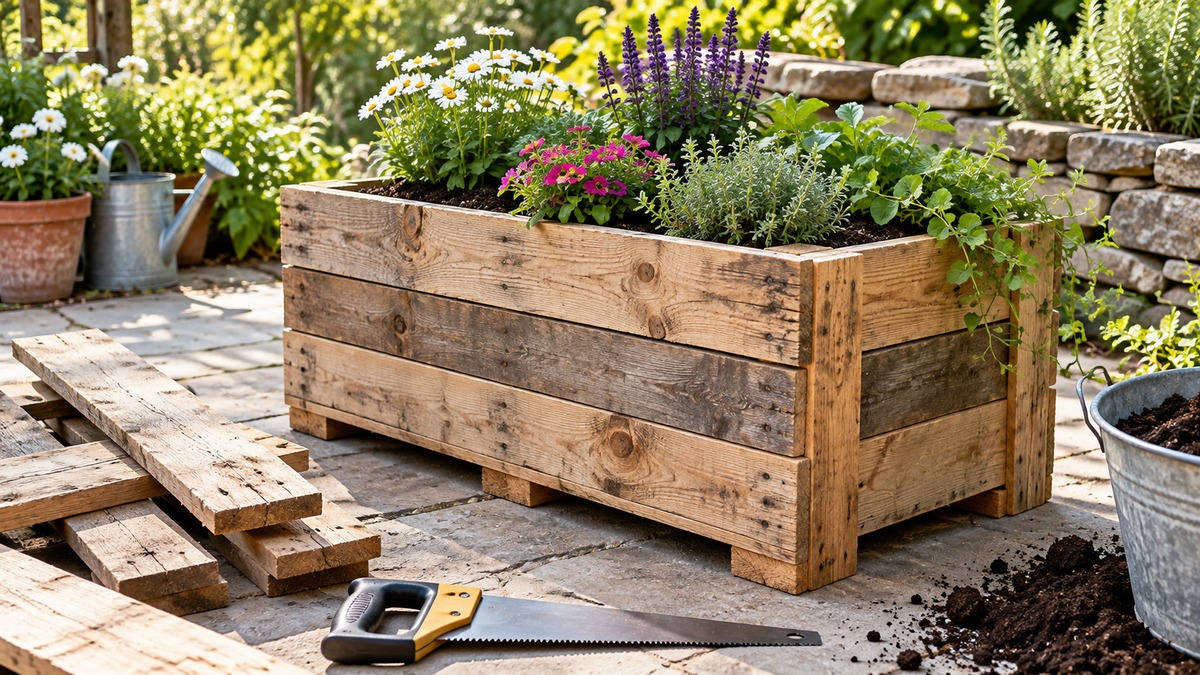
- Build the frame. Join corners with 4 inch decking screws and reinforce each inside corner with a wood block or metal plate, as Utah State describes for wooden boxes. Iowa State adds that corners matter most for preventing wall failure.
- Make drainage. Iowa State says tabletop beds should have 1/2 inch holes drilled every 6 inches across the base, lined with landscaping fabric. That is the closest figure in the sources; applying it to a pallet planter is our extension of it. Utah State says boxes under 12 inches deep should have no bottom, so roots can reach the soil below.
- Fill. Fill with soil mix. Do not line the bottom with plastic; Alabama Extension warns this prevents drainage.
Worked example
This is planning arithmetic for one planter that you reach from one side. Your pallet boards will differ.
- Size: 4 feet long, 1.5 feet wide, 10 inches deep. The width is the low end of Iowa State’s 1.5 to 2 foot one-sided limit, and 10 inches sits inside Utah State’s 6 to 12 inch range.
- Soil volume: 4 x 1.5 x (10 / 12) = 5 cubic feet.
- Drainage holes if you use a bottom: 1/2 inch holes every 6 inches. Along 48 inches that is 7 holes per row (at 6, 12, 18, 24, 30, 36 and 42 inches), and across 18 inches it is 2 rows (at 6 and 12 inches), so about 14 holes.
- Same planter 12 inches deep: 4 x 1.5 x (12 / 12) = 6 cubic feet.
Who should skip pallet planters
Skip them if you cannot find a stamp, if the only pallets available are stained or smell of chemicals, or if you want a planter that lasts many years with no maintenance. Skip them for vegetables if your only source is an unmarked pallet. In those cases the sources point toward other materials; UF/IFAS lists naturally rot-resistant lumber such as redwood or cedar, and Utah State says cedar and redwood resist rot.
Mistakes to avoid
- Using a pallet without reading the stamp.
- Treating KD or DB as proof of safety. KD and DB are not pest treatments, and a pallet can carry DB-MB or KD-MB.
- Assuming a clean-looking pallet is uncontaminated.
- Lining the bottom with plastic and blocking drainage.
- Making a box wider than 2 feet when you can reach it from only one side.
Products
This guide does not name any product. No Amazon listing was used.
Sources
Sources opened for this guide (opened 2026-10-18):
- Picking Pallets for Raised Beds, UC ANR The Backyard Gardener (Ryan Daugherty, UC Master Gardener Volunteer) (August 19, 2024).
- Building Raised Beds, UF/IFAS Gardening Solutions (no publication date shown).
- Creating Raised Bed Planters, Iowa State University Yard and Garden (last reviewed March 2024).
- Raised Bed Gardening, Utah State University Extension (February 2012).
- Raised Bed Gardening (ANR-1345), Alabama Cooperative Extension System (April 2024).
FAQ
Is it safe to use pallets for a vegetable planter?
UC ANR says HT (heat-treated) pallets are generally safe for gardens, and MB (methyl bromide) pallets should never be used. If the treatment history is uncertain, it says to use the pallet only for non-edible plants.
What do the pallet stamps HT, KD, DB and MB mean?
HT is heat-treated with no chemicals, KD is kiln-dried to 19 percent moisture or below, DB is debarked, and MB is methyl bromide fumigation. DB-MB and KD-MB also mean methyl bromide.
Can I use a pallet with no stamp?
UC ANR advises against it, because unmarked CCA-treated pallets are still in circulation and the treatment history is unlikely to be confirmed.
How deep should a pallet planter box be?
Utah State gives 6 to 12 inches as the minimum height for framed boxes, and says boxes under 12 inches deep should have no bottom so roots can reach the soil below.
Related guides
For the planter and its soil, see Best DIY Planter Box for Deck Railing, Best Way to Fill Raised Beds, and Best Raised Bed Garden How Much Soil.