How to Use a Rain Barrel for Watering Plants
As an Amazon Associate we earn from qualifying purchases.
How to use a rain barrel for watering plants starts with one clear rule: the stored water suits ornamental plants and lawns best, and it is not meant for drinking. Extension pages from Wisconsin, Arkansas, Nebraska and Washington State all make that point. They are also more cautious about vegetables than about ornamentals and lawns. This guide turns their advice into a plan you can follow, from estimating the catch to setting up gravity flow and keeping the water clean.
Quick answer
- Use the stored water on ornamental plants and lawns. Wisconsin and Arkansas both name those uses, and Washington State advises against vegetable gardens.
- One inch of rain on one square foot of surface gives about 0.6 gallons, so a 1,000 square foot roof can give about 600 gallons from a one-inch storm.
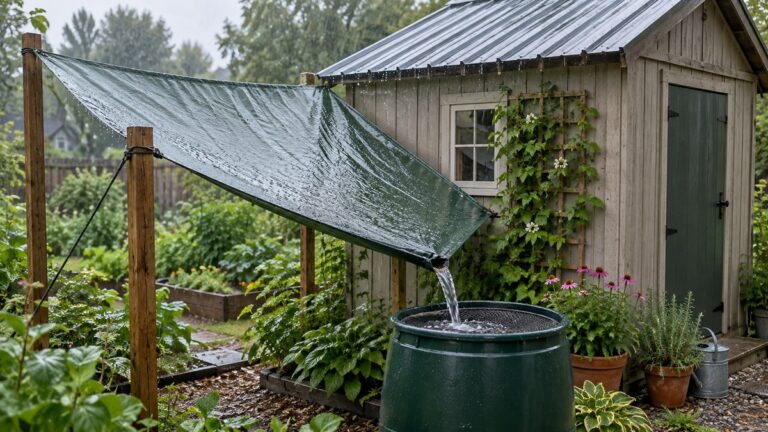
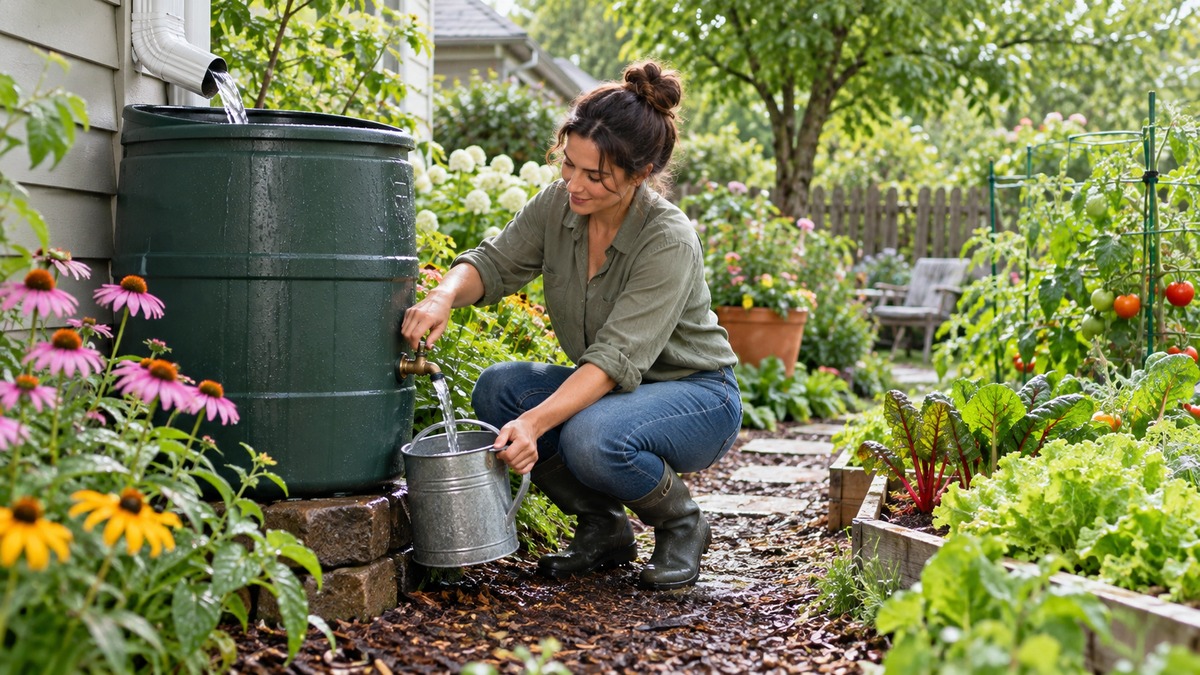
- Raise the barrel, attach the hose to the spigot near the bottom, and let gravity push the water out.
- Screen the lid, do not let the water stand for more than five to seven days, and drain the barrel before winter.
Match the water to the plants
Rain that runs off a roof is soft and is not treated with chlorine. The Nebraska page says rainwater “is naturally soft, oxygenated and more acidic than tap water.” It adds that it “is free of chlorine, fluorine and salts.” Wisconsin describes the main purpose of a barrel as giving gardeners “a source of soft, slightly acid water” for “woody and herbaceous ornamentals, as well as lawns.” Those are the plants the water is meant for.
Vegetables need more caution. Wisconsin says that, because of possible leaching from roofing materials, rain barrel water “is not recommended for use on vegetables, or for human consumption.” The Arkansas fact sheet is more measured. It says that “While rain barrel water is safe to use on ornamentals and lawns, there is not definitive research on the safety of using rain barrel water on edible plants.” Nebraska puts its advice in one short line: “Ideally, only use it for watering ornamentals.” If you do water edible plants, Nebraska lists extra precautions, including “avoiding contact with edible plant parts and using food safety practices.” Washington State goes furthest, saying the water is not fit to drink and advising against vegetable gardens.
Work out how much the barrel can catch
The main number is simple. Wisconsin says that “For every inch of rain that falls on 1,000 square feet of roof, about 600 gallons of water can be collected.” Arkansas gives a similar figure in its own words: a “one-inch storm on a 1,000 ft2 roof generates over 600 gallons of free, soft, nonchlorinated rainwater.” Washington State gives the rate per square foot, saying that “One inch of rain falling on one square foot of surface yields approximately 0.6 gallons of water.”
The Nebraska page gives a much lower number. It says that “From a 1000 square foot roof, it is estimated up to 125 gallons of water will flow from one downspout during a one-inch rain.” That is about a fifth of the other figure. None of the four pages explains the gap. One possible reason is that a roof drains to more than one downspout, but no page says that. This guide shows both figures and does not pick one silently.
| Roof area draining to the barrel (sq ft) | Rain (inches) | Estimated catch (gallons) |
|---|---|---|
| 500 | 1 | 500 x 1 x 0.6 = 300 |
| 1,000 | 1 | 1,000 x 1 x 0.6 = 600 |
| 1,000 | 0.5 | 1,000 x 0.5 x 0.6 = 300 |
The table is our own arithmetic, using the Washington State rate. The formula is roof area multiplied by rain depth multiplied by 0.6. The figures leave out losses, because none of the pages gives a number for them.
Storage size is the next question. Washington State says that “A single rain barrel will hold from 30 to 75 gallons.” Nebraska says rain barrels are “typically 50 to 100 gallon size.” Wisconsin describes a common option, a reconditioned food-grade barrel, as “approximately 55-60 gallons” that “often work well.” Washington State also estimates that “You’ll need about half a gallon of water per week per square foot of garden.” For a 100 square foot garden, that rate works out to about 50 gallons a week, which is roughly one full 55-gallon barrel. That multiplication is our arithmetic.
Set the barrel up for gravity flow
Gravity does the work, so height matters. Arkansas says that “A hose can be attached to a spigot at the bottom of the barrel for water to be released through gravity pressure.” Its fact sheet also says that “Your rain barrel needs to be raised above the ground to allow access to the spigot and provide enough head pressure to water your plants through gravity flow.” Nebraska recommends a platform: “Placing rain barrels on a sturdy platform, like cinder blocks, provides a slight increase in pressure and makes it easier to hook a hose to the spigot.”
Washington State gives the simplest test. Its page says that “Your rain barrel should be raised high enough that you can get a watering can under the spigot to fill.” It adds that “The higher the barrel, the more gravity will work for you when you want to get water out of the barrel and into your garden.” Arkansas warns that “Rain barrel placed without a stand will have reduced water pressure.” So set the barrel on blocks or a stand before you connect a hose, and check that a watering can fits under the spigot.
Safety comes with the stand. Wisconsin says that “Rain barrels should be installed only on level surfaces and elevated using concrete or cinder blocks, or a sturdy wooden stand.” It also says that “Barrels must have a secure base to prevent tipping.” The same page adds a warning about weight: “Fifty gallons of water weigh several hundred pounds, and may be a risk to children if they try to climb on the barrel and the barrel tips.” Nebraska asks you to “Firmly attach containers to buildings for safety.” A full barrel is heavy, so plan the stand before you fill it.
Keep mosquitoes, algae and debris out
An open barrel invites trouble. Wisconsin notes that “Mosquitoes are a frequent concern with rain barrels as these insects breed in stagnant water.” The fix is a screen. Wisconsin says that “A fine mesh screen or filter fitted to the lid of your rain barrel will prevent adult mosquitoes from gaining access to the barrel and laying eggs.” Washington State says a lid or screen top keeps mosquitoes from “laying eggs in the water” and keeps debris “from being blown into the barrel.”
Timing helps too. Wisconsin says that “Most problems with rain barrels can be easily avoided if water is not allowed to stand in the barrel for more than five to seven days.” It also notes that “If you opt not to use a screen or filter, you will need to completely empty your barrel every week so that mosquitoes do not have time to breed.”
Sunlight and sediment cause the other common problems. Wisconsin warns that “Growth of algae may also be a problem if rain barrels are placed in direct sunlight.” Nebraska suggests that you “Use dark-colored, painted, or opaque barrels to limit light and place rain barrels in a shady location if possible.” It also links algae to what falls into the barrel: “To reduce this, limit nutrient build-up in the barrel by decreasing the amount of sediment and plant debris entering the barrel.”
Cleaning is part of the routine. Nebraska says to “Clean roof gutters at least annually” and to “Clean the barrel at least once a year to remove sediment.” If algae do build up, Wisconsin suggests emptying the barrel, washing it with a dilute bleach solution, and rinsing it well afterward.
Water plants from the barrel
Once the barrel is set, the watering method decides how much of the water reaches the roots. Wisconsin says rain barrels “work particularly well on smaller properties where plants can be watered directly from a barrel using an attached hose.” Arkansas makes the same point about routine and cost. Its page says that “Using this water for irrigation is an easy and economical way to help you maintain healthy gardens.”
Delivery matters as much as volume. Washington State says a drip irrigation system or soaker hose gets water to the roots, which it describes as much more effective than a watering can. The same page has a section headed Make Rain Barrel Water Go Further, and it says that “Mulch keeps down weeds that compete with plants for water and slows evaporation of water from the soil surface.”
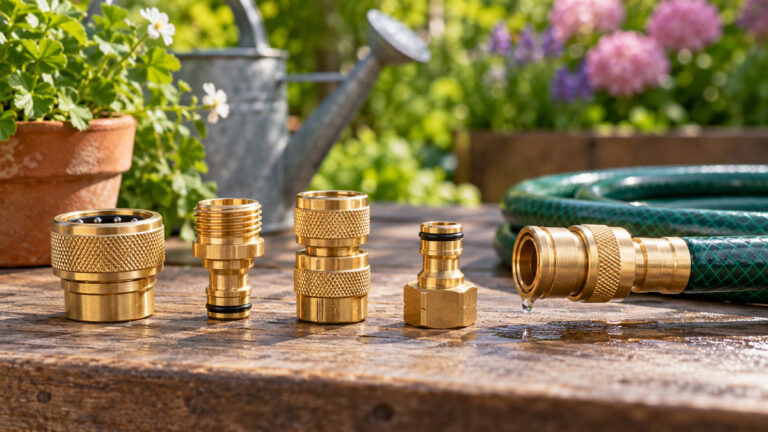
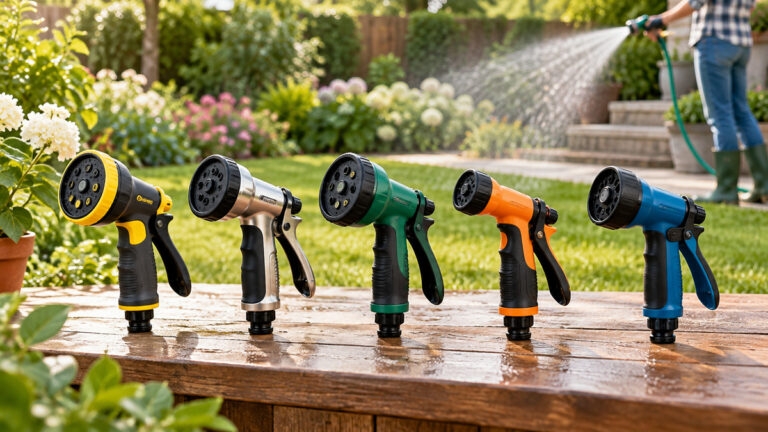
If one barrel holds too little for a bed, Washington State says that “Joining a series of barrels together with linking kits will increase your storage capacity.” For the hose side of a drip setup, see our guide to garden hose to drip irrigation adapters. For a simple attachment that suits watering by hand, see our guide to hose attachments for watering plants.
Keep people and pets away from the water
Rain barrel water is for plants only. Arkansas says that “Collected rainwater should never be used for drinking or cooking.” Nebraska is broader: “Untreated water should not be used for drinking by people or pets, to fill children’s swimming pools, for hair washing, bathing, or to wash harvested produce.” Nebraska also asks you to “After handling rain barrel water or cleaning barrels, wash your hands.” Keep that habit in mind when children help with watering.
The roof is the other half of the water quality question. Nebraska explains that “As it flows over a roof it picks up bacteria from bird or squirrel droppings or chemicals leached from roofing materials and gutters.” Washington State lists the cases where you should not catch roof water at all: “Do not catch water from your roof if you have recently applied a moss killer or other toxic chemical, if you have lead, copper, or galvanized flashings, or if your roof is made of treated shingles or of roofing materials that contain zinc or asphalt.” Wisconsin adds that “Rain barrels are not recommended for homes with tar and gravel roofs, or roofs made of asbestos or treated cedar shakes shingles.”
The barrel itself must also be safe around kids and animals. Washington State says that “Your rain barrel should be kid and pet proof.” Nebraska makes a similar point when it says rain barrels “need to be covered and have fine mesh screens” to keep children and pets out.
Maintain the barrel through the year
A barrel needs a short yearly routine. Clean the gutters and the barrel at least once a year, as Nebraska suggests, and remove sediment before the watering season starts. Wisconsin’s fall advice is that “Finally, in the fall, disconnect and drain your rain barrel to avoid freezing and cracking over the winter.” It also says to reconnect the downspout when the barrel is not in use, so roof water runs away from the house foundation.
Arkansas gives a choice for the cold months: “During winter, either empty and store your barrel or maintain a low water level so repeated freezing and thawing of water in your rain barrel does not split the screen or cause cracks in the plastic.”
How we chose
The pages used here are four university extension pages, checked on 2026-10-22. They are a Wisconsin Extension article on rain barrels, a University of Arkansas System fact sheet on building rain barrels, a University of Nebraska-Lincoln Extension article on rain barrels, and a Washington State University Extension column on rain barrels. The advice below comes only from text on those pages, and every quoted sentence was matched against the page text. Where the pages disagree, both figures are shown.
What we could not verify
The pages give rules of thumb, not a full watering plan. They do not give a schedule for each plant, the rain depth needed to fill a barrel, or the water pressure a barrel makes at a given height. They also give different barrel sizes and different gallon figures. This guide does not name products, prices or brands, and it does not check any barrel for leaks, durability or finish.
What the sources do not say
The pages do not explain the difference between 125 gallons from one downspout and about 600 gallons for a 1,000 square foot roof. They do not state how fast a hose delivers water from a barrel at a given height. They also do not give a screen mesh size, and they do not set a cleaning schedule for every barrel material. Where a page is silent, this guide says so.
Frequently asked questions
Can I water my vegetable garden with rain barrel water?
The pages advise against it. Wisconsin says rain barrel water is not recommended for use on vegetables, Washington State recommends against vegetable gardens, and Arkansas says research on edible plants is not definitive. If you water edible plants anyway, Nebraska lists precautions, including avoiding contact with edible plant parts.
How much water will a rain barrel collect?
The rate is about 0.6 gallons for each square foot of roof area per inch of rain. For a 1,000 square foot roof in a one-inch storm, that rate gives about 600 gallons. Nebraska gives a lower figure of up to 125 gallons from one downspout, so measure how much of your roof drains to the barrel before you plan around either number.
Do rain barrels need a screen?
Yes, according to Wisconsin and Nebraska. Wisconsin says a fine mesh screen on the lid stops adult mosquitoes from laying eggs in the barrel, and Nebraska asks for fine mesh screens to keep children, pets, wildlife and mosquitoes out.
How do I get water out of a rain barrel?
Attach a hose to the spigot near the bottom, or fill a watering can there. Washington State says the barrel should be high enough to fit a watering can under the spigot, and Arkansas says a hose can be attached to the spigot for gravity flow.
Can people or pets drink rain barrel water?
No. Arkansas says collected rainwater should never be used for drinking or cooking, and Nebraska says untreated water should not be used for drinking by people or pets. Washington State also says the water is not fit for humans or animals to drink.
Sources
- https://hort.extension.wisc.edu/articles/rain-barrels/ (opened 2026-10-22)
- https://uaex.uada.edu/publications/PDF/fsa-9534.pdf (opened 2026-10-22)
- https://water.unl.edu/april-showers-and-rain-barrels/ (opened 2026-10-22)
- https://wpcdn.web.wsu.edu/extension/uploads/sites/57/2014/03/061110.pdf (opened 2026-10-22)