As an Amazon Associate we earn from qualifying purchases. Details
A Giraffe Tools hose reel that is not retracting usually has a short list of causes, and most of them take minutes to check before you spend money on a new reel. This guide starts with those checks.
It then explains why reel type matters, since a spring-driven retractable reel and a hand-crank box fail in different ways. Last, it compares three reels using what their listings state about operation, hose capacity, mounting, and included parts. Nothing here replaces the maker’s manual for your model, which is the final word on repairs.
At a glance: the troubleshooting checklist, in order
| Step | What to check |
|---|---|
| 1. Walk the hose path | Pull to full length, look for a kink, a loop caught under a post, or a snagged fitting |
| 2. Check the hose end | Unhook any nozzle/sprayer that can catch on the guide; wind in by hand to test |
| 3. Clear debris | Brush and rinse away leaves, grit, dried mud with the water off |
| 4. Check the wind | Unwind a few turns and rewind evenly by hand if the hose bunched up |
| 5. Check for a lock | Some automatic reels lock at any length — find the release before assuming the spring failed |
| 6. Check the mount | Tighten mount hardware; make sure the reel sits level |
| 7. Stop if damaged | Cracked housing, bent guide, or a spring out of its seat is a repair question — contact the maker, don’t open the housing |
Run these checks in order and stop at the first one that explains the problem. If none change the behavior, the cause may be inside the housing — that’s a question for the manufacturer.
Quick answer
Start with the reel type. A spring-driven retractable reel that will not pull its hose back is often held up by the hose path, a kink, debris, or a fitting that has caught on the frame. A hand-crank box does not retract on its own, so there is no retraction fault to fix. You wind it by hand.
For buying, choose the top choice if you want a wall-mounted automatic reel with a 50 ft hose length in its listing. Choose the second choice if you need a freestanding automatic reel that sits on a metal spike in the lawn or a bed. Choose the third choice if you prefer a large outdoor manual box and you are comfortable winding by hand.
Why a hose reel stops retracting
Hose reels come in a few common styles. Most are spring driven (self retracting), hand crank or motor driven. Each style stops working for a different reason, so identify yours before you start turning parts.
A spring-driven reel depends on two things at once: the spring that pulls the hose back, and the path the hose travels along. If either one is blocked, the hose stops coming in even when the spring is fine. Garden hose is typically made of extruded synthetic rubber or soft plastic, often reinforced with an internal web of fibers. That flexibility is what lets it be pulled past trees, posts and other obstacles, and it is also why it snags on those same obstacles on the way back in.
A hand-crank reel is a different case. It has no retraction spring to fail. A hose that will not wind in is usually a crank, guide or seating problem that you can see with your own eyes. A motor-driven reel adds a power source, and this guide does not cover its electrical parts.
The second choice in this set is a Gardena automatic reel, so the advice in the next section applies to it directly.
Checks to run before you buy anything
Run these checks in order. Each one takes a few minutes and needs no tools beyond your hands. Stop at the first step that explains the problem.
- Walk the hose path. Pull the hose out to its full length and follow it from the reel to the far end. Look for a kink, a loop caught under a post, or a fitting hung on the frame.
- Look at the hose end. A quick connect, nozzle or sprayer at the end can catch on the guide or the frame as the hose comes back in. Unhook it, then bring the hose in by hand to see whether it winds freely.
- Clear debris. Leaves, grit and dried mud can block a guide or stick the spool. Brush and rinse away what you can see, with the water off.
- Check how the hose is wound. A hose that was wound unevenly last time can bunch up on the spool and jam. Unwind a few turns, then rewind them evenly by hand.
- Check for a lock. Some automatic reels describe a lock at any length. Two of the three choices in this set mention that feature. If your reel has one, find out how the lock is released before you assume the spring has failed.
- Check the mount. A loose or tilted mount can change how the hose feeds onto the spool. Tighten the mount hardware and make sure the reel sits level.
- Stop if you find damage. A cracked housing, a bent guide or a spring that has come out of its seat is a repair question, not a DIY fix. Read the maker’s manual for your model and contact the maker before you open any housing.
If none of these steps changes what the reel does, the cause may be inside the housing. That is a question for the maker, not something to guess at from the outside.
What to compare for this topic
Readers who search this phrase usually want one of two things: a reel that retracts on its own, or a reel that is easier to live with day to day. These five measures separate the choices.
- Retraction style. Automatic and manual reels are different machines. The listings for the first two choices state automatic operation. The third choice states manual operation, so it winds by hand and no retraction setting will change that.
- Hose length and size. Check the hose length the listing gives, not only the reel size. The first and second choices each carry 50 ft in their titles. The third choice’s bullets say it can store up to 150 ft of 5/8 inch hose or 200 ft of 1/2 inch hose, and that 3/4 inch hose does not fit.
- Mounting. A wall mount needs a solid wall or post. The top choice’s listing describes a wall mount with a 180° swivel, which suits wall-mounted hose reel choices that stay in one place. The second choice is spike-mounted and freestanding with a 360 degree swivel, which suits a yard with several watering zones. The third is an outdoor freestanding box with a stabilizing footrest.
- Included parts. What arrives in the box changes the real cost of setup. The top choice lists a 10-pattern nozzle, quick connects and mounting hardware. The second lists a 15 m hose, a mounting rod and a mounting aid. The third includes a 5 ft leader hose and a crank handle that the listing describes as easily assembled. If you need a different connection at the end of the hose, a short hose to connect a hose reel guide covers that choice.
- Materials and build. The top choice’s listed material is polypropylene. The second’s is alloy steel. The third’s is metal with a rust-resistant coating, according to its listing. Polypropylene is a thermoplastic polymer with high chemical resistance. That is a general property of the material, not a promise about how any reel will last outdoors.
Worked example: setup hose length
The hose you need is 40 ft plus 10 ft = 50 ft.
A 50 ft length matches the titles of the first and second choices, so either one covers that run on paper. Hose that bends around a corner uses more length than a straight line, so measure the actual route rather than the straight-line distance. If the route needs more than the listed length, a heavier-duty choice such as one from the heavy duty garden hose reel list may be the better place to look.
Mistakes that waste money
Most wasted purchases come from the same few errors.
- Buying a cover to fix a reel that will not retract. A cover protects the reel from weather and dust. It does not change how the spring, guide or crank works, so it will not make a stuck reel retract.
- Expecting a manual box to retract. It will not. It winds with the crank, and that is the trade-off you accept when you choose it.
- Trusting the wrong capacity figure. The third choice’s capacity field reads 150 cubic inches, while its bullet gives a hose length of 150 ft. One is a volume and the other is a length, so the two do not describe the same measure. Use the hose length statement, and confirm it on the listing before you buy.
- Mixing hose sizes. The third choice’s listing says 3/4 inch hose does not fit. Measure the hose you own before you buy a reel that is sized around 5/8 inch or 1/2 inch hose.
- Buying the wrong mount type. A wall mount and a spike base solve different placement problems. Buying the wrong one leaves you with a reel you cannot place where you need it.
- Reading a capacity field as hose length. The second choice’s capacity field reads 20 gallons. That is a volume figure and tells you nothing about how much hose fits. Use the 50 Feet in its title instead.
How to choose
Use the rules below, then read the cards. Each card lists the specs its listing states, along with pros, cons and who should skip that reel.
- Choose the top choice if the reel will live on a wall or post and you want it to retract on its own.
- Choose the second choice if you need a freestanding reel that moves around the yard, and you have a spot where a metal spike base can sit firmly. If you already use a reel cart, a 4 wheel garden hose reel cart guide shows a different way to place a reel.
- Choose the third choice if you want a manual crank in a metal outdoor box and you accept winding by hand.
- Do not buy any of these to fix a retraction problem unless the checks above show that the reel itself is at fault.
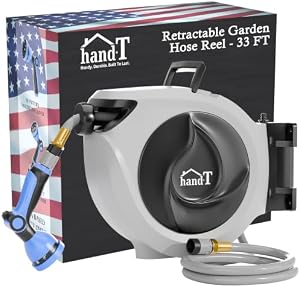
1. USA Based Retractable Garden Hose Reel, 1/2 in x 50 ft Quick Connect 10-Pattern Sprayer, Wall (Best for a wall-mounted self-retracting reel)
Specs from the listing (checked 2026-10-14):
- Operation Mode: Automatic
- Installation Method: Wall Mount
- Material: Polypropylene
- Item dimensions L x W x H: 15 x 7 x 13 inches
Pros
- Listing describes automatic operation with a wall mount
- Listing includes a 10-pattern nozzle and quick connects
- Listing says the reel can lock at any length with a simple tug
Cons
- The listing does not state how long the warranty lasts
- Its listed weight is 5.44 kg, so plan the mount before lifting the reel into place
- Its listed material is polypropylene, and the listing does not state its impact resistance
Best for: Anyone who wants a wall-mounted, self-retracting reel with 50 ft of hose listed.
Skip if: You need a freestanding reel for a lawn or bed and have no wall or post to mount on.
View on Amazon (affiliate link)
2. GARDENA Automatic Retractable Garden Hose Reel – 50 Feet – 360 Degree Swivel Outdoor Hose Reel (Best freestanding automatic reel)
Specs from the listing (checked 2026-10-14):
- Operation Mode: Automatic
- Installation Method: Freestanding
- Material: Alloy Steel
- Capacity: 20 gallons
Pros
- Listing describes a 360 degree swivel mount with rotating ground support
- Listing says the metal spike base gives stable placement
- Included parts list a 15 m hose, a mounting rod and a mounting aid
Cons
- The listing gives the capacity as 20 gallons, which is a volume and does not state hose length
- The listing describes a limited warranty for private use and does not give its length
- The listing does not describe how to release a locked length
Best for: Watering a lawn or bed where a freestanding reel is easier to place than a wall mount.
Skip if: You want the reel to live on a wall, since this one is spike-mounted and freestanding.
View on Amazon (affiliate link)
3. Giraffe Tools SW5 Metal Hose Reel Box, Heavy Duty Garden Hose Storage Reel Hideaway, Crank Handle (Best manual crank metal box)
Specs from the listing (checked 2026-10-14):
- Operation Mode: Manual
- Installation Method: Outdoor
- Material: Metal
- Capacity: 150 cubic inches
- Item Weight: 26 pounds
Pros
- Listing describes a crank handle and hose guide for winding the hose evenly
- Listing says you can open the lid to inspect the interior
- Listing describes a stabilizing footrest to keep the reel steady while winding
Cons
- It is operated manually, so the hose does not retract on its own
- The listing gives a capacity of 150 cubic inches and a hose length of 150 ft, which measure different things
- The listing says 3/4 inch hose does not fit, so measure your hose first
Best for: Someone who prefers a crank, wants a large metal outdoor box, and accepts winding by hand.
Skip if: You want the hose to retract automatically when you let go of it.
View on Amazon (affiliate link)
The cards above hold each choice’s specs, pros, cons and who should skip it. The sections below cover what the listings leave open.
Limits of the listing data
Several details are missing or unclear across these listings, and you should check them before you buy.
The top choice’s listing does not state how long the warranty lasts. The second choice’s listing describes a limited warranty for private use, but it does not give a length. Neither listing says how the lock release works in practice, even though both name the feature.
None of the listings states how the reel performs after years of use. This guide makes no durability claim for any of the three reels, and you should treat any durability question as open until the maker answers it.
FAQ
Why won’t my hose reel retract all the way?
In practice, the usual causes are a blocked hose path, a kink, debris, or a hose end caught on the frame. Work through the checks above in order. If the reel still will not retract after a clear path and an even wind, the cause may be inside the housing, and the maker is the right contact.
Is a hose reel cover a fix for a reel that will not retract?
No. Its job is limited to keeping weather and dust off the reel. It does not change how the spring, guide or crank works, so a cover will not make a stuck reel retract.
Can a manual crank reel be made automatic?
Not with the parts in these listings. A manual reel winds with its crank, and the third choice’s listing describes it as operated manually. If you want automatic retraction, choose one of the first two choices instead.
Which choice works best on a wall?
The top choice. Its listing gives the installation method as a wall mount and describes a 180° swivel. Confirm that your wall or post can hold the mount and the listed weight of 5.44 kg before you buy.
How much hose does the third choice hold?
The listing says it can store up to 150 ft of 5/8 inch garden hose or 200 ft of 1/2 inch garden hose, and that 3/4 inch hose does not fit. Its capacity field reads 150 cubic inches, which does not describe hose length. Check the listing before you rely on the hose figures.
Is polypropylene a sturdy material for a hose reel?
Polypropylene is a thermoplastic polymer with high chemical resistance, according to its general description. That describes chemical resistance. The top choice’s listing does not state its impact resistance or how it performs in strong sun, so check the listing for any stated durability before you buy.
Does an automatic reel lock in place at a set length?
The first and second choices’ listings describe a lock at any length. The listings do not explain how the lock is released, so read the maker’s manual for your model before you rely on that feature.
Bottom line
If an automatic reel will not come in, work through the checks first. Then decide whether the cause is the hose path or the housing. If it is the path, fix the path. If it is the housing, contact the maker.
If you want a reel that retracts on a wall, choose the top choice. If you want a freestanding automatic reel for a lawn or bed, choose the second. If you prefer a manual crank in a metal box and accept winding by hand, choose the third. Do not buy a cover expecting it to fix retraction.
Prime covers fast, free delivery on eligible items. See whether a Prime free trial is available for your account.
Check Prime on Amazon →Sources
- Wikipedia: Hose reel: describes spring driven, hand crank and motor driven reel styles.
- Wikipedia: Garden hose: construction and flexibility of garden hose.
- Wikipedia: Polypropylene: properties of the material listed for the top choice.


