Connecting a Rain Barrel to a Garden Hose
As an Amazon Associate we earn from qualifying purchases.
How to use a rain barrel with a hose comes down to a few connections: the spigot near the bottom, the overflow near the top, and the fill hose that carries roof water in from the downspout. Extension guides from Penn State, Arkansas, Wisconsin, Nebraska and Washington State describe these parts. This guide walks through them in the order you would install them, then covers the checks that keep the water flowing without leaks.
Quick answer
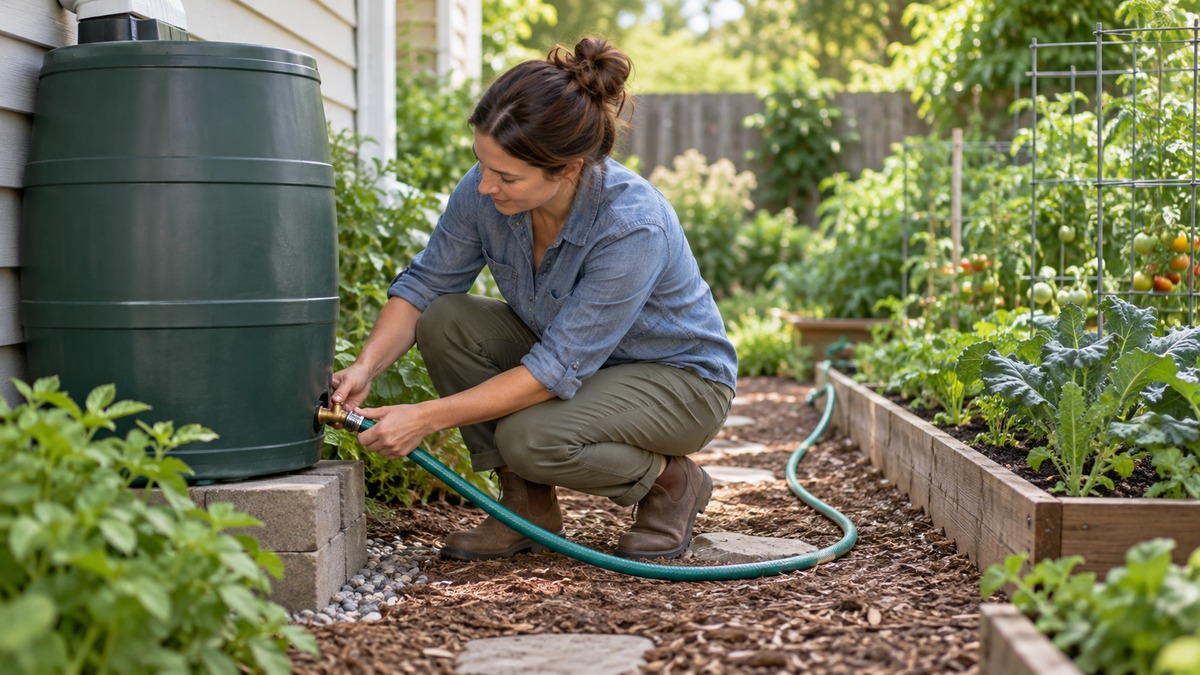
- Fit the spigot near the bottom with its end pointing down, then attach a garden hose to it. Gravity supplies the flow.
- Raise the barrel on blocks or a stand before you connect anything, because extra height gives more pressure at the spigot.
- Give the overflow a route away from the house foundation, using a hose, PVC pipe or flexible downspout.
- Check every fitting for leaks, and disconnect and empty the barrel before winter.
Gather the parts and tools first
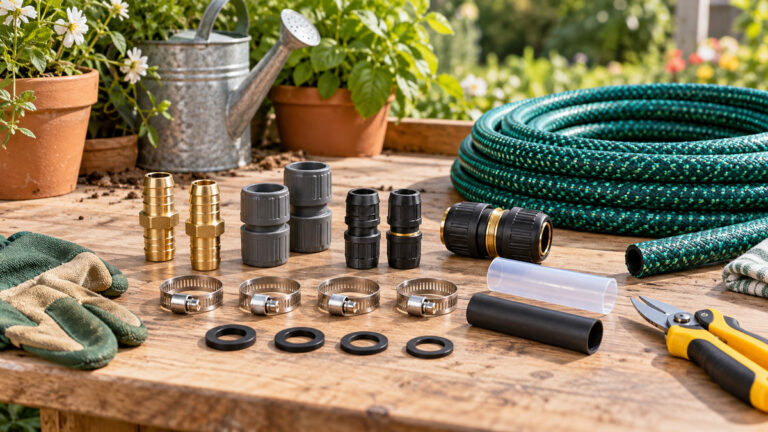
Penn State lists the supplies you will need: safety glasses, a drill, a measuring tape, a pencil or marker, a level, a screwdriver and scissors. Its kit includes a spigot, a downspout adapter, a flexible connector hose, hole saws, a drill bit, rubber seals and screws. Arkansas suggests a jig saw or reciprocating saw, a drill, a hole bit that matches the bulkhead fitting and spigot, an adjustable wrench, a staple gun and a utility knife. Its parts list also includes a fiberglass window screen to keep mosquitoes out. Lay the parts next to the barrel before you cut anything, so each one has a matching hole.
Arkansas also asks for a clean starting point. It says that “If you are reusing a 55-gallon barrel, make sure it is food grade and wash it out thoroughly.” After the holes are cut, it tells you to “Use a utility knife to smooth out the plastic burrs around all holes and cuts.” The last step is to clean the inside of the barrel, so no plastic shavings stay in the water.
Set the base so the spigot has pressure
Placement comes first. Penn State says, “Choose a downspout that is easily accessible.” It also says to “Make sure the ground is level and firm.” Its setup step suggests sand or gravel to level the spot. Then Penn State says to “Elevate the barrel on a cinder block or bricks.” That step is about pressure, and the guide says so: “This will increase the water pressure out of the spigot.”
Arkansas makes the same point from the other side. Its page says that “Rain barrel placed without a stand will have reduced water pressure.” Nebraska adds that a sturdy platform “makes it easier to hook a hose to the spigot.” Penn State also gives the order of work: “Be sure the barrel is placed onto the elevated surface before marking the downspout.” Set the base first, because the downspout cut depends on where the barrel sits.
Install the spigot so it points down
Penn State’s spigot step is short. The rubber seal goes in first: “Insert the threaded rubber seal into the hole while pinching the seal for easier insertion.” Then the spigot goes in: “Thread the spigot into the seal until it is firmly in place and the spigot points down.” Wisconsin places the spigot “a few inches from the bottom of your rain barrel”, so the barrel can also be drained.
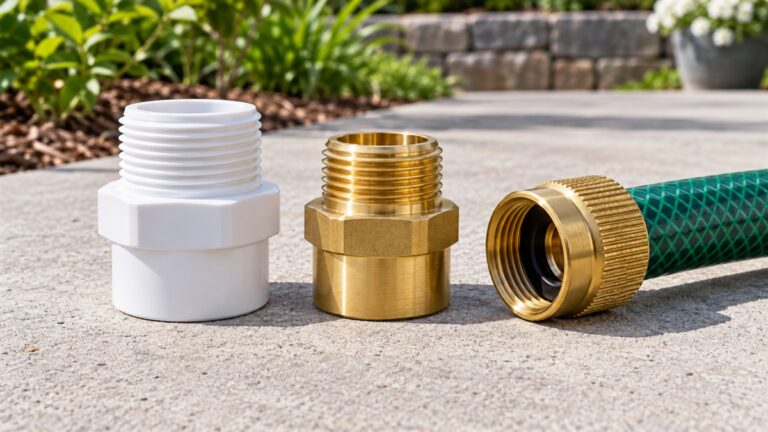
Arkansas warns about the threads. Its bulkhead fitting uses a tank fitting that goes in from the inside, and the page says that “These fittings have left-handed threads, so tightening seems backwards.” It also tells you to wrap the spigot stem before it goes in: “Wrap the spigot stem in plumbers tape and insert it into the bulkhead tank fitting.” Wisconsin adds a sealing step for every fitting: “Seal all fittings and spigots with caulk to minimize water leakage.” If the hose connection needs an adapter, see our guide to connecting PVC pipe to a garden hose.
Route the overflow away from the house
The overflow is the part people skip, and the pages treat it as critical. Wisconsin says that “An overflow valve is critical to redirect water during periods of heavy rain and when the barrel is full.” Arkansas places the overflow hole near the top of the barrel, on either side, and it describes the hose-to-hose connector that screws into that hole. Wisconsin describes the outlet choice: “Use a spigot or barbed spout and hose, or attach a downspout elbow and flexible downspout to the barrel to guide excess water away from the barrel and any water-sensitive areas (e.g., a house foundation).”
Nebraska says the opening near the top is where excess water leaves once the barrel is full, and that PVC pipe or flexible hosing usually connects there to carry the water to a lawn, a shrub border or a rain garden. Washington State gives the two options in one sentence: “Your rain barrel should have either a downspout diverter or an overflow system directing excess water into the downspout drainage system, or somewhere in your yard well away from the house foundation.” Pick one of those routes before you fill the barrel, so the first heavy storm has somewhere to go.
Fill the barrel from the downspout
Penn State’s fill setup links the downspout to the barrel through a diverter. When the diverter goes in, the guide says: “Make sure that the cup part is facing upwards, and the diverter does not get twisted.” The fill hose comes next: “Connect the fill hose to the end of the downspout diverter and press it in firmly.” Then, “Connect the other end of the hose to the water inlet on the barrel and press it in firmly.” If the hose is too long, “The hose can be cut if needed to shorten the length.”
Arkansas takes a different route at the downspout. It says, “Disconnect the elbow at the bottom of your downspout.” The page then explains how to mark the downspout cut so the barrel can be removed later for maintenance. Wisconsin describes a direct connection as one option: “Alternatively, you can cut a hole the exact size of your downspout and secure the downspout directly to the barrel.” Washington State also describes a first-flush option, where “First-flush systems divert the first flush of water off the roof, allowing the rain barrel to fill once most of the debris and contaminants have been washed away.” The pages do not say which setup gives the cleanest water, so choose the one that fits your gutter.
Link more than one barrel
Linking adds storage. Washington State says that “Joining a series of barrels together with linking kits will increase your storage capacity.” Wisconsin describes the parts for it: “valves that can be used to connect multiple barrels together with hoses”. The pages disagree on where the link should go. Wisconsin says to “Add additional spigots and hoses at the top of a rain barrel to connect several barrels together to maximize water collection.” Arkansas says to “make the connection in the appropriate (lowest) place to ensure hydraulic connection between barrels.” This guide shows both positions. The pages do not say which one gives better flow, so fill the linked barrels and check the flow before you depend on them.
Test the connections before you rely on them
Leaks are the usual first problem. Penn State says to “Inspect the barrel regularly for any leaks.” It also says to “Ensure spigot and inlet are functioning properly”, and to “Clear any debris that may be clogging downspouts/gutters or inside the barrel.” Arkansas adds a screen check: “Ensure a tight fit to prohibit insects from entering the barrel.” If a screen is not an option, Arkansas says the screen “can be wrapped over the edges of the barrel and fastened down with bungee cords or straps.”
Repeat the check after any change, since Penn State’s maintenance list covers the same parts: the barrel itself, the spigot and the inlet. Look at each seal and joint once the barrel has water in it.
Use the hose day to day
When the connections are sound, the hose does the rest. Nebraska says that “Spigots are attached near the bottom for attaching a hose to access the water.” Its platform advice also helps here. Washington State adds a practical height test: “Your rain barrel should be raised high enough that you can get a watering can under the spigot to fill.” Use the same test for the hose. If you want a shut-off at the hose end, see our guide to garden hose connectors with a shut-off valve.
Keep the rules for the water in view when the hose is out. Arkansas says that “Collected rainwater should never be used for drinking or cooking.” Nebraska adds that “After handling rain barrel water or cleaning barrels, wash your hands.” Both rules apply every time the hose is connected.
Prepare the barrel for winter
Penn State says that “It is critical to disconnect and empty your barrel before winter.” The reason is simple: “This ensures there is no water to freeze and crack the barrel.” When spring comes, the guide says to “Reconnect the barrel in the spring and continue use.” Wisconsin gives the same advice for the fall: “Finally, in the fall, disconnect and drain your rain barrel to avoid freezing and cracking over the winter.” Store the spigot, hoses and fittings with the barrel, so the connections are ready in spring.
Keep children and pets safe at the connections
Wisconsin warns that “Fifty gallons of water weigh several hundred pounds, and may be a risk to children if they try to climb on the barrel and the barrel tips.” Nebraska says to “Firmly attach containers to buildings for safety.” Both warnings apply at the connections too, so check the stand before you attach a hose.
How we chose
This guide uses five university extension pages, all opened on 2026-10-22: Penn State Extension’s rain barrel construction guide, the University of Arkansas System fact sheet on building rain barrels, a Wisconsin Extension article on rain barrels, a University of Nebraska-Lincoln Extension article, and a Washington State University Extension column. We kept the steps a reader can carry out with a hose, which means placement, fittings, overflow, fill hose, linking and checks. Each quoted sentence was matched against the text of its page, and where the pages disagree, both positions are shown.
What we could not verify
The pages describe parts and steps, but they do not give a full plumbing plan. They do not state the pressure at a hose outlet, the flow rate through a standard hose, or how long a hose can run before the barrel empties. They also differ on where to link barrels. This guide does not name products, prices or brands, and it does not check any fitting for leaks, thread size or fit.
What the sources do not say
The pages do not say whether a given hose thread matches every spigot, which is why the Arkansas parts list names a connector instead of a size. They give no sealing method for plastic fittings beyond caulk and tape. They do not say which linking point gives better flow. The Washington State column is from 2010, and the pages do not cover local rules for rainwater use. Where a page is silent, this guide says so.
Frequently asked questions
Can I attach a garden hose straight to the spigot?
Nebraska says spigots are attached near the bottom for attaching a hose. Arkansas lists a pipe-to-garden hose connector among its parts, which is the piece that lets a standard hose thread on. Check the thread on your spigot before you connect anything.
Do I need an overflow hose?
Wisconsin says an overflow valve is critical when the barrel is full or in heavy rain. Nebraska says PVC pipe or flexible hosing usually connects to the overflow opening. Washington State lists a downspout diverter or an overflow system as the two options.
Can I connect two rain barrels together?
Yes. Wisconsin describes valves that connect barrels with hoses, and Washington State says linking kits add storage. The pages disagree on where the link goes: Wisconsin says the top, and Arkansas says the lowest place that gives a hydraulic connection.
How do I check for leaks?
Penn State says to “Inspect the barrel regularly for any leaks.” Wisconsin recommends sealing fittings with caulk, and Arkansas wraps plumbers tape around the spigot stem before the fitting goes in.
Do I need to disconnect the barrel for winter?
Penn State says to disconnect and empty the barrel before winter, so there is no water to freeze and crack it. Wisconsin gives the same advice for the fall, and Penn State says to reconnect in the spring.
Sources
- https://extension.psu.edu/rain-barrel-construction-guide (opened 2026-10-22)
- https://uaex.uada.edu/publications/PDF/fsa-9534.pdf (opened 2026-10-22)
- https://hort.extension.wisc.edu/articles/rain-barrels/ (opened 2026-10-22)
- https://water.unl.edu/april-showers-and-rain-barrels/ (opened 2026-10-22)
- https://wpcdn.web.wsu.edu/extension/uploads/sites/57/2014/03/061110.pdf (opened 2026-10-22)