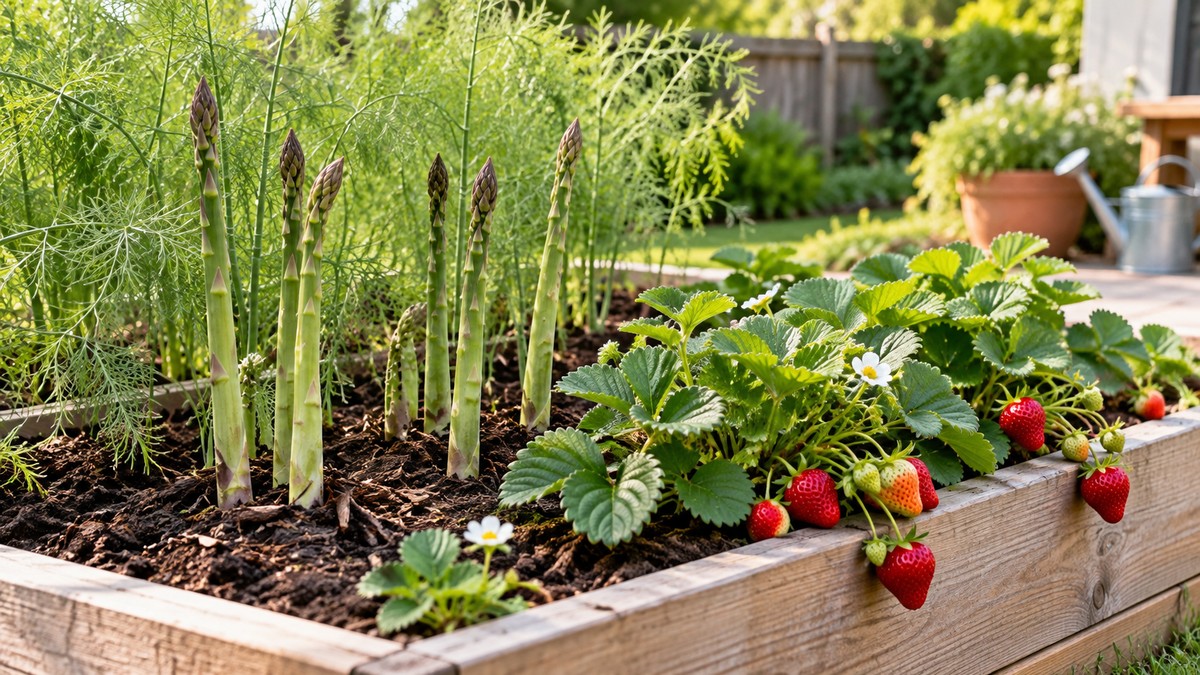
How to Grow Asparagus and Strawberries in a Raised Bed
As an Amazon Associate we earn from qualifying purchases.
How to grow asparagus and strawberries in a raised bed means planning for two crops on two different clocks. Asparagus is a perennial that rewards patience, with no harvest in its first season, while strawberry beds need renewing every few years. Both want full sun, good drainage and winter protection, so one bed can work when the layout respects each crop’s needs. The sources below cover each crop separately, and none of them describes this exact pairing, so the layout advice is labelled where it is our own reasoning.
Quick answer
- Give both crops full sun and a bed with good drainage, which the extension sources name as core needs.
- Space asparagus crowns 15 to 18 inches apart, and set strawberry plants about 15 inches apart in each row.
- Leave asparagus unharvested in its first season, then harvest lightly for three to four weeks in the second year.
- Mulch asparagus in autumn, and cover strawberries with a fluffy layer of mulch three to six inches deep from mid-November.
Decide whether one bed fits both crops
The shared needs are simple. The Virginia Tech asparagus guide asks for good drainage and full sun, and the Oregon State strawberry guide describes ideal conditions as full sun and fertile, well-drained soil. Sun and drainage are the first things to get right in any shared bed.
The conflict is height and shade. The Virginia Tech guide warns that tall asparagus ferns may shade other plants, so plan accordingly. Our own reasoning, which no source states for this pairing, is to place the strawberries on the sunny side of the bed, away from the asparagus crowns. For other crops that suit raised beds, see vegetables to plant in raised beds.
Time is the other conflict. The Virginia Tech guide says asparagus is a perennial that will live from 12 to 15 years or longer, so its place in the bed is long term. The University of New Hampshire guide says a strawberry bed can usually be carried over for three to five years or more when the plants are vigorous and the bed is kept weed-free and renewed every year. The two crops therefore need different plans for replacement.
Build the raised bed and its soil
Bed height has to suit both crops. The Oregon State guide says raised beds made from mounded soil should be about one to one and a half feet high. The UNH guide describes a smaller build for day-neutral strawberries: beds six inches high and 24 inches across on top. Those are two different builds, so choose the height your frame allows and check it against each crop’s needs.
Soil comes next. The Oregon State guide says strawberries prefer well-drained soil and can benefit from the improved drainage of raised beds. For a framed bed, it says to fill the frame with potting mix, or with a combination of soil and any needed amendments, and to use the same cultural practices as for soil plantings. For more on how much soil a raised bed needs, see our guide to raised bed soil amounts.
The Virginia Tech guide adds the asparagus side of the soil question. It says to add leaf mold or compost at the rate of 20 percent by volume, and that a soil test is always the best method of determining the fertilization needs of the crop. In heavy soils, it recommends double digging. The same guide says its trench method may be used in wide-bed plantings, with plants staggered in three rows, which is the closest it comes to a raised bed.
Plant the asparagus crowns
The Virginia Tech guide says crowns are usually shipped and set out in March or April, so spring is the planting window. Set the plants 15 to 18 inches apart, mounding soil slightly under each plant so the crown sits just above the roots. Spread the roots over the mound, cover the crown with two to three inches of soil, and firm it well.
The guide also describes filling a trench by pulling soil over the crowns as the plants grow, about two inches every two weeks, until the trench is full. A raised bed has no trench to fill in that way. The sources we opened do not say how to adapt that step to a bed, so it stays an open question here.
Plant the strawberries without burying the crowns
For strawberries, planting depth matters as much as spacing. The UNH guide says to plant in holes wide enough to spread the roots out slightly and deep enough to bring the soil halfway up the crown. The Utah State guide says that only the roots and the base of the crown should be covered with soil, leaving as much of the crown above ground as possible.
Spacing depends on the system. The Oregon State guide sets plants about 15 inches apart in the row, and it suggests rows three to four feet apart, center to center, on raised beds. For day-neutral types, the UNH bed of six inches high and 24 inches across is a compact option. In the planting year, June-bearing plants produce very little fruit, and the Oregon State guide says no flower pruning is necessary. For a related idea on mixing crops in one bed, see companion crops for raised beds.
Light, drainage and frost
Full sun is the common rule. The Virginia Tech guide says to choose a site with good drainage and full sun. The Oregon State guide says that strawberries need full sun, and it warns that poor drainage can lead to root death and root diseases.
Raised beds help drainage, but they cost some warmth. The Utah State guide says raised beds put the roots at greater risk of winter injury. The Ask Extension answer for a Minnesota gardener says temperatures in raised beds will likely be several degrees colder than ground-level plantings in winter. The same answer notes that asparagus is at least a zone 3 plant, and it says plants in raised beds need more protection than plants at ground level.
The Oregon State guide also warns that strawberries can be sensitive to winter cold and frost damage in late winter and early spring. It suggests selecting a site with good air circulation.
Protect both crops through winter
The Virginia Tech guide says asparagus is a hardy perennial that should be mulched in autumn. The Ask Extension answer goes further for a raised bed. It says to mulch the asparagus crown heavily, pile as much snow as possible on the sides of the bed, and consider bales of straw to insulate it. For more on getting a raised bed ready for the cold, see preparing raised beds for winter.
Strawberries need a different mulch. The UNH guide says to apply mulch over strawberries in mid-November, to protect the plants from extreme winter cold and from root damage caused by rapid freezing and thawing of the soil. It asks for a fluffy layer three to six inches deep over the plants, and it says to rake the mulch off into the aisles in early spring, around mid-April. The Oregon State guide warns about the growing season instead: do not use deep straw as a mulch then, because it buries the crowns and can attract voles, field mice and other rodents that damage the plants.
Our own reading is that one mulch depth will not suit both crops in a shared bed, because asparagus is mulched heavily at the crown while strawberries need a layer that is raked off in spring. The sources do not give a mulch depth for asparagus, so that figure is left open.
Water and feed both crops
The Oregon State guide says strawberries need adequate water to thrive, from irrigation or rainfall. It also says that plants with sufficient nutrients are growing well and have healthy green leaves, not pale green or yellow ones. Leaf color is a practical check on feeding for the strawberries.
The Virginia Tech guide describes asparagus as a medium-heavy feeder that needs high phosphorus and potassium, plus organic matter at planting, all per soil test results. After harvest it may be sidedressed, and it benefits from a yearly topdressing of compost in late winter or early spring. Because the guide ties all of this to a soil test, the test is the place to start.
Harvest on two different timelines
Asparagus takes patience. The Virginia Tech guide says spears should not be harvested in the first season after the crowns are set. It advises a light harvest for three to four weeks in the second year, and says that when plants reach their fourth season they can be harvested for eight to ten weeks each year. The same guide reports research in which plots harvested one year after planting had a cumulative yield 23 percent lower after five years than plots first harvested two years after planting.
Strawberries crop sooner but need renewal. The Oregon State guide says June-bearing plants produce very little fruit in the planting year. The UNH guide says a strawberry bed can usually be carried over for three to five years or more if the plants are vigorous, the bed is kept weed-free and the planting is properly renewed or renovated every year.
Mistakes to avoid
- Harvesting asparagus in its first season. The Virginia Tech guide says spears should not be harvested then.
- Burying strawberry crowns under organic mulch. The Oregon State guide says this can lead to crown rot or plant death.
- Letting asparagus ferns shade the strawberries. The Virginia Tech guide warns that tall ferns may shade other plants.
- Assuming a raised bed is as warm as the ground. The Ask Extension answer says raised-bed temperatures will likely run several degrees colder in winter.
- Using deep straw on strawberries during the growing season. The Oregon State guide says it can bury the crowns and attract rodents.
How we chose
We set out to cover the planting, soil, light, winter and harvest questions that a shared raised bed raises. We looked only at university and cooperative extension pages. We opened five of them on 2026-10-22: one Virginia Tech asparagus guide, three strawberry guides from Oregon State, New Hampshire and Utah State, and one Ask Extension answer on asparagus in raised beds. We kept a point only when one of those pages states it in plain words, and we checked each quoted sentence against the fetched page text before using it. Where the asparagus and strawberry guidance differs, for example on mulch, we say so.
What we could not verify
The main gap is the pairing itself. The pages we opened cover each crop on its own. None of them describes asparagus and strawberries growing together in one raised bed, so the layout advice above is our own reasoning, labelled where it appears.
What the sources do not say
The sources do not give a bed depth or width that suits both crops. They do not give a mature fern height for asparagus, so we cannot say how much shade a bed of ferns would cast on strawberries. The Virginia Tech trench method for filling soil over the crowns does not say how to adapt it to a raised bed. The UNH mulch schedule is written for strawberries, and no source gives a mulch depth for asparagus. The Ask Extension answer is one expert reply for a colder climate, not a formal publication. The Utah State guide is a PDF whose columns made some passages hard to read, so only sentences that read cleanly appear here. None of the pages gives a plant count for one bed.
Frequently asked questions
Can asparagus and strawberries share one raised bed?
None of the sources covers this pairing directly. Both crops need full sun and good drainage, but the Virginia Tech guide warns that tall asparagus ferns may shade other plants. Our own reasoning is to keep the strawberries on the sunny side of the bed.
How deep should a raised bed be for these crops?
The Oregon State guide says a mounded raised bed should be about one to one and a half feet high. The UNH guide describes day-neutral strawberry beds that are six inches high and 24 inches across on top. The sources do not give one depth that suits both crops.
When can asparagus be harvested?
Not in the first season after the crowns are set. The Virginia Tech guide advises a light harvest for three to four weeks in the second year, and says that from the fourth season, plants can be harvested for eight to ten weeks each year.
How much mulch do strawberries need in winter?
The UNH guide says to apply mulch over strawberries in mid-November, in a fluffy layer three to six inches deep over the plants. It says to rake the mulch off in early spring, around mid-April.
How should strawberry crowns sit in the soil?
The UNH guide says to plant in holes deep enough to bring the soil halfway up the crown. The Utah State guide says only the roots and the base of the crown should be covered, leaving as much of the crown above ground as possible.
Sources
- https://ext.vt.edu/content/pubs_ext_vt_edu/en/426/426-401/426-401.html (opened 2026-10-22)
- https://extension.oregonstate.edu/catalog/ec-1307-growing-strawberries-your-home-garden (opened 2026-10-22)
- https://extension.unh.edu/resource/growing-fruit-strawberries-fact-sheet (opened 2026-10-22)
- https://extension.usu.edu/yardandgarden/research/strawberries-in-the-garden.pdf (opened 2026-10-22)
- https://ask.extension.org/kb/faq.php?id=792133 (opened 2026-10-22)