Attracting Hummingbirds Without a Feeder
As an Amazon Associate we earn from qualifying purchases.
If you want to learn how to attract hummingbirds without a feeder, the sources point to one main tool: nectar-rich flowers, planted so that something is in bloom from spring through fall. Red and orange tubular blossoms draw the birds, native plants suit local conditions, and a mix of trees, shrubs and perennials keeps the supply going.
The university pages below are regional, so their plant lists differ. Oregon, Pennsylvania, Illinois and North Carolina each have their own local species, and this guide keeps those differences visible rather than merging them into one list.
Quick answer
- Plant red, orange or pink flowers with tubular shapes. North Carolina Extension says hummingbirds are attracted to red or orange tubular flowers, and Illinois Extension lists tubular red, orange and bright pink blooms.
- Plan for blooms from early spring to late summer or fall. Illinois Extension recommends planning for continuous bloom from spring through fall.
- Choose native plants for your region. Oregon State Extension says native wildflowers provide the highest quality nectar and are plants the birds recognize.
- Group the plants and leave room around the flowers for hummingbirds to maneuver, as Oregon State advises.
Know which hummingbirds visit your yard
In Illinois, the visitor is the ruby-throated hummingbird. Illinois Extension notes that “There are more than 360 species of hummingbirds worldwide, but only one, the ruby‑throated hummingbird (Archilochus colubris), breeds in Illinois.” The same post says those birds “typically begin arriving in Illinois in mid to late April, though timing can vary from year to year”. Illinois Extension also says, “Each spring, they migrate north from overwintering grounds in Mexico and Central America.”
The birds are small, and that shapes what they need. North Carolina Extension says, “Hummingbirds are our tiniest birds, most weighing less than a nickel.” It also says they “come from Central America and Mexico to raise their young, only to return round trip in the fall.”
What hummingbirds need from a garden
Hummingbirds need more than flowers. North Carolina Extension says that “In the meantime, they need places to nest and perch, shelter, and most importantly, a supply of food.” A garden that offers only flowers covers one of those needs, so the plantings should also give the birds places to rest and nest.
Nectar is the food they look for first. Illinois Extension calls it “an essential part of a hummingbird’s diet,” and it says that “incorporating nectar-rich flowering plants into a landscape is one of the best ways to attract them.” Nectar is not the whole diet, however. The same post explains that “insects are an essential, and often overlooked, part of their diet, especially during egg-laying and while raising chicks.”
The insects matter in numbers too. Illinois Extension says that “an adult female hummingbird can consume up to 2,000 insects per day.” That is one reason the sources treat the garden as a habitat with several parts, not as a single flower bed.
Choose red, orange and pink tubular flowers
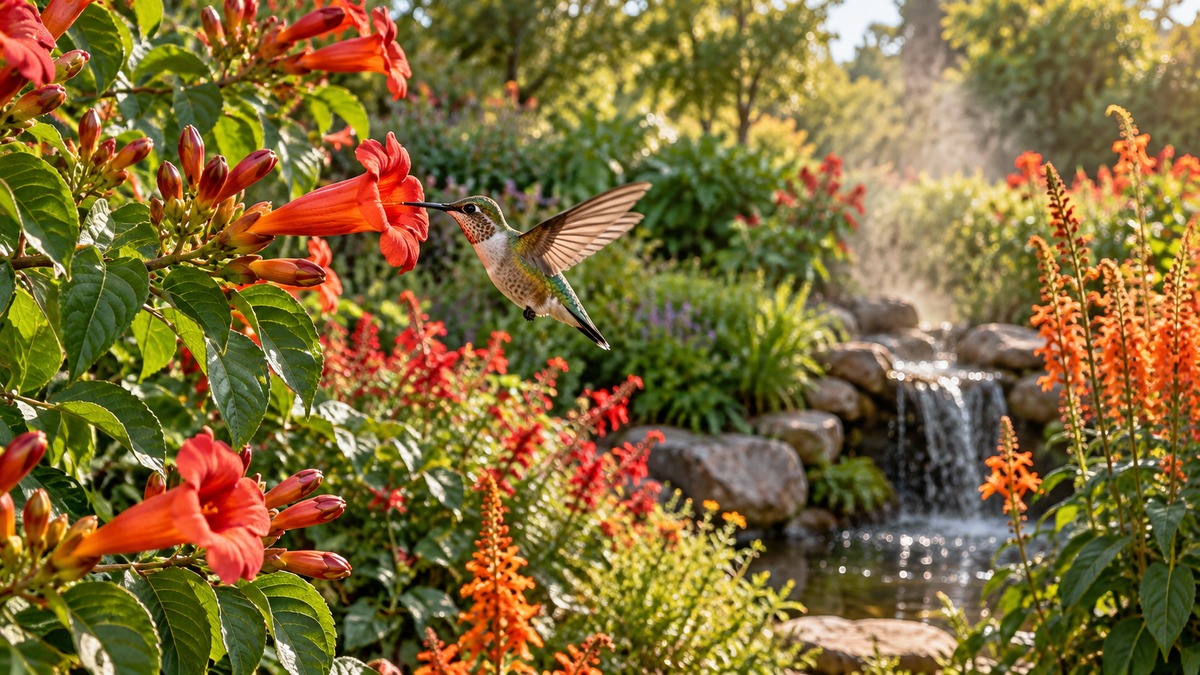
Shape and color come first. Oregon State Extension says, “Plants with red, tubular-shaped flowers are an excellent choice for your garden.” North Carolina Extension gives the same signal: “They are attracted to red or orange tubular flowers, but do not feed on them exclusively.” The same page explains the shape: “Their long bills allow them to reach nectar deep inside the bloom.”
Oregon State’s home-landscape page gives a short list. It says, “Hummingbirds prefer: Red, pink and orange flowers”, and it names “Flowers shaped like tubes in all sizes, such as bee balm, honeysuckle, penstemon and hardy fuchsias.” Illinois Extension adds that hummingbirds are “especially drawn to tubular red, orange, and bright pink blooms,” even though they will visit other colors.
Flower structure matters as well. Oregon State says, “A typical hummingbird plant has many flowers with open blossoms.” It also says, “The flowers are on the outside of the plant, so hummingbirds can feed from them without hitting their wings against the foliage.” Open blooms set at the edge of a plant are easier for a hovering bird to reach than blooms buried in foliage. Oregon State also says, “They are the only birds that can truly hover and fly backwards.” That hovering flight is why the planting advice below keeps room around each bloom.
Scent is not the cue. Illinois Extension says, “Hummingbirds rely on sight, not smell, to locate flowers.” Oregon State makes the same point from the plant side: “Most hummingbird plants do not have fragrance.”
Pick native plants for your region
Native plants come next. Oregon State Extension’s guide says, “Wildflowers that are native to your area are a good choice.” The same guide adds, “They provide the highest quality nectar and are plants the birds recognize.” It also explains the reason: “Also, they are better adapted to the local climate, elevation, and soils, so they are more likely to thrive.”
The lists are local, and the sources say so. Oregon State’s table “lists preferred hummingbird plants” and “includes species that are native to the Pacific Northwest.” Penn State Extension’s Chester County page gives a spring and summer list for its region. North Carolina’s native advice names trees that provide food and cover: “Native trees such as red buckeye, hawthorn and yellow poplar not only produce blooms, but also provide nesting areas.”
Illinois Extension names a native example for its own state: “Royal catchfly (Silene regia) is an attractive native plant for hummingbirds.” That line shows what a native choice looks like in one region. Pick the equivalent in yours rather than copying a list from another state.
Penn State Extension gives a practical tip for buying: “Don’t buy a plant unless it has the correct Latin name attached.” It also suggests using “a native plant reference to find the Latin names of the native plants you need.” The Latin name is the check that the plant is the one listed as native to your area.
Plan bloom from spring to fall
A single bloom period leaves the birds short. Illinois Extension says, “Planning for continuous bloom from spring through fall helps ensure a consistent nectar supply.” Oregon State Extension gives the same timing in terms of the bird’s stay: “Put in plants that bloom in succession from early spring to late summer to ensure a food source for hummingbirds throughout their stay.”
North Carolina Extension describes the mix that makes this work: “A landscape that provides varieties of trees, shrubs, vines and perennials that have a succession of blooms throughout the spring and summer will help ensure a continuous supply of nectar.”
Penn State Extension’s Chester County page splits the year into two targets. For migrants arriving in spring, it says to “provide plants that offer nectar-rich blossoms in late April and early May, such as azalea, penstemon, native columbine, Virginia bluebell, eastern redbud and bleeding heart.” For the rest of the summer, it says to “offer a variety of long-blooming, nectar-rich plants such as native honeysuckle, trumpet vine, bee-balm, phlox, cardinal flower, impatiens, and fuchsia.”
Illinois timing gives a useful check. Because the ruby-throated birds typically arrive in mid to late April, a bloom that opens only in July will miss the first weeks. Oregon State advises that you “Think of blooming periods when you decide which species to plant.” Map the bloom dates in your own yard against the arrival window for your state, and fill any gap you find.
Weather is part of the timing problem too. Oregon State Extension says, “Weather is the main threat to hummingbirds.” It lists the risks: “They can die of cold weather, long rainy spells, dry weather that causes flowers to wither, and storms during their migration.” The sources do not say which plants hold up best in those conditions.
Group plants and give them room
Grouping helps the birds find the flowers. Illinois Extension says, “Grouping plants together makes them easier for hummingbirds to locate and increases feeding efficiency.” Oregon State adds a spacing point: “It is important to leave enough space around flowers for hummingbirds to maneuver.”
Open access matters more than a single number. The sources do not give a spacing in inches or feet, so use the mature size on each plant tag and leave room between groups.
Use trees, shrubs and perches
Woody plants do more than bloom. North Carolina Extension notes that native trees “not only produce blooms, but also provide nesting areas.” That gives a garden two jobs in one plant: food and a place to build a nest. The same page lists “places to nest and perch” among the hummingbird’s needs, so a garden with some woody plants covers the perching and nesting needs as well as the nectar.
The sources do not give shrub heights, spacing or cover sizes for hummingbirds. Choose woody plants whose mature size fits the spot, and use them alongside the flowers rather than in place of them. The trees supply nesting places and the flowers supply nectar, and the mix keeps the garden useful across seasons.
Water and feeders are separate questions. For water, see our guide to bird baths for hummingbirds. If you decide to add a feeder later, our guide to making hummingbird nectar at home is the next step.
A simple planting checklist
- Choose native plants with red, orange or pink tubular flowers that suit your region.
- Pick a mix that blooms from early spring into late summer or fall, timed to the arrival window in your state.
- Group the plants and leave room around the blooms for hovering birds.
- Add a few native trees or shrubs for nesting places and perches.
How we chose
We chose sources that are university extension services: Oregon State Extension, Illinois Extension, North Carolina State Extension and Penn State Extension. We opened each page on 2026-10-22 and kept only sentences that appear in the text we fetched. The sources come from four different regions, so we show their local lists instead of merging them. The federal Forest Service hummingbird guide returned HTTP 403 when we opened it, so it is not used here. We left out retail pages and content-farm pages, even when they came up in searches. No product is recommended in this article.
What we could not verify
What the sources do not say
The sources we opened do not give the time it takes for hummingbirds to find a new garden, a plant spacing in inches or feet, or a bed size. They do not give a single native list for every region, and no page here ranks plant species against one another for hummingbird use beyond the examples named. The pages were written for their own regions, so check your state extension office before you buy and before you rely on the arrival window in this article.
Frequently asked questions
What flowers attract hummingbirds without a feeder?
Red, orange and pink flowers with tubular shapes draw them most reliably, according to Oregon State and North Carolina extension. The Oregon State home-landscape page names bee balm, honeysuckle, penstemon and hardy fuchsias. Choose the native equivalent in your region.
Do hummingbirds need native plants?
The sources favor native plants. Oregon State says native wildflowers “provide the highest quality nectar and are plants the birds recognize.” It also notes that native plants are better adapted to local climate, elevation and soils.
How long does a hummingbird garden take to bloom?
That depends on the plants and the season, and the sources give bloom timing rather than a time to attract birds. Illinois Extension recommends continuous bloom from spring through fall, and Penn State lists early spring and summer plants for its region.
Do hummingbirds need insects as well as nectar?
Yes, according to Illinois Extension. It says insects are “an essential, and often overlooked, part of their diet, especially during egg-laying and while raising chicks.” It also says an adult female can consume up to 2,000 insects per day.
Do hummingbirds need perches and nesting places?
Yes, according to North Carolina Extension. It says hummingbirds “need places to nest and perch, shelter, and most importantly, a supply of food.” Native trees such as red buckeye, hawthorn and yellow poplar also provide nesting areas.
Sources
- https://extension.oregonstate.edu/sites/extd8/files/documents/lommena/ec1541.pdf (opened 2026-10-22, HTTP 200)
- https://extension.illinois.edu/blogs/good-growing/2026-04-10-more-feeders-attracting-hummingbirds-your-landscape (opened 2026-10-22, HTTP 200)
- https://lee.ces.ncsu.edu/news/plants-to-attract-hummingbirds/ (opened 2026-10-22, HTTP 200)
- https://extension.psu.edu/programs/master-gardener/counties/chester/how-to-gardening-brochures/gardening-to-attract-birds (opened 2026-10-22, HTTP 200)
- https://extension.oregonstate.edu/gardening/pollinators/create-home-landscape-pollinators-butterflies-bees-hummingbirds (opened 2026-10-22, HTTP 200)