How to Attract Pollinators to Your Garden
As an Amazon Associate we earn from qualifying purchases.
How to attract pollinators to your garden naturally comes down to four things the sources repeat: plant native flowers, keep something blooming from spring to fall, group flowers in sunny spots, and leave room for bees and butterflies to nest. The Ohio State University fact sheet ENT-47, a Washington State University Extension article and a U.S. Fish and Wildlife Service guide all make these points. None of them asks for a special product. The plan below follows their advice in the order a gardener would act on it.
Quick answer
- Choose native plants first. The WSU article says that “native plants are four times more likely than nonnative plants to attract bees.”
- Plan for bloom from early spring through late fall. Ohio State says gardeners can help pollinators by planting “a sequence of bloom throughout the growing season, from early spring through late fall.”
- Group plants together in sunny places, and leave dead stems, brush piles and bare sandy soil where bees can nest.
- Avoid complex double flowers and unusual cultivars where you can, because Ohio State says they are “less attractive to pollinators.”
Start with native plants
Pollinators matter well beyond the vegetable bed. Ohio State says that “Approximately 75 percent of all plant species depend on animal pollinators to move pollen from plant to plant,” and that pollinators are “essential to the survival of native plants.” The USFWS guide lists habitat loss among the threats to pollinators, along with “the introduction and spread of invasive plant species.”
Native plants are the first choice in all three sources. The WSU article explains why: “Natives, including wildflowers, shrubs, and trees, are naturally adapted to the region’s climate and soil.” It also cites research that “native plants are four times more likely than nonnative plants to attract bees and significantly increase the abundance of butterflies and moths.” That is a strong reason to start with a regional plant list rather than the flowers most often sold at the big box garden center.
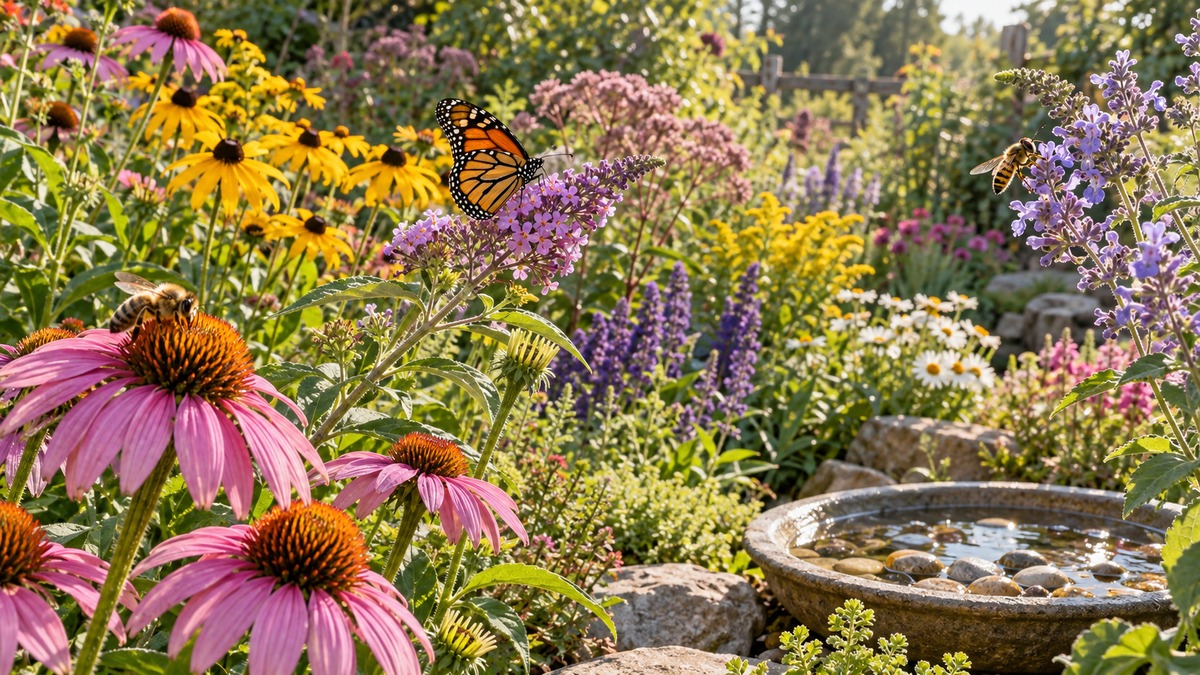
The USFWS guide tells gardeners to “Plant a garden using native flowering plants,” and to choose a variety of colors and shapes that will attract a wide range of pollinators. Ohio State adds that “An abundance of different flower shapes, sizes, and colors will appeal to a variety of pollinators.” Mixing shapes matters because different pollinators feed in different ways. Ohio State notes that “Different flower shapes and colors attract different pollinators.”
Why natives draw more visitors
The WSU article points to the local fit of native plants, which are “naturally adapted to the region’s climate and soil.” Plants suited to that climate and soil are the ones the article recommends first. The article also says that efforts are underway to add more native plants to its demonstration garden.
Plant in groups, in the sun
Ohio State gives a simple layout rule: “Grouping plants together in sunny locations helps pollinators find and feed on desirable flowers while expending less energy in the search for plants.” A bed of one kind of flower is easier for a bee to find than a single plant at the edge of a lawn. The WSU article makes a related point, saying that experts recommend “at least three different pollinator plants within each of the three blooming seasons: spring, summer, and fall.”
Keep something blooming from spring to fall
Timing keeps pollinators coming back. Ohio State says that “Gardeners can help pollinators by planting flowers with a sequence of bloom throughout the growing season, from early spring through late fall.” It names early and late food sources: “Early-blooming trees such as maples, willows and redbuds, and late-season perennials like asters and goldenrod provide important food at especially critical times.” The USFWS guide gives the same advice in shorter form: “Choose plants that flower at different times providing nectar and pollen sources throughout the growing season.”
The WSU article describes how to check a plan against the calendar. It suggests that gardeners check “what is blooming each month” at a local demonstration garden or nursery. Its Discovery Garden signs list “the plant names, what pollinators they draw, and the bloom time for the specimens on display.” Copying that approach at home means writing down the month each plant blooms and looking for gaps. For spring bulbs that can fill an early gap, see our guide to bulb planters.
Mix colors, shapes and sizes
Pollinators find flowers by color and shape, and Ohio State explains that flowers “use a variety of strategies to attract pollinators, including petal color, scent, UV light patterns and nectar guides.” Different flower shapes attract different pollinators, so a mix gives more kinds of visitors something to use. The WSU article says that “Pollinators are drawn by a variety of plant qualities, colorful blooms, and the availability of pollen and/or nectar.” That sentence is a good checklist: colors, pollen, nectar and shape together.
Avoid double flowers and unusual cultivars where you can
Some popular garden flowers are less useful to pollinators than their wild relatives. Ohio State says that “Some cultivars with complex petal arrangements and unusual colors are less attractive to pollinators.” The WSU article quotes the Pollinator Partnership on the same problem: “Non-native plants such as cultivar and hybrid plant species are, in most cases, not good for pollinators as they can result in double flowers.” Double flowers hide the pollen and nectar that bees and butterflies look for.
This does not mean every cultivar is useless. The sources say that the flower shape and the reward are what matter, not the name on the tag. If you choose a cultivar, look for single flowers with open centers, and check the plant tag for the bloom time and any note about pollinators. The WSU article’s demonstration garden uses signs that list each plant’s pollinators and bloom time, which is a practical model for your own labels.
Give pollinators places to nest
Food is only part of the habitat. Ohio State notes that “Gardeners can play an important role in pollinator conservation by providing plants and nesting sites for pollinators and by adapting gardening practices to protect pollinators.” Its fact sheet describes three kinds of wild bees, and each needs a different kind of nest. Bees also “forage for food close to their nesting sites,” a practice Ohio State calls central place foraging, so a nest site works best when it sits near the flowers it will use.
Ground-nesting bees
Ohio State says that “Solitary ground-nesting bees usually nest in sandy, well-drained soils on south-facing slopes.” A small patch of bare, sandy, well-drained soil in a sunny spot can serve them. The same fact sheet says that “Native mining bees frequently nest in sandy soils on south-facing slopes,” which is the same kind of site. Keep a patch clear of mulch and plants so the soil stays open.
Cavity-nesting bees
Some bees use hollow or pithy stems. Ohio State explains that “Cavity-nesting bees make their nests in the pith of twigs like elderberry or sumac, or in abandoned beetle burrows in dead trees.” Leaving some of those twigs and dead trees in place, where safe, gives them what they need. Ohio State also says that “Artificial nesting sites can be made or purchased to encourage cavity-nesting bees,” so a bundle of hollow stems is an option if you do not have natural ones.
Keep brush piles and dead stems
Overwintering matters too. Ohio State says that “Brush piles, dead standing trees and clumping grasses all provide important nesting and overwintering habitat for bees and butterflies.” Bumble bees take a different route. The fact sheet says they “prefer to nest in pre-existing cavities with some form of insulation such as old rodent nests or bird nests, both above and below ground,” and that they “will also nest under clumps of grass.” A tidy garden that clears every stem in fall removes both the stems and the overwintering places.
Keep a corner that you do not clear until spring. This follows directly from the overwintering advice and takes little extra work.
Give pollinators shelter and gathering places
Flowers are not the only things that bring insects together. Ohio State says that “Flowers also provide shelter and gathering places for pollinating insects.” It also notes that “Trees, shrubs and herbaceous plants can provide food and nesting habitat for pollinators.” A planting with trees, shrubs and perennials together gives more options than a single bed of annuals. For a seed-based start on native wildflowers, see our guide to seed starter kits.
Common mistakes to avoid
- Planting one flush of bloom. Ohio State says to plant for “a sequence of bloom throughout the growing season,” and the USFWS guide asks for plants that flower at different times.
- Scattering single plants. Ohio State says grouping “helps pollinators find and feed on desirable flowers while expending less energy in the search for plants.”
- Choosing only double or unusual flowers. Ohio State says some cultivars with complex petal arrangements are less attractive to pollinators.
- Clearing every stem and brush pile in fall. Ohio State says brush piles, dead standing trees and clumping grasses provide overwintering habitat.
- Covering all bare soil. Ohio State says solitary ground-nesting bees usually nest in sandy, well-drained soils on south-facing slopes.
How we chose
This guide draws on three pages from extension and federal sources: the Washington State University Extension article “Attracting Pollinators” (2025), Ohio State University’s fact sheet ENT-47, and the U.S. Fish and Wildlife Service guide “Attracting Pollinators to Your Garden.” We kept advice that at least two of them state, or that one states with a clear reason. We left out product listings and retail pages. Where the sources give a list of plants, we say that the list is regional and should be checked against your own area.
What we could not verify
The WSU article is written for Washington, so its plant names may not grow in your region. Check a regional native list before you buy. The sources do not give a number of plants per square foot, a bed size, or a spacing for groups. They do not name a plant that works for every region.
What the sources do not say
The sources we opened do not give water guidance for pollinators, such as shallow dishes or puddles, and they do not give a depth for a sandy nesting patch. They do not say how long a dead stem should stay in place, or how far a brush pile should be from the house. The bloom calendars they describe are general and not tied to a particular month for a particular region.
Frequently asked questions
What is the single most useful step for pollinators?
The sources point to native plants first. WSU says native plants are four times more likely than nonnative plants to attract bees, and it recommends natives that are adapted to the region’s climate and soil. Start there, then add a bloom sequence.
How many plants do pollinators need?
The sources do not give a number. WSU does recommend “at least three different pollinator plants within each of the three blooming seasons: spring, summer, and fall,” which gives a planning target for variety, not a count for area.
Do pollinators need a water source?
The sources we opened do not cover water for pollinators, so this guide does not give a method. Check the regional guidance from your extension office before you add one.
Should you leave dead stems and brush in the garden?
Ohio State says brush piles, dead standing trees and clumping grasses provide important nesting and overwintering habitat for bees and butterflies. Leaving some of these in place, in a corner you do not clear until spring, follows that advice.
Are double-flowered plants a problem for pollinators?
Ohio State says some cultivars with complex petal arrangements and unusual colors are less attractive to pollinators. The Pollinator Partnership, quoted in the WSU article, says cultivars and hybrids are “not good for pollinators” in most cases, partly because they can result in double flowers. Choose single flowers with open centers where you can.
Sources
- https://wpcdn.web.wsu.edu/wp-extension/uploads/sites/2073/2025/07/Attracting-Pollinators.pdf (opened 2026-10-21)
- https://ohioline.osu.edu/factsheet/ent-47 (opened 2026-10-21)
- https://www.doi.gov/sites/default/files/fws-attracting-pollinator-to-your-garden.pdf (opened 2026-10-21)