Raised Bed Garden: How Much Soil Do You Need?
As an Amazon Associate we earn from qualifying purchases. Details
Working out how much soil a raised bed needs comes down to one formula: inside length times inside width times fill depth. Measure the inside of the frame, not the outside, because wall thickness takes up room that soil would otherwise fill. Shallow beds need less soil, but they dry out faster, so the depth you choose affects both the bag count and how often you water.
Below you will find the math, a table of four beds with their stated sizes and capacities, and one beginner book for soil prep. Use the stated capacity on a listing when there is one. Outside dimensions can overstate what a bed really holds.
Quick answer
Multiply inside length by inside width by fill depth, all in feet, to get cubic feet. A 4 ft by 2 ft bed filled 1 ft deep is 8 cubic feet. A 4 ft by 4 ft bed is 16 cubic feet. A 4 ft by 8 ft bed is 32 cubic feet, and with 10 percent extra for settling you should have about 35.2 cubic feet on hand. When a listing states a capacity, as the Land Guard (7.14 cubic feet), the VIREO GARDEN 4×4 round bed (10.7 cubic feet) and the fabric bed (113 gallons) do, order to that number, because curved walls hold less than a straight box of the same footprint.
Comparison table
| Product | Type | Stated size | Stated capacity | Material |
|---|---|---|---|---|
| Land Guard oval kit | Galvanized metal bed | 4x2x1 ft; 48 x 24 x 12 in | 7.14 cubic feet | Metal, double-layer galvanized |
| Fabric grow bag, 2 x 8 ft | Felt fabric bed | 8x2x1 ft; 94.4 x 23.6 x 11.8 in | 113 gallons | Felt |
| Round 4×4 bed | Galvanized metal bed | 4x4x1 ft; 48 x 48 x 12 in | 10.7 cubic feet | Metal |
| 1MORE oval green bed | Galvanized metal bed | 4x2x1.4 ft; item dimensions field conflicts | Not stated | Metal |
| Raised Bed Gardening For Beginners | Book, not a bed | 6 x 0.46 x 9 in; 202 pages | Not applicable | Not applicable |
How the math works
Fill depth you actually use
Many gardeners do not fill to the rim. Leave an inch or two for mulch and watering. A bed that is 12 in tall and filled 10 in deep needs less than the full-height number. Shallow fill suits lettuce and herbs; deeper fill suits carrots and other longer roots.
A 4 x 8 ft bed, 12 in deep
Step 1: 12 in is 1 ft. Step 2: 8 ft x 4 ft x 1 ft = 32 cubic feet. Step 3: add 10 percent for settling, which is 3.2 cubic feet, to get 35.2 cubic feet. One cubic yard of bulk soil is 27 cubic feet, so 32 cubic feet is about 1.2 cubic yards before the settling allowance. These are geometric figures, not listing claims.
Smaller beds at the same depth
A 4 ft by 4 ft bed 1 ft deep is 16 cubic feet. A 4 ft by 2 ft bed 1 ft deep is 8 cubic feet. Replace the numbers with your inside measurements and the same steps apply.
Gallons and cubic feet
The fabric bed lists 113 gallons while the metal beds list cubic feet. One cubic foot holds about 7.48 US gallons, so 113 gallons is about 15 cubic feet. Convert on paper before you combine bulk and bagged soil.
Open base and settling
Several of these beds are described as having an open base or open bottom, so water can drain into the ground below. Fresh mix settles after the first soak. Fill, water, wait, then top off to your target line before planting. Finished compost mixed into the fill also helps soil hold water, according to EPA guidance on home composting.
The products, one by one
Land Guard Galvanized Oval Raised Bed Kit, 4 x 2 x 1 ft
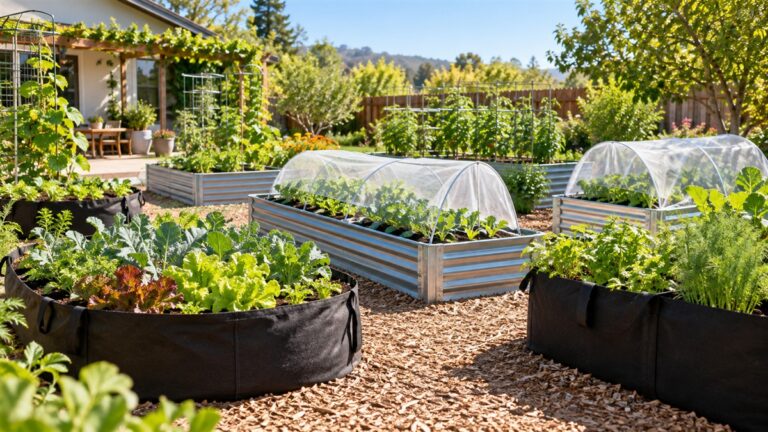
What it is: A galvanized metal oval bed. The listing states size 4x2x1 ft, item dimensions of 48 x 24 x 12 in, capacity of 7.14 cubic feet, material metal, finish double-layer galvanized and item weight of 5 pounds. It describes an open base and says assembly takes about 5 minutes.
Who it suits: A first-time gardener with a small patio who wants a bed with a stated soil volume, for herbs, salad or peppers.
Pros
- Capacity is stated (7.14 cubic feet)
- Compact 48 x 24 in footprint
- Open base described for drainage
Cons
- The oval holds less than a straight 4 x 2 x 1 ft box, which would be 8 cubic feet
- Small volume for a family vegetable block
Skip if: You need a large bed such as 4 x 8 ft or deeper roots in one bed.
View the Land Guard bed on Amazon (affiliate link)
Fabric Raised Garden Bed Grow Bag, 2 x 8 ft (ikanboo)
What it is: A long felt fabric bed. The listing states size 8x2x1 ft, item dimensions of 94.4 x 23.6 x 11.8 in, capacity of 113 gallons, material felt and item weight of 0.66 kg. Features listed are breathable, foldable, lightweight and portable. It requires no assembly.
Who it suits: A renter or anyone who wants a long 8 ft row that folds away after the season, on grass, patio or concrete.
Pros
- Capacity is stated (113 gallons, about 15 cubic feet)
- No assembly and folds for storage
Cons
- Fabric walls flex, so usable depth can shift when full
- Gallons need converting before you mix with cubic-foot bag labels
Skip if: You want rigid walls that hold an exact shape.
View the fabric bed on Amazon (affiliate link)
Galvanized Round Raised Garden Bed, 4 x 4 x 1 ft (VIREO GARDEN)
What it is: A round galvanized metal bed. The listing states size 4x4x1 ft (1PCS), item dimensions of 48 x 48 x 12 in, capacity of 10.7 cubic feet, material metal, shape round and outdoor use. It describes folded edges, rounded corners, a rubber strip on the top edge and an open bottom.
Who it suits: A central yard spot where you can reach in from every side for a mixed vegetable or flower block.
Pros
- Capacity is stated (10.7 cubic feet)
- Open bottom described for drainage and aeration
Cons
- 48 x 48 in footprint needs room to walk around
- Round shape is awkward for row planting
Skip if: Your path is narrow or you want a long thin row. Note that a straight 4 x 4 x 1 ft box would be 16 cubic feet, so do not order by outside size.
View the 4×4 round bed on Amazon (affiliate link)
1MORE Galvanized Raised Garden Bed, 4 x 2 x 1.4 ft, Green
What it is: A taller green oval metal bed. The listing states size 4x2x1.4 ft (1 pcs), material metal, color green, shape oval, floor-standing mount and outdoor use. It describes 0.7 mm panels with double-layer anti-corrosion, folded edges, rubber strips and included tools.
Who it suits: A gardener who wants a taller bed for deeper roots and less bending, and who will confirm the volume with the seller before buying soil.
Pros
- 1.4 ft height gives deeper fill potential
- Tools and rubber edge strips described in the listing
Cons
- The item dimensions field reads 4 x 2 x 1 inches while the size reads 4x2x1.4 ft, so the listing conflicts with itself
- No capacity is stated
Skip if: You need a firm stated capacity to order soil in one go.
View the 1MORE bed on Amazon (affiliate link)
Raised Bed Gardening For Beginners (book)
What it is: A reference book, not a bed. The listing states 202 pages, dimensions of 6 x 0.46 x 9 in, a weight of 12.8 ounces, publisher Independently published and a publication date of February 24, 2024. The title names soil preparation and choosing a bed type.
Who it suits: A beginner who wants background on bed types and soil prep before buying mix.
Pros
- 202 pages of guidance
- Compact size, 6 x 0.46 x 9 in
Cons
- Adds no soil volume and lists no capacity
- Book advice does not replace the specs for a given bed
Skip if: You just want a container to plant in today.
View the book on Amazon (affiliate link)
Buying checklist
- Write down your inside length, width and target fill depth in feet before you shop.
- Use a stated capacity when the listing gives one. Do not use outside size alone.
- Convert gallons and cubic feet before you combine bulk and bagged soil.
- Add about 10 percent for settling, then top off after the first watering.
- Check access: clear a path for bags or a bulk pile, and protect the patio if you set a bed on it.
Related guides
To pick crops and fill methods, see Best Veg to Grow in Raised Beds and Best Way to Fill Raised Beds.
FAQ
How do I calculate how much soil a raised garden bed needs?
Multiply inside length by inside width by fill depth in feet to get cubic feet. Compare that with the listing’s stated capacity and order to the smaller number first, then keep extra for settling.
How much soil does a 4 x 8 raised bed need?
At 12 in deep, 8 ft x 4 ft x 1 ft is 32 cubic feet. Adding 10 percent for settling gives about 35.2 cubic feet. Your need drops if you fill less deep.
How much soil does a 4 x 4 bed need?
A straight 4 ft by 4 ft bed filled 1 ft deep is 16 cubic feet. The round 4×4 bed in this guide states 10.7 cubic feet, so use that figure for that model.
Do I need to replace raised bed soil every year?
Usually you top off rather than replace. Soil settles and organic matter breaks down, so add labeled mix or compost to restore depth, then level and water before planting.
Can I use topsoil alone in a raised bed?
Topsoil alone can compact and drain poorly, depending on the bag. Many gardeners blend it with compost. Follow the soil maker’s label for ratios.
Closing note
Start with the math, then check each bed’s stated capacity. The Land Guard fits a small patio, the 4×4 round bed suits a central block, and the fabric bed gives a long row you can store. Confirm the 1MORE dimensions with the seller before you buy soil, since its listing conflicts. The book helps if you want more background on soil prep.
Sources
- EPA composting at home: supports the statement that compost helps soil hold water