How to Build a Bee House
As an Amazon Associate we earn from qualifying purchases.
If you want to know how to build a bee house that solitary bees will actually use, start with the tunnels. Mason bees, leafcutter bees and similar species nest in holes or tubes of a set width and length, placed in sun and kept clean. North Carolina State Extension and Virginia Tech both explain the basics. They agree on the basics, and this guide shows where they differ, mainly on cardboard tubes and on drilled wood, along with the reason behind each view.
Quick answer
- Use natural tubes or holes of the right size. Virginia Tech says nesting tubes should be five to six inches long, with a diameter between three-thirty-seconds and three-eighths of an inch.
- Use natural materials. North Carolina State says to use “natural, breathable materials such as wood, twigs, and plant stems, not plastic or glass”.
- Hang the house in full morning sun, with entrances facing southeast if you can. The sources differ on orientation, so treat that as a common default.
- Replace the nesting tubes each year after the bees emerge, and choose a design you can open and clean.
Pick a design you can clean
There are several basic designs, and the choice affects how easy the house is to maintain. North Carolina State Extension describes drilled blocks, grooved boards and bundled tubes. Drilled blocks are “made by drilling holes into chunks of logs, branches, or untreated wood”. The same guide says they are “difficult to clean or inspect unless each hole is lined with a paper or cardboard insert”. Grooved boards are the alternative, because “Grooved boards, when stacked, simulate drilled blocks, but facilitate seasonal cleaning and inspection”.
Virginia Tech’s article takes a firmer line on drilled wood. It quotes an extension expert who advises against houses made by drilling holes in a block of wood. The reasons given are that drilling a six-inch hole is too labor-intensive, and that the result is not an ideal nest. The article prefers reed or cardboard tubes that can be replaced each year.
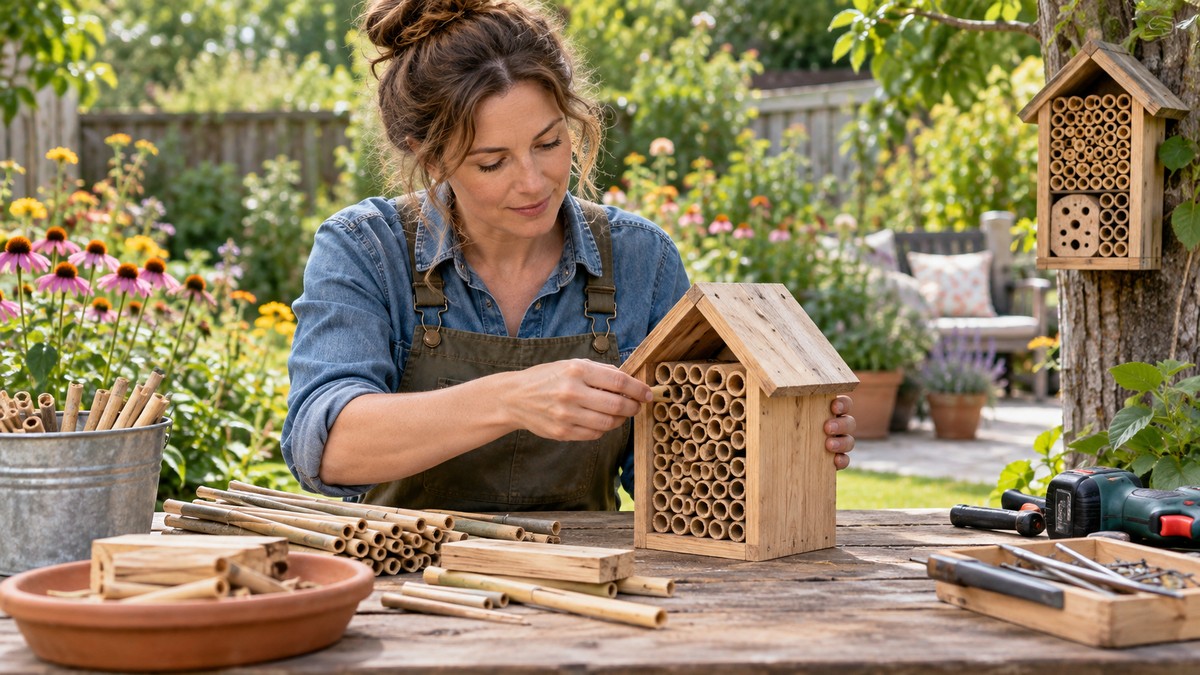
A bundled design is simple to build from stems you already have. North Carolina State notes that “Reeds or bamboo, cut at a node, are popular because they naturally have one open end and one closed end”. The closed end matters because mother bees fill their nests from back to front. North Carolina State describes bundled tubes as including “a variety of purchased or found plant stems”, so the material can be whatever natural stems you can source.
Choose the right tube or hole size
Size decides which bees use the house. North Carolina State says: “the diameter of the nesting tunnel determines which species can use it”. It recommends a spread of sizes, and gives a range: “provide a variety of tunnel sizes from about 5/64″ (2 mm) to 1/2″ (12.7 mm) in diameter”. For a single species, the guide says to match the diameter that species prefers: “To target specific species (such as the blue orchard bee), use the specific hole diameter they prefer”.
Virginia Tech gives a simpler standard for a home house. Its article says: “Different types of bees will use different diameter tubes, but they need to be between three-thirty-seconds of an inch and three-eighths of an inch in diameter”. It also sets the length: “When buying or making a bee box, the first thing is to look for one with nesting tubes that are 5 to 6 inches long”. Length is a species question too. North Carolina State says ideal length “varies among species”, and gives two examples: alfalfa leafcutting bees do well in nests between 2 and 3 inches long, and blue orchard bees do well with 6-inch nests.
Both guides warn against very short tunnels. Virginia Tech’s article notes that bees will investigate a house with only a few inches of tube and may still leave it unused, which wastes their time. North Carolina State lists a second problem: a mother bee in a too-short tunnel may build only one or two chambers before she has to seal it and search for a new one.
Materials: natural wood, reeds and the paper question
Natural materials are the first rule. North Carolina State says: “Use only natural, breathable materials such as wood, twigs, and plant stems, not plastic or glass”. The guide also asks for smooth openings: “All tunnels should have smooth entrances, free of splinters or cracks”.
The sources disagree on cardboard and paper. North Carolina State says: “Do not use cardboard, paper, glass, or plastic tubes in nesting bundles”. It gives the reason. Straws are about the right size, but “nests in plastic straws are often ruined by mold, while those in paper straws are often parasitized”. Virginia Tech’s article takes the opposite line in one respect. It recommends “a house with natural reeds or cardboard tubes which can be replaced each year after the bees emerge”.
The two positions can be reconciled in part. North Carolina State allows paper and cardboard in a particular place: “Paper and cardboard tubes are OK to line drilled wooden tunnels, but not as stand-alone materials”. The difference is the replacement schedule. Virginia Tech’s cardboard option depends on swapping the tubes every year, and North Carolina State warns against re-using nests year after year.
Build the house: spacing, shelter and drainage
North Carolina State gives construction details that are easy to miss. Keep the holes away from the edge: “In both drilled blocks and grooved boards, the nest tunnels should be positioned at least 3/4″ from the edge of the block or stack”. The same guide says that spacing reduces parasitism by one wasp species. If you build with stacked boards or bundles, stagger the rows: “Stagger nesting blocks or reeds by about 3/4″ so that nest entrances do not all lie in the same plane”.
Moisture is the next problem. The guide says: “Excess moisture can lead to mold problems or deterioration of nest materials”. It recommends a roof over the nest openings: “shelters should overhang nest entrances by at least a couple of inches to protect from rain”. It also asks for drainage: “drain holes in the bottom of any shelter (not the nests themselves) will prevent water accumulation”. The drain holes go in the shelter, not in the nests.
Mounting is simple by comparison. The guide says: “A mounting height of about 5′ is often recommended”. That is a starting point, and the guide does not say a single height works for every site.
Where to hang it
Sun is the placement advice that both guides support. Virginia Tech says bee boxes “should be installed in a location that will receive full morning sun”. The same article adds distance from pollen: the box “is within 100 to 200 yards of a pollen source”. It also recommends mud nearby for nest building, within about 50 yards, because some bees use mud to build their nests.
North Carolina State is more cautious about heat. It says the nest can get much hotter than the air on a sunny afternoon, and it gives a warning for overheated nests: “This outcome is common when nests overheat in the afternoon sun”. Its figure caption describes mason bee larvae that died in a nest that overheated. The guide also reports that “Studies in English and German cities found that bee hotels in sunny locations were more than twice as likely to be occupied than those in shady locations”. Taken together, the guides favor sun, and the afternoon warning suggests morning sun where afternoons run hot.
Orientation is less settled. North Carolina State says: “It is customary to place bee hotels in a sunny location with nest entrances facing southeast”. It then adds: “This has worked fine for decades and remains the default placement, despite mixed evidence”. Its own note on wind is “Nest entrances facing away from prevailing winds may be preferred”.
If you have to choose between a spot that is hot all afternoon and one with morning sun, the sources point toward the morning sun. North Carolina State notes that warmer temperatures usually speed development, but that “at some point, too-hot temperatures become lethal”, and it does not give a temperature limit for your region. If you also hang a birdhouse nearby, our guide to hanging a birdhouse on a tree covers a different kind of nest box.
Protect the nests from birds and pests
Birds are a common problem. North Carolina State warns: “Birds can destroy a bee hotel by pulling tubes out of it or breaking nests open”. It suggests a shelter first, since “Simply placing nesting materials inside a shelter will help and may be sufficient in some habitats”. Only add more protection if it is needed: “If (and only if) birds, rodents, or other predators become a problem, attach a sheet of chicken wire over the nest entrance”.
The guide also names a wasp that lays eggs inside bee nests. It ties that parasite to placement: keeping tunnels at least 3/4 inch from the edge reduces parasitism by that wasp. If you want another project that brings birds into the yard, see our guide to a DIY water dispenser for birds.
Yearly care and cleaning
Replacing the nesting material is the step that both guides call essential. Virginia Tech says: “Importantly, nesting tubes need to be replaced each year after bees emerge, otherwise they can harbor disease and parasites”. North Carolina State states the same risk in its own words: “If re-used year after year, nests can build up parasites and diseases”. Its solution is an emergence box, which provides “a transitional area for used nesting materials”.
Timing matters for grooved boards. North Carolina State says that opening the grooves “damages active nests and should only be done in the winter when nests are complete and bees are dormant”. Virginia Tech’s article recommends against trying to clean out used nesting tubes, which it says is difficult to do well enough to remove pathogens, and recommends replacing them instead.
Mistakes to avoid
- Reusing old nests without replacing them. North Carolina State says re-used nests “can build up parasites and diseases”, and Virginia Tech says the tubes need replacing each year.
- Using plastic or glass tubes. North Carolina State says to use natural, breathable materials, not plastic or glass.
- Drilling deep holes by hand into a solid block. Virginia Tech’s article advises against it, noting the labor and the result.
- Opening grooved boards during the active season. North Carolina State says that damages active nests.
- Placing the house in deep shade. North Carolina State cites studies where sunny locations were more than twice as likely to be occupied.
How we chose
We opened three pages on nesting bees with curl on 2026-10-22: a North Carolina State Extension design and placement guide, a Virginia Tech news article that quotes extension entomologists, and a South Dakota State Extension article on backyard nest boxes. The sections we kept describe design, materials, size, placement and upkeep. Several other extension pages returned HTTP 403 and were left out. The guide recommends no products.
What we could not verify
The sources do not agree on cardboard and paper tubes, and they do not give one size that suits every local species. The South Dakota State article describes a trial of solitary bee nests, but the opened text does not give the full dimensions, so we did not use it for measurements. None of the opened pages gives a measured occupancy rate for a home-built house.
What the sources do not say
The pages do not say how many tubes a house needs, what its overall dimensions should be, or what thickness of wood to use. They do not say which bee species a particular yard will attract. They do not give a temperature limit for a hot site, and the afternoon overheating warning and the morning-sun advice come from different pages without a stated threshold between them.
Frequently asked questions
What size should the holes or tubes be?
Virginia Tech says tubes should be between three-thirty-seconds and three-eighths of an inch in diameter and five to six inches long. North Carolina State recommends a range of sizes, from about 5/64 inch to 1/2 inch, so that more species can use the house.
Should a bee house use cardboard or paper tubes?
The sources disagree. Virginia Tech’s article recommends natural reeds or cardboard tubes that can be replaced each year. North Carolina State says not to use cardboard, paper, glass or plastic in nesting bundles, but allows paper and cardboard as a liner for drilled wooden tunnels.
Where should you hang a bee house?
Choose a spot that gets full morning sun and sits within about 100 to 200 yards of a pollen source, according to Virginia Tech. North Carolina State warns that nests can overheat in afternoon sun, so a spot with some afternoon shade may suit a hot yard.
How often should the nesting material be replaced?
Virginia Tech says nesting tubes need to be replaced each year after the bees emerge. North Carolina State recommends an emergence box to hold used material, and says grooved boards should be opened only in winter, when the bees are dormant.
How do you protect the house from birds?
Start with a shelter over the entrances, as North Carolina State suggests. Add chicken wire over the nest entrance only if birds, rodents or other predators become a problem, since the guide describes the wire as a step for that case alone.
Sources
- https://content.ces.ncsu.edu/how-to-manage-a-successful-bee-hotel/bee-hotel-design-and-placement (opened 2026-10-22)
- https://news.vt.edu/articles/2020/03/ext-entomologists-tips-for-installing-and-maintaining-native-bee-houses.html (opened 2026-10-22)
- https://extension.sdstate.edu/backyard-biodiversity-nest-boxes-native-bees (opened 2026-10-22)