How to Rotate Crops in a Garden
As an Amazon Associate we earn from qualifying purchases.
How to rotate crops in garden beds comes down to one rule: do not plant the same plant family in the same spot too often. Each vegetable belongs to a family, and the family, not the vegetable name, decides where it goes next year. Extension pages from Wisconsin, Iowa State, Illinois and Maryland agree on the basic idea and differ on the length of the gap, which this guide shows in full. Use the plan as a starting point for your own beds.
Quick answer
- Group vegetables by plant family, and keep each family out of the same spot for three to four years, as Wisconsin and Iowa State advise.
- Use separate beds or raised beds, because Iowa State says “The best way to achieve crop rotation is to have multiple separate garden beds or plots.”
- Keep a garden log or a map so you can see where each family grew.
- Count cover crops and weeds in the plan, not only the vegetables you plant on purpose.
Why the family matters
Wisconsin Extension starts with a simple fact: “Each vegetable can be classified into a particular plant family.” Plants in a family “oftentimes are susceptible to similar insect pests and diseases, and have similar nutrient requirements.” That is the reason the family, not the vegetable name, drives the plan. Wisconsin Extension also advises that you “Plan the crop rotation for your vegetable garden based on the types of vegetables that you grow.” Tomatoes and peppers look different in the garden, but they share a family and so they move together.
Iowa State Extension makes the same point about soil. “Vegetable crops in the same botanical family tend to use the same type and amounts of nutrients from the soil.” Its example is the gourd family: “members of the gourd family (Cucurbitaceae) tend to utilize a lot of nitrogen from the soil.” The family list also tells you which crops are the heavy feeders, so you can plan their place with that in mind.
The University of Maryland Extension page makes the nutrient case in plain terms: “Rotation can help even out nutrient removal from the soil, because nutrient needs vary by crop.” A plan built on families therefore does two jobs at once: it spreads the nutrient load across the beds, and it keeps the crops that share pests and diseases apart. The Maryland page adds that “Crop rotation can also reduce weed pressure because weeds associated with certain crops grown in particular ways can become abundant over time.”
The gap: three to four years, or more
The length of the gap is the decision most gardeners need. Wisconsin Extension says “do not plant an area with vegetables or cover crops/green manures from the same plant family more than once every three to four years.” Iowa State Extension says gardeners “should not plant vegetables belonging to the same plant family in the same location for 3 to 4 years (or 5+ years, if possible).”
Illinois Extension sets a longer minimum. Its page says “A three-to-five-year schedule is recommended as a minimum for the method to be most effective and beneficial.” The ranges overlap at three to four years, and the Illinois page reaches five years, which matches the Iowa State advice when space allows.
Wisconsin Extension admits the length can be hard to reach. It says “This length of crop rotation can be difficult to achieve in small gardens, but even changing plant families grown in an area of a garden from year to year is helpful.” A small garden can still rotate, even if it cannot wait the full cycle, so change the family in each spot every year.
Iowa State Extension frames the goal the same way: “When rotating crops in the vegetable garden, your goal is to not plant the same plant family in the same garden location for at least 3 or 4 years.”
Make the beds do the work
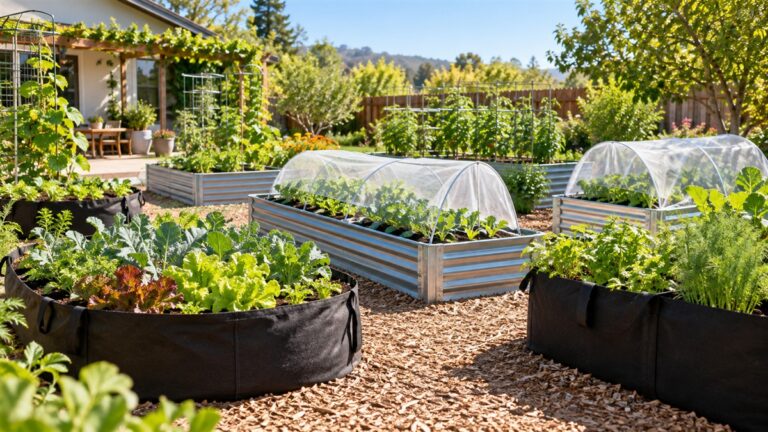
Separate beds make rotation simple. Iowa State Extension gives a worked example: “For example, establishing four raised beds allows you to rotate plant families around to each bed and only plant the same botanical family in the same raised bed once every four years.” Four beds on a four-year cycle means that each family returns to its bed once every four seasons.
Illinois Extension says the same thing from a different angle: “Creating garden zones or using separate beds encourages rotation.” It adds that “A greater number of zones provides an opportunity for more plant families to be rotated through the garden each year.” Iowa State suggests three or four raised beds, and Illinois notes that more beds give more room to rotate. Illinois also says that “Some plans are as simple as changing the family of plants grown on a plot of land each year”, while others add cover crops for a year.
For a layout that puts related crops in the same bed, see our notes on companion planting and garden layout. For the crops that fit a raised bed, see our notes on vegetables to plant in raised beds.
Group the crops by family
The Wisconsin family table is the most practical reference in the sources. It groups the common vegetables by family, and the table below uses its names for each family.
Illinois Extension recommends starting from the crops themselves: “When developing a rotation schedule, begin with knowing what crops are going to be planted and to which family they belong.” Iowa State Extension adds a practical point about small families: “Vegetables from smaller plant families can be grouped together or used to fill in empty spots with other larger families.”
| Family (as Wisconsin Extension names it) | Common vegetables in the list |
|---|---|
| Nightshade Family (Solanaceae) | Eggplant, pepper, potato, tomato |
| Gourd Family (Cucurbitaceae) | Cucumber, muskmelon, pumpkin, summer squash, watermelon, winter squash |
| Mustard Family (Brassicaceae) | Broccoli, Brussels sprouts, cabbage, cauliflower, kale, radish, turnip and others |
| Pea Family (Fabaceae) | Bush bean, lima bean, pea, pole bean, soybean |
| Onion Family (Alliaceae) | Chives, garlic, leek, onion |
| Carrot Family (Apiaceae) | Carrot, celery, parsley, parsnip |
The names differ between pages. The Iowa State and Illinois pages call the onion group the Amaryllidaceae family, so check the family name on the page you use before you build the schedule.
Plan for cover crops and weeds
A rotation plan covers more than the crops you plant on purpose. Iowa State Extension says “Consider not only the vegetable crop but any cover crop or abundant weeds in or near the garden.” Illinois Extension says that “When using a green cover crop in a rotation schedule, account for the crop family in the succession plan of the garden.”
Iowa State Extension notes that “Cover crops have many advantages, but they add a layer of complexity regarding crop rotation.” It also says that “Various weeds common in and around vegetable gardens belong to some of the same plant families as the vegetables in your garden.” In practice, that means a cover crop counts toward the family rule. If a bed rests under a legume cover crop, the bed counts as a legume year, and the next bean or pea crop should wait. The same logic applies to weeds that belong to the same families as your crops.
Containers and small gardens
Rotation works in pots and small plots too. Illinois Extension says that “Whether growing in-ground or in containers, crop rotation can work in any garden no matter the size or configuration.” Iowa State Extension gives a specific use for containers: “Utilizing containers for especially disease-prone vegetables, such as heirloom tomatoes, is a great way to rotate a crop out of your main garden plot.”
The Maryland page is honest about the limit. It says rotation “is still a beneficial practice for home vegetable gardens,” but “it is only marginally helpful in lessening insect and disease pressure in those settings due to the smaller scales involved.” Treat rotation as one part of good planning, not as a complete answer to pests or disease.
Succession planting is a different tool
Succession planting is often mentioned alongside rotation, so keep them apart. The Maryland page says “Crop succession is closely related to the concept of crop rotation.” Succession planting is “planting seeds or transplants in spots vacated by spent plants”; one bed can grow two crops in a season. Rotation changes the family from year to year. Succession changes the crop within a season.
Keep a record
A written plan is the only way to rotate reliably over four years. Iowa State Extension says to “keep a garden log, draw a map, create a diagram, or take a photo to help you remember where vegetables are planted each year and your plans for upcoming years.” Illinois Extension adds that you should “Keep good garden records from year to year to maintain a rotation schedule and maximize the benefits of the cultural practice.”
Wisconsin Extension gives the simplest version: “keep a garden log or map as a reminder of where vegetables are planted each year.” A map on paper, a note in a phone, or a photo of each bed at planting time all count, as long as you can find it next spring.
A quick checklist
| Step | What to check | Source |
|---|---|---|
| Families | Group every crop by plant family before you plant. | Wisconsin Extension |
| Beds | Use three or four separate beds or raised beds. | Iowa State Extension; Illinois Extension |
| Gap | Wait three to four years, or three to five as a minimum. | Wisconsin Extension; Iowa State Extension; Illinois Extension |
| Cover crops | Count cover crops and weeds in the family plan. | Iowa State Extension; Illinois Extension |
| Containers | Rotate a disease-prone crop into a container. | Iowa State Extension |
| Records | Keep a log, map or photo of each bed each year. | Iowa State Extension; Wisconsin Extension |
How we chose
We opened extension pages from four universities and kept a page only when it states the point in plain words. We checked each quoted sentence against the text of the page as fetched on 2026-10-22. Where two pages give different gap lengths, we show both.
We did not rank crops or products, and this guide does not recommend a product. Pages that returned errors when opened are not cited.
What we could not verify
Rotation is a planning method, and the pages we opened describe it as a rule rather than as a result. The points below are either missing or stated only in general terms.
What the sources do not say
- The pages do not say how much a rotation reduces pests or disease in a specific garden. The Maryland page calls its effect marginal in home gardens.
- No source we opened gives a schedule for perennial vegetables, so this guide does not place them in the rotation.
- The pages do not give a bed size or number of beds for a garden of a stated area.
- The family names differ between the Wisconsin page and the Iowa State and Illinois pages, so the family list depends on the page you follow.
- The Illinois page lists cover crops by family but does not say which one suits a particular garden, so this guide does not recommend one.
Frequently asked questions
How long should a bed rest before the same family returns?
Wisconsin Extension and Iowa State Extension say three to four years, and Iowa State adds five or more if possible. Illinois Extension sets a three-to-five-year minimum.
Can crops be rotated in containers?
Yes. Illinois Extension says rotation can work whether you grow in the ground or in containers. Iowa State Extension notes that containers are a useful way to move a disease-prone crop out of the main plot.
Do cover crops count in a rotation plan?
Yes. Iowa State Extension says to consider any cover crop in the plan, and Illinois Extension says to account for the crop family of a cover crop in the succession plan.
Is rotation the same as succession planting?
No. The Maryland page says succession planting means planting in spots vacated by spent plants within a season, and that rotation moves families to new locations each growing season.
What should be written down each year?
Write down where each vegetable went. Iowa State Extension suggests a garden log, a map, a diagram or a photo, and Wisconsin Extension suggests a log or map.
Sources
- https://hort.extension.wisc.edu/articles/using-crop-rotation-home-vegetable-garden-0/ (opened 2026-10-22)
- https://yardandgarden.extension.iastate.edu/how-to/crop-rotation-vegetable-garden (opened 2026-10-22)
- https://extension.illinois.edu/blogs/good-growing/2024-01-05-sow-grow-rotate-how-crop-rotation-promotes-gardening-success (opened 2026-10-22)
- https://extension.umd.edu/resource/vegetable-succession-and-companion-planting (opened 2026-10-22)