How to Plant Bare Root Roses
As an Amazon Associate we earn from qualifying purchases.
Knowing how to plant bare root roses comes down to four steps: timing, soaking, hole size and the depth of the bud union, which is the swollen graft point on the stem. Bare-root roses arrive dormant, with no soil around their roots, so the planting steps matter more than they would for a potted plant. The four extension and university pages below agree on most of those steps. They differ on a few details, and this guide shows where.
Each step comes from one of four pages we opened on October 22, 2026. Where a page gives a number, we give it with the source. Where the pages disagree, we show each figure instead of picking one.
Quick answer
- Plant bare-root roses in early spring, before growth begins. Colorado State prefers spring planting and says to finish by mid-April at lower elevations.
- Soak the roots, but not for too long. The sources range from one to two hours to 8 to 12 hours, and Colorado State sets a limit of 24 hours.
- For grafted roses, Iowa State and Colorado State both place the bud union 2 to 4 inches below the soil line, while Illinois and the UC Master Gardeners give different depths.
- Keep the roots and canes from drying out until growth starts, and cover the canes when the weather is dry or cold.
Buy and inspect the plant
Start with the plant itself. Iowa State says to open and inspect bare-root shrubs as soon as they arrive. The roots should be firm and heavy, not dry or brittle. The packing material around them should be damp, and the buds should be green and firm. Colorado State says most experienced rose growers prefer bare-root, dormant plants from a reputable nursery, and it warns buyers to check that the plant has not dried out on the shelf.
UC Master Gardeners in Amador County add a few selection points. They say to buy plants with at least three strong canes, and to avoid plants with shriveled, brown or damaged canes. They also note that nurseries usually carry bare-root roses from late January, so winter is a good time to buy.
Timing and storage
Iowa State says to plant bare-root shrubs and roses as soon as possible before spring growth begins. If planting has to wait, it advises storing them in a cool, non-freezing place at around 40 F, such as a refrigerator, an unheated garage or a root cellar. Illinois Extension recommends scheduling delivery as close to planting time as possible. In northern growing areas, it says roses can go in as soon as the soil can be worked in spring. If the roses arrive early, keep the packing moist and store them in a cool, dark place.
Colorado State is the most specific on timing. It prefers spring planting over fall for bare-root roses, and it says to finish by mid-April at lower elevations. If you cannot plant right away, keep the roses somewhere cool but above freezing so they do not de-acclimate to outdoor conditions. Whatever the storage spot, the roots must not be allowed to dry out. Iowa State says not to let any part of the plant dry out, especially the root system.
Soak and trim the roots
Soaking is where the sources differ most. Iowa State says to soak the roots in a bucket of water for one to two hours. Illinois says 8 to 12 hours helps rehydrate the roots. Colorado State says to soak bare-root plants overnight if they look dry, but never for more than 24 hours. Use the range your source gives and do not leave the roots in water longer than that page allows.
The sources agree on trimming. Illinois says to trim off any damaged or diseased roots after soaking. Colorado State says to prune damaged or broken roots once the hole is ready, and it allows long roots to be shortened as long as 8 to 10 inches of healthy root remain. Keep the roots moist while you prepare the hole, because Colorado State says they should never be allowed to dry out.
Illinois also prunes the canes. It says to keep three to five canes per plant and to cut each one back to three to five buds. Colorado State gives the cut details. Make each cut at a 30 to 45 degree angle, about 1/4 to 3/8 inch above a bud eye, leaving roughly 5 to 12 inches of cane. Cut to an outward-facing bud so the center of the plant stays open for air and light.
Dig the hole and build the base
Hole size depends on the soil. Iowa State says to dig a hole two to two-and-a-half times wider than the spread of the root system. Colorado State gives measured figures. For a prepared bed, it says about 18 to 24 inches across and 14 to 18 inches deep, and it allows up to 36 inches across and 18 inches deep in compacted soil. Illinois is less exact. It says the hole should be wide and deep enough to accept the roots comfortably.
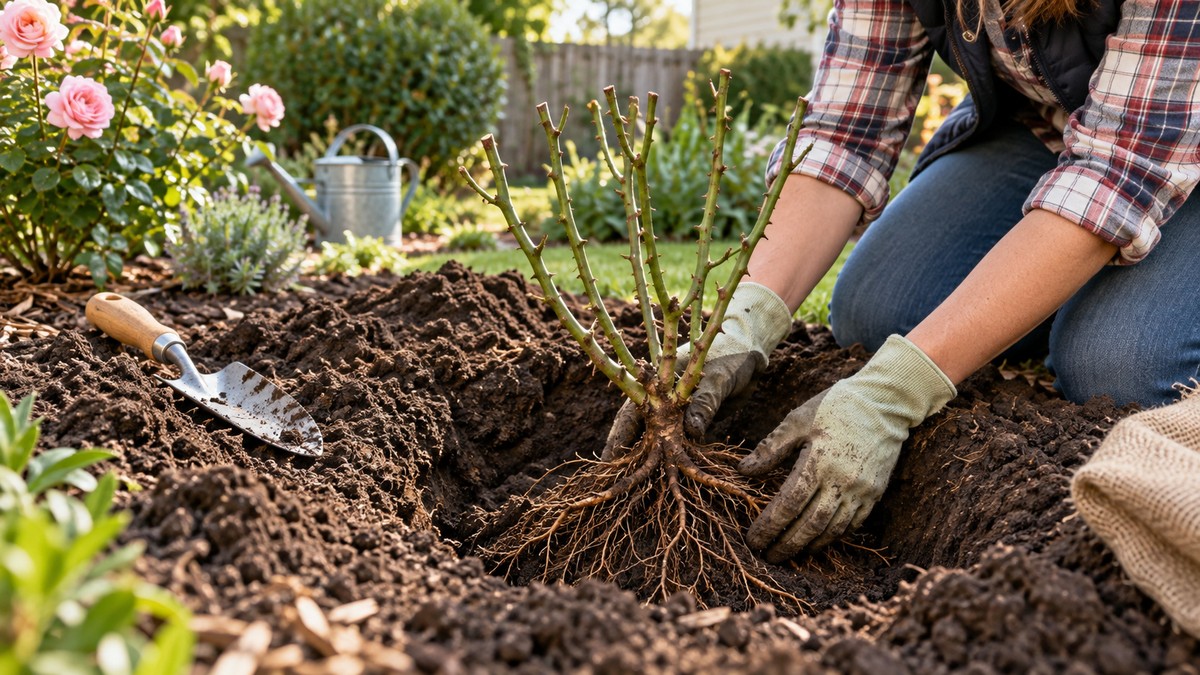
Then build the base. Iowa State says to form a cone-shaped mound of soil in the center of the hole, set the plant on top, and spread the roots evenly over the mound. Colorado State describes the same cone but calls for a small mound of amended soil. Those two sources disagree on amendments, which the backfill section below covers.
Set the bud union depth
The bud union is the most important depth in this guide, and the sources do not match. The table shows what each page says.
| Source | Advice for the bud union |
|---|---|
| Illinois Extension | Set it at soil level. It settles to 1 to 2 inches below the soil, which helps winter protection in northern climates. |
| Iowa State Extension | For grafted roses, 2 to 4 inches below the soil surface. |
| Colorado State Extension | Grafted roses 2 to 4 inches below the soil line. Own-root roses have the crown 1 to 2 inches below. |
| UC Master Gardeners | Slightly above the soil line. |
Read the table against your climate. Illinois ties its shallower depth to northern winters, and Iowa State says its deeper placement helps protect the rose from harsh winter weather. None of the pages gives a single depth for a mild region, so this is a point to check with a local extension office before you finalize the depth.
Backfill, firm and water
Backfill in stages. Illinois says to fill the hole about two-thirds full of soil and add water, making a slurry that gets between the roots. It says not to tamp the soil, because tamping compacts it and destroys its structure. After the water drains down, add more soil and repeat the process until you reach the original soil level. Illinois notes that loose soil settles after planting, so the bud union ends up lower.
Firming is another difference. Iowa State says to firm the soil in the hole with your hands as you backfill. Colorado State says to firm gently with your hands, then settle the soil mainly by watering, and to water deeply at planting. Colorado State also says not to pack the soil around the roots.
Amendments are the sharpest disagreement. Iowa State says not to amend the soil with compost, sphagnum moss, sand or other amendments. Colorado State builds its cone from amended soil. The pages we opened do not settle the question for poor soil.
Protect the canes after planting
Dry canes are the early risk. Illinois calls the practice of covering newly planted roses sweating. It says to place a temporary soil mound about 8 to 10 inches deep over the canes for about 2 to 3 weeks, or until new growth starts. When growth begins, it says to wash the soil away gently with a hose so the new growth is not disturbed. Other methods that work well, according to Illinois, include wrapping the canes in moist burlap or mounding them in sphagnum moss. Illinois also warns against plastic bags, because heat buildup can cause injury or even death of the plant.
Colorado State makes the same case for dry climates. It says preventing the canes from drying out is the most important step when planting a bare-root rose in Colorado because of the low humidity. It allows a cover of loose, loamy, moist soil, a compost-and-soil mix or mulch, and says the cover may stay on for two to seven weeks, depending on the weather and the plant’s progress. Watch the progress by exposing the tips of the canes, and use a garden hose to remove the cover.
Water and care in the first season
Water deeply at planting, as Colorado State advises, and keep the root zone from drying out. Iowa State says to water shrubs as needed through the first growing season until they are fully established. It suggests checking once or twice a week and watering when the soil around the roots is dry. UC Master Gardeners say roses need irrigation through the growing season, and they describe deep watering once a week. For watering tools, see our guide to hose attachments for watering plants.
Potted roses are the easy option
If you buy a potted rose instead, Illinois says potted roses are the easiest to plant because the plant is already growing. If a potted rose was bought late in the season, its roots may have filled the pot and become tangled. In that case, loosen or cut them before planting, because circling roots may never spread out in the garden. Colorado State adds that a rose bought directly from a greenhouse should be hardened off outdoors in its container for several days before planting. Its planting window for potted roses opens after the last killing frost. Wear gloves when you handle thorny canes, and see our note on gloves for thorny canes.
How we chose
We limited this guide to extension and university pages on planting roses: Illinois Extension, Iowa State University Extension, Colorado State University Extension and the University of California Master Gardeners. We opened each page on October 22, 2026. A Missouri Extension guide returned an error and is not counted. We chose extension pages over magazine and retailer guides, which also appear in search results.
We did not recommend a rose variety or a product in this article. Where the sources disagree, we show each figure and say which source gives it, and we did not average them.
What we could not verify
The sources disagree on several planting steps, and none of them can tell you how a particular bed will perform in your climate. Treat the disagreements below as open questions to check locally.
What the sources do not say
- The right soak time. Illinois says 8 to 12 hours, Iowa State says one to two hours, and Colorado State says overnight but no more than 24 hours.
- One bud union depth for every climate. The four pages give different advice, and only some tie the depth to climate.
- Whether to add compost or amended soil to the backfill. Iowa State says no, and Colorado State builds its cone from amended soil.
- Watering detail for hot or dry weather. Iowa State gives a check-once-or-twice-a-week rule for shrubs, and the UC page gives a weekly deep-watering figure, with no further adjustment that we verified.
- Recommended varieties. Colorado State lists them, but we did not include them because this guide covers planting.
Frequently asked questions
How long should bare root roses soak?
The sources differ. Iowa State says one to two hours, Illinois says 8 to 12 hours, and Colorado State says overnight, but never more than 24 hours in water.
Should bare root roses be planted in fall?
Colorado State says spring planting is preferred over fall for bare-root roses. Iowa State says to plant bare-root shrubs and roses before spring growth begins, and Illinois says northern gardens can plant once the soil can be worked in spring.
How deep should the graft union go?
For grafted roses, Iowa State and Colorado State both say 2 to 4 inches below the soil. Illinois says the bud union should sit at soil level and settle to 1 to 2 inches below in northern climates, and the UC Master Gardeners say slightly above the soil line.
Do bare root roses need compost in the planting hole?
The sources disagree. Iowa State advises against adding compost, sphagnum moss or sand to the backfill, while Colorado State builds its cone from amended soil. The pages we opened do not give one rule.
Can a potted rose be planted in summer?
Colorado State says potted roses can be planted any time after the last killing frost, and that a rose bought directly from a greenhouse should be hardened off for several days first. Illinois says potted roses are the easiest to plant because they are already growing.
Sources
- https://extension.illinois.edu/roses/planting (opened 2026-10-22)
- https://yardandgarden.extension.iastate.edu/how-to/how-plant-bare-root-shrubs-and-roses (opened 2026-10-22)
- https://extension.colostate.edu/resource/selecting-and-planting-roses/ (opened 2026-10-22)
- https://ucanr.edu/sites/default/files/2020-02/319533.pdf (opened 2026-10-22)